
Bees and Honey
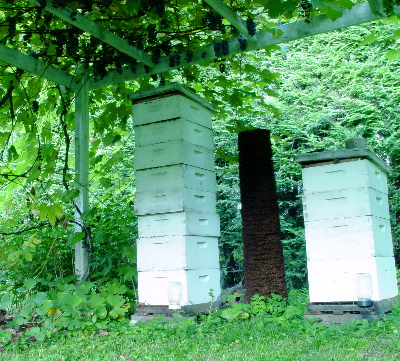
The well furnished home food garden has always and still should include at least one hive of honeybees. But this is easier said than done, so learning that bees were part of Bill’s dowry may have been the thing that clinched the deal, back when we were courting. Fast forward 16 honeyed years: I’m writing a N.Y. Times bee story and in the course of research discover – who knew? – that this little insect may well be the canary in the agricultural coal mine.
Honeybees don’t get much press compared to, say, petroleum, but their pollination services are just as crucial as fuel and fertilizer to about 15 billion dollars a year in crops, from almonds and alfalfa to sunflower seeds. More bees are needed in each place than any one place could provide, so tens of thousands of hives get loaded on trucks, taken to fields or orchards in bloom, then packed up again and hauled elsewhere.
These migratory honeybees are essential to agribusiness monocropping, which could not exist if it had to depend on local pollinators. That’s why the bees have been getting their 15 minutes of fame* – a mysterious affliction called CCD ( colony collapse disorder) has destroyed so many colonies it’s threatening a major industry. Farmers are paying much higher prices for hive rental while also worrying there may be shortages that can’t be overcome, even with expensive imports.
More than you really want to know is posted, with running updates at beeculture.com, but the very short version is:
*CCD probably isn’t new; reports of similar, albeit far smaller, epidemics go back at least as far as 1898.
* CCD is almost surely not one disease or pest or insecticide but rather some unknown combo thereof that exploits the weakness of bees stressed by profoundly unnatural ways of being kept and used. No study has yet revealed a single insult that is/was the tipping point. Each time a likely culprit is fingered, further investigation confirms that it is at best only part of the puzzle.
* Domestic honeybees are livestock: living creatures raised and used by humans. What do we know about them compared to what we know about chickens and cows? Zilch. What are we likely to learn soon? Also zilch, in part because there is no massive bee industry to lobby for public funds or undertake its own research.
The internet allows posts like this to go on at enormous length, but that doesn’t mean they should, so here are a few visuals from our own
Home Grown Honey Harvest, October 7, 2007
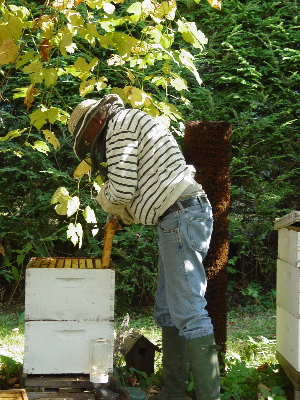
Bill checks to see if there’s any honey in the frame ( a pre-built foundation for the bees to start from).
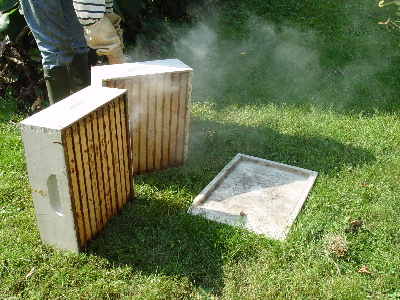
I always thought smoke made the bees think the hive was on fire, so they were too busy worrying about the house to sting anybody. Beekeepers just say it calms them, with the same result.
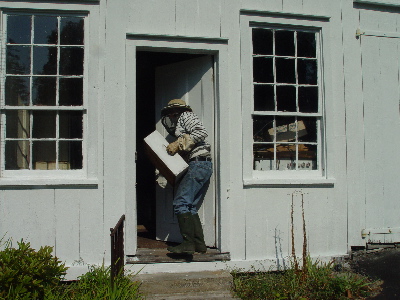
They don’t stay calm long; you have to extract the honey someplace they can’t get to, in this case the barn.
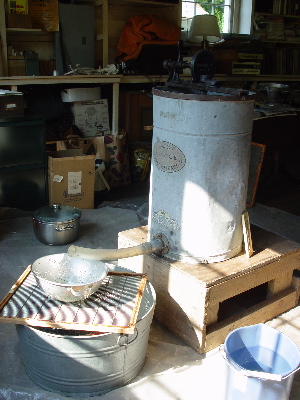
This is Bill’s honey extractor, a galvanized antique called the Root Novice. Modern extractors are steel or plastic and this is probably the place to say that honey is more or less self-sterilizing. It’s so sweet bacteria can’t grow in it and so low in water content yeasts won’t grow either. The reason you can’t give it to babies is that it can contain spores of anaerobic bacteria like botulism. The acid in all human digestive systems that process solid food prevents those spores from growing, but new people who still drink all their nourishment don’t have that protection.
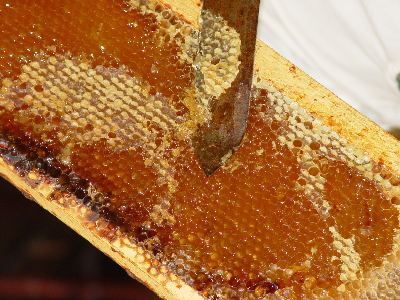
After each cell is filled with honey, the bees cap it with a wax lid. You have to slice off the lids (with a wicked sharp, thin-bladed knife) before you can extract the honey.

Bees gather honey from one source at a time. If you want to name the honey for its source – check out the list at honeylocator.com – you have to harvest it before the bees move on. The dark patch looks sort of like buckwheat but I’m sure it’s not. Doesn’t matter, whatever it is will just add complexity to this year’s vintage.

Frames are held upright by arms in the extractor. Turn the crank and the arms whirl around, flinging the honey out by centrifugal force, same as in a salad spinner.
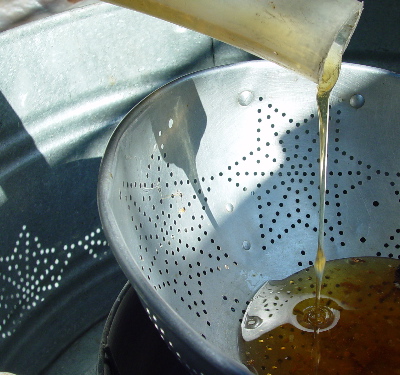
Honey isn’t the only thing that gets flung; the colander catches things like stray bits of wax and the occasional unfortunate bee that didn’t respond to the smoke.

After collection, the honey is poured into sterilized jars. Over the next couple of weeks, any tiny impurities rise and form a thin layer at the top. For gift-giving, we take the layer off. For us, we just leave it as an extra seal until we want to use the honey.
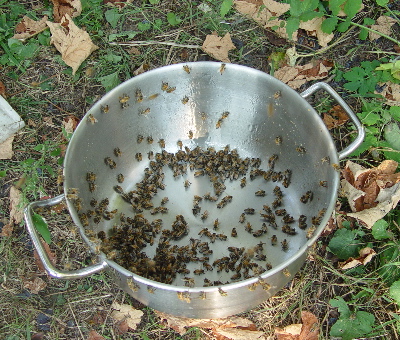
Before the equipment is washed and stored, it’s put outdoors for the bees to clean. They will retrieve almost all of the honey to add to their winter stores.
* Fifteen minutes seems to be about right. Bees are as gone from the headlines as they are from all those dead hives. Tune in next February for a brief flare-up, when almond orchards will need a surge from an army so grievously depleted it may not have enough troops.

Share this





Leaving gear out for cleaning by “robbing ” is not to be encouraged as it encourages the bees to rob any weaker hives in the vincitity and also is a potential mechanism to spread infected honey eg AFB, Chalk Brood etc. Better to let drain overnight in a bee free area and then clean.
Thanks so much Henry, I’ll pass your advice along to Bill, who is in charge of all this.
Think he probably is aware of the dangers as he’s attentive to when and where he puts out the gear, to maximize the likelihood it will be cleaned by the bees that made it.
Meanwhile, please explain to us outsiders how making honey available encourages bees to rob weaker hives. Intuitively, it makes sense ( draws outsiders to the hives just harvested; creates a taste for easy eats in the original bees ) but I’m not sure I understand how one would prove such a thing without marking bees to see who’s robbing who.
thanks again
Leslie
Hi Leslie
I am in the process of trying to get a hand operated 2 frame honey extractor working that I have had for years. While trawling the web for information I came across your page with Bill operating the exact same extractor as the one I am trying to fix. The reason that it is not going is because the small bevelled pinion gear is missing and was when I purchased it. I am about to make a replacement gear and have been trying to establish how many teeth it would have.
My conclusion so far is that it would have 12 teeth giving a 1 : 5 ratio which does not fit with any of the information that I have found. A.I. Roots books talks of 1:3 ratio (20 teeth) but to achieve that ratio by my calculations the gear would be too large to fit, so it would be good to have the number of teeth confirmed.
I have estimated the gear would be about 20 mm high (3/4 inch) and has a 7 degree taper.
The other measurement that would be most helpful is the diameter of the gear at the widest end given that the gear is tapered.
It would be greatful if any of this information could be supplied.
Regards
Mark
Auckland
New Zealand
Hi Mark,
I know it has got to be close to the honey harvest down under because it has been so late winterish cold up here: snow, ice, and the bitter north wind that cuts right through the house. And my barn is like ice, but I went out to check the Root Novice and…
Cheers! You hit the measurements right on the button. The tapered gear does have 12 teeth. It is about 3/4 ” high (with the teeth themselves being about 5/8ths of an inch in height). The diameter of the largest (lower) end is about 1 3/16ths of an inch. The measurements are all approximate as I could not undo the housing so had to squint between the housing itself and the large vertical gear,
As to the taper, I must confess to being – as the extractor states- a complete novice in such matters.
You might be interested in the provenance of my extractor: I got it from a blind beekeeper about 30 years ago. He managed about 20-30 hives, and could tell their health by the smell and sound. And I have to assume he had a rather gentle touch when it came to manipulating the chambers and frames.
I came to know him from one of my students who was a Pennsylvania Dutch conscientious objector to war and was assigned to work in a facility near the apiary. He –my student- was so impressed that first he, then I also became beekeepers. (My first package was $15.15 from Sears Roebuck and Co., delivered by US Post. Last year a package cost $85 and involved two auto transits as the Post won’t deliver them any more.) And it has become much more problematic to keep hives alive over the winters what with the diseases and all.
But the extractor is a honey. Even blind men can use it! I am confident that you too will find it elegantly simple. The only problem I have had was in spinning too hard on the first side allowing the heavy back side- still loaded with honey- to break through the foundation and reinforcing wires. Silly energetic me! Once the front is spun out, however, the second side can be run more forcefully.
Good luck in your foundry and apiary.
Bill
Hi Bill and Leslie
Thank you both for your replies and the information it has made the task of making the pinion a lot easer.
My extractor also has a some what interesting past. I have had it for about 17 years, it was one of the items that were sold off when the psychiatric hospital that I was working at as a gardener was being closed down. The hospital in its hay day was like a small town with everything service you could imagine, including an apiary. By the time I worked their the hay days were well and truly over. I purchased it with the intention of one day getting back into bees. The last time I kept bees would be back in 1987, then I had 4 hives in the back yard but with the increasing urbanisation around where I live made it increasing difficult to continue. Getting the extractor working is one of the step in getting back into bee keeping another is moving.
I will have to get use to a different way of keeping Bee from 1978 as we now have varroa mite no these shores since 2000. Until then the use a chemicals in the hive to control disease was not allow. Now it has become a necessity. I heard on the radio the other day that bees are now completely reliant on humans for their continued survival, which is a little sad.
On that sobering note I will say thanks once again for the information and head off to start working out how to construct the pinion.
Regards
Mark
Auckland
New Zealand
I found this website while trying to get some info. I have an old, galvanised four frame honey extractor made by the Standard Churn Company of Ohio. It’s so old, I’m alittle worried about using it and thought I might sell it as an antique and use the $ to buy a new one. Does anyone know anything about the age or value? I have not been able to find anything on the Internet, other than a patent for a 3 frame in 1919.Thanks
Hi Susan,
Neither Leslie nor I know anything about the antique value of your extractor. Have you tried looking at the eBay auction site?
I know that our old extractor works well for small batch hand extraction. It does require a bit of baling wire maintenance from time to time, but, it seems to me, this is par for the course if you are actually using older equipment.
I have seen newer extractors made of stainless steel, with and without heating coils and they certainly are sturdy enough to use with an electric motor. I have also seen economy plastic models complete with heating coils around the tub which also work well for hand extraction.
It is my guess that your old galvanized model is probably adequate if it still spins around. Any loose or missing bolts, nuts, etc. should be replaced, of course. And the gear mechanism might like to have a few drops of food grade oil (Olive, Grape seed, Corn etc) worked in and around the friction areas.
You might fill a few frames with water and give her a trial spin… Don’t be frightened if it wobbles and rocks around. That is just caused by unequal weight distribution. A small difference in the amount of honey in the frames can cause a big change in centrifugal force, similar to an unequal amount of rubber in an automobile tire. (That is why tires need to be ‘balanced’ as they are mounted on the wheel.)
You will quickly learn to distribute the frames as best you can, spinning out the heavier side first – and do so gently as the still loaded inside can and will burst through the frame if you get too energetic at first. When you reverse the frames the now empty inner side, being relieved of their load of honey, will not cause the comb to punch through the frame. You can therefore spin this side a bit more energetically.
Good luck. I feel confident that your extractor is going to work out just fine!
Let us know how it goes.
Bill
I really enjoyed reading all the comments. Today I extracted seven frames of honey from our hive with the very same A.I. Root Novice extractor Bill has in the picture! How fun to see it somewhere else. It worked excellently. I was afraid I would lose too much honey, but after a good scrubbing it really did a nice job. We only got a pint a frame. I think our bees are on the lazy side. That is their annual production. Does Bill have any idea the age of the extractor? Mine came from my brother who got it from an old (probably in his 70s or 80s) honey man we went to church with growing up in the mid 70’s. Any idea of the age of that Novice Extractor – mine has B5 on it I think…. Thanks!
Hi Tirzah,
I was intrigued by your question so Googled ‘Root Novice Extractor’ and discovered that Root described how to construct a centrifigual extractor in the 1880 ABC’s of Beekeeping book. By 1869 they introduced the Novice Extractor in their catalogue and the model 5 was listed in the 1909 edition of Gleanings in Bee Culture for $8.00.
They seem to be good old machines. Sweet, eh!
I also have a standard #406 4 frame extractor that I picked up from an older gentleman. I have read several comments about the galvanized extractors not being safe to use because the chemicals will leach into the honey. Any thoughts on this as it is in great shape and I really want to use it. Also I am a novice and was wondering if the extractor is supposed to have something to hold the frames upright while in the basket? Any information would be of great help.
Thanks,
Gary
Hi Gary,
Thanks for your comment.
Yes there are wires across the bottom of the carriage upon which the honey frames rest. I had to replace/add the wires on one of the carriages. Once you begin to spin the centrifugal force will hold the frames tightly in the carriage. You will want to try to balance the weight of the two frames as you spin the extractor, otherwise there will be a rather serious wobble caused by unequal force. Also be careful not to spin the frames too hard/fast on the first (A)side as the still-loaded back (B) side will explode through the foundation. This cannot happen when you reverse sides and have the empty cells (A) on the backside. If any honey remains in the A side, you can always reverse again, go back and re-spin.
I suspect that if the honey -which is acid- is left in the extractor for any length of time (or in a galvanized washtub for that matter) some lead may leach out: This seems similar to drinking wine or spirits from quality lead crystal. If the spirits are stored in a crystal decanter
high levels of lead can leach into the gin, scotch, bourbon or wine. If the alcoholic beverage is served in a crystal glass at the table the amount of lead leaching is inconsequential.
We always rinse our extractor before and after use and the honey flows down the walls and out into non-reactive tubs – food grade plastic, stainless or enamel pots.
A few years ago I spent some time examining the literature concerning lead poisoning (see http://www.nemf.org/files/bakaitis/MORELS_FROM_APPLE_ORCHARDS.pdf ). In the section of this lengthy article dealing with Lead in the Body is this finding:
Concerning sequestration, as the low level exposure continues, visible “lead lines” appear in the bones. These start to appear at blood levels of about 45 ?g/dL and indicate significant chronic exposure. About 6–8 weeks of lead exposure > 45 ?g/dL is required to produce “lead lines”.
I think one is more likely to get lead poisoning from one’s water tap where the water sits for hours/days in galvanized pipes than from a bit of honey. There is a lot more material about lead in the links included in the article.
Have a sweet time with your extractor, keep your honey in glass jars, spread it on your toast and stir it in your tea. You will probably live to be a very old gentleman, just like most of the bee keepers I meet who used the galvanized extractors for decades. Everything except love and fidelity in moderation.
Bill
my root extractor is a 4 frame. galvanized tank.it has levers that turns the frames mechanicly wjthout removing them. it was old 70 years ago when i first used it. i was thinking abouy sandblasting it and having it powdercoated.i wonder if it would contaminate the honey the next time i use it?? gary in oregon.
Hi Gary, and thanks for the VERY interesting idea… sorry to say I have no clue about whether it would contaminate the honey. There’s a chance the powder coating outfit could tell you one way or the other; I’m sure people have thought about doing it to kitchen countertops or something else that touches food. (If they DO say it’s safe, I’d ask for some kind of trustworthy back-up article or similar, just to be sure). The thing that comes first to my mind is that because honey is quite acid it might leach something unpleasant out of the coating.
On the other hand, it’s not supposed to be a good idea to put food – especially acid food – in things that are galvanized and you have 70 years of no discernable ill-effects from using the extractor. Bill’s only been at it for 50 years or so, but he seems to be fine too. That may be because the honey isn’t in the extractor long enough to start pulling toxic components out of the metal. For what it’s worth, I don’t think they make galvanized extractors any more.
Update I sent your question along to Bill, here’s what HE had to say:
Hi Gary,
This sounds like a question for a chemist, metallurgist, or food equipment engineer.
However, knowing that Honey is acidic (pH 3.4-6.1 according to Wikipedia) it should be able to strip the Galena- galvanizing-compounds (mostly Zinc but perhaps also Lead) from our Galvanized extractors, but probably only if the honey stands in the container for some time. Here in the Northeast acid rain has been implicated in the increase of lead in household drinking water and a similar process seems likely with Honey.
We solve the water problem in our old house by drawing water for the morning coffee the night before and storing it in a non-reactive vessel for the morning. When a lead test is done prior to a house sale, the water is run for 20 minutes prior to the test in order to flush the lead from the pipes. Houses routinely fail the lead test without such flushing. All of our honey is quickly removed from our extractor and stored in non-reactive containers.
My quick Google reading of powder coating indicates that there are different formulations and application methods, hence, different grades. In some articles there is mention of carcinogenic compounds. As I say, this seems like a question for a specialist. Perhaps one of the large apiary supply houses would have an answer for you.
good luck,
Bill