
Celebrating Squash
For a delicious, versatile, inexpensive vegetable that has “winter” right in its name, hard-shelled squash gets surprisingly little seasonal respect. Dedicated foodies who can wax eloquent over the respective merits of yellow-eye beans and Jacob’s cattle seldom discuss the much larger differences between, say, the dry-fleshed, nutty-flavored Tetsukabuto and the creamy, well-named Sweet Dumpling.
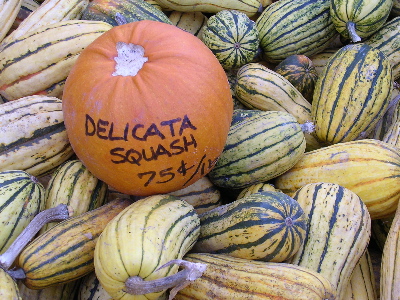
The sign-squash is a rejected pumpkin. No stem, no sale.
Think I’m exaggerating? Have a squash tasting, using at least 3 varieties and preferably 3 species. That might be delicata (Cucurbita pepo), buttercup (C. maxima ) and butternut (C. moschata), but if you range beyond the supermarket, you can probably put together a more exotic assortment. Either way, you will be amazed, and unless there are a lot of you you will also wind up with quite a bit of extra cooked squash. Terrific! Just freeze it in meal-sized packets and you’ve got a stockpile of nearly-instant great food.
When the basic ingredient is ready to roll, it’s only minutes to warming cream of squash and orange soup, with or without a sprinkle of Aleppo pepper; baked squash under a blanket of crisp crumbs flavored with olive oil and lemon zest; or utterly simple broiled squash, spread in a shallow buttered pan and broiled until the top is dotted with flavorful, caramelized brown spots. This is also tasty with store cheese grated over it at the last minute. Also salsa. Also parsley pesto… you get the drift; if you want it even sweeter, the thing to make is pie.
To Prepare Squash for a Tasting ( or almost anything else): Heat the oven to 375 degrees. Rinse any clinging dirt from the squash and whack off the stem with the back of your heavy knife. Cut squash in half as evenly as possible and scrape out the seeds. Oil the cut surfaces with olive oil and put the squash cut side down on a sheet pan or jellyroll pan. Bake until a thin-bladed knife sides in easily, anywhere from a half hour (Sweet Dumpling) to about an hour and a half ( Marina di Chioggia), depending on the thickness of the squash meat and the variety of squash. Turn it right side up and use a sharp-edged spoon to scrape the squash meat away from the rind.

Share this




> hi leslie—i came across your blog while looking for a recipe for
marina
> di
> chioggia squash. i live in southern california and the squash have
> gone
crazy—big and the leaves are still producing. i was wondering if you have
> a recipe for me—couldn’t find one on the web.
>
> thanks,
> miriam
Hi Miriam
The basic recipe is at the end of the post, under “To Prepare Squash for a Tasting.”
As noted, fully ripe Marina di Chiogga takes a long time to cook. That’s because it’s very dense fleshed – when it’s fully ripe, which also takes a long time ( be sure the skin cannot be dented with a thumbnail before you harvest). Other than that, you can use your bounty of Marinas in any recipe you like that calls for winter squash.
And you don’t have to use them up quickly; Marina di Chioggia is a good keeper and in fact will be tastier after about 2 weeks than it is fresh off the vine.
thanks for this valuable info—-i will let the other marina that i harvested rest for a few days. several got so big and started to rot.
the two i picked could be dented slightly with my fingernail—i was afraid to let them stay any longer. the desert heat 115 is a killer.
thanks again
wow, miriam,
115 degrees! I’m happy to confess that’s not a problem I have much experience with (though I am surprised it could cause rot).
The good part of a climate like yours is it gives you a chance ( I’m jealous!) to grow the Southwestern heirlooms offered by Native Seeds/SEARCH –
http://nativeseeds.org. As part of their conservation mission they offer all kinds of wonderful things we Northeasterners could never grow, and they also list 5 varieties of Cucurbita maxima, the species to which Marina belongs. You might well have better luck with one of them.
I also was looking for a ravioli filling recipe…
Hi Jen
Glad you asked – ravioli doesn’t use up much squash but it’s certainly a delicious thing to do with it. The usual filling is just mashed cooked squash with ricotta and parmesan, seasoned with salt and nutmeg. The ricotta lightens the mixture and keeps it from being pasty, the parmesan adds both flavor and firmness. Quantities are often specified, but by me that’s unwise since how much of each cheese is required depends on the flavor and texture of the particular squash. Best bet is to start with seasoned squash, add a small amount of ricotta and an even smaller amount of parmesan, then taste and adjust as suits you. Some recipes skip the ricotta but they are in the minority.