
Collecting Wild Mushrooms Part 2 , Chanterelles
As the recipes – more to come! – suggest, my job is to have a great time collecting, followed by having a great time cooking and preserving. HIS job is to know where and how to look, so here’s another guest post from mushroom expert Bill Bakaitis.
Finding Chanterelles
by Bill Bakaitis
Mention ‘summer mushrooms’ around here and someone is sure to say “Oh yes, Chanterelles! They are the only mushroom I collect.”
And for good reason. They are delicious, they resist insect damage, clean up easily, are distinctive and easy to identify, and are found in beautiful locations. Oh, did I mention that they are delicious?
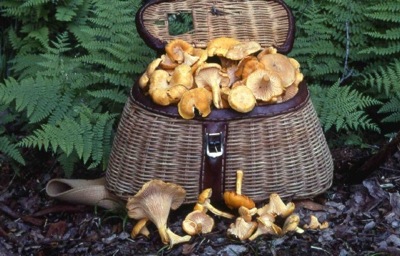
The warm rains of summer bring about a profusion of fungi, in a bewildering array of sizes shapes and colors, all overlapping and intergrading in confusing splendor. Hundreds, if not thousands, of species can fruit in almost any part of the continent. No one, it seems, knows them all, but part of the fun of mycology lies in trying, and it becomes a consummate challenge to do so as many species compete for a relatively few identifying characteristics.
Adding to the challenge is the profusion of names, scientific and common, that get attached to the same mushroom over time and across locales. Anne of Green Gables might add in her signature way that “Mushrooms give scope to the imagination!” Here is a frontier for the naturalist with plenty of room to roam.
But for those of us who are less than expert, and particularly for those of us who want to collect for the table, finding a group that is safe to eat in spite of the inherent diversity is a blessing. I am sure this is one reason that for many collectors, summer mushrooming means collecting chanterelles, for with one notable exception, and a few ‘look-alikes’ almost all of the chanterelles are edible.
My guess is that if you have read this far, you have probably collected and eaten chanterelles and are waiting for the helpful hints on where to find more. I’ll get to that in a moment.
If you are a beginner and wish to forage for them, I would suggest at the very least getting a reliable field guide and preferably seeking the aid of an experienced collector. Best is to find and join a local mycological association and go out with them until you get your feet wet.
Below is a flow chart field key for the Chanterelles of the Northeast that might help. It has been modified (with appropriate additions) from Miller and Miller’s 2006 treatment in North American Mushrooms.
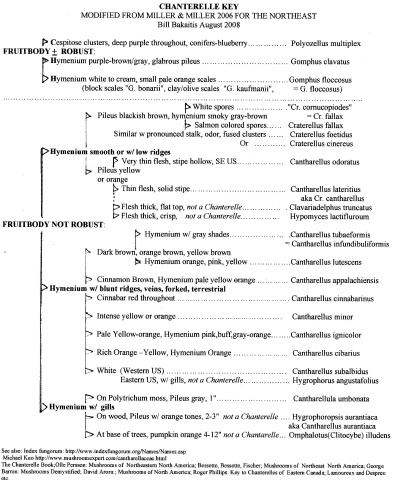
Chanterelle Key : image is attached but text is tiny….you will know what to do.
Of the 18 “Chanterelle” species treated, only one is usually considered toxic, Gomphus floccosus.
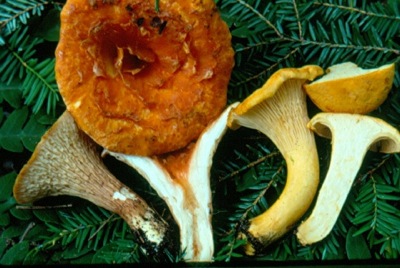
Gomphus floccosus: The toxic Gomphus floccosus is on the left. It has a hollow stem and scales over the top. The desireable Cantharellus cibarius is on the right. Note the smooth cap and solid stem. Both have the blunt edged “false gills” typical of Chanterelles.
Similarly, only one of the ‘look-alikes’ is reliably toxic, the Jack O’ Lantern Omphalotus illudens, although it is best to avoid all of the look-alikes until your second or third season of collecting.

Omphalotus illudens: Note the knife edge true gills of this orange to pumpkin colored Jack O’ Lantern mushroom. It grows in clusters at the base of mature trees. It smells good, but is quite toxic, reliably producing severe gastrointestinal symptoms.
In fact, the best advice one can give for collecting is to go slow. Learn one or two new mushrooms a year. Stick to the easy ones at first and move to the confusing ones only after watching them for several seasons. It is just like bird watching. Crows and Robins are easy. Confusing fall warblers are not.
The three chanterelles you might begin with are:
Cantharellus cibarius: This is the prototype Golden Chanterelle: egg yolk yellow, thick flesh, blunt edged “false gills” on the underside, with a fruity odor.

Cantharellus cibarius: These large C. cibarius were collected under Birch and Oak along a stream which flowed over deep glacial deposits.
Cantharellus cinnabarinus: A small mushroom, cinnabar red throughout, with blunt and wrinkled false gills. It is thin fleshed, but often appears as an ample carpet on the forest floor.

Cantharellus cinnabarinus: This small red mushroom with the wrinkled ‘false gills’ can carpet an acre or more of the forest floor. What it lacks in size is compensated by the numbers.
Craterellus fallax complex: These “Black Trumpets” are ash through brown to black, thin fleshed, with a smooth underside becoming grayish to salmon-buff. They are very fragrant, often smelled before they are seen.

Craterellus fallax complex: Hard to see, thin of flesh, but Oh, soooo good!.
Habitat: So here are the collecting tips. All three of these fungi are associated with rich forests, particularly those which have some age to them.
I recall a bit of video from the 1980’s or ’90’s which featured Julia Child on her hands and knees, head protected by a helmet and plastic face mask, hands encased in leather gloves, pushing her way through dense underbrush, squealing with delight when she found a stray clump of chanterelles. She emerged with her mushrooms but bloodied by briers and prickers, covered with debris and bugs. But that was in Louisiana.
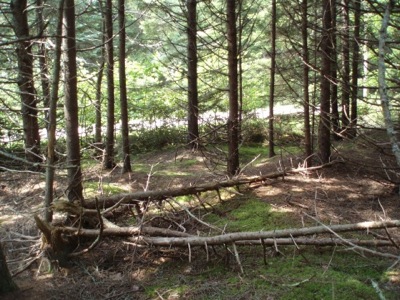
Here in the northeast one walks erect, strolling easily down mossy paths, woods roads, or streamside under a cool canopy of tall trees. Like trout, chanterelles here prefer to live in areas of supreme beauty, and when we hunt them we come away satisfied even if our creels are less than full.
Most mycologists consider chanterelles to be mycorrhizal, that is, there is a symbiotic relation between the fungus and the trees under which they grow. Some mycorrhizal tree species are Oaks, Birch, Poplar, Pine, Spruce, and Hemlock, and here is where you will find your chanterelles.
The fungi bring moisture and minerals, chiefly phosphorus, to the marriage and also help protect the tree roots from infection from parasitic fungi. In return the tree provides sugars and proteins which allow the formation of the large fruiting bodies – the mushrooms we seek. So, once you find a patch of these chanterelles, you can return in future years and be reasonable sure of collecting more. They will be attached to the tree roots.
The hard part then is finding the first ones. Leslie and I like to look in moist low-lying mossy areas of mature trees or old growth mixed forests. These forest soils generally become more acidic as the trees mature and the fungi pull phosphorous to the tree roots. Chanterelles seem to prefer these soils. As Olle Persson puts it “Chanterelles grow best when the pH equals 5.5, a value that is very close to the pH of a normal birch grove” (The Chanterelle Book: Ten Speed Press)
I think of such a stand of birch, sandwiched between an old growth forest and a lake that in fifteen years has never failed to excite us with the sight of acres of Cantharellus cinnabarinus growing as a carpet in the fern and moss under the birch.
Another birch stand, along a mossy stream interspersed with spruce, pine and oak has given us exceptional fruitings of very large Cantharellus cibarius. We look forward to visiting it every July and August. It has failed only once, and that in an exceptionally dry year.
The Black Trumpets too seem to be associated with moist mossy forests where birch is interspersed among oaks, spruce, and hemlock. The word is that a little limestone underfoot helps them along.
But these guys are very hard to see. Recently I took Leslie to an area where I had made good collections of Trumpets in the past. Nothing! Boy was I disappointed. “They were right here under this Oak” I said, but look as we might we found nothing. Two hours later, on our walk back to the car, there they were. The slant of the light had changed and suddenly we were able to see them, right where we had previously looked, right where I had found them in years past.
As it happens, all of these areas are located on deep glacial deposits, and (in the Northeast) I am inclined to list this as another characteristic of a preferred location for chanterelle (and many other kinds of mycorrhizal fungi). From Maine to the Adirondacks, to the Hudson Valley of New York, a mature forest over deep glacial till is an area worth investigating.
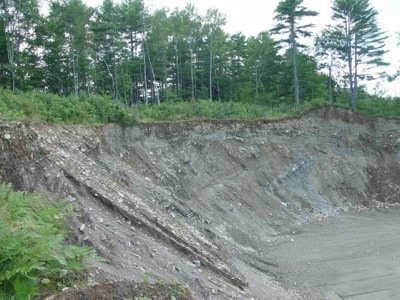
Glacial deposit: A proven Chanterelle spot. Note the Birch and Spruce over the very deep glacial deposit. This pit is close to 100 feet deep.
The edge effect: There is something about the edge that seems to favor mushrooms. The speculation is that the underground mycelium grows, expanding outward ’till it meets an area where growth is inhibited. In an effort to ensure it’s survival it must then create a fruiting body – the mushroom – in order to produce spores which then can find new areas to exploit.
The edge can be the boundary between a field and forest, two kinds of trees in a forest, the barren scrape of a woods road, asphalt secondary, hard packed trail, or eroded stream bank. Such areas are almost always more productive than a pure stand of monocultured timber.
The edge: Another reliable Chanterelle spot. Here all the Chanterelles are found in the thin strip of vegetation between the forest and the road (the bright strip is the gravel road)
These areas are easy to navigate, and the mushrooms are easy to find. They are often right at your feet.
So, pack a small picnic lunch, hang a creel over your shoulder and plan on a graceful walk along a trail in a forest primeval. Listen for the liquid call of the wood thrush. When he sings the chanterelles will be nearby!

Share this





Hi Leslie, I do PR for MarxFoods.com and after reading your post wanted to let you know we’re having a chanterelle recipe contest. We’d love to have you enter a recipe! The prize is 2 lbs. of fresh chanterelles.
Ah PR, ever alert. I’m well supplied with chantarelles but maybe some readers will be moved to give it a go, so thanks for letting us know about it..
I, too, am “well-supplied” with chanterelles. Can I get access to your recipes? And, what is your most successful way of preserving them? Thank you.
Hi Judy
Congrats on the chanterelles. I’m happy to share recipes but don’t have a file of them that I could provide access to. Your request reminds me to to do a post with cooking suggestions. It will be comin’ up shortly, with any luck ( luck finding time, that is. The chanterelle luck has been pretty good).
Meanwhile, preserving. We saute them in butter until just cooked through, then freeze. Dried chanterelles have a lovely flavor but only while they’re still dried. Rehydrated they seem just so-so, and the water, broth or whatever doesn’t get much flavor at all.
Dried chanterelles DO make a very tasty mushroom powder that can be used to flavor things, especially starches like pasta dough, mashed potatoes and crepes. Only problem with this is you need a lot of dried chanterelles to make a useful quantity. Be sure to keep the powder in a dark jar – like spices, the dried mushrooms lose flavor faster when exposed to light.
Great post. I found all 3 of these scrumptious nummies just yesterday and am cooking a tasty 3 chanterelle omlette right now! I wanted to chime in that your observations regarding the edge effect and the deep glacial deposits hold true for NJ as well. That describes where I found mine! Thanks for the post!
Catfish –
Does that handle tell us where you’re from or is it about going fishing?
In any event, thanks for saying such nice things, and for the report on NJ – I love the idea of a three chanterelle omelet!
I am in total agreement about dried chanterelles. Powder is the way. Powder is good for homemade pasta, white/bechamel type sauces and many other applications. Potatoes, rice and eggs go well with chanterelles (and most other mushroom species).
I believe chanterelles are a white wine mushroom. They will be best matched with the foods you would normally associate with white wines. Since chanterelle flavor is subtle, getting carried away with spices is not a good idea. As David Arora says, “If you can’t taste it you waste it”.
Chanterelles may not be good in “mixed mushrooms”. They will not mix well with Agaricus species or Boletus edulis but will be good mixed with mushrooms with similar flavor signatures such as black trumpets, winter chanterelle, yellowfoot/flame colored chantarelle, hedgehogs etc. Black trumpets will be quite assertive in a mix like this but not uncomplimentary.
I make liquor with chanterelle powder. It is quite surprising in flavor and the peppery character really comes out. I sweeten it very slightly.
Now if it were only medicinal……..
David Spahr
Washington, Maine
I have plenty of chaga and reishi for these purposes so no sympathy comments please.
Welcome, David,
And thanks for all those useful tips; they remind me I should be posting a few more wild mushroom recipes!
Thanks for this wonderful site. I’m just learning about mushroom gathering, and wonder how much of a factor elevation is. I live in Nevada City, near Grass Valley, about 2200 feet up. Any thoughts? Likewise, re morels? Mostly, what I’ve found so far are agaricus campestris, which are pretty easy to identify.
Hi Diane,
Leslie and I are glad that you have found this site and this entry of interest, and we are confident that you will find mushrooming equally interesting. As one of my friends once put it, “mushrooming is like one big year-long Easter egg hunt!”
I am afraid that I have very little to say about your specific question however, as I know nothing about the geography, ecology, plants and habitat structure of your home area. Suffice it to say that mushrooms often vary considerably over areas only an hour removed from one another. Add elevation rainfall, and temperature and this variability increases exponentially.
Changes in elevation, for example, mimic changes in latitude. All things being equal, the higher up the mountain one goes, the more ‘northern’ are the species to be found. Over geological time this higher elevation and colder climate becomes more likely to be glaciated leading to the extirpation of the species found there. Subsequent repopulation becomes dependant upon the proximity of more southerly or lowland survivors. In the Northeast, the long North-South trending Appalachian Mountains allowed for easy repopulation of the glaciated mountain chain. The highest peak near us, Slide Mountain in the Catskill, is only 4100′ high, yet was covered by over a mile of ice when glaciers slid southward towards the Mason-Dixon Line. When the glaciers melted and retreated there was a flourishing flora and fauna ready to reclaim their hegemony over the area. Today one can find ‘northern’ species on the tops of this old mountain chain, ‘southern’ species along the valleys and coastline, and generalists everywhere. Surprisingly, even ‘Sub-Tropical’ species can be found in the microclimate of the Hudson River Valley. This effect is easily seen along our coastline. Every fall substantial populations of tropical fishes appear in the rivers, estuaries, and beaches of the northeast, ready and apparently willing to take up permanent residence should the climate allow.
In the vast areas of continental North America, particularly those subject to arid conditions, another pattern seems likely, one where the mountain tops become isolated ‘islands’ cut off from repopulation should their habitats deteriorate. Under harsh conditions those populations often retreat into smaller and smaller mountain-top regions. I would not feel comfortable speculating upon how this might affect your local populations of plants and fungi, but I am sure that a literature describing these effects (particularly under projected Climate Change conditions) exists.
To help with your specific problem of learning more about the mushrooms to be found in your area, you should try to contact a mycologist familiar with your region. It might be hard. When I checked the North American Mycological Association (http://www.namyco.org/ ) directory of members I found only three names listed for Nevada, two from Las Vegas and one from Sparks. By contrast New York has 115 names. But check their data base and look to nearby states for help. Colorado for example has a very active mycological community. Check also your local Colleges and Universities
Concerning Morels, you might be able to find material relative to your local collecting conditions at http://www.fs.fed.us/pnw/publications/gtr710/. This is a major study of Morels in the Western United States.
And for a long time David Aurora’s Mushrooms Demystified has been a standard reference for western mycologists. (Find it at Amazon or your local bookstore)
Good luck,
You will have fun. That is sure!
Bill
Hi Bill,
To the list of mycorrhizal trees list in your list, I would add beech. I have been particularly lucky finding Cantharellus cibarius near beech trees and use that as an indicator in some of my new searches for spots. I would also definitely second the edge effect as some of the biggest bounties I have found (many shopping bags full scale of finds) have been near edges of streams and in transitions of geological formations.
Cheers,
Paul
Thanks for the tips Paul.
Now you got me chompin’ at the bit, and here it is only February with a blizzard raging outside. Snow, that poor mans fertilizer. I can’t wait to see how it affects the collecting this year.
Bill
First off, thanks for the incredibly informative posts on mushroom hunting! My wife and I just joined your former club (the Mid-Hudson Mycological Association), and we are interested in identifying areas near us (Poughkeepsie) to go for chanterelle walks.
We’re going to keep an eye out for the types of trees that you mentioned above when we go walking, so that is a big help. But one thing I didn’t know was how to find glacial deposits. Are there specific maps or people I should consult to find where these are located? If they’re anything like your picture above, I don’t think I’ve ever seen one. Any ideas would help.
Hi Naseer,
The entire Mid-Hudson Valley was once covered by glaciers. In Poughkeepsie, Dutchess Community College for example sits on a drumlin, from which Drumlin Hall derived it’s name. If you Google ‘Dumlin’ you will find a number of pictures and diagrams illustrating their dominant geological characteristics. Armed with this in your mind, you will then begin to see them scattered across the region. Geological maps may also help in identifying specific deposits.
Since drumlins are comprised of a loose aggregate of sand and gravel they are often mined for these deposits. Many of these sites will also show up on Geological Quadrangle maps, but you will soon see them as you drive throughout Dutchess County, often named by the company which is mining them. Check the yellow pages for ‘sand and gravel’.
Chanterelles (and other mycorrhizal fungi) are often found on these deep deposits because of their ability to form relationships with the trees which need the fungi to bring nutrients to the tree. Any sandy or gravelly deposits then are places worth investigating. Think ‘sandy stream beds’, ‘gravel out tailings of flood prone areas’ , ‘the base of natural avalanches’, as well as the more obvious terminal moraine and drumlin deposits.
Because Dutchess, Ulster and Columbia Counties (to name just three) were repeatedly covered with glaciers you would be better off to use the forest characteristics to fine tune your search. Look for Birch, Oaks, Poplar, and as Paul suggests (above), Beech. If you find Amanita, Lactarius, Russula, and Boletus, you are in the right habitat.
The Mid-Hudson Mycological Association will have walks for Chanterelles this summer.
Good luck and bon appitit!
Wow! That is a very thorough response, Bill. Thank you for all the information. We hope to participate in the Chanterelle walks this summer, and maybe even find some on our own with the clues you provided.
Hi
I came across this trying to identify Chanterelles – I am still not sure – anyone care to help? I have some good pictures. The flesh is white and smells good, the centre of the stem is not hollow, so it all sounds good. But the gills don’t look like most of the photos on the web. I am in Scotland and they were growing below beech trees. I am just itching to try them :-))
Please help
Colin,
In the western part of the US there is a white chanterelle which is associated with Douglas Fir.. Here in the east species of white Hygrophorous, particularly those which develop a thickened stem, are sometimes mistakenly identified as ‘white chanterelles’. I know that Scotland is well known for its chanterelles, but I would never hazard even a guess at species identification outside of my home region (the Northeastern part of the US).
You might run this by Roger Phillips http://www.rogersmushrooms.com/, or Geoff Kibby http://pipl.com/directory/people/Geoffrey/Kibby
or the folks at Kew Botanical Garden http://www.kew.org/plants-fungi/plant-fungi-groups/fungi-kingdom/
And you are 100% correct. Never eat any mushroom unless you are completely certain that it is an edible species – and then only after you test your own reaction to a small bit, and then retest a day or two later for any developed allergic reaction.
Good luck (and send our regards to Roger or Geoff when you contact them).
Bill
can anyone tell me a specific place i can hunt for chaga close to nyc? im thinkin harriman or bear mt? i also heard that perhaps the chaga so south may not contain as many medicinal properties as that growning in NH or north?
thx so much
mushrm newb
Hi mushrm newb, and welcome to the Blog.
Inonotus obliquus, the fungus also known as Chaga, is a pathogen of Betula papyrifera, (Paper Birch). It therefore can be found throughout the range of this primary host. It has also been reported on Ulmus (Elm) Ostrya (Hornbeam) and Fagus (Beech).
The two volume monograph on North American Polypores by Gilbertson and Ryvarden illustrates the known range of I. obliquus on a map (p384) showing it running the spine of the Appalachians from Georgia through Maine and the Canadian Maritimes. It also has been documented in the Northern Great Plains and the Canadian Rocky Mountains, as well as the Alaskan Coastal Mountains.
Although I. obliquus looks rather substantial because of the dark pile of ruptured bark on the exterior of the sterile conk, the simple-septate hyphae of the interior is easily deteriorated by both insects and weathering. Consequently these sterile conks are usually hard to find even in stands of birch which are known to be infected.
I have collected it on both standing and downed timber in March in Dutchess County, NY, and on standing wood in August in Coastal Maine, and have seen it from time to time in the Catskills, but this is not a fungus that is usually on my radar screen.
Which brings us to your second question. Asking me (or Leslie) about the medicinal properties of Mushrooms is like asking a Teetotaler about the culinary properties of fine wines. Sorry.
As you undoubtedly know, there are myriad web sites dedicated to gathering, preparing, and purchasing Chaga. Critical thinking and skepticism is recommended when perusing these sites. One reputable site is http://www.messiah.edu/Oakes/fungi_on_wood/crust%20and%20parchment/species%20pages/Inonotus%20obliquus.htm
Good luck and Caveat Emptor; these mushrooms can be difficult to identify correctly. In a recent meeting with a group of very experienced New York City Mycologists, I was told that they had recently been collecting what they thought was Chaga, only to learn their find was Inonotus glomeratus, another species entirely. (Gilbertson and Ryvarden describe 23 species of Inonotus in North America.)
I just started collecting mushrooms in Western North Carolina. I agree with the comments about acidic soil. I have collected three different species of chanterelle this year: cibarius, cinnabarius and minor. The minor was found under mostly pine with some mountain laurel. The red was brought to me by a friend who identified it as growing under mountain laurel. And the cibarius was collected in the typical oak-heath forest for the region. I did notice that they seem to like the flatter areas where there is minimal underbrush and the laurel is not super thick.