
Gardener’s Holiday – Solstice Cookies
Part 1: Heirloom Pizzelle
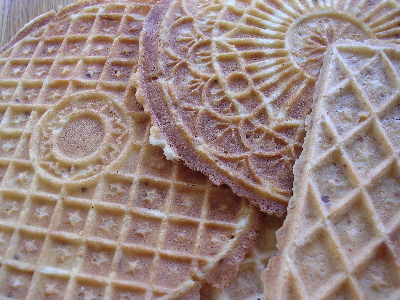
Most pizzelle baking irons are round, probably because it’s much easier to get lace-edged circles than any kind of rectangle. But regardless of shape or perfection thereof, these crisp, light not-too-sweet cookies look great on the plate – while they last. Scroll down to skip straight to the recipe.
In the middle of the Northeastern winter, when gardening consists largely of spraying insecticidal soap and looking out the window at the naked spot where you meant to plant a chamaecyparis ‘Filifera’ but didn’t, baking is a natural outlet for some of that thwarted creative energy, aka urge to potter around.
Said urge might be resistible if it weren’t for the Pavlovian aspect, but just as springtime is full of cues to get out there with trowel and pruning shears, the Let’s Banish Darkness season* is laden with near constant reminders that cookies should be made.
Some years we begin with gingerbread, adding the warm perfume of spices to old reliable butter + sugar + flour + oven = happiness; but we usually start with pizzelle, a family tradition from the Italian side of Bill, who arrived in my life equipped with his grandmother’s pizzelle iron.
That would be grandmother Josephine, the world’s greatest cook, born Giuseppa Cario in 1894, near Palermo, resident for most of her life in Washington, PA (near Pittsburgh).
The grandmotherly pizzelle iron IS iron, not the more modern cast aluminum. And it has both a very long handle and little feet, like the feet on old cast iron skillets, suggesting original design for use on an open hearth although they may simply be there to provide balance; the applied handle means the plates don’t lie flat.
Most importantly, the iron has grandma’s initials and those of grandpa Fidele engraved on one side. On the other is the date: 1931, the twentieth year of their marriage.
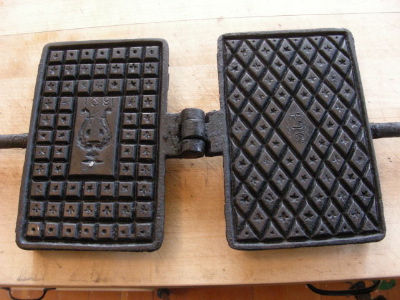
The personalized parts are not deeply cut, so they never show up as clearly as the patterns standard on the iron, but that just adds to the challenge. If the dough comes out just right, you can see ‘em. If it doesn’t, the pizzelle are still delicious and of course if you’ve gotten close enough to eat them, you don’t have to see the initials to know they’re there.
The basic batter is easy to make, and over the years I’ve tried many variations, some with vanilla, some with citrus rinds, some with crushed nuts and spices. Even chocolate, which is better than it sounds but not all that terrific unless you’re one of those people with a chocolate problem. Reception is always the same: Bill takes a bite and then says “My grandmother’s had anise in ‘em.”
E-bay is rich with vintage pizzelle irons, both stovetop and electric, but there are many modern versions, including several with non-stick coating (which is widely considered non-good). Fante’s in Philadelphia has a particularly broad selection, including a version of our family heirloom that you can engrave with YOUR initials and pass down to your grandchildren.

PIZZELLE
are ideally so thin they’re almost translucent, their intricate patterns picked out in the gold brown of perfect toast (middle top). But achieving this goal is not essential. Even when quite thick they’re still delicate, and tasty doneness can be anything from barely colored to almost burnt. In all of its manifestations homemade is so much better than commercial it’s like the difference between a twinkie and a Payard petit four.
What you’re making is basically a batch of extremely thin waffles and as with all waffles success is not instant; you generally have to discard the first couple. This was clearly no problem in former times; old fashioned recipes make 60 or more. This one yields far fewer, but it can be doubled effortlessly as long as you have a sturdy mixer.
For 18 to 24, depending on size:
2 large eggs, at room temperature
½ cup sugar
flavoring: either 1 1/2 teaspoons vanilla or the shredded rind of a lemon – or half orange – or about ¼ teaspoon anise oil (not anise extract) or for Bill a tablespoon of anise seeds
¼ pound butter, melted and cooled, plus more for the iron
1 heaping cup cake flour or 1 scant cup all purpose flour, plus a bit more if needed
1 teaspoon baking powder ( use only 1 ½ teaspoons if doubling the recipe)
½ teaspoon salt
a pizzelle iron is a must; a pastry brush (for buttering the iron) and a knife with a long narrow point (for cookie prying) are nice but not essential. A small wire brush is a good cleaning tool for vintage iron baking irons. Otherwise, consult instructions that come with the gizmo.
1. Beat the eggs and sugar at medium speed until the mixture is thick and pale and falls from the beaters in a fat ribbon. While this is happening, melt the butter and thoroughly mix the cup of flour with the baking powder and salt.
2. When the egg mixture is ready, beat in the flavoring, then slowly add the butter.
3. Gently fold in the flour mixture by hand and set the batter aside, loosely covered, for 15 to 30 minutes.
4. Heat the pizzelle iron on a medium flame until a drop of water sizzles vigorously, not quite dancing but almost. Brush the plates lightly with melted butter. ( Many recipes suggest cooking spray, not my idea of fun but if you use it all the time you probably like it).
5. Gently stir the batter/dough, which should be the texture of very stiff whipped cream. Add a bit more flour if it’s softer but err on the light side; it’s far easier to add more than try to compensate for too much. Put about a tablespoonful on the iron, spreading it out a bit as you deposit it. Slowly close the iron and use a table knife to remove anything that oozes out. Peek after about 30 seconds, the pizzelle should part from one side of the iron and the surface look dry. If it’s dark brown turn down the heat. Reclose iron (and turn if on stovetop) and cook about 30 seconds more.
6. Open iron, lift/pry off cookie and place on a cooling rack. If it’s too thin, add a bit more flour. If it doesn’t come off neatly, return iron to the heat to dry it out some more, then pry as necessary to clean the iron. Get the iron hotter and greasier next time; the pizzelle will tell you what it needs more succinctly than I can.
7. Attempt to prevent your husband from eating them all immediately. They keep well for 10 days or so in an airtight tin.
* The last time I addressed this subject I was in the throes of irritation at the people who are endlessly on about the meaning of Christmas trees and so neglected to mention things like Saturnalia and Hanukkah. Please consider them mentioned. That post also includes a recipe for shortbread, the world’s easiest holiday cookie and one of the very best.

Share this




I’m looking for a cast iron stove top pizzelle iron with
the design of two people toasting a glass of wine.
would you know where I might find this item?
Thank you for this wonderful information. I searched high and low before finding your web site. Ebay has had a number of handheld pizzelle irons listed. It was not know to me whether there were to be a part of an antique collection or whether they could actually be used. I, of course, plan to use a pizzelle iron when I acquire one. My concern is that I have a smooth top electric range and that is where I would use the iron.
Sharon, if you will post contact information with a repeat of your question, maybe a reader will have the iron pattern you’re looking for. I’ve never seen one so can only suggest those two never-fail sources: ebay and craigslist. It may take a while for one to turn up, but if one exists it will no doubt appear eventually.
Barbara,
Thanks for the kind words. I wish I could be as encouraging in return, but I’m afraid an electric smoothtop and a handheld pizzelle iron will never be friends. If you want to make these wonderful cookies – pizzelles rule! – you had better start shopping for an electric iron. Some of the vintage models on e-bay are as good as the modern ones, but the best of them are often more costly than brand new so there’s not much point in going for used unless you’re a collector.
My friend, Anna, had this problem first (and now, so do I) the solution? Purchase an electric hot plate…it works just fine.
I’ve been reading some blogs about pizzelle and irons tonite, and how some people are in search of the good old-fashioned cast irons. I say keep looking until you find one. I’m lucky enough to possess my great-aunt’s simply decorated iron, and I wouldn’t cook pizzelle any other way. I’ve been working on my mother for years to give up her other one that she has collecting dust in the basement, but she won’t give! That one is marked Philadelphia 1926. To me my iron is one of my most prized and cherished possessions. Thanks mom!
My quest: to find a pizzelle iron (I’ve seen one!) with the regional
towns of Italy including my roots: abruzzi. Please advise?
Grazie
My quest: to locate a pizzelle iron with the regional towns of
Italy, in particular my roots: Abruzzi italy. I know it exists.
Grazie!
I am trying to find where I can have a personalized (Monogrammed) Pizelle Iron made..can anyone help me?
Hi,
Very nice posting.
Just wonder, which type of pizzelle iron do you recommend most, traditional cast iron made or modern non-stick surface type? I mean which one gives better taste?
Thank you
The Pizzelle Maker
Richard –
please forgive me! somehow the comment notifier didn’t work in your case. Fante’s (link above in the post) sells an iron that you can have monogramed, so they’d probably know where you can get the monogramming done.
PizzelleMaker –
better taste is in the mouth of the taster, of course, but I think the thinner cookies you get with heavy uncoated cast iron plates are better than the thicker non-stick ones. They’re crisper and have a more toasted quality. In addition to Bill’s iron, we have a vintage electric one ( @1950) with similarly serious plates and it does just as well as Bill’s as far as taste is concerned.
Do you know who the manufature of the above pizelle maker was. My great grandfather had the same one with his initials engraved in it.
Hi Mike,
I just went and looked. Bill’s grandmother’s iron is marked:” T. Calabrese waffle iron” above the handle bulge,” 70 no. Fatt st. Carnegie PA.” on two lines below. I think there were probably a lot of small foundries in Western Pennsylvania in those days and that it was pretty easy to have them make customized products. Happy pizzelle!
Leslie
Hi, Leslie…
Just came across your blog when looking at pizzelle info on the web. Being of Italian heritage, my family has made these for as long as I can remember, and longer. Even though I use an electric iron, I do have and cherish my grandmother’s old hand-held cast iron press. Can’t imagine using it, though. LOL
These were the first thing I sent my husband to be years ago when we lived states away from each other. He loves them and now we make them together. The aroma of anise fills the house for at least a week, if not longer.
This year we made both the anise and chocolate ones and shared them with co-workers at both of our jobs. They were a huge hit.
Buon Natale! :0)
Monica, the same to you. What a terrific story! Pizzelle seem to be a loving link in so many families. Long may they wave! …or sizzle, I guess, would be more accurate.
The old fashioned iron IS a bit more painstaking to use, and having used ours on an electric stove I can tell you that’s not such a great idea. But if you use a gas stove – or have a friend who does – please let me put in a word for a try with your grandmother’s iron. If it hasn’t been used for years it’ll probably take a bit of re-seasoning (pls. write back if you need help with that) and of getting the hang of, but every time I turn a pizzelle out of Bill’s grandmother’s iron I feel gratefully connected to a woman he loved, even though she died long before I met him.
All best and many great pizzelle in the New Year
Leslie
Hi,
I have a pizzelle iron exactly like the one shown and am trying to track down it’s origin. Could you tell me the date it was manufactured and it’s manufacturer? It belonged to my Grandmother who came from Italy to the US in the 1940’s.
Thank you so much!
Welcome, Myrna
I love searches like yours! Grandma Josephine’s iron is marked: “T. Calabrese waffle iron” above the handle bulge,”70 no. Fatt st. Carnegie PA.” on two lines below. The only date is the customized one, but it does confirm that the irons were made in the US before your grandmother came. I haven’t done any research, but my bet is that the pattern is a traditional one, going back at least to the 19th century and used by many makers in Italy as well as here.
That said, the irons are heavy (I wouldn’t want one in MY luggage), so unless your grandmother’s is personalized she may well have gotten it after she arrived.
Thanks for all the good info. I make pizzelles in my gourmet bakery established 2002. Mom and I launched the business in 2002 during the .com boom! We are still in business, although mom fell, broke her femur, and can’t maneuver much at 88 years old. Please visit us at http://www.bellapizzelle.com. All the best to you and yours!!
Denise
Hello Denise, Thanks for checking in. It’s great to hear pizzelles can be a business all unto themselves. Good luck to you (and to your mom!)