Housekeeping
I don’t know what the weatherpundits are going to call it, but around here it’s already The Boxing Day Blizzard of 2010; most of our roughly 20 inch blanket arrived on the 26th. Lunchtime’s lazy flakes started swirling toward whiteout at about 4 PM and the hours between dark and dawn were thick with a howling northeaster.
Although snow was still falling and blowing all morning on the 27th, the blowing showed a great deal more enthusiasm. No way to start shoveling much before noon, by which time the snow was what one might call “formerly fluffy.” It wasn’t heavy, exactly, compared to some snows I’ve hefted in my time, but it was already closer to igloo material than the original thistledown.
And there was a lot of it, so both of us were out there for hours. Bill started by clearing a path around the greenhouse and down to the bird feeder
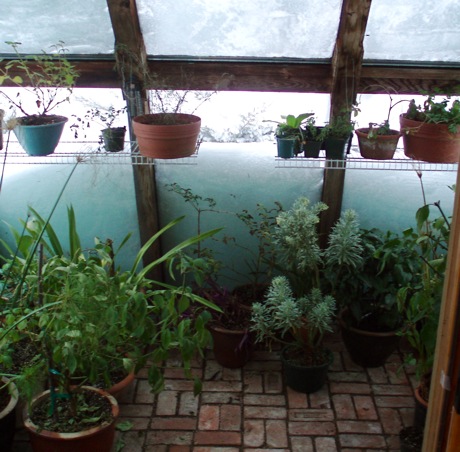
The greenhouse from inside (those shelves are 4 feet off the floor)

First chunk of first south window cleared
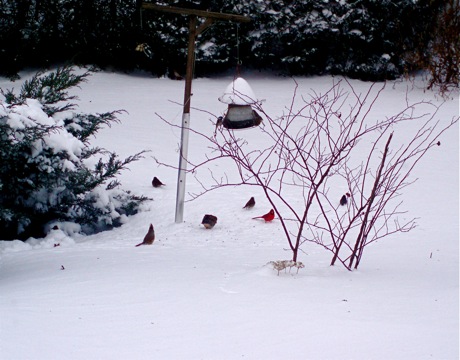
Birds, feeding
And that was the easy part. Next came
Read More…

These aren’t they, but next year...
I’m not sure I’m really all that worried about it. Between the bacon and the barbeque we’re no doubt consuming enough carcinogenic material to make it a bit bogus to get all het up about the lids on the catsup – especially since after the jars are opened I switch to one of my favorite products: plastic reusable caps like the one on the strawberry jam (reasonably easy to find although not, for reasons that elude me, available wherever canning supplies are sold).
Where was I?
About to say something about “better safe,” no doubt. BPA – free canning supplies do exist.
Read More…
As we get ready to fire up for Thanksgiving, I’m reminded how lucky I am. Not many cooks have a huge wood-burning outdoor oven, but thanks to my loving ( and very handy) husband we have two, one in New York and one in Maine.
 Bill built the Maine oven so the process could be filmed, so in a way I can thank The Three Thousand Mile Garden for that one. But that one never would have happened if the New York one hadn’t came first, and although Bill did of course build it the ultimate thanks there should probably go to his childhood.
There were several outdoor bread ovens in the neighborhood where he grew up, including one at his grandmother’s place. He never forgot the bread – or the fact that the ovens were home built – so when I started making wistful noises about how nice it would be to have one they fell on receptive ears.
Next thing to be thankful for: he’s a man of action. And that goes not just for building the ovens but also for providing instructions. You too can have one of these things, not without a bit of work and not instantly, needless to say, but very very inexpensively and it ain’t rocket science, either. Here’s his step by step how-to:
Read More…
or almost on time, anyway. Given that it doesn’t usually get its movie together until February, I’m not inclined to be too fussy,.

The Christmas cactus, 12/25/08
As you can tell from its less than splendid shape, I have mixed feelings about it. Or not mixed, really, since feelings are the only reason we keep the thing. It was a gift from our dear friend Peter’s mother. After she died we kept it for him, and now that he’s gone too we keep it for him all the more. Plus it’s the plant froggy came in on (Tree frog. Size of a quarter. Adorable. Discovered in midwinter, it lived free in the greenhouse until spring). Read More…
I’m lucky – there’s help. Always a good thing and especially a good thing when there are a lot of large plants and rather a lot of window surface.
Window surface?
You betcha. This is not about housekeeping points; cleaner they are, the better for the plants. It’s amazing how much light can be blocked by even a light coating of dust.
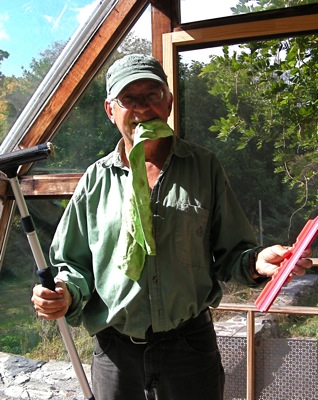
Bill clowning around with the equipment. ( Myself I wouldn't put the anti-static glasscloth in my mouth. But I would have it in hand - very useful)
It’s also nice to have someone who can do the heavier lifting.

the invaluable Kristi Niedermann's back - yes grammarians, I mean both of them.
The awkward, @ 15 pound pot is about at the height of my chin. I could have dealt with it by myself but I’m glad I didn’t have to.
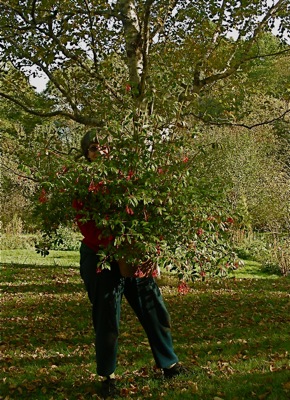
Kristi and begonia, front view
That’s a Begonia fuchsiodes, named for the drooping, fuchsialike flowers.
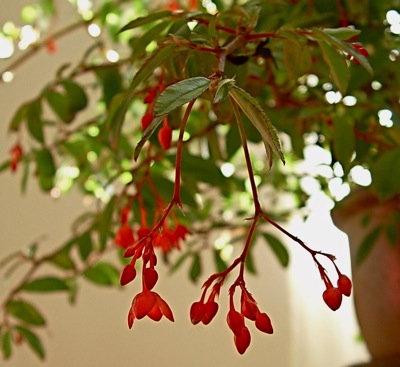
begonia fuchsioides in red. It also comes in pink.
Read More…
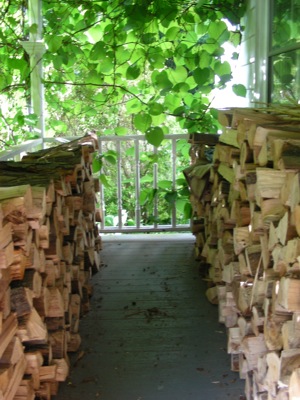
When firewood suppliers who sell by the cord or truckload say they’re selling dry wood, they mean the trees were cut down some time ago. They do not mean the wood was fitted: cut to length and split, more than about 5 minutes before it went on the truck. So if you want firewood dry enough to ignite easily and burn cleanly next winter, now is the time to order it and get it stacked out of the weather.
Gotta hand it to eggs. You can use EVERYTHING, including the shells, an extremely sharp-edged material that is almost pure calcium.
In the house:
* great for cleaning narrow-necked bottles and vases. Crush a shell, working it between your fingers so the bits aren’t stuck together. Stuff it into the bottle, add a small amount of very hot water and swish/shake vigorously until all looks clean. Pour out, catching the shell in a strainer in case you missed a spot and have to shove it back in.
In the garden:
* Dig one or two thoroughly crushed shells into the soil around tomato plants. The lack of calcium that causes blossom end rot is usually a result of inconsistent watering but a little extra insurance never hurts.
* Rinse and dry shells, then crush to roughly rice grain size bits and spread a carpet of them under hostas and similar plants to discourage slugs and snails. Many advisors say “sprinkle” the bits, but a sprinkling won’t have much effect in the deterrent department. This carpet is not beautiful. You can make it a little less sock-in-the eye by soaking the crushed shells in strong tea for several days to stain the white parts brown.
* Excellent in the compost. No need to crush if you don’t want to bother, but as with everything else, the smaller the piece the sooner it rots.
* substitute for peat pots. NOT. In An Island Garden (1894), Celia Thaxter charmingly describes starting poppies in halved eggshells. It sounds like a great idea: Biodegradable, easy to transport and free. In my experience, however, it’s difficult to get the shell halves reasonably even, even when you hard boil the eggs so you can slice them across. Then you’ve got to bore a drainage hole ( darning needle better than icepick). They don’t hold much soilless mix, so they won’t support plants for long. And then you’ve got to fracture them before planting so the tiny roots can get out. Applying just the right force to the squeeze is an art all by itself.
It’s spring! Time to evaluate, improve – or possibly discard – your current collection of houseplants. But it can be hard to see old friends clearly; loyalty gets in the way. The fix? A field trip to the nearest public conservatory. Botanic gardens, universities and colleges all over the country have greenhouses full of wonderful plants and these include (more often than not) humongous, obscenely healthy versions of those meek green units in the living room.

Your fiddleleaf fig could be 13 feet tall too, although you might be just as glad it’s not.
Tropical orchids, ferns on steroids, fragrant blossoms dripping from vines and trees – even the smallest of these places puts spring flower shows to shame. And small can be especially beautiful. Displays will be far less polished but publicity is nonexistent, which means they’re seldom crowded. Call ahead to find out the slow times and you might be the only visitor.
What a deal, especially in raw, cold March. What’s not to like about peaceful warm rooms filled with tropical beauties that somebody else has been taking good care of for years and years and years?
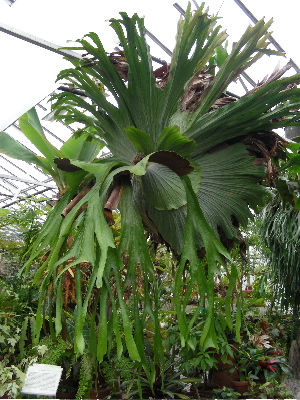
This staghorn fern, more than 6 feet across, was not built in a day.

It also takes more than a moment to grow a good sized flock of birds of paradise.
Oddly enough, seeing one’s familiar home companions in this new light is more energizing than depressing and there is almost always something to learn: When a fiddleleaf gets old, the bark gets gorgeous; dormant orchids don’t look any better when there are 60 pots of them; pruning matters as much indoors as it does in the yard; and whether camellias are worth the hassle may be a function of heritage. Could be you have to be southern.


Oh right, I forgot to mention fruit. In addition to proving dwarf citrus trees CAN produce something that looks like a crop (those are ponderosa lemons, not grapefruit), these places harbor edibles most of us can’t see without buying a plane ticket.
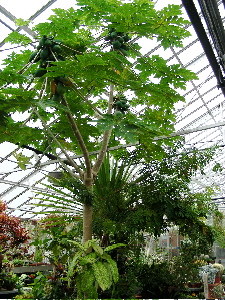
Papaya tree at @ 16 feet ( those dark footballs are the papayas)
The base of the tree is fat, gray and gnarly; the roots go right through the gravel floor, deep into the deeply alien Hudson Vally soil.
But not for much longer, and thus we come to the carpe diem part. These pictures were taken at the greenhouse that belongs to the Cary Institute of Ecosystem Studies, in Millbrook New York. It will be closed before the end of March, its collection dispersed, the building dismantled. Gone forever after more than 30 years.
And it’s not likely to be alone. Glasshouses cost a lot to heat; older models cost really a lot to heat. As the price of oil sails ever upward while funding for public institutions shrinks and those institutions start thinking about greenness in a different way …
A bit of creative googling is likely to turn up at least one that’s close to you, but you might as well start with the advanced garden search at the American Public Gardens Association and the international list at Gardening@Closerange.com.
SOME PLACES TO PUT FOOD BY
(so you can eat locally all year long)
Upstairs: Food Historian Sandy Oliver keeps winter squash under the bed. Bottom of the linen closet is also good; just don’t forget they’re there.
Downstairs: An unheated basement ( 35 to 45 degrees) , a second refrigerator ( or the back of the one in the kitchen) is almost a root cellar. Things to keep in it from harvest to spring: Beets, Carrots, Cabbages, Onions, Wine, Beer, Cheese.
In a cool back bedroom or similar: Potatoes. They like to be cold, but not quite as cold as other roots.
In the pantry/ food cupboard:
Dried: Wild bolete mushrooms, wild or cultivated agaricus mushrooms, tomatoes, shell beans.
Canned: Applesauce, fruit spreads, ketchup, tomatoes, roasted tomatoes for instant sauce.
In the garden: lightly mulched Parsley and Kale will survive until a very hard freeze (@ 26 degrees); the more slowly it gets cold, the more cold they can take. Chard, Brussels sprouts and Broccoli raab aren’t quite as hardy but still can stand – indeed benefit from – repeated light freezes. Many gardening and country food books, including some of mine, suggest leaving beets and carrots in the ground under a heavy mulch and then harvesting as needed. It works fine if you don’t have voles.
In the freezer: Wild mushrooms (morel, chanterelle, sulfur shelf, blewit, hen of the woods) sautéed in enough butter to be a sauce for the pasta, baked potato, winter squash or other starch that is then dinner; Toasted almond pesto or other pesto to use like the mushrooms ; Berries; Whole tomatoes for soup and sauce; Full-meal soups like Minestrone and Corn chowder, Harvest Vegetable Stews like corn, squash and pepper/ tomato, pepper and onion/ snap and shell beans with summer squash. Chickens. Your quarter of a local lamb, pig or steer, divided into the cuts you’ve ordered. Make an inventory and keep it near the freezer!( along with a pen on a string for crossing off)
Taking apart the windows and giving them a thorough washing is classically a part of “Spring Cleaning” – a classification that makes sense if you’re the sort who takes down the storms each spring and puts them up in fall.
But if you are not that sort, an easy negative for some of us, window cleaning tends to slide until
a) every crumb of light is precious, and
b) every crumb of light that comes in, comes in at just the ideal low angle for showing off the difference between translucent and transparent.
Nothing will ever make it fun, but on the basis of our recent tour of the kitchen fenestration , here are a few things that make it easier:
* Cloudy days : the cleaning agent doesn’t dry out as quickly and it’s easier to see which side the streaks are on.
* Distilled water: doesn’t matter if you’re using bottled window cleaner (or – deduct many, many green points – one of the alas very efficient petrochemical sprays), but if you belong to the old fashioned vinegar or ammonia in water school, using hard water will make the job harder because hard water leaves spots.
* lint is the enemy, which is why old manytimeswashed diapers or t-shirts make ideal rags. Just be sure to give them a double rinse and dry without addititives; laundry soaps and fluffing agents leave residues that streak windows. Only downside is that you need a lot – can’t get things clean using dirty rags. That’s why
*crumpled newspaper really is the easiest and least expensive wiping medium. Rumors about ink notwithstanding, it’s the cheap low-fiber (lint-free) paper that makes it so effective. Yes, the ink comes off. Big deal. It comes off of you, too. Wear thin rubber or latex gloves if you have manicure issues.
* You think you have gotten the corners. You have not gotten the corners.