Friends and Foes
for anyone who lives where it has been raining rather a lot lately. All this dampness, combined with cool temperatures, creates a perfect environment for the spread of Late Blight, Phytopthera infestans.
Just to refresh your memory, that’s the disease responsible for major crop devastations from the Irish potato famine of the 1840s to the Eastern US tomato catastrophe of 2009.
Although Late Blight isn’t a fungus, it’s like a fungus in that once you’ve got it, you’re cooked.
Read More…

Their backs turned to us: no problem. Our backs turned to them: catastrophe!
At this point, most people are at least dimly aware that it ain’t about the honey. Honey bees (Apis mellifera) are essential to the commercial production of most fruits and vegetables and those bees are in deep, deep trouble.
Being a locavore helps, especially if the locality is your own back yard, but staying away from agribusiness produce isn’t going to fix the problem. Even crops grown on small farms and in gardens need pollinators, and in many respects the woes of (non-native) honeybees are also the woes of native bees (there are scores of species) and other native pollen transporters.
What to do?
Read More…
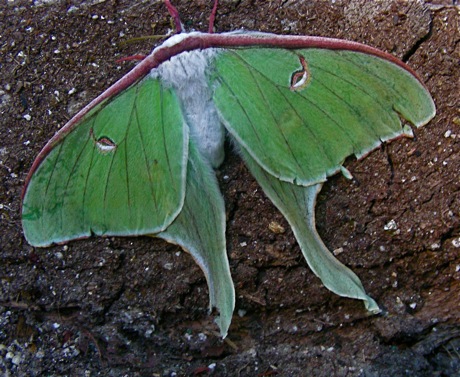
A Luna moth (Actias luna). Not the enemy, even though its children are very large and green.
I don’t have a picture of a hawkmoth, aka sphinx moth or hummingbird moth (so named for its ability to hover and its very long tongue). But if you see one of these gray-brown creatures, almost big enough to pass for a small bird, you’re seeing disaster on the wing. The Hawkmoth’s very large green children are hornworms.

Tomato – or more likely tobacco - hornworm (Manduca quinquemaculata or M. sexta), both voracious consumers of tomato, pepper, petunia, tobacco and other plants in the nightshade family.
In our New York and Maine gardens, hornworms usually show up in late July or August. But I’m thinking about them early this year because a Facebook friend in Virginia is already beset.
“Hornworms are eating my tomato plants,” she wrote, “anyone have advice on how to get rid of them?”
But of course!
Try the tips on Hornworm eradication at the end of this post, I replied, and if you get the chance, employ these two major organic defenses:
Read More…
It’s been a great tomato year so far, especially after 2009. We are well into tomato roasting, tomato drying, catsup-making and BLT’s. But it’s never too late for nature to pipe up and say don’t count your chickens.
Two cases in point: Hurricanes and Hornworms.
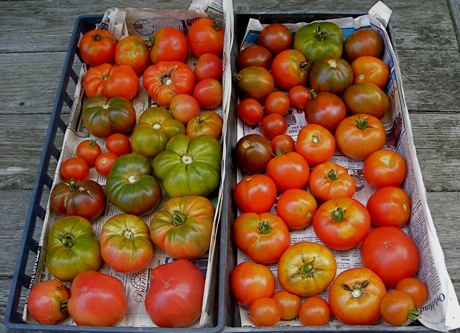
Most of these tomatoes would still be on the vine if heavy rains weren’t on the radar. The very green ones are almost ready, btw. They will still be green when ripe, just slightly yellower
Read More…

Ornamental millet ‘Limelight', in a bed with peppers (at right) and Verbena bonariensis. That's the tomato patch in the background.
Not long ago, I found and wrote a brief post about an amazing millet bug – amazing in that it was huge, gorgeous, and something I’d never seen before.
I was hoping somebody would recognize it. So far no luck. Also, at least so far, no one who shares my appreciation of its beauty. Commenters have been silent, but e-mails and conversations with friends have reminded me that for many people, bug = disgusting.
Too bad. Some insects are just plain creepy – earwigs come at once to mind – but a lot of them are drop down gorgeous, however disgusting their behavior.
Read More…
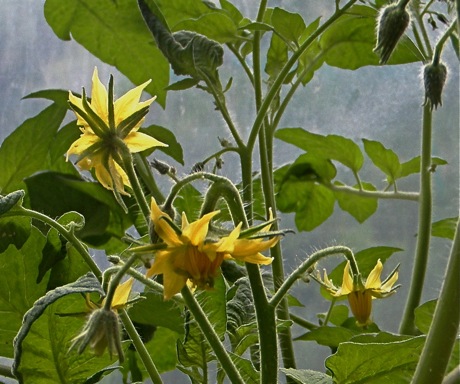
Will these Brandywine blossoms make it to tomatohood if the weather stays hot hot hot?
Our friend Melinda writes:
“It’s been my understanding that when it’s too hot for a sustained period (including high overnight temps–like around 80), that many veggie plants drop their flowers before they fruit (e.g., tomatoes, peppers, squash, etc.). Is that true in your experience?”
Yes, but less often than you might think – or fear, given the ongoing heat wave. High night temperatures sterilize pollen and flowers that are not pollinated fall from the plant. But the window for this kind of blossom drop is comparatively narrow.
Pollen forms before the flower opens, but not that long before, and after the flower opens it must be pollinated within a day or two (over the course of a single morning, in the case of squash), no matter what else is going on.
Read More…
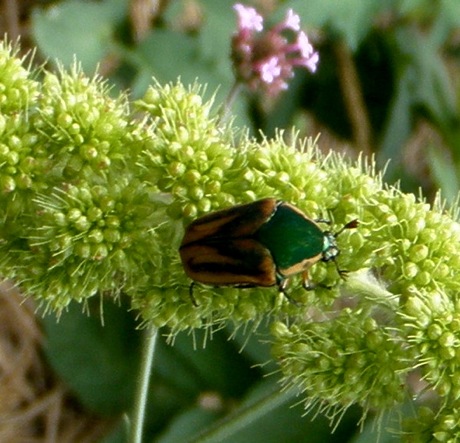
The iridescent green of the head is also in stripes at the joints, so the side view shows a string of jeweled beads
Anybody recognize this creature on the Limelight millet?
First pass at google confirms the likelihood that it is as it appears to be, some kind of stinkbug; they seem to be major pests on millet. But none of the common green and brown ones are anywhere near this large – it’s about an inch long.
Dial “M” for millet, right? It was the only one I saw but I fear it has friends and relatives nearby.
Yes, yes, I know: “for dummies” is just a convenient code that means “for non-experts, in non-technical language,” but if I live to be a million I’ll never understand what’s dumb about wanting that.

part of our Hudson Valley vegetable garden
In Kitchen and Garden has always been In Garden for Kitchen as much as anything else, so there’s a lot about growing vegetables tucked in among the posts about flowers and shrubs, preserves and pastries and architecture and wild mushrooms and coyotes and
where was I?
Giving pointers on food gardening, I think. Here are a few posts that may prove helpful as we teeter on the brink of the 2010 growing season:
Read More…
At least I hope it’s after the snow. Today has been warm right through and sounding like rain, every gutter running, every eve dripping as the compacted layers slowly sink.

After the 1st and 2nd snowfalls, before the 3rd and 4th. That’s a 12 foot ladder
Up until a bit more than a week ago, I was in a pro-snow mood. Seemed like everyone else in the Eastern half of the country was having piles and piles of white beauty, while we had ugly patches of bare brown ground and nothing to ski on.
Be careful what you wish for.

When all is finally revealed, this viburnum will be about half as tall as it used to be. Those three broken leaders were due for pruning but I’d have preferred to choose where to cut without quite so much help.
Read More…
One more misery for this week: The valiant radicchio that made it through multiple nights down to 5 and 6 degrees was no match for the hungry voles, voles no doubt obscenely cosy in the warm double tunnel that was protecting the row. Wretched creatures have gobbled every single head.

Notice the nibbled edges on this baby and the large dark hole where a full sized head used to be.
I haven’t had the heart to look at the row – on the other side of the garden – that I harvested extra carefully and then left covered in hopes of a super-early spring crop. (Cutting the heads off just slightly above the base often results in regrowth, so if the weather is with you – and the voles aren’t – you get a flush of leaves and sometimes a whole new head as soon as the garden wakes up.)

Complete and utter carnage; somehow the scraps where a healthy root should be cause particular pain.
Too late now for the radicchio, but a good reminder to go out and check the viburnums and plums and
Read More…