Food and Flowers
supposedly comes from the fact that cucumber skin is cool to the touch, even when the weather is hot – a gift from the fruits’ water content and from the vines’ sheltering leaves. The analogy first shows up in print in 1732, meaning pretty much what it means today.
Not quite that much antiquity for my favorite cucumber, but Boothby’s Blonde does go back a while, too, somewhere around 5 generations in the Boothby family of Livermore, Maine.

a baby Boothby Blonde, spines still too young to color
It’s short and blocky like a pickling cuke, and it does make excellent sweet cucumber pickles ( assuming you like sweet cucumber pickles), but the great thing is that unlike every other cucumber in creation it doesn’t get nasty when it starts to get ripe.
The flesh stays flavorful and crisp even when seeds are well developed, and the seeds themselves are almost sweet in all stages of development. This is useful to know, because like alas all too many vegetables they tend to arrive at the farmers market only when they are way bigger than they should be.
Ideal size is about 4 inches long and a bit more than an inch in diameter, at which stage the skin is white to very pale primrose and the black spines are barely there. Boothbys you see at the market tend to be more like 6×2, with golden skin ( and bumps where the spines were, the spines having been rubbed off). Of course, that’s only insofar as you see them at all, they’re one of those heirlooms that’s poised on the brink but hasn’t yet become a marketing clichaé.
In addition to their other merits, they’re madly prolific, and reasonably quick to bear – about 60 days from seed to first bite. That means it’s a bit late to start a fall crop in the Northeast, but if you garden in a sheltered spot, or anywhere south of New Jersey; there’s still time to give ’em a try.
Lots of specialty seed companies carry Boothby’s Blonde, but why not buy from the outfit that has done so much to keep heirlooms alive: Seed Savers Exchange.
It’s little. It’s weedy-looking. The simple 4-petaled flowers are a washed out purple-pink and they close when the sun shines on them.
The beauty part is a night fragrance as strong as any in the garden and a great deal more refined than most. Instead of the heavy tropical spice of brugmansia or the decadent perfume of lilies, night scented stock offers a combination of vanilla and new mown hay.

Its botanical name is Matthiola longipetala, aka M. bicornis, genus name pronounced Mat-ee-O-la because it’s named for Pierandrea Mattioli, a 16th century Italian botanist who knew a good thing when he smelled one.
Seeds are widely available. Plant some next spring ( you could try it even now and get lucky if it’s a long fall).
(Please scroll down or hit coming attractions for the Garden Tour Plant List)
With garlic, it’s almost impossible to fail completely. Plant one clove, get one multi-clove bulb, pretty much no matter what. The catch is that it’s quite easy to fail partially. I did for years, simply because I kept planting softneck garlic, the most common kind, even though I was in Maine and the garlic wanted to be in Southern California. Over and over, I got small bulbs filled with small cloves that were very tedious to peel, a defect slightly mitigated by the fact that the garlic was so incredibly strong and hot you didn’t need (or want) much.
What I’ve learned since:
* If you live in the North, plant hardneck garlic, the kind with the stiff stem running up the middle. It’s much hardier than softneck garlic. Bigger and sweeter, too. ( it doesn’t store as well, but it stores well enough).
* Big cloves make big bulbs. When you get your seed garlic, either at the farmers’ market or from a source like Filaree Farm; plant only the large outer cloves. Eat the smaller cloves at the center or plant them in the perennial border and let them stay there indefinitely, making larger and larger clumps of their gorgeous, twirly stems.
* Plant in well-drained, fertile, weed-free soil, in late September or early October. Goal is to have good strong roots but only short green shoots when hard frost puts growth on hold until spring.
* Garlic comes up early. So do weeds. Mulch helps, but you’ll probably still have to pull a few. The plants are too narrow to shade anything out and they have small, shallow roots that do not compete well.
* The combo of increasing warmth and lengthening days tells the plants to stop making leaves and start making bulbs. Energy to do this comes from those leaves, so the goal is to have them get as big as possible as soon as possible. ( A little fish emulsion at intervals never hurt anybody).
* Bulbs keep putting on size until mature and must be mature to store well, but if they stay in the ground after they’re ready, they split and spoil quickly. Generally speaking, it’s time to harvest when about half of the leaves have fallen over or turned brown or both. Dig on a dry day, brush off dirt, then spread the plants on racks ( screens on bricks, for instance) to dry. Ideal spot is a barn or shed that’s warm, dry and dark. Let the bulbs cure for about a month, then cut off the tops; hardneck is not braid material.
* Eat lots. No matter how you store it, it will start sprouting by February. We like:
Garlic Roasted With Olive oil and Potatoes: several head’s worth of peeled cloves for about 2 pounds of small , new potatoes. Big splash of oil in a jellyroll pan. Be sure potatoes are thoroughly dry, so they don’t stick. Roll everything around to coat well, then bake in the upper third of a 400 degree oven until interiors are soft and outsides have lots of crisp brown spots, about 45 minutes. Stir with a flat spatula from time to time. Malden salt at the half hour mark or at the end but not at the start.
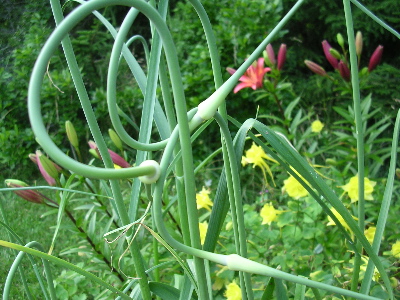
This garlic came up in the compost at the edge of the garden and has been left to make scapes for bouquets. More ( much more) about hardneck garlic, the garlic to grow if you’re in the North, after the garden tour is but a memory ( plant list for tour is below)
(Please scroll down or click at right for coming attractions)
Upper garden, as you enter from the field:
Blue-purple spike flowers around right edge are Salvia transylvanica
Cobalt blue flowers are Salvia patens
Blue flowers with balck calyces are Salvia Guaranitica ‘Black and Blue’
Shrubs with gray foliage and long thorns are sea buckthorn, Hippophae rhamnoides
Foamy yellow flowers w/blue leaves are Thalictrum flavum ssp glaucum (yellow meadow rue)
Large vines framing greenhouse door are hardy kiwis (that refuse to bloom at the same time so I never get any fruit)
In iron urn opposite stone wall:
Vine with lavender-blue flowers is Thunbergia grandiflora
Sawtooth-leaves are Melianthus major ‘Purple Haze’
Big seed head is Star of Persia ( Allium christophii)
Giant hosta is ‘Sum and Substance’
Plant with long, narrow purple bells is Iochroma cyaneum ‘Royal Blue’ ( which only goes to show you)
Vine with purple flowers in clay pot is Asarina scandens
Plant in iron urn in front of lilac is Brilliantaisia subulugarica
All hollyhocks (including the dark magenta ones) are self-sown great-grandchildren of a yellow Alcea ficifolia
Vines in front of greenhouse:
Orange daisy-flowers: Senecio confusis ‘San Paulo’
Orange/pink/white flowers all together : Mina lobata ( Spanish flag)
Bright red trumpets: Ipomoea quamoclit ( Cypress vine)
Salvia w/yellow and purple flowers ( almost done) is S. bulleyana
Plant with long deep purple spikes (on right, in front of holyhocks) is a butterfly bush, Buddleia davidii ‘Black Knight’
Poppies by path on left are self-sown annual shirleys ( P. rhoeas). On right, a perennial sold to me as P. alpinum but I don’t think it is.
The red coleus is ‘Kingswood Torch’
The purple-brown grassy-looking thing is ornamental millet, ‘Purple Majesty’
Dark green leaves on black stems are Alocasia , cultivar name lost ( there are much larger ones in the white garden)
The orange Turk’s cap lilies are L. davidii
The yellow coneflower is E. ‘Big Sky Sunrise’
The yellow flowered bush at the very back (on the road side) is a heliopsis, cultivar name forgotten
White garden:
Vines on the entry arch are
Clematis virginiana (virgin’s bower) and
Lathyrus latifolius ‘White Pearl’
Plant in the middle with big white trumpets is a brugmansia
Low rosettes of big silvery leaves are Salvia argentea ( silver sage)
Striped Euphorbia ( ball on a stem) : ‘Tasmanian Tiger’
Tall stems with seed heads, Allium giganteum ‘White Giant’
Striped red and white rose is ‘Scentimental’
plant with tuft on top that looks like a pineapple is Eucomis bicolor (pineapple lily) There are other eucomis beside the path – including one with purple leaves – which have not yet bloomed.
Dark green leaves on black stems are Alocasia , cultivar name lost
Fragrant shrub near the path end, Aloysia triphylla (lemon verbena)
The hedge is Hydrangea tardiva
In windowbox:
the big tree is Acnistus australis. It has purple-blue flowers when it gets sun in spring.
The thing that looks like a little palm tree ( sort-of) is a begonia
In bathtub, vine with orange and yellow flowers is a leggy Abutilon megapotamicum that isn’t getting enough sun.
Lower garden:
Pink and yellow border – inspired by the Minton bowl in the picture posted underneath the birch

Pink cotton candy is Filipendula rubra (queen of the prairie)
Yellow scabiosa on steroids is Cephalaria gigantea
Large shrub at end is a golden elderberry, Sambucus nigra ‘Aurea’
Small shrub in center with long yellow leaves is a sumac, Rhus typhina ‘ Tiger eyes’
Annuals:
Purple brown trumpets in front are salpiglossis ‘Chocolate’
Self-sowns on left are calendula ( grandchildren of ‘Pink Surprise’); Bupleurum rotundifolium ( no common name that I know of), blue nigella (love in a mist) , silene (the screaming pink), and larkspur ‘Blue Cloud’.
Single cosmos are ‘Psyche, ‘ doubles are ‘Doubleclick’
Special thanks to assistant/garden-helper/friend Kristi Niedermann, without whom this garden could not exist.
Just realized I promised – on the vhv podcast – to post a list of summer annuals that it makes sense to buy as seedlings, either because they’re fussy to start, because they have timing issues related to light-levels, or because they take a long time between seed-in-the-ground and bloom. For those that do better directly-seeded, see the post below.
In no particular order: petunias, snapdragons, impatiens, stock, tall marigolds and giant zinnias (shorter plants and smaller flowers are pretty swift), cosmos, China asters, bells of Ireland, lisianthus, scabiosa – aka pincushion-flower, statice, and crested celosia – the cockscomby ones. Plume type celosias are faster and can be started from seed.
In spite of the persistent cold, the annual annual fever is on me: can’t resist mop-headed China asters, tall snapdragons (I love old fashioned black prince, the one with the black green leaves and deep, velvety red flowers), fragrant little yellow Lemon Gem marigolds, cosmos, petunias – and let’s hear a good word for petunias, hey. Not the doubles that look squirted out of a can, like the whipped cream on a cheap sundae, but those like the Wave hybrids that have decently small, simple flowers with some of the old fashioned petunia fragrance but not the old fashioned petunia tendency to collapse utterly at the first raindrop. And…
You know how it goes: take a quick trip to the garden center to get a new pair of gloves or a half-pound of grass seed and the next thing you know you’re wandering down the aisles, drawn by that patchwork carpet of bright colors, each teeny plant in its tiny cell putting out flowers that call, “buy me, buy me, buy ME!”
It can be hard to ignore them, but it’s better to buy the ones that are still more potential than performance, stocky little guys with multiple stems and healthy-looking leaves. And when I say little I do mean little. Best trick is to mutter “roots, roots” while shopping . After all, with constant water and fertilizer an annual can grow 8, 10 inches – a foot and more – tall in a pot the size of an ice cube, but that plant is going to have major adjustment problems when it moves into the garden.
And while we’re on the subject of seedlings, I see to my horror some places are selling baby sunflowers. SUNFLOWERS! There are gazillions of terrific sunflowers – classic yellows with one huge flower, like Russian Giant, not classic dark reds like Velvet Queen, that makes a huge, flower covered bush, and just about everything in between although as yet none are purple ( thank heaven for small mercies).
Point of rant: all of them will make MUCH better plants if you start them from seed. Nasturtiums , too, which are also more and more sold as seedlings but phooey on that, and here are a few more
Things that should be started from seed: poppies, evening-scented stock (Matthiola bicornis) coriander, annual phlox (Phlox drummondii), larkspur, annual lupine, morning glories… I’d say sweet peas , too. But those should be in by now.
Is easy, asparagus being a crop that offers fabulous returns for very little work. Admittedly, it’s a project to plant, involving the preparation of a deep trench and lots of good soil to fill same. But you only do THAT once every 15 to 20 years; in between there is nothing but semi – yearly maintenance: spring mulching; fall cleanup and fertilizing. That’s it, unless you count harvesting.
I don’t. Picking asparagus is not work. Neither is cutting the beautiful tall ferns to enhance summer bouquets.
In short, assuming you plan to stay put for a while, there is just one thing about asparagus that can be a deal breaker: It isn’t small. A row generous enough for 4 people to pig out all season takes about 30 x 3 feet and that’s a substantial chunk of real estate.
On the other hand, asparagus needn’t be in the vegetable garden. The ferns are handsome enough to make it a suitable background for roses, say, or you could use it to mask a pool fence… or
Anything that lets you grow your own. Truly fresh asparagus is right up there with truly fresh peas, a vegetable apart.
Variety also matters, though this is one case where just about all of them are tasty – differences mostly come in looks , yield, and disease resistance. Only one, the new(ish) Purple Passion, is substantially sweeter than the others. It’s also reputed to contain less of the compounds that some smell in urine ( Not everyone pees asparagus pee; and of those who do, not all of them can smell it. )
I asked Bill what kind he planted when he set ours, 13 years ago. “Whatever they were selling at the Agway,” he said. “Jersey King, maybe, or maybe it was Martha Washington.” So much for being fussy about varieties. Whatever we have is plenty tasty enough, but it is highly variable… and there are so many female plants I think it’s probably old standard Martha, even though early releases of J. King were not as all-male as promised.
More serious truck gardeners would have dug up and discarded the less spear-productive females – easy to distinguish because they have berries – but we have so many plants (about 75 feet of row; it’s a long story, mostly about greed) that we haven’t bothered. Even now when I’m getting ready to plant some Purple Passion, I’ll just put it at the end of one of the rows we already have.
We’ll get our Purple Passion from Nourse Farms , the same place we got the strawberries extolled back on May 1st. An alternative source is Pinetree Garden Seeds. The Nourse website has good planting instructions, complete with diagrams.

Our neighbor Dan’s Purple Passion, just starting
He offered to weed when he saw the camera, but I told him the unexpurgated version was probably more inspiring. Once it gets well established, asparagus is not easily discouraged by a little competition.
When it comes to strawberries, I’ve been a yoyo gardener for years. They do come under the heading of “one more thing,” and the Northeast is gratifyingly full of pick your own farms that grow decent varieties. Result: the patch languishes and by and by I take it out. Then I taste something delicious, or write a story and remember how easy they are to grow. Next thing you know, I’m out there setting a small bed – just enough to, you know, make sure there are enough to nibble on.
Any more, all we grow is Tristar, best tasting of the day neutrals, varieties that can bear from spring to fall because they don’t depend on day length to trigger flowering. ( This year I was going to try Everest, supposedly even better. But by the time I got around to ordering, they were all sold out…
Many strawberry connoisseurs feel about day neutrals the way I feel about “early” tomatoes, namely: ” so what? I’d rather just eat great ones in season and let it go at that.” But early tomatoes are always followed by more wonderful tomatoes, whereas day neutral strawberries just keep coming, long after the spring wonderfuls are gone. With day neutrals, the smallish spring crop starts a season that runs through summer, peaks in early fall, then continues at a modest pace until stopped by hard frost.
That said, the fussbudgets are right about flavor – the tastiest action is all in old fashioned June bearers, original fruit of the 18th century cross between tiny, super sweet North American Fragaria virginiana and bland but big F. chiloensis, from the continent to the south.
There are several hundred named June bearers, though you’d never know it by shopping – whether for fruit OR for plants. Strawberries are still 2 or 3 decades behind tomatoes in the heirloom awareness/ variety savvy department.
Yet – let’s all fall over with surprise – there are umptillion kinds of home garden strawberries that beat out most commercial fruit, for the usual home garden reasons: no need for durability, no need to turn red before ripening, no need to whap out large crops all at once to cut down on field labor…
June bearers that have been delicious for us include ‘Northeaster’, somewhat shy bearing but very flavorful; ‘Fairfax’, which spoils in less than a day from the plant – too juicy! – and is close to wild strawberries for the fragaria part, and good old fashioned ‘Sparkle’, on the small side but otherwise yummy and grown by several pick your owns, the fact that frees us to focus on Tristar.
For more – far far more – about garden strawberries, check out the excellent strawberry site put up by let’s hear it for a GOOD use of tax dollars! the National Agricultural Library
I get my plants from Nourse Farms
Strawberries in the kitchen to come – after they’re better in market.
Meanwhile, possibly under the influence of the buzz about “Feeding Desire” the Cooper-Hewitt’s new utensil show (new show, old utensils), I started hankering after an – I confess, second – silver berry spoon, for the ultimate in dishing ’em out. On eBay: 12089 “strawberry” items; 542 in home daécor; 1 – one! – silver berry spoon. At google: 11,600 responses to a request for “silver berry spoon.” In the garden, fortunately for my budget: 11,600 things that need planting/weeding/mulching… and picking. The asparagus is up! (while you’re cruising the Victorian silverware, get a load of all those nifty asparagus tongs)

That’s chervil on the left, nestled up against dandelion, another delicious weed (harvesting and recipe tips below – in the entry for April 3rd). No pic of the coriander – yet. It’s too windy every time I think of it…
The first seeds we planted (peas) have barely broken the surface, but the coriander and chervil that planted themselves are off and running; chervil vinaigrettes have been on the menu for several weeks now and we had the first guacamole with homegrown cilantro about 10 days ago.
Having these two in abundance after a winter of pallid store cilantro* and no chervil at all, what a thrill!
The flavors are very different; clean-spicy anise-y chervil has nothing in common with the funky richness of cilantro except a penetrating greenness, but in the garden they are almost twins:
Both are cool weather plants that sprout early, go to flower in the summer and make a second crop in fall.
Both are rampant self-sowers; just let a few of those flowers ripen and drop seeds and you can have truly delicious weeds.
Both are easy to remove if they do show up in the wrong spot, in part because both are tap rooted, which means
Both will either die or bolt ( send up flower stalks) if you try to transplant seedlings. Same goes for dill, another annual herb that should always be grown from seed. Parsley is tap rooted, too, and often presents the same problem, but because it’s a biennial it’s tougher. Parsley seedlings can move successfully as long as they are still very small and young.
The not-twin part is in the seeds:
Chervil seed should be very fresh, it doesn’t keep well from year to year. Cilantro seed is much longer lived. Also much cheaper to buy in bulk as spice. It won’t germinate if it’s been irradiated, but it usually hasn’t, so there’s no reason to buy those little dinky packets. Seeds cost less than a dollar an ounce when they’re sold as flavoring – for chili / sweet yeast breads/ gin…
Chervil seed is no special culinary delight, but coriander is not only great dried ( the classic spice use), it’s also delicious when green and soft. The flavor is right between funky leaf and sweet-flowery dried , wonderful in sauces for fish, in potato salad…
*cilantro is the most common US name for the leaves of the coriander plant, and is used here for convenience.