The view from here
SOME PLACES TO PUT FOOD BY
(so you can eat locally all year long)
Upstairs: Food Historian Sandy Oliver keeps winter squash under the bed. Bottom of the linen closet is also good; just don’t forget they’re there.
Downstairs: An unheated basement ( 35 to 45 degrees) , a second refrigerator ( or the back of the one in the kitchen) is almost a root cellar. Things to keep in it from harvest to spring: Beets, Carrots, Cabbages, Onions, Wine, Beer, Cheese.
In a cool back bedroom or similar: Potatoes. They like to be cold, but not quite as cold as other roots.
In the pantry/ food cupboard:
Dried: Wild bolete mushrooms, wild or cultivated agaricus mushrooms, tomatoes, shell beans.
Canned: Applesauce, fruit spreads, ketchup, tomatoes, roasted tomatoes for instant sauce.
In the garden: lightly mulched Parsley and Kale will survive until a very hard freeze (@ 26 degrees); the more slowly it gets cold, the more cold they can take. Chard, Brussels sprouts and Broccoli raab aren’t quite as hardy but still can stand – indeed benefit from – repeated light freezes. Many gardening and country food books, including some of mine, suggest leaving beets and carrots in the ground under a heavy mulch and then harvesting as needed. It works fine if you don’t have voles.
In the freezer: Wild mushrooms (morel, chanterelle, sulfur shelf, blewit, hen of the woods) sautéed in enough butter to be a sauce for the pasta, baked potato, winter squash or other starch that is then dinner; Toasted almond pesto or other pesto to use like the mushrooms ; Berries; Whole tomatoes for soup and sauce; Full-meal soups like Minestrone and Corn chowder, Harvest Vegetable Stews like corn, squash and pepper/ tomato, pepper and onion/ snap and shell beans with summer squash. Chickens. Your quarter of a local lamb, pig or steer, divided into the cuts you’ve ordered. Make an inventory and keep it near the freezer!( along with a pen on a string for crossing off)
There’s a big turf war going on in New York City: Natural versus Artificial. You can read all about it in the New York Times, but the short version is that playing fields made of genuine grass cannot be played upon constantly and that means there aren’t enough of them to go around. How much this is due to population pressures and how much to the fact that ‘“New Yorkers expect to play where they want, when they want,” ’ as the Parks and Recreation Commissioner put it, is not revealed in the story.
But the commissioner, Adrian Benepe, sees it as part of his mission to fight childhood obesity, and making sure children can run around as much as possible is a very good way to do it. That being the case, there is much to be said for the artificial stuff: you can put it on places like asphalt-covered lots where grass would never grow; it’s in place year round yet costs less to maintain. And as the commisioner did not say, you can install it without running afoul of the junk food lobby.
The natural camp argues that urban children need more contact with nature, not less. And they add that while playing is certainly healthy the artificial turf is not. It’s rife with personal and environmental hazards from excess heat absorption to carcinogenic chemicals.

The real deal. Those ragged pale tips, to my shame, reveal that our mower blade needs sharpening.
My sympathies lie – naturally – with the natural grass camp, but I wish this were not being cast as an either-or choice. The city has more empty asphalt than one might think, especially in the outer boroughs. So why can’t the places that can support grass be encouraged to do just that while places that can’t grow grass anyway are covered with the artificial turf ?
But lets not keep calling it “artificial turf” or even worse, just “turf,” as the article does repeatedly. And let’s stop dyeing it grass green as though it were some kind of equivalent. It isn’t. It’s Plastic Play Surface, and if a concerted effort were made to create some that was more benign, it would be a win-win for everyone. New York is not the only city that’s short of playing fields.
Why couldn’t the stuff be made from old soda bottles, say, and tinted against glare in a very pale blue, pink or yellow? It wouldn’t match grass as a natural air conditioner, but the lighter color would make fewer heat problems. And the fact that it was absolutely not green would be a reminder that it was, however useful, absolutely not grass.
( Please don’t remind me a pale rug would show the dirt. Maybe showing that dirt deposited on plastic cannot return to the earth would be a good idea.)
It’s nice to learn that a respectable, long-term study has confirmed that organic tomatoes contain far more beneficial flavonoids than the conventional kind, but this news won’t be much of a surprise to people who value true organic produce* for its (frequently) superior flavor. Other things like variety, climate and distance-from-farm being equal, good taste and high nutrient content are both results of a growing method that works in partnership with plants instead of treating them like machines for turning synthetic fertilizers into edible widgets.
Tomato plants grown the conventional way get frequent doses of those fertilizers and of powerful pesticides that provide blanket protection. Organic feeding is slower and steadier; and the permitted pesticides are usually less speedy and less lingering. That means organically grown plants must be able to stand up for themselves, and one of the ways they do it is with the antioxidants that look so promising for fighting human disease. Plants that have all their needs met in advance produce far less of these compounds.
And plants have evolved to use solar power. Sun on leaves is what makes flavor, especially when there is a high ratio of leaves to fruit. Heavy jolts of fertilizer can goose the plants into making more fruit, but fertilizer can’t make more sunshine. Result according to people with taste buds: pallid flavor. Result according to the scientists: “nutrient dilution.”
Meanwhile, back in the garden:
* be sure your tomato plants are getting enough water and getting it consistently. The stress of alternating drought and deluge prevents plants from taking up calcium; calcium deficiency leads to blossom end rot.
* if you have an eye on the county fair, consider sacrificing part of the crop. Remove all but one baby tomato from each truss of fruit and the survivor will grow far larger than it would have otherwise. ( Same goes for your dahlias, by the way. )
* if you are growing beefsteak type heirloom tomatoes like Brandywine and Georgia Streak, it’s best to harvest them before they’re completely ripe. I’m not talking about green ( at least not until frost) but just barely on the pale side of fully colored – 2 or 3 days in front of vine ripe. Picking before the fruit is ripe may seem counter to the whole point of growing your own, but unlike strawberries tomatoes do continue to improve after they leave the vine. Taking them indoors while they’re still slightly firm lessens the chances they’ll crack from a late rain or, as far as I can tell, just natural cussedness.
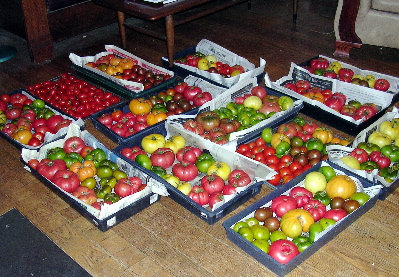
This is sort of cheating because it was taken in late fall and some of these were rather green when they left the vine. Note that they are in single layers, which helps prevent rot – among other things because we can’t help keeping an eye on them. Anything nasty gets removed promptly, before problems can spread. Flavonoid content of tomatoes like these has not been studied, as far as I know. But I do know that only the red ones contain significant amounts of lycopene (another, quite different, antioxidant that’s also much in the news) and that if you want to load up it’s best to cook and concentrate ‘em. Cup for cup, old fashioned Jersey-Italian tomato sauce will deliver a lot more lycopene than Southwestern salsa.
* I say “true organic” because sustainability matters. Spinach grown without conventional pesticides is a better choice than spinach grown with them (especially if you’re feeding children) . But if the organic spinach was grown on a monocropped 1000 acre field; tended and harvested by underpaid itinerant workers and then shipped clear across the country in something that burns petroleum, it still has a way to go before it’s organic by me, and it may also fall short in the flavor department.
Maps that divide the country into cold-hardiness zones are the tools you love to hate. The more experience you have, the less faith you put in those numbers and yet some belief is essential; no way to predict unknown-plant survival without some guidelines, be they ever so crude.
I’ve been reading reports ( both scientific and anecdotal ) on this ever-vexing subject for about 35 years now. And for the last 15 of those years I’ve been tending two gardens, one 400 miles Northeast of the other , both of them in the same zone: 5, according to the old fashioned USDA map – or 6 if you go by the more up to date Arbor Day Foundation version . Insights gained are below.
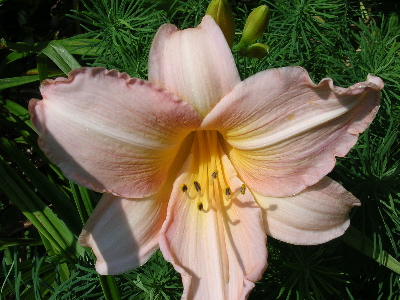
This is just to keep you amused; it has nothing to do with climate zones except that being a daylily (Hemerocallis spp) it’ll grow almost anywhere.
Rules that help:
a) Allow for 1 zone on each side of the one you’re allotted. If the map says you are in zone 5 you can probably grow a Zone 6 plant, but on the other hand your winter may kill something that has Zone 5 as its permitted lower limit.
b) Do the same thing with plant labels; they tend to be either overcautious or overhopeful, or (on those that offer a range of zones) both.
c). Learn your garden – if it’s big enough to call a garden, it’s probably big enough to have warm and cool spots, windy and sheltered ones, and quite possibly different soils within 10 feet of one another.
Hardiness Maps that attempt to Improve things:
By refining the description of the plants –
The American Horticultural Society has created a HEAT zone map, which makes a great deal of sense; most plants have death points at both ends of the thermometer. This map made its debut in 1960, but like the metric system it hasn’t made much headway.
It is used by the society’s magazine, where spicebush, for instance, is referred to as “Lindera benzoin, Zones 4-9, 8-1″. The first set of numbers are the cold zones, by the way, should you happen to run into a pair like this on a plant label somewhere and if you do please write and tell me about it.
By refining the description of the Zones:
Sunset Publishing offers – and works from – a national map that includes not only heat and cold but also length of growing season, humidity, rainfall and rainfall patterns. It is silent on the subject of soils, probably just as well given that there are 45 zones as it is.
Our old house came with a yard full – and I do mean full – of old fashioned plants, things like yews and lilacs and peonies, a big magnolia and a truly hideous orange azalea that has long since gone to its just reward.
Among the plants we class as riches is a tree-sized autumn olive, Elaeagnous umbellata. It may have been planted when they were still on the OK list. Or, in the manner of autumn olives it may have arrived naturally, delivered by a passing bird.
In any event it’s here now, a late spring star whose clouds of starry white flowers perfume the entire lower yard. Beneath it, looking like fallen petals, is a carpet of tender white violets. Pick a bouquet of both and you see the olive blossoms are in fact pale cream.
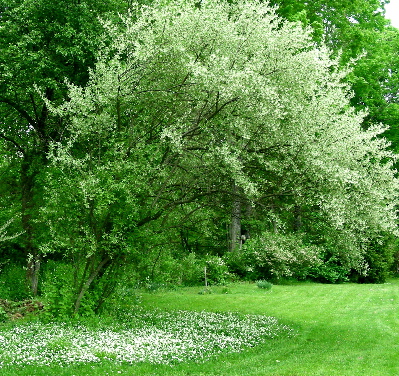
Both plants are invasive weeds, though only the olive seems to excite strong passions among preservationists. ( Plenty of people hate violets in the lawn. Another whole story.)
Because it is now tree-size, we thought for years it was a Russian olive, E. angustifolia. This made us feel slightly less guilty: the Russian kind seems marginally less inclined to cover the earth.
But only slightly, both olives are on the don’t plant this list and any day now we will cut ours down. Right after we fertilize the poison ivy, an unimpeachably native vine of which we have a great deal more than either Elaeagnous.
In the meantime, we’ll remember that these “olives” feed many wild creatures including but by no means limited to: Ruffed Grouse, Wild Turkey, Cedar Waxwing, Northern Mockingbird, Cardinal, Wood Thrush, Yellow-rumped Warbler, assorted sparrows, Black Bear, opossum and skunk).
Of course they also feed fellow-invasives like starlings. And deer are fond of them. These things are never simple.

These are the flowers that convinced me it was E. umbellata, after I read about the difference here.
As lilac lovers go, I’m a very small timer: there are 8 of them in the New York yard; 10 in Maine, a mere token compared to big public collections like Highland Park, in Rochester NY, where 500 different lilacs – 1200 plants – are blooming right this minute.
But even our tiny assortment gives us a full six weeks of fragrant delight because it includes a few season stretchers: bushy, pale purple ‘Miss Kim’ (Syringa patula), pink-flowered ‘James Macfarlane’ (S. x prestoniae) and a 20 foot tall pair of Japanese tree lilacs (S. reticulata), all of which bloom later than the old fashioned French kind (S. vulgaris).

I wish I could tell you. I bought it at a clearance sale at an Agway now long gone and it was supposed to be a plain old single flowered purple lilac, the sort used for hedging in an ampler age.
Hence this bit of lilac advice: keep the sales slip until you see flowers. Mislabeling is fairly common and it’s vexing – take it from my experience – to get a dark purple-red that looks like ‘Charles Joly’ when you thought you bought a white ‘Miss Willmott’.
One way to know what you’re getting is to join up with the National Phenology Network and request one of their lilac clones. Follow the” submit data” links and you’ll be sent to the application form.
The lilac will be a ‘Red Rothomagensis’ (S. x chinensis) a somewhat gangly, fragrant early bloomer with reddish buds that open to dark pink flowers. There is a picture of one here.
And why is the National Phenology Network sending you this present? Because they want your help. Phenology is the art/science of measuring climate with biological events like frog song, fish migration and plant bloom; and lilacs were chosen, way back in the 1950’s, to be standard measuring instruments. Gardeners all over the country have been watching lilacs, sending in data and, as citizen scientists, helping to document the process of climate change. (In the Midwest, where the Network was born, spring – as measured by lilac – is now almost a week earlier than it was 50 years ago).

For now, we’re watching this common lilac, which is already in place in Maine. As long as you monitor the same plant, year after year, you can contribute useful data by watching any lilac you choose. But we will ask for a ‘Red Rothomagensis’ and start watching that one too, because that’s even better. By eliminating the variations of species, cultivar and individual plant, clones make it easier to measure accurately.
For more on this communal effort, read the short history of the project that was broadcast on National Public Radio or go directly to Project Budburst, where there are full instructions and a long list of alternate watch plants. If lilacs aren’t your thing – and for some reason you’re still reading – the list includes ocotillo, redbud, wild strawberry and many other common plants.
One warning about the clone: Can’t say for sure about RR, but most Chinese lilacs are very mildew prone, and although the fungus does no long-term harm it isn’t very attractive. Try to plant your contribution to science in an inconspicuous place.
PS: Losing your local Agway isn’t phenological, but it’s just as reliable as a measure of change. Our county in Maine ( Knox) has fewer and fewer farms and truck gardens, more and more suburban sprawl.
Well, one good thing to be said for procrastination – at least when it comes to making the case for More Local Food – is that if you just wait a little while, the inimitable Michael Pollan will do all the research and then say, far better than you could, more or less what you planned to say when you got around to it. Pretty much everything (except growing instructions) is right there in The Vegetable Industrial Complex, in the 10/15/06 NYTimes magazine.
It should probably be said at the outset that I’m more or less the dairy queen; if it’s got butterfat in it, I’m for it. But I’m particularly fond of cheese, which leads us to a recent party where Masako, a friend from the city, wandered into the kitchen as I was butchering a rather elderly Barat.
“What’s that? ” she asked. “It’s a local cheese, ” I said, “comes from a place called Sprout Creek Farm . It’s a cow cheese – nutty and mild, a bit on the dry side … (especially this one, I thought without saying) It’ll be great with the red wine you brought.”
Meanwhile the Barat is coming apart in very funny looking chunks – you can only cut it neatly when it’s very fresh – so of course I handed her a piece.
She chewed. I unwrapped crackers and went looking for the walnuts. ” Where IS this farm? ” she asked. ” Far from here? Do we have time to go there before dinner? ”
Point of story: it’s easy to forget how far American cheese has come in just the last little while. The Barat, for instance, is local in the Hudson Valley, which has lately become a hotbed ( coolbed ? ) of very tasty cheese. If you go to the website of the New York State Farmstead Artisan Cheese Makers Guild, you’ll find links to 20 farms, each of which makes multiple cheeses: cheddars and blues and gouda-types, ricottas and fetas…almost all from the milk of beasts that live outdoors in summer and eat grass, almost all cheese that tastes of this place and nowhere else.
Stop me before I swoon… Of course every one of these marvels is either pasteurized or aged for at least 60 days. It’s against the law to sell the kind of goozy, fresh raw milk cheeses that you eat in Europe and think, well, maybe I could buy a little apartment and just live here part of the year. But one Wisconsin cheesemaker has found a way around this problem and it’s such a lovely idea it deserves widespread dissemination.
The story comes by way of Steve Jenkins, one of the country’s best known cheesemongers, currently plying his trade – and blogging –at Manhattan’s famed Fairway market. The entry is for January 21st; the teller is one of Jenkins’ suppliers, a woman named Mary Falk. She sent him some splendid fresh raw milk cheese, he asked what it was called. And here in shortened form is what she said:
” The ‘cheese’ is currently called “Fishbait” since it is only 6 weeks old and made from raw Jersey cow’s milk… My customers have been routinely asking me for young, fresh, grassy raw milk cheeses. For the past 10 years I have dutifully told them that it is against the law in Wisconsin and Minnesota to sell raw milk cheese aged less than 60 days for human consumption. This has always been a sore spot for me since our farmstead milk is so darn clean.”
Then she explains and says a whole lot more ( it’s a long story, but well worth reading). Then she describes an aborted attempt to sell the raw milk cheese as cat food. THEN she says:
” I phoned the Department of Natural Resources and asked them what, if any, license requirements were necessary to produce fishbait. The DNR said that it would be nice if the product was bio-degradable. I said that we could do that.
So now we bring Fishbait to the St. Paul Farmers’ Market and we sell it with a sign that states that it is not legal to sell raw milk cheese aged less than 60 days for human consumption … so we bring it to the citizens of Minnesota, Land of Ten Thousand Lakes, as “Fishbait”.
We have been EXTENSIVELY inspected by the state of Wisconsin because of our Fishbait, and also by the USFDA, but it seems OK so far to sell the product in this manner as long as the public is properly notified that it is fishbait, and not legal cheese… ”
Ms. Falk has not copyrighted the name fishbait and is actually hopeful that cheesemakers elsewhere will follow her lead.
Me too. But while we’re waiting, there is plenty of great local cheese being made – in plenty of localities. For a partial – and very impressive – guide to what’s shaking nationwide, check out the member-locator map at the American Cheese Society.
As a gardener whose life is nurtured by, centered in , moored to the earth and the passing upon it of the seasons, I have to say all this flapdoodle over the name of the evergreen in the living room really rankles my curd. Here’s what: it’s a holiday tree; the holiday is the winter solstice; and people have been celebrating it with these trees for more millennia than Christianity can claim.
The decorated holiday tree is a symbol of life in the midst of darkness that belongs to everybody, atheists included. The only people who might reasonably claim it has been hijacked are Druids – and at least so far most of them have had the good sense to just keep quiet and eat cookies ( another aspect of the celebration that is WAY older than certain religions).
‘nough said. And since by now you probably have your tree if you’re planning to have one, I will say only don’t forget to keep it watered, to minimize the risk of fire and to make sure it smells good for as long as possible.
THE COOKIE PART – SHORTBREAD DIVISION
Shortbread is “cookie” reduced to the absolute basics, you can’t get any closer to eating sweetened butter unless you do it with a spoon. And recipes don’t get much easier, either. This one spends a lot of words on the fine points , but the bottom line is a short ingredient list and about 5 minutes of work.
Because the ideal texture is extremely tender and crumbly, recipes typically call for mixing all purpose flour with something like cornstarch or rice flour to lower the overall gluten content. It’s easier to just use cake flour, which every baker should keep a supply of for just these occasions. (The good side of its being devoid of any meaningful nutrient content is that it keeps forever).
For about 40 cookies, depending on how you shape them:
½ pound butter – freshness is more important than either salt or fat-content
¼ cup brown sugar
¼ cup white sugar
¼ teaspoon salt or a pinch more for unsalted butter
2 ½ – 3 cups cake flour ( amount needed will vary with the moisture content of the butter, the way you measure, and how rigid you want the finished cookies to be. The less you can get away with, the better – within reason, of course. )
ok,
1. Take the butter out of the fridge and let it soften until it is claylike, neither slump-squishy nor hard.
2. Put the sugars, salt and a few tablespoons of the flour in a processor fitted with the metal blade. Process until you don’t hear any brown sugar lumps. Add enough more flour bring the total up to 2 ½ cups. Give it another whirl or two.
3. Cut the butter into 8 or 10 pieces, scatter them over the flour, then pulse until the dough forms large clots and is just about to make a ball. This is lots of pulses.
4. Let the dough sit in a cool but not cold place for at least half an hour, up to half a day ( remove from processor and wrap in plastic if opting for the latter).
5. When ready to bake, heat the oven to 325. Roll about a tablespoon of dough into a ball, then lightly flatten it into a cookie. Put it on a piece of foil; put the foil in the center of a small, flat pan ( bottom of a pie tin works fine) and put it in to bake. Check after 6 or 7 minutes. It won’t be done yet, but it will have done enough of what it’s going to do so you will know whether to knead in more flour. Do so if necessary – freestanding shapes often need a bit more to avoid puddlehood.
6. Shape the dough (see below) on an ungreased cookie sheet, preferably the double kind with the air-layer in the middle. Bake until the shortbread is pale gold clear through , 15 minutes for pressed cookies, 20 to 30 minutes for classic wedges or little molds. Do not underbake; if it looks like the edges are browning too fast, just turn down the heat.
SHAPING SHORTBREAD DOUGH
Classic: Gently roll into balls the size of tennis balls. Flatten into circles a bit more than ¼ inch thick in the center, slightly thicker at the edges ( they get more heat). Circles should be about 5 to 6 inches in diameter. Use floured fork tines to punch into 8 wedges, then punch the center of each wedge. Leave everything attached. After baking, repunch wedges while the cookies are still hot, then separate when cold.
Molded: This is a good dough to use in the tiny fluted metal cups – about 1 inch across the top – intended for candies and Swedish sandbakkelsen. Roll teaspoon size pinches of dough into balls, put ’em in the ungreased cups, then go back and press down in the center with your thumb. Dough should come about ¾ of the way up the sides. ( It will smooth out in the baking but still be a bit dimpled.) Be sure to let them cool completely before trying to unmold. Serve as is or put a dollop of tart jam or chocolate ganache in the dimples.
Pressed: Standard advice for pressed cookies is to use a cold sheet and warm dough. With these, it works better to have both items at room temperature. If you can’t get the pressed shapes to stick, use the star opening and make rings.
(Shortbread-Molded: fancy cookware stores sell clay shortbread molds with elaborate patterns. For best results, use the recipes that come with them. )
I did follow my own advice in the matter of the bush beans, planting only very short rows, but we are still being inundated. It’s all the fault of the obscene heat – it’s forcing the pole beans to start pumping ’em out much sooner than usual. These are late pole beans, they’re supposed to FOLLOW the bush beans, but evidently somebody forgot to tell them that. And of course like everything else you have to keep picking or they won’t keep beaning.
The thing to do at a time like this is to give ’em away, so I called the Food Bank of the Hudson Valley and sure enough, they maintain a huge list of pantries and soup kitchens – six counties’ worth – and are more than glad to help you find a few nearby. Their phone number is 845 534 5344, website’s foodbankofhudsonvalley.org, and the counties they cover are Dutchess, Orange, Putnam Rockland, Sullivan and Ulster.
It may take a couple of tries – last time I did this ( not around here) it took a while to find a place that could use garden extras: soup kitchens don’t always have enough workers to mess around with fresh produce, pantries can’t always store it. But this time there’s an easy solution. The food bank picks up leftovers at some farmers’ markets, so gardeners who coordinate it right can hand off the beans – or whatever else is in overflow mode – when they go to pick up eggs and cheese.