Friends and Foes
GROWING CORN
It’s easy, if you have the space. The hard part is ignoring the latest megasweetamazing hybrids featured in seed catalogs, each a new breakthrough in orgasmic splendor. Please try. It’s better to buy that kind of sweet corn directly – or at one remove – from a farmer, assuming the farmer is growing it somewhere near you which they probably are if you have enough space to grow corn.
+ The farmers are pros. They actually do know what they’re doing.
+ All these yummy modern hybrids hold quite well after picking, especially if kept chilled. The old rule about getting the water boiling before you pick the corn can safely be set aside for sugar-enhanced and supersweet varieties.
+ Help keep small farms from turning into subdivisions by purchasing the food they produce. (If they produce it sustainably, so much the better, but growing corn takes up so much real estate “local” trumps almost everything else.)
+ You need the space for the wonderful sweet corns that cannot be bought at any price, even from boutique organic farms at the cutting edge of fashion. Stowell’s Evergreen! Country Gentleman! And the subject for today: Black Mexican, an incredibly flavorful variety that’s tender and juicy when immature, then still delicious as it grows increasingly starchy and finally winds up being the best cornbread you ever baked.
In spite of its name, Black Mexican is a New York State heirloom, introduced in the mid-19th century and probably given its exotic name as a marketing ploy. And in spite of the fact that it’s usually listed as sweet corn, I have my doubts. True sweet corn eventually gets starchy, but it never develops enough starch to make credible cornmeal.

Bakaitis photo
The Black Mexican is on the right. We’ll discuss the other varieties – and the cross-pollination that leads to those dots – some other time.
Whatever class you put it in, Black Mexican’s life as great corn on the cob is pretty limited. The pure white tender and juicy stage ( maybe one ear of it, underneath at the back) only lasts a few days. The unique splendor is that it remains outstanding
When it’s still very sweet but slightly starchy (more white than black): curried corn soup; summer succotash with fresh green beans; creamy corn pudding spiked with jalapenos…
When it’s very starchy but still slightly sweet (more black than white): any place fresh shell beans would be good; in marinated salads; in pilafs with rice; in tomato-based fish stews…
and
When it’s meal corn that hasn’t dried yet (not shown. kernels are completely black and starting to stiffen but are still soft enough to puncture with a fingernail). You need a grain mill to grind it after it’s fully dried, but if you catch it at this stage you can use the processor to make a sort of proto-cornmeal that works fine in most recipes. All you have to do is use a little bit less liquid and boost the still-developing starch with a small amount of flour or cornmeal.
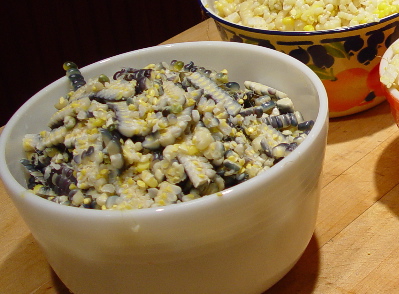
Bakaitis photo
Blanched, cut from the cob and ready for freezing, this batch is a little past “slightly starchy” because that’s when Bill was down to harvest it. The yellow spots are the germ, which reminds me to point out that blue corns tend to be the highest in protein.
Seed for Black Mexican, aka Black Aztec and Aztec Black, is sold by Southern Exposure Seed Exchange and Seeds Of Change, among others, I’m glad to say. When we started growing it about 15 years ago it was difficult to find, and saving corn seed is a lot harder than saving tomatoes: varieties must be separated by at least a quarter mile unless you’re up for considerable fiddling.
(Opinion is divided on whether Black Mexican and Black Aztec are the same thing. We have grown both – or at least both as available retail – without seeing significant differences)
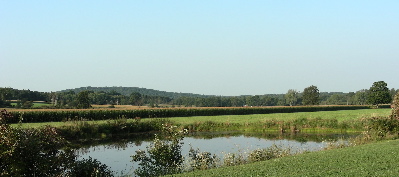
That dark green and orange line in the middle distance is a stand of hybrid feed corn; all plants as close to identical as human ingenuity can manage.
TASTY MOVIE
The documentary King Corn gets that rating because it’s not only fun to watch, it’s also – if there can be such a thing – a refreshingly gentle polemic. The narrators, a savvy pair of quasi-innocents deeply influenced by Michael Pollan, revisit their distant Iowa roots and through a year of growing the stuff discover how subsidized feed corn, sold to the public as a fine idea: more food for everyone! at low prices! turns out to be a taxpayer milking, fossil fuel guzzling threat to public health that’s dismantling farm communities all over the Midwest. Take a look. Even if you think there’s no connection between America’s weight problem and an average daily consumption of 200 to 400 calories’ worth of high fructose corn syrup,* you might want to see how much of its cost is coming straight out of your wallet.
* Amounts we eat of anything are notoriously difficult to measure. This range is based on pounds of HFCS per person per year as conceded by the Corn Refiners Association (41, citing the USDA) and asserted in King Corn’s press kit (73, citing the American Journal of Clinical Nutrition).
And their sisters and their cousins whom they reckon up by dozens… no, no, just joking, but there are all kinds of nifty peonies.
And all of them have ants. Long ago, some observant gardener noticed that ants on peony buds always meant the flowers would open soon. Always. And so a bit of folk wisdom was born: Peonies cannot open until ants eat away the seal that keeps the buds closed.
I grew up believing this, my mother went to her grave believing it, and just the other day I heard it repeated again. But it isn’t true. The thing the ants are eating is nectar, not glue, and what this does for the peony is make sure there are plenty of ants around to eat any soft-bodied insects that might like to eat peonies.

This bud belongs to a super-early short peony that opens almost a month before the common (lactiflora) kind. It was here when we got the house and all we know about it is that it’s tough. The double flowers last a long time, too, a mixed blessing given that they are – to put it kindly – magenta.

When these fern leaf peony buds open the flowers will be single, in a clear true red. They’ll last about 35 seconds. And that nifty foliage will disappear by midsummer. Catalogs that describe fern leafs ( P. tenuifolia ) as rare and special seldom mention these attributes, but it’s something to bear in mind before plunking down large dollars. Oh, also they take several years to settle in and start blooming well. On the good side, they’re indestructible, even in acid soil that gets only a few hours of sun. And once you have them, you have them. Even small bits of root make new plants.

Ok, ok, here’s a picture of an actual peony, probably Queen Victoria, one of the antique varieties that came with the place.
Peony Tips Worth Repeating:
*They do need sun, but not that much; with most varieties you can get decent flowers from a half day’s worth and the farther south you are, the more the peonies can use a break from broiling afternoons.
* Be sure to plant shallowly – those fat growth buds should be no more than an inch and a half below ground. The number one cause of bloom failure is over-deep planting… or, over time, the gradual movement of compost and mulch that buries those buds as effectively as if you had done it yourself.
* They don’t like acid soil; if rhododendrons are doing great, better you add some lime to the peony bed before you start planting.
* Fall is the best time to plant. Potted peonies can go in the ground now, but the bare root kind – the kind with all the dazzling choices – must be planted in fall.
* No peony parts in the compost! The Botrytis blight that plagues them – their own personal fungus: Botrytis paeoniae – is ever present, even on apparently healthy growth, so everything that leaves the peony bed should stay gone: discarded bouquets , the fall cleanup pile, Everything. Burn it if you can, toss it deep into the woods where no peonies will ever grow, or be deeply retrogressive and send it to the landfill.
* Peonies last a long time as cut flowers and can be held in bud stage for a month or more – if you have the room in the refrigerator. For an exhaustive and very useful treatment of cut-flower choices and procedures, download Fresh Cut Peonies, from Kansas State University.
The plant breeder who creates a rhododendron that deer don’t like is going to be rich, but you don’t need to wait for this golden shrub if you have large old rhodies, which I wish I had but I don’t. What I do is nag all my friends and design clients: Think tall. Think sculpture. Think of Japan.
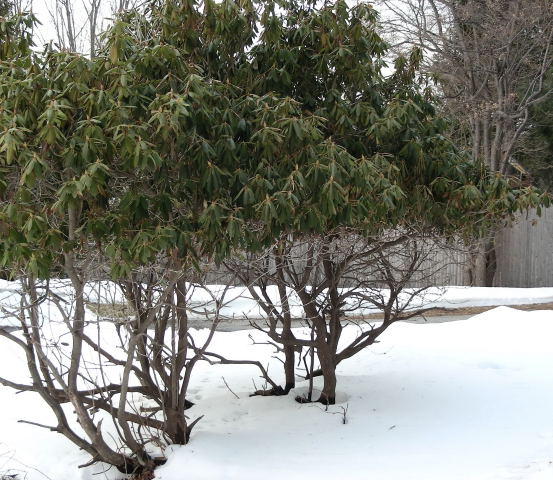
This clump grows about 1/3 mile from where the deer below were standing. Over and over in springtime those naked stems sprout healthy new growth, which sticks out randomly here and there in unhealthy-looking tufts. Over and over, the base fills out about halfway. Over and over, just when you’re starting to root for the thing and imagine it might manage to bush back out, Wham! Eaten again.
Mercifully, the owners do not encase the whole works in a gigantic net bag, but they also fail to see the obvious, which I would illustrate right here and now if I were adept with photoshop. Meanwhile, just look at those handsome trunks and the full green canopy of bud covered foliage. Imagine pruning out all but the strongest, most graceful wood. The easy, no-waiting deer-proof rhododendron is simply a multi-trunked tree. Hungry deer will stretch on tippy-hoofs, but they’re not goats. They don’t climb.
In the dampy doldrums of March, when all is dirty snow and mud, when snowdrops, skunk cabbage and tiny bulb shoots are more or less it for new green, it’s easy to forget that deer, like rust, never sleep.
But right now they’re hungrier than ever; they’ve already nibbled all the easy wild stuff; the leftover acorns are still buried… and your tender roses, hydrangeas, etc. are just starting to swell.
‘nough said. Get out there and spray before it’s too late, i.e. before they take the first nibble.

Deer are often boldest in spring; hunting season is long over and so is their easy access to wild food. This group was right next to the road until I was 50 feet away, and they only ran about 50 yards before figuring that was enough.
Most gardeners know how it is with lilies – you have enough; you definitely have enough. And then it’s March and it’s extremely dreary and here – surprise! – is a pile of summer bulb catalogs with extremely yummy pictures of lilies and you think, well, there’s always room for a few more in the cutting garden and they do make such effortless bouquets

And then, in an increasing number of cases, you think: well, nah; the wretched lily beetles will just get these too and make me feel terrible.

Gilles Gonthier
The scarlet lily beetle, Lilioceris lilii, is marching across New England, laying waste to all lilies in its path. Not everybody has them yet, but everybody who does has gone through the same dispiriting sequence: First there are only a couple and you hand pick them and it’s no big deal. Then there are a dozen or two and a combination of picking and neem sprays seems to do the trick. Then it’s many dozen and pyrethrin, and then it aint pretty.
It’s hard to think of anything good to say about these voracious creatures, but there is in fact one Giant Ray of Sunshine: they don’t travel far on their own. Unlike, for instance, Japanese beetles, which can fly considerable distances, lily beetles spread mostly by way of infected soil, and that means control is possible.
Our Lilioceris Strategy:
1. Prevention: No new ones! We don’t buy potted lilies (or fritillarias, their preferred host). When new bulbs arrive, we throw all the packing material in the trash and gently rinse the roots in tepid water if there is soil clinging to them. There shouldn’t be – and haven’t been – any of the oval, yellow eggs, which are deposited on the leaves, but we always check, just in case.
2. Constant Vigilance: overwintered adults are supposed to emerge from the soil in June. We assume ours might be precocious and start expecting them as soon as the lilies come up. I try to stay ever-alert for beetles or signs that they’ve been chewing, and a couple of times a week I scrunch down and look up. Eggs are deposited on leaf undersides and the black larvae tend to stay there until they’ve oozed out to the leaf tips and started chomping inwards. (Ragged leaf tips are a dead giveaway) .
3. Paranoiac Vigilance: They aren’t always on the lilies. Kristi found the very first one we saw on a tomato leaf. Alas, it was not the first one we had, and thus we come to
4. Kill, Kill, Kill:
a) Adults drop from the plants when disturbed, teach yourself to grab upward so they don’t get away. Crush thoroughly or drop in a jar of soapy water.
b) Larvae are disgusting – gooey and black because covered in their own shit, to keep predators at bay ( aint nature grand?), and they do much more damage than the adults. Removing them is unpleasant but easy; just wipe them from the plants with a rag or a glove covered hand. If you start at the base of the stem, wrap your hand around it under the first set of leaves and stroke gently but firmly upward, you can usually get most of them with one or two passes. People who make lewd remarks may be approached with the working hand, which will shut them up in a hurry. Be sure to revisit affected plants frequently, new larvae are likely to show up.
c). Don’t slack off. Many descriptions of L. lilii say there is only one generation per year. Hah! There are at least two, even in Maine.
5. Perseverance Furthers. It’s probably impossible to eradicate them, but our experience suggests you can keep them to small numbers without working too hard. Reducing them to small numbers from large ones does take a season of of all-out war, but after that it’s easy.
6. Oh, did I mention? The price of lilies is eternal vigilance.
Late July Addendum: When it became clear my torn knee would keep me from Maine all spring, I asked Kristi to put some diatomaceous earth on the leaves as well as on the ground ( see comments), and it looks like Peggy is on to something. It didn’t get rid of them completely and it did look horrible; but allied with the stuff on the ground it kept the population in check until I was back on patrol.
(For coming attractions, please scroll down)
Why is the number 40 beginning to echo in my mind? Why does the word plague, applied to the slugs and snails, seem especially appropriate?… Better not to answer, even if the ongoing rain, in both New York and Maine, is making one wonder if something – how shall we put it ? – special , is afoot. Having 3 hundred-year floods in less than 12 months does make you think there may be more to this than random luck.
We ourselves ARE lucky, actually, nothing wrong with our place except a soggy basement and a world-class collection of slugs and snails, on, among other things, a whole bunch of otherwise very happy hostas.

A happy hosta, in part because its leathery leaves are hard for slugs and snails to chew.
There are a variety of controls that do not involve metaldehyde, the most common mulloscicide, and this is a good thing because metaldehyde kills just about anything else that ingests it, including dogs, cats and birds. Dogs are especially vulnerable because the bait put in to attract the slugs also – they’re dogs, right? – attracts them, too.
So I spent years putting out tuna cans filled with beer, spreading diatomaceous earth, banding my raised beds with copper foil, doing all the approved organic things… but no more. Now I use what might be called Okslugbait, known to its friends as iron sulfate, marketed under trademarked names like Sluggo and Escar-go. It costs quite a bit more than old fashioned poisons, and you have to reapply it more often. But it doesn’t kill anything except mollusks and it’s environmentally benign, a fertilizer in the amounts needed to keep the average garden from being terminally ravaged.
The cost doesn’t make a lot of sense – iron sulfate is cheap – they just know they have you over a barrel. And have you they do, unless things have changed in the couple of years since I tried to buy some (which I figured I could combine with bait in the privacy of my own kitchen).
No dice. Googling turned up plenty of iron sulfate suppliers, but all of them sell it by the boxcar load. So if there are 2 or 3 hundred of you out there who’d like to go in with me…
I jest. But it is great stuff. Makes slugs and snails stop eating, so they eventually starve. The action takes days, however, and although they stop eating almost right away, they’re still THERE, thumbing their slimy little noses at you. So I also use the old-timer’s remedy, ammonia and water in a spray bottle. Near- instant knockdown, very gratifying and ammonia too is a fertilizer in the doses required. Most plants have no trouble handling the spray, though I’ve noticed that salvias and violets sometimes get minor leaf damage. The old timers mixed it 50-50; I usually use about 1/3 ammonia to 2/3 water, but as the “about” suggests, there’s no real need to measure.
Note: When we were preparing for the podcast , Dean reminded me I have already sung the praises of iron sulfate, at about this time last year. True. If we have this weather again in ’07, I’ll praise it again then, too.
(For coming attractions, please scroll down)
The big three of forest consumption: gypsy moth larvae, Eastern tent caterpillars and forest tent caterpillars are again this year munching their way toward a tree near you, if they aren’t already in it. Some tips for taking action:
* All these caterpillars pupate into moths, which don’t feed, by around the end of June to the middle of July. The trees then make new leaves – or try to – and that’s where the trouble really starts because weak trees get exhausted and fall prey to other insects, diseases and climate stress. Thus the most important protection for trees is simply to keep them strong: Water young and newly planted trees regularly; water older and established ones if there is a long dry spell. Mulch to prevent competition from weeds, keeping the mulch away from the trunks so it doesn’t rot bark or lead to insect infestation. And hold off on the strong fertilizer, especially if the trees have been attacked. Whether chemical or organic, food supplements encourage soft growth that’s especially vulnerable to bugs, diseases and (later on) freezes
* While they’re eating, spray with Bt — the younger the caterpillars, the more effective this is, because they have to eat it to die and they don’t die right away. It can also help to band the trees loosely with burlap and apply Tanglefoot or something else sticky. Idea is to keep them from climbing up and down and expanding their range.
* Remove the tents and destroy the occupants. A long stick will usually snag the tents, then you can smoosh them underfoot, drop them into pails of soapy water or – if you’re squeamish – leave them in the center of busy roads. Old timers used to burn ’em out and that’s still a tempting way to go, but it’s very easy to hurt the tree as much as you hurt the caterpillars.
* Later in the summer: Turn off porch lights and garden lights from mid-July to mid- August . Adult moths are attracted to lights from as much as several miles away, and once in your yard will look around for a good place to lay eggs.
* Even later ( next winter in February or March): Use dormant oil sprays in to kill egg masses.
Entomological note: The forest tent caterpillar actually makes resting mats, rather than true tents. Not a saving grace. Kill ’em.
More on strawberries – and cream – shortly. Meanwhile a bit of garden serendipity. Was just weeding under the plum trees and came across this souvenir of late last year who knows when. Leaf is a bit of garlic mustard – evil weed! Beetle genus and species a mystery but if you take that metallic blue and pump it up tenfold you’ll see what I saw – tiny and shining in the shifting shade.

As promised, more on keeping the deer from driving you to a garden composed entirely of barberries and gravel:
* Smelly rope trick: Instead of ( or in addition to ) spraying, you can soak cotton clothesline in odor based repellent and run it as deer nose level fencing around your perennial beds. Easiest installation is through eye hooks screwed into wooden posts, but if you use cup hooks for the running length and thumb-latches at the ends, it’s easy to remove the string and resoak it from time to time.
* A loose dog (confined by an invisible fence) works very well – assuming you choose a dog that doesn’t do more damage than the deer do. But it only works in good weather because it only works when the dog is out there. And of course high maintenance does not even begin to describe it. This is really just a suggestion to consider springing for the fence if you already HAVE a dog.
* Wireless fence: described and sold at wirelessdeerfence.com. This is a set of posts that attract deer, then deliver a painful shock that teaches them to stay away. Same principle as a baited electric fence and – according to the manufacturer – just as effective without all that wire.
* Hunting. If you don’t like the idea of guns on the property, consider putting out the word that bow-hunters would be welcome. Unlike the deer, whose population numbers are exploding, hunters are an endangered species. Average age is somewhere around 50, but they are still around
* Community action: Deer lovers in some communities have instituted sterilization programs. And who knows? King Canute did not have notable success at the ocean’s edge, but maybe he didn’t throw enough money at the project. You can read about one effort in this direction – and see pictures of doctors operating on the deer – here.
* Permanent Fencing ( in the end that’s where you always wind up), is well if dauntingly described by ATTRA, which also goes over a great deal else.
Note: In fairness, it should be said that Canute knew he would fail, he was just trying to prove his human limitations to a bunch of sycophants.
Today I come to you directly from a jolly therapy session; half an hour of poking around at our big orange jasmine, scraping off the scale. The therapy is for the plant, not me – those houseplant gurus are thinking wishfully when they say this kind of screwing around has a calming effect. But it does remind me to remind you to go peer closely at your indoor greenery for signs of unwanted life. Midwinter is explosion time for aphids, whiteflies and scale. Like all of us, the plants have had it with short dark days and dry stale air.
The jasmine, a murraya, actually, is also getting a course of drenchings with insecticidal soap. You know the drill: Put the plant in the tub. Spray the hell out of it, being sure to get the undersides of the leaves. Leave it in place overnight. Next day, put a sheet of plastic over the pot surface to protect the soil, weight it with a few shampoo bottles or whatever, so it doesn’t slip, then draw the curtains and give the plant a long, gentle, tepid shower.
Is that it? No it’s not. Once there are enough bugs to see, there are enough bugs to breed, and it usually takes 2 or 3 treatments to get rid of them. Why bother? In the case of the murraya, fragrant flowers all year round, in batches every couple of months. The full name is Murraya paniculata, and they are not all that uncommon – I got mine at a local nursery that offers them every winter.
BTW, the shower part is a good idea even for plants that don’t have bugs… not only will they look better without dust, they’ll be able to absorb more sunlight. Needless to say, this advice does not apply to cactus or to damp-hating succulents like aloes and jades.
* Nothing like fooling around with the houseplants to make you want to head outdoors, to refill the birdfeeder if nothing more. And while we’re out here, allow me to recommend the hanging wire mesh conical collapsing basket model, currently playing at a hardware store near you. They’re terrif: unobtrusive, welcoming to multiple birds and difficult for squirrels to get at – — also hard for larger perching birds, as we discovered by watching one poor female cardinal ( the winter’s loveliest bird, in my opinion) swooping hopefully by the sides without being able to land. To solve this problem , stick a few lengths of thin bamboo stake through the mesh, letting them protrude just a few inches on each side. As long as you choose a very thin stakes, the perches are too flimsy to support anything bigger than a bird.
* And finally, a nice tidbit for lovers of Jamaican food: there is suddenly quite a bit of goat meat around, probably a happy outgrowth of the goat cheese boom. This is not tender young kid, it’s grown goat. Wonderful for curries and stews, but tough and I do mean tough. You’d think a 2 inch piece of anything would get tender after 2 and a half hours of stewing, but if you were thinking about goat you’d be wrong. Don’t forget to start dinner early.