Garden
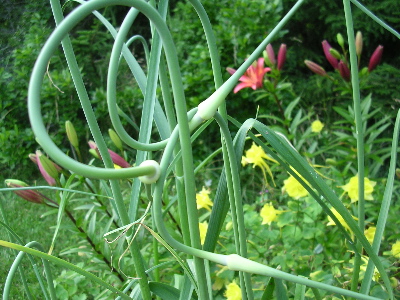
This garlic came up in the compost at the edge of the garden and has been left to make scapes for bouquets. More ( much more) about hardneck garlic, the garlic to grow if you’re in the North, after the garden tour is but a memory ( plant list for tour is below)
(Please scroll down or click at right for coming attractions)
Upper garden, as you enter from the field:
Blue-purple spike flowers around right edge are Salvia transylvanica
Cobalt blue flowers are Salvia patens
Blue flowers with balck calyces are Salvia Guaranitica ‘Black and Blue’
Shrubs with gray foliage and long thorns are sea buckthorn, Hippophae rhamnoides
Foamy yellow flowers w/blue leaves are Thalictrum flavum ssp glaucum (yellow meadow rue)
Large vines framing greenhouse door are hardy kiwis (that refuse to bloom at the same time so I never get any fruit)
In iron urn opposite stone wall:
Vine with lavender-blue flowers is Thunbergia grandiflora
Sawtooth-leaves are Melianthus major ‘Purple Haze’
Big seed head is Star of Persia ( Allium christophii)
Giant hosta is ‘Sum and Substance’
Plant with long, narrow purple bells is Iochroma cyaneum ‘Royal Blue’ ( which only goes to show you)
Vine with purple flowers in clay pot is Asarina scandens
Plant in iron urn in front of lilac is Brilliantaisia subulugarica
All hollyhocks (including the dark magenta ones) are self-sown great-grandchildren of a yellow Alcea ficifolia
Vines in front of greenhouse:
Orange daisy-flowers: Senecio confusis ‘San Paulo’
Orange/pink/white flowers all together : Mina lobata ( Spanish flag)
Bright red trumpets: Ipomoea quamoclit ( Cypress vine)
Salvia w/yellow and purple flowers ( almost done) is S. bulleyana
Plant with long deep purple spikes (on right, in front of holyhocks) is a butterfly bush, Buddleia davidii ‘Black Knight’
Poppies by path on left are self-sown annual shirleys ( P. rhoeas). On right, a perennial sold to me as P. alpinum but I don’t think it is.
The red coleus is ‘Kingswood Torch’
The purple-brown grassy-looking thing is ornamental millet, ‘Purple Majesty’
Dark green leaves on black stems are Alocasia , cultivar name lost ( there are much larger ones in the white garden)
The orange Turk’s cap lilies are L. davidii
The yellow coneflower is E. ‘Big Sky Sunrise’
The yellow flowered bush at the very back (on the road side) is a heliopsis, cultivar name forgotten
White garden:
Vines on the entry arch are
Clematis virginiana (virgin’s bower) and
Lathyrus latifolius ‘White Pearl’
Plant in the middle with big white trumpets is a brugmansia
Low rosettes of big silvery leaves are Salvia argentea ( silver sage)
Striped Euphorbia ( ball on a stem) : ‘Tasmanian Tiger’
Tall stems with seed heads, Allium giganteum ‘White Giant’
Striped red and white rose is ‘Scentimental’
plant with tuft on top that looks like a pineapple is Eucomis bicolor (pineapple lily) There are other eucomis beside the path – including one with purple leaves – which have not yet bloomed.
Dark green leaves on black stems are Alocasia , cultivar name lost
Fragrant shrub near the path end, Aloysia triphylla (lemon verbena)
The hedge is Hydrangea tardiva
In windowbox:
the big tree is Acnistus australis. It has purple-blue flowers when it gets sun in spring.
The thing that looks like a little palm tree ( sort-of) is a begonia
In bathtub, vine with orange and yellow flowers is a leggy Abutilon megapotamicum that isn’t getting enough sun.
Lower garden:
Pink and yellow border – inspired by the Minton bowl in the picture posted underneath the birch

Pink cotton candy is Filipendula rubra (queen of the prairie)
Yellow scabiosa on steroids is Cephalaria gigantea
Large shrub at end is a golden elderberry, Sambucus nigra ‘Aurea’
Small shrub in center with long yellow leaves is a sumac, Rhus typhina ‘ Tiger eyes’
Annuals:
Purple brown trumpets in front are salpiglossis ‘Chocolate’
Self-sowns on left are calendula ( grandchildren of ‘Pink Surprise’); Bupleurum rotundifolium ( no common name that I know of), blue nigella (love in a mist) , silene (the screaming pink), and larkspur ‘Blue Cloud’.
Single cosmos are ‘Psyche, ‘ doubles are ‘Doubleclick’
Special thanks to assistant/garden-helper/friend Kristi Niedermann, without whom this garden could not exist.
( For coming attractions, please scroll down)
There are about 22 species of Digitalis, all of them known as foxgloves, but today’s special is D. purpurea, the common foxglove, a weed of the English hedgerows and a weed in its willingness in gardens across the US northern tier. ( The farther south you go, the less delighted they are.)
They’ll bloom for months if kept deadheaded, but are most glorious in early summer, just reaching their maximum 5 or 6 feet as the peonies start declining. And foxgloves can be almost as permanent as peonies, even though they are biennials (or short-lived perennials), because they self-sow so prolifically.
Each flower is good for at least a hundred seeds – usually, there are far more – and a happy plant will produce anywhere from 60 to more than 100 flowers on its roughly 5 to 9 spikes. (The woodland world is not paved with foxgloves for the same reason that the woodland streams are not paved with trout; most of the babies don’t make it. )

As D. purpurea suggests, the species flower is purple ( purple-pink, actually, with maroon spots – scroll down to see). But there is a selection: D. purpurea f. albiflora that is, as ITS name suggests, white, and it does pretty well at staying white through generations of mixed breeding.
Foxglove growing tips:
* Alkaline soil helps, but is not essential. What really counts is good drainage. Foxgloves like a lot of moisture but rot swiftly if roots stay wet.
* Foxgloves are often on lists of shade-bloomers, but that doesn’t mean deep shade. They do best where they get filtered light all day or plenty of morning sun.
* Fertilizer makes large plants gigantic, but also makes them more prone to fungus diseases. Don’t use it in damp years or where the plants are crowded ( which is where they are most charming).
* Because plants bloom in their second year and frequently die at the end of same, you have to plant from seed 2 years running to get a good stand of them going. Not difficult, but seed must be fresh for good results. If you have a friend with foxgloves, just ask them to let a stalk go to seed. If you don’t , buy a blooming-size plant from a garden center and do the same. When most of the seedpods have dried ( those on the bottom will have already split) just cut the stalk and wave it around where you want foxgloves. Seed forms in August or September, and baby plants should be up by the end of the season.
* Foxgloves are shallow rooted and frequently heave out of the soil in winter. But it’s hard to get around that with mulch because the plants spring back to life long before the freeze-thaw cycle is over. They’re also prone to rot in prolonged spring damps. The moral: do not move or thin them until after soil settles and weather warms and you know how many you have.
* The secondary spikes will be stronger if you cut those giant lead ones well before all the flowers open, when about a third are still in bud. It’s painful and I don’t always do it but when I do I just put them in a vase. They keep opening for quite a while, though after 5 or 6 days the purple ones start getting paler and paler.
Nomenclature Department: The dominant explanation seems to be that foxglove is a corruption of folksglove, idea being that the flowers are gloves for faeries but faeries do not like to have you say their name and will retaliate unpleasantly. They must be called “the little folk,” preferably in a soft voice that does not attract their attention.
Pretty story but unlikely to be true, given that the earliest use is Old English foxes glofa, which means just what it sounds like it means. Foxes, like faeries, inhabit the hedgerows where these flowers grow, and foxes have smaller paws than you might think.
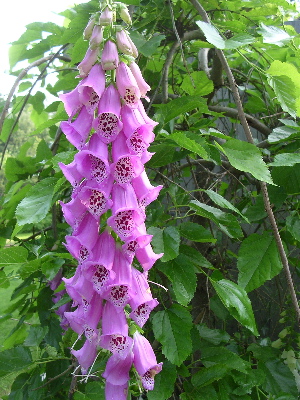
This is old-fashioned Digitalis purpurea and there will be tips on growing it as soon as I finish weeding the white garden or the mosquitoes drive me in, whichever comes sooner.
(For coming attractions, please scroll down)
Why is the number 40 beginning to echo in my mind? Why does the word plague, applied to the slugs and snails, seem especially appropriate?… Better not to answer, even if the ongoing rain, in both New York and Maine, is making one wonder if something – how shall we put it ? – special , is afoot. Having 3 hundred-year floods in less than 12 months does make you think there may be more to this than random luck.
We ourselves ARE lucky, actually, nothing wrong with our place except a soggy basement and a world-class collection of slugs and snails, on, among other things, a whole bunch of otherwise very happy hostas.

A happy hosta, in part because its leathery leaves are hard for slugs and snails to chew.
There are a variety of controls that do not involve metaldehyde, the most common mulloscicide, and this is a good thing because metaldehyde kills just about anything else that ingests it, including dogs, cats and birds. Dogs are especially vulnerable because the bait put in to attract the slugs also – they’re dogs, right? – attracts them, too.
So I spent years putting out tuna cans filled with beer, spreading diatomaceous earth, banding my raised beds with copper foil, doing all the approved organic things… but no more. Now I use what might be called Okslugbait, known to its friends as iron sulfate, marketed under trademarked names like Sluggo and Escar-go. It costs quite a bit more than old fashioned poisons, and you have to reapply it more often. But it doesn’t kill anything except mollusks and it’s environmentally benign, a fertilizer in the amounts needed to keep the average garden from being terminally ravaged.
The cost doesn’t make a lot of sense – iron sulfate is cheap – they just know they have you over a barrel. And have you they do, unless things have changed in the couple of years since I tried to buy some (which I figured I could combine with bait in the privacy of my own kitchen).
No dice. Googling turned up plenty of iron sulfate suppliers, but all of them sell it by the boxcar load. So if there are 2 or 3 hundred of you out there who’d like to go in with me…
I jest. But it is great stuff. Makes slugs and snails stop eating, so they eventually starve. The action takes days, however, and although they stop eating almost right away, they’re still THERE, thumbing their slimy little noses at you. So I also use the old-timer’s remedy, ammonia and water in a spray bottle. Near- instant knockdown, very gratifying and ammonia too is a fertilizer in the doses required. Most plants have no trouble handling the spray, though I’ve noticed that salvias and violets sometimes get minor leaf damage. The old timers mixed it 50-50; I usually use about 1/3 ammonia to 2/3 water, but as the “about” suggests, there’s no real need to measure.
Note: When we were preparing for the podcast , Dean reminded me I have already sung the praises of iron sulfate, at about this time last year. True. If we have this weather again in ’07, I’ll praise it again then, too.
(For coming attractions, please scroll down)
The big three of forest consumption: gypsy moth larvae, Eastern tent caterpillars and forest tent caterpillars are again this year munching their way toward a tree near you, if they aren’t already in it. Some tips for taking action:
* All these caterpillars pupate into moths, which don’t feed, by around the end of June to the middle of July. The trees then make new leaves – or try to – and that’s where the trouble really starts because weak trees get exhausted and fall prey to other insects, diseases and climate stress. Thus the most important protection for trees is simply to keep them strong: Water young and newly planted trees regularly; water older and established ones if there is a long dry spell. Mulch to prevent competition from weeds, keeping the mulch away from the trunks so it doesn’t rot bark or lead to insect infestation. And hold off on the strong fertilizer, especially if the trees have been attacked. Whether chemical or organic, food supplements encourage soft growth that’s especially vulnerable to bugs, diseases and (later on) freezes
* While they’re eating, spray with Bt — the younger the caterpillars, the more effective this is, because they have to eat it to die and they don’t die right away. It can also help to band the trees loosely with burlap and apply Tanglefoot or something else sticky. Idea is to keep them from climbing up and down and expanding their range.
* Remove the tents and destroy the occupants. A long stick will usually snag the tents, then you can smoosh them underfoot, drop them into pails of soapy water or – if you’re squeamish – leave them in the center of busy roads. Old timers used to burn ’em out and that’s still a tempting way to go, but it’s very easy to hurt the tree as much as you hurt the caterpillars.
* Later in the summer: Turn off porch lights and garden lights from mid-July to mid- August . Adult moths are attracted to lights from as much as several miles away, and once in your yard will look around for a good place to lay eggs.
* Even later ( next winter in February or March): Use dormant oil sprays in to kill egg masses.
Entomological note: The forest tent caterpillar actually makes resting mats, rather than true tents. Not a saving grace. Kill ’em.
July 12: Benefit Luncheon Garden Party with Don and Patrisha McLean
At “Lakeview,” their Camden home. Starts at 12:30 with Champagne, appetizers and stroll through the organic gardens full of heirloom roses. Includes lunch and a talk by Eric Rector, former president of MOFGA, and ends with a 3 o’clock Q&A session presided over by yrs. truly.
$75.00 donation, for the Castine Historical Society. Space limited. (207) 326-4118 or on the net.
July 16: Georges River Land Trust Garden Tour
The 15th anniversary tour, 10 AM to 5 PM rain or shine. Eight gardens , including mine. Tickets $20.00 in advance, 22 bucks the day of the tour. Details through the Trust: (207) 594 – 5166 or on the net.
September 15-17: Maine Fare
A 3 day celebration of all things downeast and delicious , with a gala tasting, a food vendors’ marketplace, cooking demonstrations and assorted talks, including a panel discussion ( led by moi) on Eating Local in a Cold Climate. Information at 207 236 8895 or on the net at mainefare.com.
Funny word when you say it enough times, which is easy to do when they are defoliating large swaths of the Eastern forest. Tips for defending your own trees follow, as soon as I get the rest of the callas in and the tomatoes mulched. But first, a word about defending your dill, which can also be defoliated by a caterpillar.
Unlike the ones that are eating the forest, which grow up to be small, drab moths of no special aesthetic distinction, the caterpillars that eat dill, parsley, and fennel become black swallowtail butterflies (Papilio polyxenes).
Fortunately, there’s no need to kill them to preserve your herbs – they like Queen Anne’s lace just as much as they like other umbellifers, so you can just gently pick them up and move them to wilder pastures. There are 3 generations a year, but unless you have acres and acres to tend, it doesn’t take long to relocate all threats to the tabbouli.
“In peaceful old gardens that remain unfretted by changing fashions and modern introductions we are apt to find huge bushes of the old May-flowering peony… ”
thus Louise Beebe Wilder, in Color in My Garden, published in 1918.
Still true in 1991, when we bought this house. Its peonies must have been planted by old Miss Wells, last of the line that built the place in the 1870’s and, by the evidence, a demon gardener. By the time we got here, she’d been gone for a dozen years and the gardens were pretty much rack and ruin, but the peonies were everywhere : lined up along the side of the barn, half-hidden under the overgrown hedges, buried in the weed-choked flowerbeds…

Survivors : Antique peonies and blue flag iris, undaunted by ladies bedstraw, milkweed, and rampant bittersweet.
There are some early magenta bombs and even earlier bright red fernleaf ones, but most of them are lactifloras, famously known as memorial day peonies because that’s when they start blooming.
After dividing and moving the ancient clumps, we wound up with – I just went out the other day and counted: 61plants, each of which is about 3 feet wide, covered with dozens of flowers and buds. But do we have single reds with twisted clusters of gold-tipped petaloids in the middle? silky white semi-doubles right out of Japanese prints? perfect apricot coral cups?
Nope. There are literally hundreds of possible peonies, but Ms. Wells was keen on repetition: we have one pink, one dark magenta and one white.
Can’t place the dark one, but I’m pretty sure the silvery pinks are Sarah Bernhardt , a fragrant double with ruffled center petals that made its debut in 1906. The white, a bomb with shell pink outer petals and red streaks at its heart is probably Queen Victoria, called the “Old Farmstead ” peony by Hollingsworth Nursery , which describes this flower’s extensive travels from the East into the Midwest in the early 20th century.
It’s clearly a child of Festiva Maxima, pretty much the same but with more fragrance and without the pink petals and the one peony to have if you’re having only one. Festiva Maxima was introduced in 1851 and I wouldn’t be surprised if the original plant were still alive somewhere.
Peonies are TOUGH, which is part of their charm. Also very handsome when not flowering; the leaves make a lovely hedge behind later blooming flowers and are also a good screen to mask the ripening foliage of spring bulbs. Deer and rabbits do not eat them. They do not need dividing
They are also a great comfort in a difficult world, a link with the past, a bet on the future and big huge silky fragrant luxurious joy in the morning – at least until it rains.
Peony Tips:
*They do need sun, but not that much; with most varieties, you can get decent flowers from a half day’s worth and the farther south you are, the more the peonies can use a break from broiling afternoons.
* Be sure to plant shallowly – those fat growth buds should be no more than an inch and a half below ground. The number one cause of bloom failure is over-deep planting… or, over time, the gradual movement of compost and mulch that buries those buds as effectively as if you had done it yourself.
* They don’t like acid soil; if your rhododendrons are doing great, it’s a sign you should add some lime to the peony bed before you start planting.
Now is a good time to do it, since fall is the best time to plant. Potted peonies can go in the ground now, but the bare root kind must be planted in fall … and the bare root kind is where all the goodies are.
* Never in the compost! The Botrytis blight that plagues them – their own personal fungus: Botrytis paeoniae – is ever present, even on apparently healthy growth, so everything that leaves the peony bed should stay gone: discarded bouquets , the fall cleanup pile, Everything. Burn it if you can, toss it deep into the woods where no peonies will ever grow, or be deeply retrogressive and send it to the landfill.
* Peonies last a long time as cut flowers and can be held in bud stage for a month or more – if you have the room in the refrigerator. For an exhaustive and very useful treatment of cut-flower choices and procedures, download this useful guide, from Kansas State University.
Just realized I promised – on the vhv podcast – to post a list of summer annuals that it makes sense to buy as seedlings, either because they’re fussy to start, because they have timing issues related to light-levels, or because they take a long time between seed-in-the-ground and bloom. For those that do better directly-seeded, see the post below.
In no particular order: petunias, snapdragons, impatiens, stock, tall marigolds and giant zinnias (shorter plants and smaller flowers are pretty swift), cosmos, China asters, bells of Ireland, lisianthus, scabiosa – aka pincushion-flower, statice, and crested celosia – the cockscomby ones. Plume type celosias are faster and can be started from seed.