
The Mushrooms of Autumn (hen of the woods)
OK, mushroom fans, another guest post from Bill Bakaitis, on another of the all time great delicious wild mushrooms, the hen of the woods ( Grifola frondosus), now appearing on an oak tree – or on a shelf at a high end market- somewhere near you.

time to look for hen of the woods
by Bill Bakaitis
September. The days grow shorter. For mycologists, gone are the languid days of summer when we would slowly, patiently, and gently try to identify those interesting mushrooms that grow singly here and there. The photographs, spore prints, the keys, the chemical and microscopic analysis, the process that might take hours or days for us to determine even the genus are luxuries we can no longer afford. The sap that now flows through our veins and that of the world around us cries out for haste. There is so much to do in so little time: the garden, the house and yard, the movement of game in the forests, fall migrations of fishes in the ocean. Each claims its hegemony over our lives and the dwindling hours available. As for mushrooms, we have not time for the tiny, the new, the tantalizing odd; we long instead for the truly substantial. Enter frondosus!

Polyporus (Grifola) frondosus
Frondosus – call it Polyporus frondosus, or Grifola frondosus, Maitake, Sheep’s Head, or Hen of the Woods. Here is the mushroom that answers the question, “Where’s the meat?” It is large in size and fruits reliably in the same locations year after year, allowing us to take a twenty minute detour from our hectic lives to collect a year’s supply. And it is one of the best tasting of all wild mushrooms, appearing on every mycologist’s top ten list. Unlike July’s jumble of difficult-to-identify Boletes, frondosus stands nearly alone in form and structure, although it is at times hard to see. As its name “Hen of the Woods” suggests, it reminds some of a mother hen, feathers all ruffle. To those us not so attuned to barnyard activity however, it looks simply like a pile of leaves.
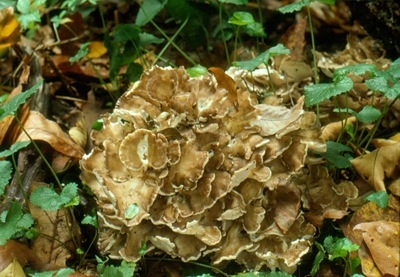
Frondosus often resembles a pile of leaves
I am often surprised when one suddenly jumps into focus, and then I see another and another and another. Their camouflaged appearance aside, you will recognize them instantly. (more on identifying this mushroom here) There are two mushrooms with which one might confuse frondosus: Polyporus (Grifola) umbellatus and Polyporus (Meripilus) giganteus. Both are edible; umbellatus is choice, but the blackening fronds of Meripilus become tough and somewhat bitter in age. In my experience, neither is as common as frondosus. I do not have good images of either but they may be seen here and here.
Where to find Hen of the Woods: In the Northeast frondosus has a rather lengthy season, from late August in coastal Maine through mid-November in the Hudson Valley of New York, but throughout its range I have found the third week of September to be the best time to look. For the past two decades the classes I conduct with The Culinary Institute of America include a foray on the weekend closest to the equinox. Rare is the foray when we do not find frondosus. Frondosus grows almost exclusively at the base of mature Oak Trees. They may nestle against the trunk or wander out for a few feet along the roots they infect. You will want therefore to seek out areas where these trees have been protected, conserved, or simply ignored. Think ‘forever wild’, ‘landed gentry’, ‘old estates’ or ‘family farms’. One of my best strategies is to walk old property lines or fence rows looking for line trees. Two-hundred year old White Oaks should never, ever go unexamined.

Note the size of the oak tree which supported these Hens.

from one tree a minute’s walk from the car
Once you have found a productive tree or two you will want to return in the following season connecting them with a planned excursion, investigating other less obvious trees in the area. You will be surprised at how many you will find on smaller oaks – trees of a foot or so in diameter. If, like me, you live in a suburban to ex-urban area sooner or later you will find a tree that is close to a road near one of your usual travel routes. One such tree near my home has produced twenty to fifty pounds of frondosus annually for twenty years, failing only in one very dry year.
In areas where the oaks have been cut for lumber or firewood or have been toppled by storms the stumps and roots can continue to produce for several more years. In my experience, fruitings on these stumps usually occur later in the season, often after the leaves have fallen from the standing trees.
For obvious reasons it is advisable to carry a large market basket or an Adirondack-style pack basket for your hunt. A cloth shopping bag tucked into your pack is handy for the overflow. Not infrequently I have been faced with the delightful dilemma of finding a mushroom so large that help is needed to carry it out of the forest.
By now you might be asking yourself, “What in the heck does he do with all of those mushrooms?” For two reasons, the medicinal and culinary, I have no trouble giving most of it away.

Maitake often sells for $15 -$20 a pound
Medicinal Merit: Maitake, as it is known in the Orient, is reputed to boost the immune system. See Tom Volk’s positive summary of this evidence here. A critical reading of the literature from a scientific review conducted in New Zealand however reaches more modest conclusions. This is a major (50 page) review of the available literature that found: 1. Contrary to popular assertions, there is no evidence for long standing use of Maitake as a traditional medical agent in the orient. Confusion with Grifola umbellatus was cited as the probable source of this confusion. 2. Although a minor fraction of the B-glucan complex was found to produce anti-tumor activity in laboratory rats under certain conditions, in humans most of these compounds were either digested by salivary enzymes prior to entry into the gut or remained undigested and excreted in the fecal matter. 3. Much of the anti-diabetic activity seen in mice could be attributed to the high fiber content of the mushroom rather than special pharmacological properties. 4. Inadequate scientific controls and methodological errors were found in the laboratory (rat) studies. Differences between the various treatment groups and controls were found to be “unremarkable”, “unreliable” and/or “contradictory”. 5. Similar errors appeared in the clinical (human) studies reviewed. They were found to be “non-randomized”, “uncontrolled”, “unblinded”, “not subject to peer review”, and contained obvious self-serving interpretations and conclusions. 6. The mushroom however is both non-toxic and safe to use as food; its specific dietary properties change with both the substrate and age of the fruit body.
Most of the approximately 75 studies reviewed by the New Zealand panel appear to have been conducted in Japan or China, presumably with oriental strains of Grifola. I was interested therefore in a separate study in which researchers looked at the DNA of North American and Oriental specimens. This team found that despite the similarity in appearances, there are important genetic differences between the Oriental and North American strains of Grifola frondosus. By this way of reckoning, the two are not the same.
Notwithstanding, there is a tremendous interest in Grifola as a nutritional supplement. Any Google search will produce pages and pages of sites and testimonials attesting to the restorative powers of this mushroom. What gives? Well, the most parsimonious explanation is probably Norman Vincent Peal’s “Power of Positive Thinking”. Of this there is no doubt: the mere act of expecting positive outcomes – the “Placebo Effect” – produces demonstrable biochemical changes in the body. However one reads the literature, there remains a considerable interest in and appetite for the Grifola that I collect, and it gives me great pleasure to see all of those Hens fly the coop of my possession. Friends close to the HIV-infected community eagerly take all I can provide and are convinced of its restorative powers.
Culinary Interest: For my money, this is where the action is. Everybody loves this mushroom for its taste and texture. Leslie and I recently brought a dewy fresh specimen to an afternoon cocktail party where five artists gathered to escape the remnants of Hurricane Ike. Outside the wind roared. Rain pelted the windows. The trees and cabin shook. Whitecaps covered the water and leaves filled the air. We placed the mushroom on a side table and commenced the greeting rituals, but a gasp filled the air as the loose waxed paper wrap was removed from the mushroom by the host. It sat there in framed sculptural beauty. Ten painterly eyes were glued to the mushroom. Five jaws slackened, and from four mouths came the same utterance: “Ohhhh!” And then, “I can’t wait to paint (or draw) it.” The hostess remained silent for a moment, torn between twin desires. I suggested that she might want to re-wrap the mushroom to preserve the freshness. She lowered her head ever so slightly and peered at me over the tops of her glasses. “Are you kidding”, she said. “As soon as these people leave it’s going into the frying pan.”
My thoughts precisely! You will want to experiment with this mushroom, as chefs throughout the world have, and I know Leslie will want to provide a recipe of her own, but my own preference is a light treatment in the frying pan exploiting the native qualities of the mushroom itself.
The Basic Grifola Mushroom Sandwich. This will take no more than five minutes. Use top notch ingredients; Butter, garlic, and artisanal bread.
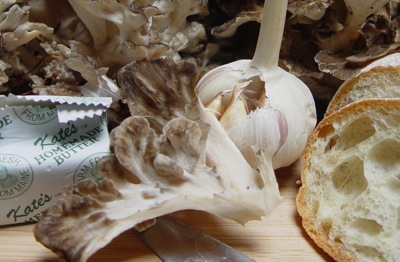
Maine butter, home grown garlic, Atlantic Bakery ciabatta, fresh hen
Over low heat melt a pat of butter in a cast iron skillet. As the butter melts, remove a handful of fronds from your Grifola; clean off any adhering duff or slug stuff, by hand, brush, or a stream of water. Using your fingers shred the fronds into quarter or half inch slivers.
Smash and dice a clove of fresh garlic. Put the garlic and mushroom slivers into the pan and cover. Simmer for a few minutes, stirring occasionally, during which time the mushroom slivers will give off a bit of liquid and a great deal of aroma. Remove the mushroom from the pan leaving some of the juices behind. Put two slices of bread into the skillet, increase the heat a touch and gently pan toast the bread for another minute. Assemble the sandwich, enjoy, and kick yourself for not preparing enough for two sandwiches. It is that good.
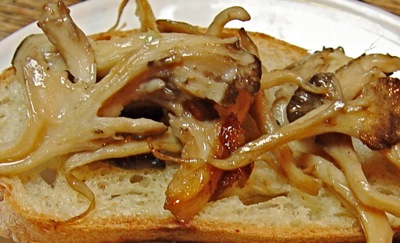
Open faced Frondosus Sandwich
For a Man’s Sandwich, add a handful of ham slivers to the pan a moment after the mushrooms.
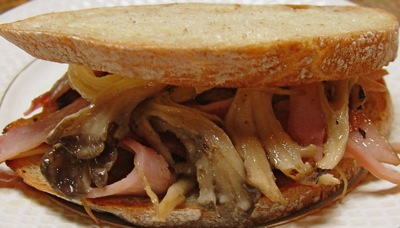
Frondosus man’s sandwich
For a Fancy Pants Special, add a few drops of sherry before removing the mushrooms from the pan. Stay tuned for other Autumn Mushrooms in future posts.

Share this





Hi Leslie & Bill,
Wow what collections!
I once found a small “hen” at the base of an oak in my yard in Bedford NY just before I sold the house and moved. I have never seen one in NH.
But in Lincoln there are not many oaks. One of the COMA members has offered to send me one because he also finds many pounds.
I am inpressed! Happy hunting.
Love, Roz
Hi Roz,
When I first came to Maine, I didn’t see many Oaks either. It all seemed a sea of Spruce and Birch. As I drove around, however, I came to notice more and more, especially on old fence/property lines and near old farm homesteads.
A month ago, in Maine, I chanced upon another collector in a wooded area somewhat new to me. I was on the lookout for Polyozellus, a fungus I have never seen in the wild, but poking around photographing anything that caught my eye. He, on the other hand, had an Adirondack basket strapped to his back and was hoofing it out to a few Oaks “a mile or so up the trail”. And he already had three in his basket from a previous site he had checked,”the other side of the mountain”. IHe said it was “Just like runnin’ a trapline”.
By the time I got back to NY by mid-September the major fruitings had just gone by. The big tree that has provided so handsomely over the years had died, leaving no appparent henly souls to brood over. But I was able to locate a new tree, miles away, and half an hours a walk into the woods that had a nice fresh cluster. Yep. It was on an old fence line at the edge of a long abandoned road.
I’ll bet there are some around you too. New Hampshire can’t be all Pine. How about checking those old cemeteries?
I Was Wondering The Best Time To Hunt The Hen Of The Woods
i will be collecting hen of he woods this year. where in missouri can i put them on market?
Have you tried the mushroom guy at soulard market in St. Louis?
Hi Doug,
I’ve never been to the market (or St. Louis, for that matter), but I’m happy to hear there’s a mushroom guy there. More and more farmers markets seem to boast a mushroom forager… we may catch up to Europe yet!
September is the start. when the leaves fall.
Thomas –
sorry to be so long answering and now I see Allan has answered your question. Sort of. As you can see from Bill’s post, the season can be quite variable, so the thing to do is seek out likely spots and then just keep checking.
Allan
I don’t know where you’d market wild mushrooms in Missouri, but if I were you I’d start by asking chefs who are known for their interest in using local food. A bit of creative googling should give you some names and so might a search of local members of the Chefs’ Collaborative. If the chefs don’t want to buy directly they may be able to suggest a distributor you could deal with. There’s also your local farmers market if you want to take the direct route.
Great article!
I just revisited this article and have to say that it is perhaps the best article I have read on the Grifola frondosus.
Knowing that there are no look-alike poisonous polyphores in MA ro RI (where I hunt) has made me a little careless in my collection of the frondosus. Consequently, I made the rookie error today of mistaking a Meripilus giganteus for a hen and was trying to figure out why the darned thing was so hard to chew. It tasted almost identical to the frondosa (I even rehydrated some dried specimens from last year’s haul to comare) but I couldn’t get my teeth through the first piece. So I thought I had better do some research and figure out just where I went wrong. Your site led me to the answer. My giganteus looked identical to, and tasted just a bit milder than, some of the hens I had previously collected. The only real difference was the black bruising around the edges of the fronds and at the base cut. No bruising had been apparent at the time of harvest.
Mystery solved!
Hi Simeon,
Welcome to the blog. I am glad to know that you found the article helpful and even came back a second time. And thanks for the compliment.
Like you I also made the Meripilus/Grifola mistake, way back in the 1980’s when I was at a NEMF Foray in New Jersey. It was summer and was hot and humid. Walking across the campus of the Glassboro Campus I saw what I was sure was frondosus growing in a clump of shrubbery. I crawled under and after some effort and a great deal of sweat, came out with a more-or-less intact specimen that I proudly brought to the collection table and labeled “Polyporus frondosus” (Both Grifola and Meripilus were once in Polyporus but have since been segregated out.)
Alan Bessette came by, looked at it and said, “You had better check this one out with Dick” (Homola), his teacher and a chief mycologist at this foray. It took Dick just a glance to see what it really was, but I still needed to collect it a few more times before I was confident.
On another occasion a member of a local Mycological Association brought in and cooked up a quite large Meripilus. The members tried very hard to enjoy it, some actually managing to down a goodly portion before the mistake was noticed. Thankfully, Meripilus is not toxic, or many like us would have had a quite different story to tell.
Good hunting. I plan to start looking for frondosus here in Maine in the next few days.
Bill
hi i have been trying to learn to hunt hens of the woods i found a big mushroom that looked like one it was white with two to three inch leaves the outer edges had a orange coller to them it had a strong smell it was under an oak my naber told me it was not a hens of the woods im sorry i dont have picture
Hi,
I live in connecticut and I think I may have stumbled upon some hen of the woods. I would love if you could help me out. I have several pictures of it. I have always wanted to get into wild mushroom foraging.
Hi Jason, Hi Brian,
Yep. It is time for Grifola. They have just started to emerge here in the Hudson Valley of New York.
Since both of you are self proclaimed novices, let me again stress that you join your local mycological association. Locate a club near you here: http://www.namyco.org/clubs/index.html, and hurry. They are going out right now and you will want to join in on the walks and have the value of hands on expert consultation. Don’t fear being intimidated by these folks: they are among the most genuine and friendly people you arte likely to know.
Also, please check out the links to identification given in this (and other) posts on this web site: Just click on the “here” where the little hand appears. It will take you to another page with more information. Only the sketchiest of descriptions are given in the body of these articles, and you are right to want to know more.
Images, however good they may be, can carry us only so far. You should always check out your specimen with the more detailed descriptions given in reliable field guides. Sorry, for various reasons mushroom ID images sent to this site cannot be commented upon.
Join in with your local mycological association. They are collecting Hen of The Woods this weekend!
Good luck good collecting, and good eating.
Bill
Hi there fellow mushroomers, hens were scarce in september so dry as it was but here now in week one and two of october we are finding a few beauties just right for the table. Matsu’s as well are still popping though spotty.
Say is that gigantus mushroom also known as berkley polypore? Its big and on oak too. I hadnt seen it mentioned.
One little known tip– hens have been also known to fruit near certain species of maple; I’ll just leave it up to ya’ll to determine exactly which one!
leo in central ne
Hi Leo,
Thanks for your comment. By the way, is “central ne” central New England, or Nebraska?
I’ll take your comments in reverse order. I have on very rare occasions found Grifola frondosus on Sugar Maple. That would be one tree in over a half century of collecting. At first I was skeptical, thinking there must be an old oak removed from that spot, but I have followed it for a few years and am now convinced that the Maple supports this fruiting. I have eaten it, but found the flavor to be thinner and less rich than those coming from Oaks.
By “Berkeley’s Polypore” I take it you are referring to Bondarazewia berkeleyi, (both the genus and species of this mushroom are named after mycologists). In Overholts’ classic text (Polyporaceae of the US, Alaska, and Canada)it is also known as Grifola Berkeleyi (Fries), Polyporus Beatiei Banning apud Peck, and Polyporus lactifluus Peck. There are about a dozen or so validly published synonyms for this species. See http://www.indexfungorum.org/Names/SynSpecies.asp?RecordID=293765 for the current list.
You probably use Lincoff’s Audubon Guide, given your choice of name for this mushroom.
Yes, it is commonly found on Oaks, and also other deciduous trees in the Northeast. The macroscopically similar B. montana fruits on some coniferous trees in the West. Some authors, Lincoff included, consider B. berkeleyi edible, but I have never met anyone who has admitted to have tried it. In my experience the young immature stage tends to occur in late June.
And bear in mind that there are many other Polypores which you will find growing on Oaks. The two volume North American Polypores by Gilbertson and Ryvarden is the current standard reference. Their 14 page index lists somewhere around 1,000 -1,200 species.
I recall finding one large interesting polypore at a foray in the 1980’s, making a full set of diagnostic photographs, carefully collecting and handling the voucher, bringing it back to the collection tables and asking the renowned resident Polypore expert, William Bridge-Cooke, for his pronouncement on it’s identification. He picked it up, turned it over, and with a sotto voce grunt handed it back to me. “Well, what is it?” I asked. “A young Polypore” was his terse reply.
End of story. As much as we have fun trying to identify the mushrooms which fruit in our region, stick to what you know and don’t try to eat everything in the woods.
Bill
Hi there. I found a 10# hen at the base of a large oak tree in my neighborhood last week. Very exciting. Does anyone know how long it takes for a hen to grow? I was concerned that maybe I ‘plucked’ it too soon; although the restaurant I donated it to felt it was ‘perfect.’
Hi Julie,
Ahhh, the pleasures of a perfect 10 pound Hen – In November, no less. I don’t think it would have gotten much bigger, at least not here in the Northeast. The cold weather and several frosts have put a stop to the growing season.
You ask about how fast they grow. I followed several this year. On Sept 18 they were just emerging, tiny, fragile primordials the diameter of a nickel, less than an inch across and thin as a corn flake.
Five days later, (9/23) they were small rosettes about the size of a tennis ball cut in half (perhaps 3″ in diameter) with well defined segments that were destined to become the fronds.
On 10/06, they were three weeks old and the size of a head of cabbage, and I last visited them on 10/10 when I picked two which were basketball sized, perhaps three to four pounds in weight. Interestingly, there was another week-old rosette coming along at that last visit, but as we had heavy frosts in the following nights and I already had well over a dozen in the large basement fridge, I did not return to that tree.
My guess is that in this year, a 10 pound hen would have been about a month old. Incidentally, those I stored in the fridge (40F) with some moisture control were still in good shape some two and three weeks later.
Those that I left in the fridge uncovered dehydrated nicely, our first try at preserving them in this manner. We will let you all know how this experiment turns out.
At $10-15 dollars/pound, your hen was probably worth $100 to $150 if my math is correct. I hope you got a good meal in fair trade for your donation.
Bill
When you get a large load, how do you prepare it to store and use later in the winter?
Hi Kimberly,
As mentioned in the article, we give lots of it away fresh, a gift always welcomed.
Some of the remaining is prepared as a duxelles, some simply sautéed in butter and packed into single portion bags for the freezer, and lately some simply put into the freezer raw. It re-hydrates easily and retains most of the texture and flavor.
My favorite method is to shred it into bubbling butter, add garlic, shallots, onions, etc. and finish with a splash of sherry. Pack into quart bags and freeze. In January one of these portions served over linguini is quick, easy, and superbly delicious. One of the best uses of one of the best mushrooms I can think of.
Good luck collecting and bon appetit!
Hi to all you lucky hunters.
I live in Madison,WI. and for the last 35 years my Honey
and I have never left the city limits to get these great
mushrooms. We picked about 3 dozen one year and ended up
canning 55 pints of mushrooms.
one was 29 lbs and was bigger than the bushel basket we
brought to carry it out.
We hope you all have good luck this year or have some good friends that will share some with you.
By the way after we opened a couple jars we found they
were 95% as good as fresh.
Thanks for letting me talk.
Don C & Wanda C
Welcome to you both –
No great surprise to hear about a big haul – once you find a good tree it really is a gift that keeps on giving. I never can mushrooms because I don’t want to bother with a pressure canner (important to use one for safety’s sake unless the mushrooms are pickled with strong acid), but your experience is bound to inspire others… and it does open up room in the freezer.
Hi! My son just presented me with a bunch and I am wondering if I have to try to slice the small pores away before I prepare it?
Welcome, Merrilee
and congratulations on your son’s find. No need to cut away the pores – just be sure there is no (gritty) dirt or bugs and you’re good to go!
This is such a wonderful mushroom! I just returned from a rainy trip to a little patch of virgin forest near Ithaca with two nice specimens. For some reason, we left the third one we found, thinking of it as a seed mushroom…. We also got a big bunch of honey mushrooms (armillaria?) but in one moment (the moment I said WOW look at THOSE!!!) we had trumped the honey mushroom haul by triple. Nice that this mushroom is so easy to identify and such a big one…. Thanks for the recipe and preserving ideas, Bill.
Glad I stumbled on this site searching for wild mushroom indentifications. we have a lot of oak trees and this year there are a lot of Hen of the Woods mmushrooms… anyone interested in harvesting them? I love mushrooms, but still a bit nervous of eating them since i am not an expert! ~Becky blb@cox.net
Welcome, Becky
And thanks for your generous offer! Someone is quite likely to take you up on it – depending on where you live, of course. Restaurant chefs especially, if there are any in your neighborhood and you let them know about it.
I am a 17 year old myconut and I had the extreme fortune to find some big hennys growing right on the side of the trail across from my house. LITERALLY NEXT TO THE TRAIL!!!! After processing the nasty bits I was left with 4lbs of edible mushroom so I bagged it and sold it to the local gourmet restaurant for $50. I love hen of the woods for the flavor and for the money and as I find more spots it’s simply more money for me each year!
Fancypants sandwich?? How about “fancypants” article.
Now, even gathering a mushroom my dago, off the boat parents gathered for years REQUIRES MAINE butter…..MAINE butter.
A “gathering of artists”…….please.
What are you gonna do when hens appear on the cover of uh………FIELD AND STREAM……suddenly discover that this mushroom is OVERRATED?????
Hello nck,
I’d say “welcome to the blog,” but it doesn’t sound as though you’ll be returning. I’m sorry for that, dissenting voices can add a lot. Vituperation, not so much.
What a great article! Thank you! In my *very* limited experience collecting hens (this is our first year, and it’s been a bountiful one), it seems that maybe they favor “yard” trees, as opposed to forest trees… Or those growing out more or less in the open, in grass, instead of in the woods? Your article mentions that the fungus infects the tree’s roots… So I’m curious if trees that have had their roots damaged, say by a lawnmower, would be especially likely to host hens?
Also wanted to mention… The first hens we found this year were all small, in a little ring around a maple tree (don’t know species of maple). The rest have been on oaks, mostly in the same park as the maple.
Hi Zoe,
Welcome to the blog and thanks for your comment. Your question reminds me of the old saw about the fellow who looked for his lost keys around the lamp-post because the light was better there. I guess frondosus may be easier to spot in open areas compared to the woods, but almost all of the fruitings I have found in 40+ years of collecting them were on trees in the woods. The few not in the deep woods were usually on large old oaks at the forest/pasture edge. Given your observation, it may be that someone else was able to beat me to the ones visible in the yards.
I have found Hens on Maple only three times, all in separate years at the base of the same Maple – which was at the edge of a yard.
But, as they say about finding Morels; they are where you find them.
I am not familiar with the precise mechanism by which G. frondosus becomes a pathogen of oaks. There are a web pages with a wide range of views which appear when a Google search of “Grifola root damage”. One from Europe postulates that within the extensive life span of a 300 year old Oak tree the same species of fungus (Grifola) can operate as a symbiont partner. a weak parasite, and a severe pathogen at different times in the lengthy evolving relationship of the two species. In this scenario, the ‘infection’ is likely to have begun prior to the invention of the internal combustion engine, let alone lawn mower. http://arbtalk.co.uk/forum/fungi-pictures/33528-grifola-frondosa-assessment-thermo-twist-2.html
By contrast, in a quite straightforward paper from North Carolina, the lawn-mower hypothesis is cited as a cause of damage which allows fungal spores to penetrate and take up residence within the Oak Tree. http://www.ces.ncsu.edu/depts/pp/notes/Ornamental/odin30/od30.htm
Both of these papers seem to deal with the type of habitat you describe, parks and urban landscapes.
You are lucky to have begun your quest for Grifola in a very good year. Indeed, here in the Hudson Valley, and along the coastal plain in Connecticut they seem to have been particularly abundant this year (although interestingly they did not reappear on the Maple where I have previously collected them.)
Good luck and let’s see what next year brings, Bill.
I swear the people in Erie PA are a butch of losers, I am a forager and can not find a store or restaurant that will buy my hens or other mushrooms, being unemployed, they are not helping me one bit. This sucks big time.
Hi Bruce,
I’m sorry – and a bit surprised – to hear you’re having trouble finding a market for wild mushrooms. Usually the problem is just the opposite (bull market encouraging heedless, ecosystem-damaging harvesting). I can’t say for sure, but your comment suggests retail may not be your strength. Brokers don’t pay as much, but they do pay.
Enjoyed reading your blog. Lots of great info. I was taking a short hike with my girlfriend when we discovered our first hens surrounding an oak. Not being sure of what it was, I took a photo and sent it to a friend who has been collecting for thirty years. He instantly texted back “Queen of the fall mushrooms”, pick it. We had to make two trips back to the car with our treasure. Love the recipes . Found a hen at the base of a very old maple last week. All others this season on Oaks. I bought a dehydrator to dry some of our catch. Plan on using in soups and stews.
Does spreading the spores of hens past their prime to the base of other old oaks meet with success the following year? Any info on this working?
Hi Ron, and welcome to the blog.
From every bit of information that has come our way it seems as though this has been the best season for Grifola in decades. As several collectors have commented, “They are everywhere”. An exaggeration to be sure, but it does point up the relative abundance of this (and other) mushrooms this year. One Mycologist suggested that this may be the best year in a century, and will be remembered as such!
As to your question: Since Grifola (like most di- and tri-mitic Polypores) takes such a long time to develop within the substrate of their hosts I don’t think that you can count on spores from this year to produce much in the immediate future. (See the response to Zoe’s question below.) But if you are thinking of your children – or perhaps grandchildren, well… hope does spring eternal.
Pushing your question just a bit further: To my mind the best thing about mushrooming, better even than consuming a flavorful meal, is the quiet focused search. During melancholy walks in the fall woods I might try to convince myself that I am looking for mushrooms, but if truth be told, I am really searching for parts of myself which have become dislodged by the more hectic activities of a modern life style. To this end the surprise and jolt of energy when I find a new tree (or species) is the thrill which fills my sails and carries me onward. For me, the new find is much more valuable than returning to a known, proven place.
As a boy on our farm in Western Pennsylvania I often became lost in the hills and forests which surrounded the fenced-in gardens and pastures. It was in those moments, hours, that I came to understand about intuition, self reliance, and what is often referred to as the Godhead Within. I suspect that looking for mushrooms today, and becoming lost in that pursuit, is an expression of that early experience. It is an extension of the known into the unknown.
In this sense it seems as though (for me) hunting for mushrooms is expansive whereas cultivation or gardening is grounding. Both obviously have their place, time and function.
Zounds! I didn’t know your simple question would take me here, but here it is! Thanks for asking.
Bill
Italian Style
My Italian family in NE Ohio for decades kept their oak tree locations secret and harvested these musrooms. Many were on naturally fallen trees. They are cooked in tomato sauce with onions and green bell pepper. Always prepared at harvest, and also prepared then canned (as in mason jars) to enjoy the rest of the year. This is an excellent preparation for this mushroom–so much so I cannot think of eating it any other way. Enjoy.
Thanks for the suggestion, TJ –
or should I say thanks for the reminder? Bill is half Italian (from Western PA) and I’m sure he had this version many times at his grandma’s house!
Does anybody know if the Hens prefer White Oaks to Red Oaks?I have only heard of them being harvested on White Oaks here in North Central Wisconsin. I don’t know many people who have harvested them, but the few that have told me they were on White Oaks. I gather from the research I have been doing is that the bigger the Oak the better.
HI Shawn,
Welcome aboard! I can’t speak for your neck of the woods, but here in the Hudson Valley and Catskill Region of New York State I have found Grifola frondosus on several species of Oaks with the edge seeming to go to White and Chestnut Oak. In general the bigger the oak, the better one’s chance of finding a fruiting, but my hunch is that size is probably a function of age: the older the tree the better the chance that Grifola has an established hegemony.
Arborists in Europe posit that Grifola lives with the tree for decades slowly changing the relationship from a symbiotic one in the early years of the Oak to a weak parasite and finally becoming aggressive enough so that the weakened tree dies, usually from other environmental effects such as drought or wind damage, whereupon the fungus continues to fruit for another season or two, either living on the still vital roots or transitioning to the saprophytic function. (find the citation above in a reply to Zoe 10/20/11)
Not having lived for the 300 years it takes to follow an Oak from acorn to death, I can’t comment on the symbiotic part of their theory, but my observations do corroborate the final sequence: Old trees is where you find the Hens where they fruit reliably for a decade or two and then for a year or so after the tree dies.
That said, I have found many Hens on smaller trees say a foot in diameter, but the larger trees always have priority in my scouting.
Incidentally, here in the Northeast : whereas last season was a ‘once in a century’ extravaganza for fungal fruiting, so far this year promises to be one of the worse in memory. Hours spent in the local forests have produced only a paltry assortment of small fungi. In three hours today for example I found one lone Lepiota procera, one Amanita crenulata, and a few Lycoperdon perlatum.
Bill
Thanks for your response Bill.
We have had an explosion of Agaricus Campestris, and Calvatia Cyathiformis in the past 2 weeks. We finally got some much needed rain. I have also found a few Laetiporus sulphureus that were quite fresh.
I was hoping to find some sort of mushroom hunting forum for this area that is up to date to help verify that Hens are showing up in the region. With all the time spent stomping the woods the past three weeks, I would enjoy hearing from other people in this region as to what they may be finding and maybe share some reports.
Thanks again and happy hunting.
Congrats on the campestris and calvatia, Shawn. I love campestris and think it sometimes gets overlooked – people thinking because it’s so closely related to cultivated mushrooms it tastes the same. It IS good to share with fellow fungiphiles, and we do seem to be everywhere. Have you tried finding a local club through the link (over in the links bar on the left of the page) for the North American Mycological Association? Good luck hunting – for both friends and fungi! Leslie
That samich looks so good, I almost cried! I’m going out frondosusing.
Do hens have a tendency to be bi-annual? Last year I got a great harvest of over 30 pounds, after looking at my pics, I realized it was Sept. 22, 2011. Now being the 25th I’m getting pretty antsy wondering why I have found nothing yet. I keep going to my secret harvest spot every day and still nothing.
Hi Wendy, welcome to the blog. Not to be too disturbed by the difficulty in finding Grifola frondosus this season; not many folks are finding them. I suspect the two main factors are the dry summer and the consequences of a very prolific fruiting last year.
This seems to happen not just for Grifola, but for many – if not most- fungi. Some mycologists do speculate that a year of prolific fruiting does something to exhaust or weaken the mycelium so that the following year has a relatively impoverished fruiting.
I have yet to find a single frondosus this year, in spite of searching fifty or more trees which are proven host trees. This has been true for trees in both Maine and New York. I cannot even find primordials in the area where fruitings are likely to occur. But the season is not over; rains are now falling; the sap is returning to the roots, and a hard freeze is not yet on the horizon. Hope, in other words, is still in the air.
Bill
Thank You Bill, but low and behold my husband came home today with 15 beautiful hens, guess I was jumping the gun a bit.
Fifteen!! Okay Wendy, time to send in some recipes!
I clean them then blanch and freeze, my favorite is to batter them and fry in oil, but I have many more recipes and my freezer is getting full!!! do you have a picture link… I would love to send you the pics…
Hen Fritters!!! Sounds delicious. We don’t have a picture link, nor immediate plans for one (although I think probably one of these days it’s going to happen. Too many tempting offers like yours). Whole we’re waiting, do you by any chance have a facebook page or pinterest account where we could all see the photos??
When classifying a Wendy you have to consider there wasn’t such a name until Peter Pan Came around. She was the first Wendy… I’m new to chroming, just cooked my first Chicken of the woods. Do you think they will keep in the freezer similarly to the Hen. I’m Hen hunting now that I’ve read this forum. If they taste even close to a Chicken I will be very happy.
Hi Wen –
Thanks for noticing Wendy, our fellow hen-lover. In answer to your question, thoroughly cooked chicken of the woods (sulfur shelf) keeps in the freezer just as well as thoroughly cooked hen of the woods. To my taste, the two aren’t really all that similar: very different in texture, and – other things being equal – hens have a richer flavor. So, I wish you good luck in the hunt.
Speaking of hunting, btw, your shout-out to J.M. Barrie sent me to google, where I found this thorough-looking argument that Wendy Darling was not in fact the first. I didn’t pursue all the links, but you – or Wendy – might get a kick out of it: http://www.straightdope.com/columns/read/2057/was-the-name-wendy-invented-for-the-book-peter-pan
Howdy, As a 3-5 year old the name Gwendolyn would bring my ire to a raging frenzy and the Garfield brothers, hunting with my father would use it on me to rouse the beast. Now a fantasy reader the name is beautiful to me. The derivation of Wendy added to my intellect and is much appreciated. I have started around the woods in my woods, many old oaks but apparently none have been infected. I will come back with an old hen’s tale as my adventures continue now that I know the game I seek. In the mean time I will have to bear up and eat fried chicken of the Woods…Thanks for the repast… Wen
Well I did find one hen this past weekend at the base of a white oak but it was getting a little dried out. Probably a couple of weeks late. But today I did find what I think is a Grifola Umbellate. I don’t see anywhere here to post a photo but the specimen is a cream colored (now turning brown at the tips), and was growing out of the ground at the base of a white oak. Although some characteristics are similiar, this did not look like any hens I have seen. I do see they are edible but aren’t listed as “choice” like the Hens are. Maybe someone out there has tried this specimen?
Hi Shawn, you are correct in that we do not publish photos sent in, nor do we offer id’s based upon photos sent to us privately. Way too many problems connected with both of those for a site like ours, unfortunately! As for the G. umbellata, I know very little about this fungus, have never seen it in over 60 years of collecting. Those reported to me (in NY) all occurred in June or July. You might check http://www.mushroomexpert.com/polyporus_umbellatus.html for Michael Kuo’s description and photos.
I can say however that G. frondosus presents a quite varied range of form and color, from tighter to looser fronds, and from white, through brown and gray to almost coal black. Furthermore, these characteristics remain more or less constant for specimens from the same tree form year to year. The white form comes back white, the black ones come back black, year after year, or at least in my collecting experience (and as photos I have will substantiate). This may be a genetic factor, but could also be an enduring environmental one, having to do with the particular tree, or soil substrate.
Good luck in what remains of the collecting season this fall.
Bill
Today, September 28, I harvested our two G. frondosus specimens here in South Central Wisconsin. They occur regularly at the base of our huge old white oak, altho this year they were about two feet farther north along the west-facing side. The tree is an estimated 200 years old, and is conveniently located only 10 feet from our kitchen door, and only 7 feet from the spigot on the side of our house. The summer unfolded with a newsworthy drought, but I kept watering the tree, especially the locations where we’ve had Grifola before. I have about 7-8 quart baggies of ready-to-cook Grifola in my freezer.
I did not check every day, but I’m pretty sure that there was nothing visible a week ago. BTW, no lawnmower has come near the tree base for probably 20 years. A Virginia creeper has made its home there amidst the accumulated twigs & leaves, and it’s putting on a nice show now of several pretty shades of red.
Arlene
Welcome, Arlene, and thanks so much for the detailed report – I don’t think I’ve ever heard before of somebody watering their “crop,” but then I’ve never heard of one so conveniently located! We do know of a large old tree that’s about as far from its owner’s house as yours is, but she has no interest in the mushroom, which she has given us permission to pick. Hearing about the speedy appearance is very encouraging to us here in the currently (semi) frondosus-free Northeast, and it should be VERY encouraging to Shawn!
Update, 9/30: I was so taken by the idea of Arlene watering her productive old oak I googled her. Wisconsin readers, it turns out she’s been busy preserving a lot more than her own personal frondosa patch. Take a google look for yourselves or jump directly to one of her projects that really caught my eye: http://www.fightingbobfest.org
This year is my first year searching for hen of the woods. Haven’t found any yet in West Michigan. I am wondering,do they actually grow up in the tree or just around the base and on the ground? I have read that polyporus umbellatus will grow on the tree trunk but hens don’t. Is this true?
Hi Ron,
Good question! In over fifty years of serious collecting I have yet to find an umbellatus, so I can’t speak to that part of your question. Hens (G. frondosa), however, I find with great regularity – although this hot dry year seems slated to produce far fewer than normal. We did find our first two today; one clearly on the ground 18″ from the trunk of a large oak, and the other pasted onto a crotch at the base of the trunk.
If you do a Google search of ‘Hens of the Woods’ or ‘Grifola frondosa’ “images,” you will find hundreds of pictures taken by all sorts of folks from throughout web-land. These will show typical presentations of the fruiting bodies; most rising from the duff, but quite a few pasted onto the trunk right at ground level. On occasion I have found them sprouting from the dead heartwood innards of an old old oak, sort of inside the trunk but right at ground level, and once or twice have found one a foot or so up on the side of a downed tree.
But don’t get carried away by these oddities. Look around the base of Old, Large oaks. The primordials start from the duff as a few tiny fronds, the whole thing the size of a quarter in diameter and rising not more than a half inch. These then grow in a week or two to the poultry sized ‘Hens” you see in the images.
You will find “Chickens” (Grifola sulphureus – the Sulfur Shelf) actually sprouting from the sound wood, but the ones called “Hens” seem to need their feet in the dirt!
Have a great time looking. You will find them.
Bill
I have another question. What is the average size oak tree where you find them growing? I appreciate your site by the way, it is very informative.
Ron
Hey Ron,
The bigger, the better. I check old (property) line oaks and always check those four feet or more in diameter. Once you locate a productive tree, then look to those smaller oaks within a hundred yard radius. On occasion I have found them on trees only a foot in diameter. The average size might be something like two and a half to three feet in diameter chest high. Big Old Oaks are what you are looking for.
For more info, go back, read the original post, check the photos, then put it into practice. Reports are coming in from many folks that they are just now finding their first of the season Grifolas.
On a related note: Leslie and I were out yesterday and found not only our first Hens of the year, but also a slew of fungi we would normally expect to find earlier in the year. The same held true today when I led the CIA’s (Culinary Institute of America) Yearly Autumn Foray. In this year, September was the old August, and October promises to be the new September.
Bil
How do you know when it is too late to pick them. Will they still be ok after a frost?
Hens are often ok after a frost – but only when they’ve been covered with leaves, protected by the tree or otherwise spared being frozen. As long as they’re firm and show no sign of decay they should be fine. (True before frost and true after).
Hi Bill. This Is my first year hunting for hen of the woods. I happen to live next to some big oaks and found my first won two days ago!! I guess it to be a #12. I didnt know what I had until a friend come over and she was jumping up and down when I asked her, “what’s that?”. Since I have eaten a hen, I’m hooked into eatting and finding more! My question is, is there a right/ wrong way to pick them? I want them to come back next year and don’t want to “ruin” anything. I live in the northern Berkshire county, bordering VT &n NY so I am a little familiar with Hudson valley. Is there any clubs in my are that you know of that forge? This blog is very informative. Thanks for your help!
Hi Matt,
Congratulations on your find. Picking the entire mushroom will do not do any harm. It’s only the fruiting body of the fungus. The mycellium – the perennial ‘plant’- grows deep underground in close association with the roots of the tree. It will live to fruit year after year so long as the tree lives (It may not fruit EVERY year, but it is still there, so don’t give up if a favorite tree doesn’t produce for a season or two).
I checked the NAMA site for affiliated clubs but cannot tell if there are any in your immediate area. You should double check yourself, at http://www.namyco.org/clubs/. If I were you I would contract the nearest clubs and ask if any of their members live near you. Check Paul Smiths College, where a recent large foray was held. Also try other colleges in your area to see if they have, or know of, a local mycologist, and check out your local Cornell Agricultural Extension service. (Extension services often register local mycologists to help with identification questions.) There must be some knowledgeable mycologists around as the Adirondack and Green Mountains have some of the best collecting areas in North America.
Good fall for hens in S.E. Ohio – running out of friends to take the surplus. Question – how much of the stem/stalk do you cook and eat? I usually only save an inch or two below the fronds and hate to think I am discarding edible mushroom. The thick white base looks as though it might be “woody” in texture but I am willing to give it a try if it is a tasty as the rest of the fungus.
Hi John,
Glad to hear you’re having a plentiful hen harvest. In answer to your question: As far as I can tell, the amount of edible base depends on the age of the mushroom – the younger it is, the farther down the stem you can go before it starts getting woody. But even when it IS on the tough side, it’s still tasty; you just have to use it for soup stock instead of trying to eat it.
Many thanks – good answer – seems logical.
Best.
JRK