
How To Make Your Tulips Rebloom
Today we have a question from Leigh Ann:
“My husband gave me a pot of tulips for Mother’s Day, “ she wrote,” how can I save the bulbs to plant next fall? “
Over my years at the Times, most questioners just wanted to know how to get the damn things to come back in the garden, but as the answers are similar and Leigh Ann was first this spring, potted tulips will be addressed in

Parrot tulip Estella Rijnveld, in Maine, in its 6th or 7th year
How to Make Your Tulips Rebloom
First thing is to call me out on that verb. You can’t make them rebloom; you can only encourage them and hope they take the hint.
Next and even more important, plant in a spot that reminds you of the mountains of central Asia, rocky places with poor soils, cold winters and dry summers. That’s where most tulips come from and they still do best when they think they’re at home.
In my experience it’s mostly the environment – and of course the will of the gods – that supports rebloom, but some tulips are more likely to come back than others, so if you want to up the odds it doesn’t hurt to see if you can love some of the most faithful types (see below).
OK,
1. Plant tulips deeply (2.5 to 3 times the diameter of the bulb) in full sun where soil drains well all year round. So far so good for Leigh Ann, commercial potting mix is usually pretty light.
2. When leaves are up a couple of inches, fertilize with liquid fertilizer at half strength. If, like LA, you’re too late to do that, feed as soon as possible unless the leaves have started to die, in which case it’s just plain too late..
3. Snip off the flowerhead as soon as you can bear to. This would be a good reason to make bouquets except the more leaves you leave behind the better. Think about making short bouquets.
4. Allow the leaves and stems to die naturally in place; don’t cut them off until there isn’t a trace of green.
5. Once they start to decline, hope it doesn’t rain, from here on dry soil is best.
6. After about 6 weeks, the bulbs will be in resting mode and even more defenseless against wet. Do not irrigate the bed they’re in or the adjacent lawn. This is the point where LA takes hers out of the pot and stores them cool and dry until fall, when she can start at 1
or not. A pot doesn’t give the plants much in the way of nurturing root room and transplanting the growing plants makes them cross, so saving potted tulips seldom results in flowers. Worth a try, though, for bulbs that have sentimental value. It might take 2 or 3 years but if you have the right conditions…
7. It helps to have deer. All my Maine tulips are at least 5 years old because – if I’m remembering right – that’s when I stopped planting new ones. More often than not I would come up in early spring and they’d look great and then the next trip they’d just be healthy bunches of leaves with green sticks in the middle. This radical pruning strengthens the bulbs, so in deer free years like this one the flowers are a sort of extra gift.
Tulips That Are Most Likely To Come Back, all other thing equal.
* Species tulips, small but mighty. Best viewed in rock gardens which are also the best place to grow them.
* Kaufmannia and Greigii, squatty but reliable. I have tried and tried to like these obliging early bloomers, but the proportions … well, I just can’t do it. If it doesn’t bother you, both of these are great choices.
* Darwin hybrids, standard looking tulips in a wide assortment of colors.
Department of Full disclosure:
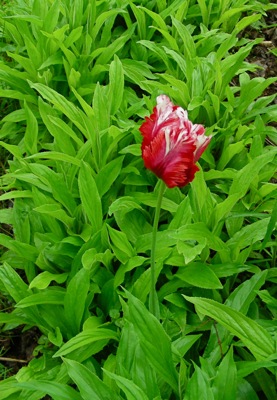
The Estella is a lone survivor, all those foxgloves (perennial D. lutea) shaded the tulip foliage until one by one they gave up
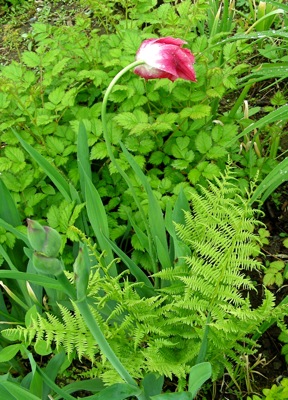
This happens frequently if you try to mix the tulips into already-crammed dry borders.

we have been having pounding rain and these are not looking too beautiful, but you get the idea. This bunch of black parrots has no competition, gets plenty of sun and is planted in extremely ( sigh) sandy soil.

Share this





Is this the same protocol for hyacinth? I just bought a bunch past flower hyacinths at the local nursery, hoping to plant them and see flowers next year.
I also brought home primrose – is it best to plant them out in a March warm spell or try to keep them alive until April or May and then plant them?
Your tulips should not have any trouble coming back, (barring deer, of course). Too much eating of anything by deer can ruin them. You have wonderful winters and cold where you are which tulips need, and hyacinths need even more than tulips. Potted flowers have also been treated to behave in such a way as to bloom in a certain time period, for sales! Most potted flowers in general are. But it can take a couple of years to get them to bloom, and if you have a favourite it is worth it. Leave the foliage on as that is how they photosynthesize to make food, but add some low nitrogen food the first year, say 2-10-10 in winter or early spring, and then 10-10-10 when it warms up. Scratching a bit of bone meal in when planted helps to shore them up, too.
Most tulips are treated as annuals here in California because of our mild winters. If we are lucky they will return, but rarely a third year. We almost ever have luck with lily-of-the-valley from the central north coast down to the south of the state. I planted some in a pot and placed it under a climbing rose and hope to see them again this year.
Primroses will bloom as long as it is cool; they dislike heat and will fade away.
That Estella Rijnveld is gorgeous!
Ilana. aargh! How have I not answered these very reasonable questions? Thank goodness Hopflower gave you a good start. To be more specific, just in case it’s not too late: the hyacinth should be hardened off before being planted out at the same depth as it was in the pot. Then proceed as though for tulip but actually you’ll have better luck. Hyacinths don’t come back strongly quickly, but they almost always DO come back, getting stronger each year.
Primroses also need hardening off; they dislike heat but greenhouse ones have been a lot warmer than it is outside, and have been so for quite a while. If they’re already out (and not frozen, my bad! ) give them a very light mulch blanket when nights go below @30.
Hopflower, welcome. I’m glad you like Estella and very glad you answered Ilana. Sorry about the tulips but if your warm winters are warm enough for things like rain lilies and cardiocrinum I’m not TOO sorry.
Out tulips bloomed this year, but in about 7 days all of the blooms were gone. I’m not sure if someone stripped them as a prank, or what. The sem an leaves look very healthy. Is there any way that I can get them to re-bloom this season?
Hi Rick,
I can’t say for sure, but it sounds as though deer or rabbits (both very fond of tulips) ate your flowers. For sure something ate them if the stems are cut off at the top and you don’t see spent petals lying around. There’s no way to get them to rebloom this season – once a year is the tulip deal – and they may or may not bloom next year depending on what sort they are and what sort of soil they’re in. If they do make flowers, whatever it is will probably eat them again. You might want to switch to daffodils, which are almost never bothered by hungry wildlife.
Leslie