
Eric’s Pet Plant: Copper Beech ( Fagus sylvatica ‘Atropururea’)
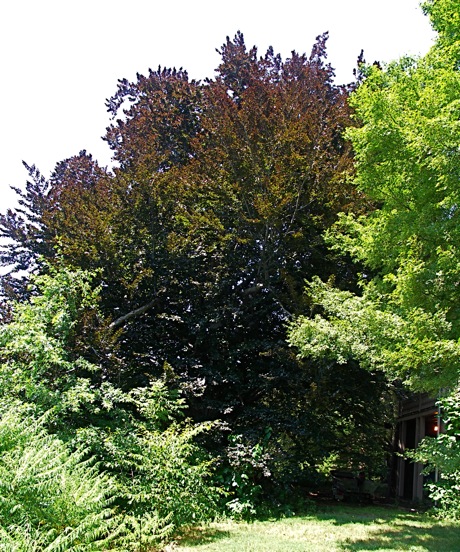
One of the copper beeches at Yale, showing the classic bronze-red color and classic full crown.
One of the great things about having Eric with us is that his pet plants are not usually the same as my pet plants, so we all get a different viewpoint (and set of growing hints). But this time around he’s making love to one of my favorite trees.
One of my favorite tree genera, actually, since I don’t think I ever met a beech I didn’t like.
Copper Beech (Fagus sylvatica ‘Atropurpurea’)
By Eric Larson
Before I proceed to the beech, I’d like to invite you all to an event on Friday, July 30, that we are calling our Midsummer Night’s Dream. The Bard can thankfully stay at rest in his grave because we will not be treading the histrionic boards, but only be paying homage to his concept.
We will have live music, light refreshments and guided tours of the greenhouses, including the new Desert Collection that Dave Garinger has been toiling over for months. Join us from four until seven as we celebrate the summer. (Click for directions.)
I got an e-mail from a Forestry School alumnus the other day asking about the locations of Copper Beeches here at Marsh Botanical Garden and at Farnum Gardens just across Prospect Street. After an exchange of several e-mails, I came to the conclusion that these beautiful trees should be revisited, even though they’re already in our pantheon of highlighted plants.
They are major factors in any landscape in which they have been allowed to mature, and are also much-beloved by the young at heart who love to climb trees and those few (love) sick people who like to carve initials and hearts in tree bark.
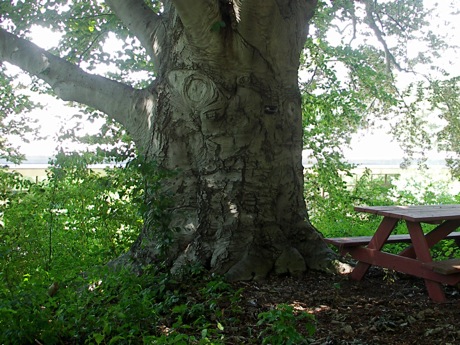
The trunk of the tree above, shown with a picnic table for scale.
This wonderful old Beech has been struck by lightning, which left a long vertical scar on the east side of the tree and probably shortened its life, although it seems healthy enough right now. The odd thing is that the Beech was purported to be the best tree to stand under in a lightning storm by the First Peoples of America. I don’t know enough about this issue, but the heavy lightning protection assembled on Marsh Hall may have had something to do with this tree being struck.
There are ten species of Beech, with two predominating in cultivation: the European Beech (F. sylvatica) and the American (F. grandifolia). All of the selected varieties (purple-leaf, cut-leaf, weeping, etc.) come from the European side of the family.
The family, Fagaceae, contains nine or ten genera, including the Oaks (Quercus) and the Chestnuts (Castanea). Fagus is the Latin name for the European Beech tree, and the species name refers to the dense woodlands that this tree is a part of in Europe. In fact, the Beech is associated with climax vegetation in both Europe and the Americas.
European Beech trees will grow to one hundred feet, but often mature and top out at around sixty, with a spread of two-thirds the height. The habit is a low-branching rounded mound. The low-branching habit makes it such a wonderful tree to climb, with convenient hand- and footholds starting at the bottom and often spaced conveniently for the human body to clamber up its structure.
These trees are slow to medium growers, with perhaps a foot a year as youngsters and much slower growth as they age. Because of this (and their particular root structure), I would consider planting European Beeches as larger specimens.
Transplanting large trees is seldom a good idea, but beeches have spreading, fibrous root systems, rather than the sort of taproots that support trees like White Oak. This means that in the transplanting process, it is more likely that the small surface-oriented feeder roots would be included in the root ball and that no disturbance of the sensitive taproot would occur.
I have helped transplant a forty foot European Beech. We dug a two foot trench around a twenty foot diameter root ball, barrel wrapped it in burlap using baling twine, and pulled it out of the hole using a metal traffic plate on the bottom, an inclined plane and a backhoe. What fun.
Planting a Beech is a gift to the next generation, however it’s done. When we removed two large Copper Beeches here at the garden for safety reasons, I planted two small ones in the same area. They are doing well, but they won’t replace those older trees until long after I’m gone. That is the just the nature of tree planting.
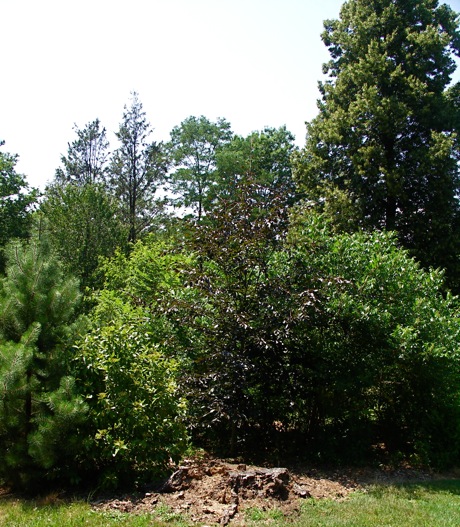
The stump of an old Beech in foreground is just in front of the young purple-leaf Beech
This bed is also planted with Rhus aromatica, Viburnums, a Pine and other shrubs and is undergoing change all the time. Sun-loving perennial plants like the Baptisia on the south side will be moved when it becomes too shady for them to thrive. (A garden is a process, not a static creation.)
If you are planting a Beech, chose a sunny spot in well-drained soil with reasonable fertility. Although not as finicky as the American Beech, the European Beech will fare much better with good soil and ample water. The tree in the opening picture is sitting on top of good water resources, as our garden is blessed with underground springs. This water helps the resiliency of a tree under stress, and also elevates growth rates.
That fibrous and shallow root system I mentioned is also an issue when it comes to planting or managing a property with a mature Beech. These trees are very sensitive to root zone disturbance, and will show signs of decline after some time due to these problems.
In an earlier article I used this image:
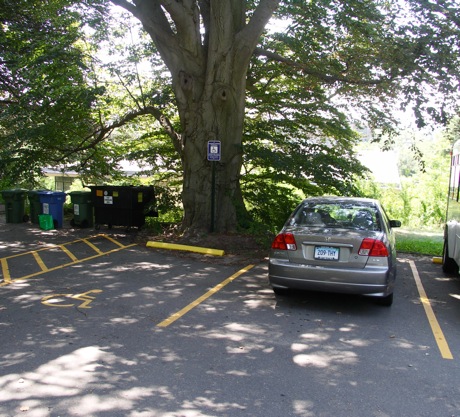
and captioned it “How not to care for your Beech: the paving is bad enough, but allowing the front tire of the handicap vehicle to overlap onto the buttress roots is a terrible precedent for a parking area connected to the original Forestry School in the United States. Not much I can do unfortunately. The top of the tree is showing signs of die-back, and while it may out-live me, it will start dropping large branches, creating safety problems for pedestrians and parkers.”
This brought a response from a reader who suggested that if the parking area had anything to do with the decline of the tree, it took fifty years to do it. I would suggest that the parking lot had been enlarged more recently than that and that subsequent ill use of the tree’s root zone didn’t help either.
So the lesson to be learned is: protect the root zone from wheeled traffic, and even heavy foot traffic. Do this by creating a mulched area all the way to (at least) the drip line of the tree, or the circumference of the birds-eye-view of the tree’s leaf surface.
The thin elephant-skin bark of the tree is distinctive, especially in winter when it stands in contrast to snow and when not much else is going on. As I mentioned earlier, this thin bark seems to attract thoughtless love-struck idiots with pocket knives who think that tattooing a tree is better than having their own hide assaulted.
There is not much a manager at a public garden can do about this but try to inform his public and hope for the best. At home, you can teach your children early on about cambium layers, tree health and the true meaning and proper celebration of a lasting relationship. Better to have them proposing marriage at Yankee stadium by dirigible than carving initials into a Beech.
Not many problems plague the European Beech, although there is a disease called Beech Decline affecting whole forests of the American Beech. There are some bark diseases that will show up, but usually the tree is already in decline if you see these. I have seen efforts to control these pathogens including pouring bleach over the affected parts, but really once you see the disease it’s a clear sign to plant a young tree nearby for the next generation.
Beech wood is not particularly stable regarding humidity, so is not used in furniture (except for use as biscuits, which expand into the slots to form a tight bond) or much in construction, although I have seen cottages sided in England with Beech slabs, so that there was enough room allowed in the installation methods for expansion and contraction due to the weather. The wood is excellent firewood, burning for a long time at a moderate rate. The American Beech nuts were used to feed pigs, and were a favorite food of the extinct Passenger Pigeon, as well as deer, bear and squirrels.
Come see the Copper Beeches here, and keep an eye out for others. There are great specimens elsewhere in New Haven and in the Northeast. They seem to like the climate in this part of the country.
Disclaimer: The views expressed herein do not reflect the views of Yale University, the Corporation, Marsh Botanical Garden, Leslie Land or even of its author, at times.

Share this





I have a copper tree european variety in my backyard, i would like to move it to the front yard and put it in the lawn. Is it a good lawn tree? Mounded? with some granite rocks around it. How big or tall will this tree get, I don’t want anything over 20 feet in the front yard. At least in my lifetime. I am 59. thanks for your comment.
Hi Ted,
If your Copper Beech isn’t too large, it can be moved, but it should be done carefully, and by a professional. My suggestion would be to find another tree that would suit that site better: it would be cheaper to buy a tree and have it planted there. Although the Beech probably will be set back by the move and won’t outgrow the limit you set, my inclination is that with the granite and the mounded soil, you might be better off with another species of tree. To really evaluate properly, I would have to at least have a photo to judge from.
Good luck!
Eric
Would like to transplant a 7 inch dia. copper beech to the center of an arrival courtyard for a new house being built. The courtyard is 63 ft square and will be for vehicular traffic to the garage. The courtyard will not be paved; however will have crushed stone for its surface. How much ‘free of traffic’ area will this tree need around it?
Beech trees have very shallow, wide ranging root systems. The shape of the above ground portion of the tree AS IT NEARS MATURITY will be a spreading rounded oval, with lower branches dipping to the ground, with a spread that is nearly equal to its height, easily reaching the 63 feet you mentioned.. Young trees are more upright, reaching for the sun, less drooping at the tips. The drip line of a tree, especially a beech, does not necessarily describe the outer reach of the root system: they extend WAY beyond the drip line. According to Dr. Kim Coder, the damage done to tree roots from vehicular passage, is severe and debilitating to some species more than others, Beech trees being very susceptible. Also according to Dr. Coder, the first event does 75% of the damage. In other words, it only takes one bozo parking in the wrong spot to damage your Beech tree. So unless you are dead set on planting a Beech, I would look for another species: for purple foliage, smoke tree, purple leaf plum, Crimson King Maple, purple-leafed birch, some of the crabapples or Quercus petraea purpures, a very nice purple-to-red leafed Oak. Any of these would be better than subjecting a Beech to the conditions you describe. If you decide that you must have the Beech: use mulch around the base of the tree, making as large a circle as you can spare from the courtyard, NOT gravel. This will help the root system, providing nutrients, cooling and water modulation, while also announcing to the bozos that the gravel is for driving and parking, the mulch is for staying off of. Plant a small tree so that it will grow into the conditions instead of a large tree which will undergo great shock and suffer the conditions much more badly. Good luck.
Eric
Eric,
Thanks for the feedback on planting the copper beech in the 63 ft courtyard. I will take your advice and try something else.
You are more than welcome. Planting the right plant in the right place is the first step to a wonderful landscape. It would have been like having a Great Dane in an efficiency apt. in Soho. You COULD do it,but it’s not fair to the tree/pooch, you or your neighbors.Eric