
The Mushrooms of Autumn (Porcini)
I take it back. Can’t talk too much about mushrooms when there are so many delicious all-stars popping up all over, so here’s our resident wild mushroom guru, Bill Bakaitis, on what may be the holy grail. I used the haul from Lois’ lawn to make a wild mushrom and caramelized onion focaccia, and the recipe for that will be coming soon. But first you’ve got to catch your porcini!
PORCINI: THE WHAT, THE WHERE, THE HOW TO FIND THEM
by Bill Bakaitis

Boletus edulis, the Porcino, cèpe de Bordeaux or Steinpilz
PORCINI, THE WHAT: These mushrooms are best thought of as a “species complex”, a group of rather similar Boletes that have a bun-shaped cap, a stem which tends to be stout and swollen in shape and which bears a white chicken wire like reticulation at its apex. The colors of the cap run from off white through the tans and browns to reddish. The taste is usually described as ‘nutty”. The variability of intergrading characteristics in the porcini poses a significant taxonomic challenge. Some of the names given to species in this complex are Boletus edulis, areus, nobilis, variipes, atkinsonii, barrowsii, chippewaensis, subcaerulescens, reticulatus, pinophilus and separans. There are others, and subspecies and varieties, and specimens which cannot be shoehorned into any known taxon. For those interested in this challenge, see Bessette, Roody, and Bessette North American Boletes (Syracuse University Press 2000). You can Google around but are likely to find websites with the disclaimer that “this page is “badly in need of revision”.

In the past,huronensis has been considered “edible’, but within the past decade a number of cases have been reported where this mushroom has been associated with rather severe, though temporary Gastro-Intestinal discomfort. Wheras identification of this mushroom often causes a headache, for many, ingestion causes a belly ache. Beginners and experst alike, beware.
If you are collecting for the pot, and not the herbarium the most important thing to look for is a substantial white reticulum on a white stem. That is the mark of a porcino, cèpe, or steinpilz, three culinary names given to this “King Bolete” which is universally considered choice.
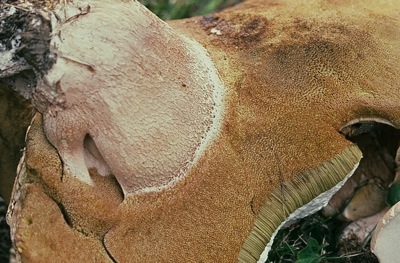
The stem and pores of a mature porcino. Note the raised reticulum on the stem.
The most common misidentification is with Tylopilus felleus which has a brown not white reticulum and has a very bitter taste. Not everyone can taste this bitterness, but for those of us who can it makes this mushroom – and the whole dish prepared with it– inedible.
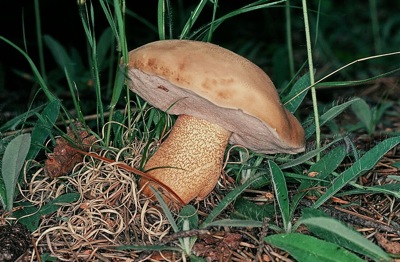
Tylopilus felleus, the Bitter Bolete: note pinkish pores, and conspicuous brown reticulum
The paramount rule of eating Boletes is to exclude any which have red tube mouths and quickly stain blue. The most poisonous are in this category. Boletus subvelutipes is the classic representative of this class in the Northeast.
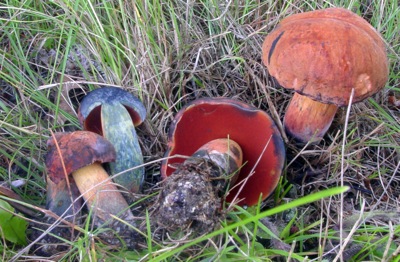
Boletus subvelutipes. Note red tube mouths and the instant dark blue staining of this toxic mushroom.
PORCINI, THE WHERE TO FIND THEM. Porcini are ectomycorrhizal, which means that they grow in close association with certain classes of trees: Spruce, Pines, Hemlock, Oaks and Birch are the ones most often cited in the literature. You will therefore want to look to the forest or other places where mature trees have been allowed to grow, such as yards, parks, or cemeteries..
They will more or less come up in the same spot seasonally and to judge from our own yard in Maine, can be encouraged to colonize new areas by the discards of an over ripe or over ambitious foray collection, provided, of course, that there are suitable host trees where the collecting scraps are thrown.
As mentioned in the Chanterelle post, my best collections almost invariably come from areas of deep glacial deposits.
If you collect these fungi you will notice that some years are much better than others. Some seasons will produce only a few specimens no matter how hard and far you look: other seasons will fill your baskets and clog your fridge and dryer. And, Oh Yes: they are better dried than fresh!
HOW TO FIND PORCINI: Let’s face it. Everyone who collects porcini has her/his own favorite and highly secret locations. Short of placing a cell phone in the master collector’s car and then reading out the geo-coordinates, you will probably want to review the previous section of this post and search accordingly. There is no substitute for time in the field.
I have found members of this complex from May to November, collecting them with spring Morels, summer Lactarius, and autumn Grifola, but by far the fall produces the best collections.
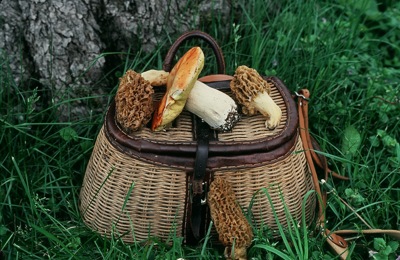
Porcini and Morels anyone?
They are often abundant after the tropical storms of autumn have soaked the forest duff. This time of year also produces the collections with the least bug and slug damage. The only notable exceptions to this rule are those specimens which can suddenly appear in the middle of a drought. In these somewhat rare cases there are no insects to infect the newly emerging fungi. They will appear however, so you have to be there and act quickly.

The cepes of summer are usually infested with worms
Porcini do not always need an old forest in which to grow. It is often noticed that a thirty to forty year old tree will produce a remarkable flush.
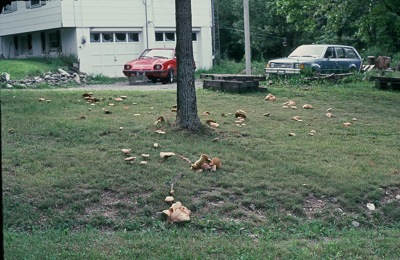
A yard full of Porcini from one tree
So go out when you can, after a late summer or fall rain is great, and investigate mixed forests over glacial deposits where ectomycorrhizal trees are found. In fall get out before the leaves fall and cover the forest floor.

easiest spotting is before leaves fall
If you can’t determine the geo-coordinates of a successful collector, do the next best thing. Join a local Mycological Association and walk with them. See NAMA http://namyco.org for clubs near you.

Share this




Bill, I took your advice about checking the Bolete info. Beautiful website. And great photos! Special thanks for the B. huronensis photo. The staining in the stipe would distinguish it from B. edulis, so I think we were right to blame the poisoning on the Leccinum.
Marilyn
Hi Marilyn,
I think for other viewers of this blog, I should introduce you and the context for this remark.
Marilyn Shaw is a poison control specialist in Mycology working out of the Colorado area. Recently she and I collaborated on a case where an elderly man developed a set of rather severe medical complications following a meal where two mushrooms were eaten. There were no mushrooms or images available to investigate, only the three-day old memories of two of the mushroom collectors who happened to disagree on some of the details of what they collected and ate. There was very little to hang a good ID upon.
One mushroom was probably a species in the Leccinum group, which does have a reputation for causing GI distress. The other was described as a ‘King Mushroom’, possibly one in the safe Boletus edulis group, as described in this blog. The medical team working one this case and I asked for Marilyn’s help as she has had considerable experience with Leccinum cases.
In the on-line discussions with several other mycologists following the report of this case there was a mention that B. huronensis has been reported to cause GI distress in some individuals. This is a rarely collected/reported mushroom and the image of what I had identified as B. huronensis appearing above is one of the very few available, and one that Marilyn (and others) were able to view and comment upon.
All of this should serve to remind beginners of the value of safe collecting habits.
Viewers of this article may wish to consult the developing B. huronensis story now (mid-August ’09) in progress at http://web.mac.com/diannasmith1/FUNGIPHOTOS/BILL_BAKAITIS_Articles/Entries/2009/8/17_DIAGNOSIS_AT_A_DISTANCE__Issues_raised_by_a_recent_case_involving_GI_Distress_and_life_threatening_symptoms_attributed_to_edible_mushrooms..html
Caution is very much in order if you are thinking about consuming even so much as a forkfull of huronensis. This is not an exaggeration!