Food and Flowers
The very first spears came up two days ago – and promptly got clonked by last night’s frost – but it won’t be long until we’ve got plenty; there’s a 100 foot row at the back of our truck garden here in the Hudson Valley.

When I got out the butter I was thinking "have a measure to show the lengths," but it doesn't hurt to remember you don't HAVE to cook it in olive oil.
It was planted 20 years ago, which means 16 years of bountiful harvests and about 5 years of asparagus posts, most recently Tips for Choosing, Storing, Preparing and Growing. Want recipes? I seem to have called it a day at Cream of Asparagus Soup (made from the otherwise discarded tough ends) and Spring On Toast, with asparagus, morels and eggs. So I was feeling faintly remiss when
Read More…
March came in with a gorgeous ice storm. Greening up on hold.
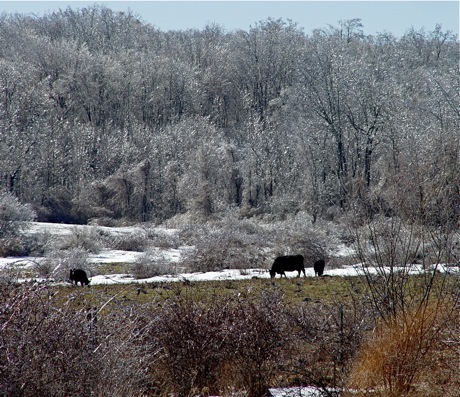
The view on March 8th.
Shortly afterward it got warmer – pleasant even – although there were still large heaps of dispirited snow in the shady spots. But gradually (very gradually), the heaps diminished to tiny piles. We heard peepers. The crocus, early iris and eranthus began to bloom.

One thing I love about eranthus are those frilly skirts. Another is their cheerful willingness to multiply.
As further encouragement, we have now had St Patrick’s day, aka Make Soda Bread day and the first day of spring and the arrival of two of my favorite fall catalogs – Brent and Becky’s Bulbs and Adelman peonies. Definitely planting time, even if it is going to be 14 – 16 degrees at night for most of the coming week.
Read More…
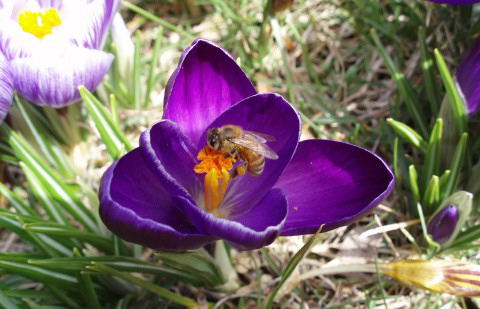
Where there are shoots, there will soon be flowers. Also bees.
I’m sure I’m not alone in feeling overwhelmed with imminent spring. It’s just so inspiring to see those fleets of tender crocus shoots pushing up; so inspiring ( in a slightly different way) to see those fleets of last autumn’s canned goods still lining the shelves.
Haven’t started raking yet, but I have been making Honey Bars, playing around with assorted vintages, pairing the perfumes of the honeys with different nuts: floral with hazelnuts, herbal with pecans, smoky with black walnuts.
That’s the thing about keeping bees: if you get any honey at all, you generally get a lot, so even though last year was a total bust we’re in no danger of running out.
The thing that’s in danger is the bees. And as Bill points out in this guest post, the first wave of threats is already pawing away at the doorstep.
Read More…
It’s that time of year again: every morning I look at the mirror, sternly, and say “ Leslie, you cannot grow everything.” Everything meaning vegetables and annual flowers. Even I know I can’t do much about my fantasies in the tree and shrub department.
Sitting cuddled up with a big pile of catalogs and a ballpoint (felt tips bleed through) is one of the best cheap thrills going, and buying way too many seeds isn’t all that much more expensive, at least compared to the trouble you can get into at an outfit like forestfarm. But this is not about that, it’s about remembering to leave room for the seeds that plant themselves.
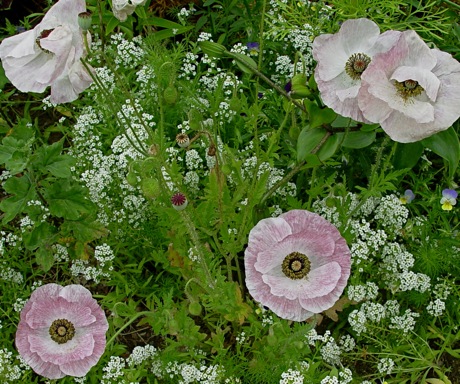
Although all colors of alyssum self-sow, white is not only the most prolific but also the most fragrant. The poppies are not fragrant, just about their only flaw.
Read More…

The words are the recipe; heat the squash, then top with cheese and peppers. The initials stand for Very Nearly Instant: about 2 minutes in the microwave, because we almost always have some baked winter squash around.
It’s one of our favorite vegetables: in the garden, where it’s quite easy to grow if you have the space, in the kitchen, of course, and up in the bedroom under the bureaus, where it’s the first thing I see – other than Bill – every morning when I awake.
Terrific way to start the day, actually. No matter how gloomy the weather or discouraging the news, here’s this good sized supply of a beautiful winter staple that’s filling, flavorful, versatile AND (blare of trumpets) requires no refrigeration, canning, freezing or other special preservation. It stays perfectly good at room temperature for an entire season.
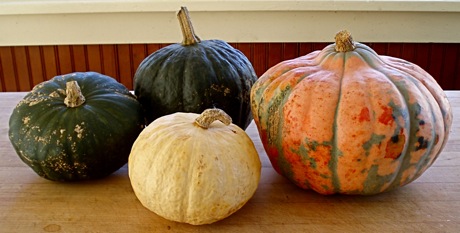
Down from the bedroom for their closeup, clockwise from left: Buttercup, Tetsukabuto, Candy Roaster Melon Squash, Queen of Smyrna.
Read More…
Nobody talks much about it, but the truth is the damn things tend to multiply.

While this is going on above ground, extension is transpiring underneath.
In the space of a single summer, one wizened little dahlia tuber can become a clutch of potatolike lumps the size of a basketball and the cannas are even worse – or better, if you’ve got a spot that could use a mass of something. Just because they got overused in the days of carpet bedding shouldn’t consign using cannas as hedging to the dustbin of horticultural history.

A section of the side yard hedge (as seen from the driveway) at the Hudson Valley house. The canna is 'Tropicana;' the neat black grass is millet 'Purple Majesty.'
This is by way of saying that – assuming you’ve got room in the cellar or garage – too much of a good thing may be just enough. And of course a bit more of an expensive thing is its own kind of gratification.
Read More…
It’s been a great tomato year so far, especially after 2009. We are well into tomato roasting, tomato drying, catsup-making and BLT’s. But it’s never too late for nature to pipe up and say don’t count your chickens.
Two cases in point: Hurricanes and Hornworms.
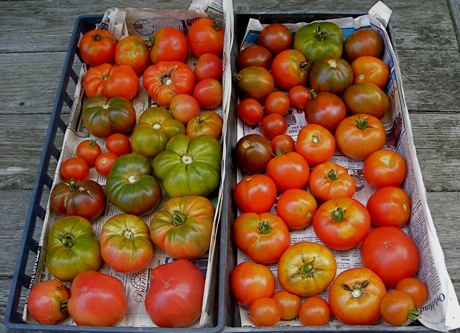
Most of these tomatoes would still be on the vine if heavy rains weren’t on the radar. The very green ones are almost ready, btw. They will still be green when ripe, just slightly yellower
Read More…
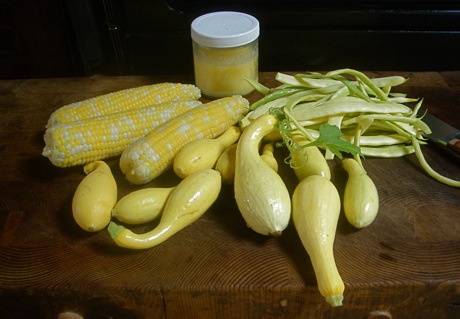
The old fashioned crookneck squash and Gold of Bacu beans are from our garden; the corn’s from the farmstand up the road and the vanilla butter* is the touch that turns them from yellow vegetables into winter joy.
Official Kitchen Garden Day was August 22, but at the time I was too busy planting fall crops, harvesting the everlasting beans and squash, canning roasted tomatoes and making plum jam to do any live-blogging, and yesterday was much the same except for an evening pizza party with freshly picked peppers, tomatoes and basil and the whole family around the outdoor oven.
If you actually have a kitchen garden, every day is Kitchen Garden Day – that’s the whole point. All spring, summer and fall, you plant and eat. All winter, you eat and plan for next year.
Read More…
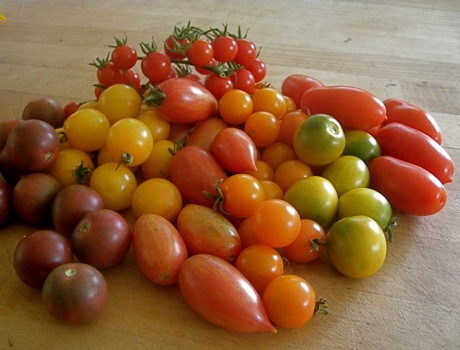
Our 2010 cherry tomatoes, left to right: Black Cherry, Gajo de Melon (yellow), Maglia Rosa, Sun Gold (orange), Green Grape, and Juliet, with Matt's Wild Cherry on top.
Like most Northeastern gardeners, I planted this year’s tomatoes with fear and trembling, still in shock from last year’s late blight and almost afraid to hope.
A certain amount of apprehension remains – in gardens it’s never too late for disaster – but so far, so more than good. Like everything else goosed forward by heat waves, the Hudson Valley tomatoes are way ahead of schedule. There are a lot of them and they are delicious. (Nothing like nights in the 70’s to make a tomato plant happy, no matter what they do to the rest of us.)
Unintended consequence: we are drowning in cherry tomatoes
Read More…

This picture was taken on 7/22, after what will no doubt come to be called The Deluge of 2010. If you don’t know what our tiny creek looks like in late July, you see a fair amount of water. If you do know, you see Niagara Falls.

Rain gauge
When we left for an evening opening at Caldbeck Gallery, in Rockland, I put an empty bucket in the driveway, carefully avoiding measurement complicators like overhanging trees and dripping eves. When we got home (after crossing three low spots that should by all rights have stopped the car, since the water was up to the doors), it was overflowing. That is not a doctored photo; we got over 8 inches of rain in less than 4 hours.
Also the lightening was nonstop throughout. Also a giant elm branch fell on the sailboat parked in my neighbor’s yard. Also many roads were washed out; basements flooded…
People are pretty much alright, however, so I’m free to say the unusual storm is a perfect symbol for the usual Summer Crescendo: way too much of everything all at once.

Fruit is ripening - fast! These blackcaps came and went in about two (glorious; I made jam) weeks.

Mushrooms are popping up everywhere. (I fried these chanterelles in butter and froze them; they were the third batch this size in 8 days.)
Read More…