“ Why won’t my amaryllis re-bloom?”
If only I had the proverbial dime for each time a reader wrote to me – at the New York Times, at Yankee, at (oh distant past) McCall’s – asking that question, I’d be rich. And if there were also dimes for “ why didn’t my daffodils flower?” Bill Gates would have to look to his laurels.
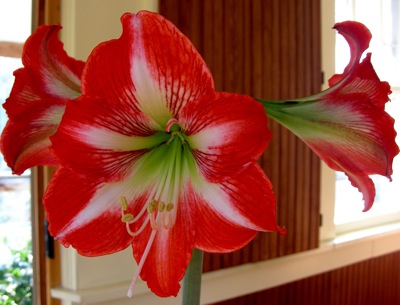
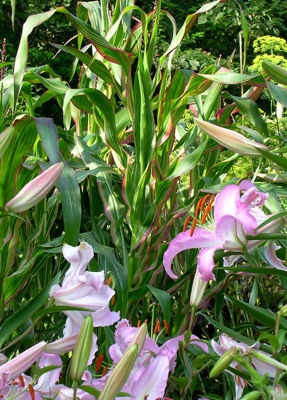
Amaryllis reblooming; this one is about 5 years old.
Answers were and are mostly about getting enough sun on the leaves that feed the bulb. Flowers for next year are already formed when these bulbs go dormant, so the stronger they are at that stage, the better the flowers will be. Good drainage is also essential, especially while the bulbs are leafless. And they prefer near-neutral soil, though they can make do in most cases.
Wet or very acid soil, shade, leaf-braiding and cutting leaves before their work is done are the most likely suspects when amaryllis or daffodils won’t flower. But there’s also another culprit that gets a lot less attention: the narcissus bulb fly, Merodon equestris.
Read More…
Familiar battle lines are being drawn. Salts of the Earth versus Clueless Elitists. Some farmers in California are up in arms about Proposition 2, which bans tight confinement of animals. They’ve started a secessionist movement to divorce the state’s agricultural heart from its cosmopolitan coast.
As this New York Times article about it makes clear, ain’t gonna happen. But it does underline the huge gulf between most traditional farmers and most consumer activists (and not just in California). Read More…
That’s “trellis” as in “utilitarian structure that holds up annual vines and comes down at the end of the season,” and the way we build them is with simple uprights and really a lot of untreated twine.

pole beans on sapling trellis, woods left and straight ahead
In Maine, we use saplings from the surrounding woods – they’re handy, they’re free, and because they’re nothing more than little trees they tie the riotous, colorful garden to its wild environment.
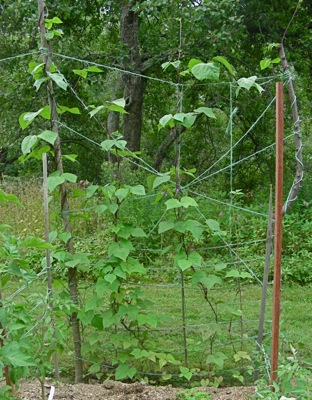
string and sapling trellis (please ignore oak posts in foreground)
This bean trellis was created by Kristi, who had evidently gotten bored with just running vertical lines. Beans would rather go up but will travel horizontally if encouraged. The spiderweb was completely covered about 2 weeks from this picture.
In New York, where there’s no convenient sapling source and the garden is if not formal at least orderly, we use 8 foot oak 2×2’s. Read More…
Are they an Eek of the Week or are they too old hat? I just discovered them yesterday, in a flyer I was leafing though after lunch to avoid going back to work. THERE’S an eek, sez I, a little plastic cup in the landfill for every cup of home brewed coffee. So much for greener than takeout.
My George H.W. Oh boy is he ever out of it Bush moment. I did know disposable pods were part of the espresso boom, but until I went to Amazon to check how common these things might be…
OMG. Double eek. But there in the list was an oddity that almost defies imagination: ” The Java Wand is a portable, single serve, miniaturized French Press filter attached to a durable, hand blown, glass straw that brews and filters coffee and tea leaves in your cup.”
If any of you have ever used one of these things, please send us a review. I burn to know, I really do.
Just in case that might be on your mind, today’s heartfelt plea is

Not yet!!
At least not in the Mid-Hudson Valley or most places north of here.
Having just been in the cutting garden getting an eyeful of dead material, I know the temptation is huge.
Resist. It isn’t yet time to encourage new growth. And I know ( having more than once said ” oh, it won’t hurt”) that if you prune properly, cutting past anything that looks weak, all the way down to a strong node, that node now has a wounded tip exposed directly to any hard frost that happens to come along.
This doesn’t keep me from removing ( and burning) the bulk of the dead stuff. I just make sure to stay well away from anything living, no matter how weak and wimpy, until safe pruning time comes. It’ll only be a couple of weeks — let us hope!
In our part of the Hudson Valley there’s still snow on hard ground in all the low places. But Sunday morning is clock-switching time and the forecast is for everything that’s usually loathsome about March. Furthermore, the stores are festooned with shamrocks and leprechaun hats and green crepe paper ribbons. Two good things to be said for the decor:
1. It reminds you to make soda bread.
2. You are warned that it’s almost pea-planting time, since tradition says you’re supposed to plant peas on St. Patrick’s Day. Where this tradition began nobody seems to know, but where this tradition makes sense are places – like Ireland – where March 17th really IS (more or less) what seed catalogs and garden guides call “ as early in spring as the ground can be worked.”
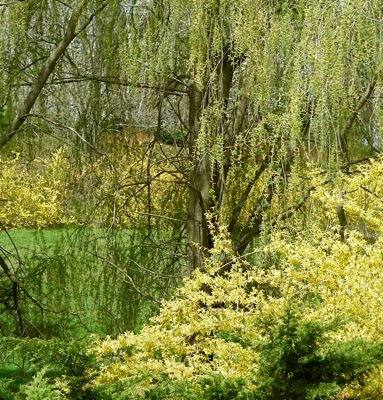
Not folkloric enough? How about “when the forsythia starts blooming?”
Read More…
isn’t the one that’s most delicious or the one with the prettiest kernels. In fact it tastes terrible and you can’t see the kernels at all, because the corn I have in mind is Zea mays var. japonica, usually sold as Zea japonica or Japanese ornamental corn.
Zea mays var. japonica
Whatever you call it, it produces brilliantly striped green, white and pink foliage, starting quite early in the season. First growth is plain green, but as long as the leaves get plenty of sun, they start coloring up when the plants are about 3 feet tall.
Read More…
“But how did you stand the winters?”
Anyone who’s lived in Maine year round and now doesn’t will be familiar with this question. There are lots of good answers but right now all I can think of is Northern shrimp, Pandalus borealis, the glory of the Maine winter, sweet, tender and buttery.
Like the wild mushrooms of the warmer months, Maine shrimp are a gift of place. If you’re near the coast, they’re everywhere, especially in a good season. Never mind fishmarkets and grocery stores. Trucks! By the side of the road. Two or three dollars a pound. Or you can be part of community supported fishing (CSF), pay in advance and be confident of the freshest and best every week.
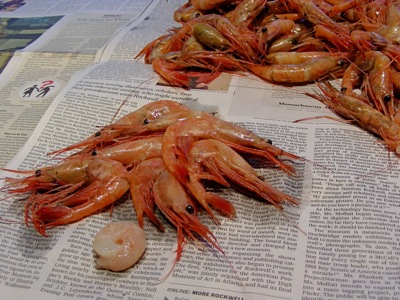
Typical size is 40 or 50 per pound (headless)
The farther they must travel, the more they cost. But even at the 8.00/pound I recently paid in Manhattan out of a giant fit of homesickness, they’re a bargain. And talk about easy to cook!
Read More…
Thought for the day, on the arrival of the final shipment of vegetable seeds: What made me think I had room to plant 7 varieties of peas?
Thought for the week, on lusting after a truly gorgeous, frighteningly minimalist modern garden seen in a magazine: What makes me think I could ever give up summer bulbs?
Even a brief pass through the catalogs of Willow Creek Gardens and Corralitos Gardens is enough to produce a wish list of gladioli, eucomis, tuberoses and dahlias that would fill about a quarter acre I don’t happen to have.
But how to choose? If your dahlia collection included

Babylon Bronze
and you were not all that into dahlias, would you really need

Blown Dry
Read More…
As Dave Barry is wont to say, I am not making this up.
As usual with the Times, the interesting agricultural news is over in the business section. First paragraph below gives you the flavor; click on the title to read the whole thing.
By Andrew Pollack
Published: February 19, 2009
Biotechnology companies are keeping university scientists from fully researching the effectiveness and environmental impact of the industry’s genetically modified crops, according to an unusual complaint issued by a group of those scientists…