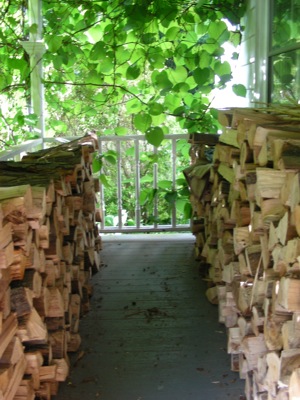
When firewood suppliers who sell by the cord or truckload say they’re selling dry wood, they mean the trees were cut down some time ago. They do not mean the wood was fitted: cut to length and split, more than about 5 minutes before it went on the truck. So if you want firewood dry enough to ignite easily and burn cleanly next winter, now is the time to order it and get it stacked out of the weather.
HA! No such thing. But if you want to make sure you don’t buy something like

this
and wind up with something like

this
Read More…
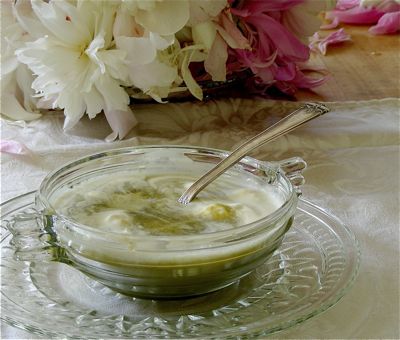
A smooth puree, accented with tender-crisp asparagus coins. Just the thing for these oxymoronic hot spring days, when it’s officially asparagus season but experientially August. We’ve stopped cutting but I see there’s still reasonably local asparagus in the stores. Read More…
is almost ( not always) a good thing. But straw isn’t always the best mulch to use.
It’s ideal for tomatoes

These tomato babies have their bases covered in more ways than one.
Strawberries, on the other hand, do better when mulched with pine needles, aka pine straw. Pine needles are slightly acid, which strawberries like, and they’re more inclined to lie flat. This is important for very short fruit plants. Fluffy oat and rye straw tend to shade low leaves, and leaves need sun to make sweetness.

are the happiest tomatoes. Well, not really. Gentle, consistent warmth is what tomato plants want – not only on their leaves and flowers ( tomato pollen is sterilized by temperatures over 85), but also around their roots, which by the way – news flash! – prefer to stay moist.
Tomato Planting Tips
By now your seedlings are probably planted, so it’s too late (for this year) to say the first line of defense is deep planting – set the baby so 1/3 to 1/2 of the stem is underground. Useful new roots will form all along the buried portion.
I used to think it was important to remove leaves and suckers before burial. Bill made fun of me. We did a side by side experiment. He was right; didn’t matter a whit. One less thing.
Ok. They’re in there. Now what? Two things
1. Mulch, really a lot of mulch. We use a thin layer of newspaper – just one fold – under a largish pile of straw. This holds moisture in the soil and helps keep roots from frying. I put my hand down on the uncovered earth when I was weeding yesterday and it was HOT. Not warm. Hot. Not good.
 Tomato mulching in progress. The brown paper grocery bags are a thicker weed (and water) barrier. Helpful if your raised beds are really raised. These are about a foot above the paths.
2. Limb them up. If you have no problems with fungus diseases you can stop right here, but if blight has ever visited you, read on.

The scar is difficult to find, but if you look closely at the left side of the stem you’ll see the scar where a branch used to be.
Removing lower leaves and suckers so the stem is naked at the base accomplishes two things:
1. It provides good air circulation, an absolute necessity ( crowding is the mother of disease).
2. It deprives the fungus spores of handy landing spots from which to travel upward. In theory, a timely application of mulch will block spores so they cannot splash up. In practice, it helps but not enough to be relied on exclusively.
Actually, one of the earliest isn’t a peony – and it’s late: it’s a peony flowered tulip, one of the last to bloom.

Kristi Niedermann
This photo of ‘Mount Tacoma’ was taken just a couple of days ago in Maine, where the peonies themselves are still a (semi) distant promise.
Here in the Hudson Valley – functionally about 2 weeks south – the real deal is starting to pop, beginning as usual with one of our inherited mysteries.

It looks a lot like ‘Cincinnati’. But ‘Cincinnati’ is midseason and this is among the earliest lactifloras to open. ‘Magenta Moon’ seemed likely until I looked up the date (on the Peony Checklist , provided by The American Peony Society). No good. ‘Magenta Moon’ didn’t rise until 1995, by which time the peony had been in place at least 15 years.
Truth is I haven’t done much research – scrolling though peony pictures is far too dangerous. No matter how swiftly you move the cursor, to look at peonies is to want peonies, especially at places like Klehm’s and La Pivoinerie D’Aoust,
One good thing about peony lust is that it tends to supplant tulip lust, so I probably shouldn’t mention it, but here’s an aspect of ‘Mount Tacoma’ that isn’t part of the usual descriptions: Given very well drained soil and not too much fertilizer it comes back – at least in Maine, where mine have been returning faithfully for at least a decade.
More often than not the deer eat them (that’s why I stopped planting more in 1997) but that’s no knock on their longevity. ‘Mount Tacoma’ was introduced in 1924 and is still one of the most common whites, available almost everywhere, but just for the record I got mine from Scheepers.
Bill happened into it when he was out fishing near Esopus creek, famous among fishermen for trout and among foodies for one of America’s most delicious apples, the Esopus Spitzenburg (frequently lauded by Thomas Jefferson), about which more some other time.
He was walking through the woods back to his car and there it was, barely dry and still wobbling. It went to ground immediately. The doe was in the underbrush, snorting. He could have picked it up and carried it away, thereby saving somebody else’s garden a lot of trouble, but of course he didn’t.

Bill Bakaitis
Newborn fawn in the woods on public land. The blue paint on the tree is a forest service mark: “this one is to be cut down.”
Back last November, after going on at some length about leaf sweepers, I promised to discuss growing chrysanthemums like this football – ‘Ticonderoga’ –
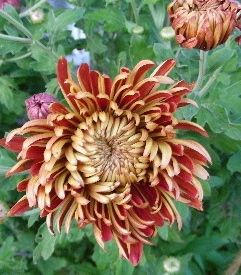
at the proper time. Which it more or less is.
For growing instructions:
Read More…
Being the part(s) I should have mentioned last post. The azalea is a very early bloomer, and it’s growing in the mid Hudson Valley, zone 5b, where many very spiffy azaleas are – at least theoretically – not hardy. According to the USDA, our average winter lows are somewhere around 10 below. According to recent history, it’s more like 2 or 3 below, max. But still.
Also neglected to show a mugshot in which the freckles were easy to see, so here they are:

Can Anybody?

Here’s what we know about it:
It was here – and huge – when we got the house, 17 years ago.
It’s evergreen.
It blooms reliably every year (and abundantly, now that we have deer fencing).
It is fragrant, more in some years than others. Always with a very light, sweet clean laundry perfume that completely suits the flowers.
It has very long internodes, even when I prune it which I usually don’t.
the leaves are fuzzy
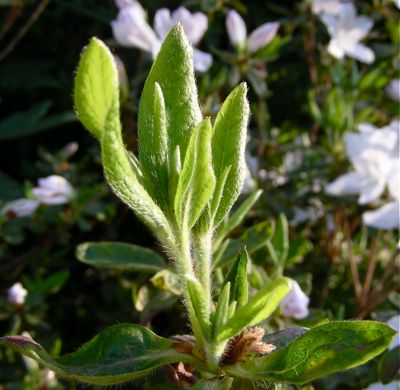
and they get occasional splotches of some kind of rusty fungus that doesn’t bother them. It doesn’t bother us, either, because the bush is on the far side of the yard, and we don’t cut the flowers for the vase.
Every spring when I go plant shopping I bring along a flowering branch. No nursery I’ve visited has had a clue. Everybody just says ” it must be something old.”
The closest thing I can find is R. mucronatum, but that’s described as a semi-evergreen that blooms midseason and is hardy only to zone 7, so it’s a case of “close but no cigar.”
I’d love to know what it is. I’d also love to know why it was planted next to a bunch of leucothoe, the stinkiest bloomer in all shrubdom whatever its other virtues.