Talks coming up at each end of the summer.
June 26, 6:30PM, Thomaston Public Library, Thomaston, Maine, Art in the Environment lecture series:
Your Own Private Environment: At Home in the Garden
A lot of what matters inside matters outside too: a comfortable flow of traffic from place to place, plenty of light, individual personality in the décor department and of course a terrific kitchen (aka vegetables). I never know until the last minute, but it’s safe to say I’ll be discussing basic cottage garden design; integrating food plants with ornamentals; and durable garden embellishments from homemade twig arches to antique urns.
September 12 – 14 Coastal Maine Botanical Gardens, Boothbay , Maine
Maine Fare – The 3rd annual get-together focussed on Maine Food: tastings, marketplace, workshops, demos, talks and a couple of very special meals. As usual, I’ll be holding forth on eating locally in a cold climate and demonstrating tasty strategies that make it easy to do. As usual, that’s all I know right now. Please check the Maine Fare Website frequently for detailed updates on the whole weekend’s offerings.
Update: Mainefare for this year has been cancelled, but that doesn’t change the “please check the website” part. Planners tell me they are doing this in order to make 09 even more wnderful and there are rumors of interesting sub-events to still be held this fall.
It has been several years since bears first came through our yard, knocking down the birdfeeders and leaving unmistakably bearlike deposits to corroborate the neighbors’ sightings: a mother and 2 cubs. The beehives remained untouched so we remained unconcerned, even though we should have known better.
As summers passed and nothing else happened, we stayed (relatively) unconcerned, even though Dan right down the road reported several ursine visits that played hell with his hives.
This year, the Dan reports were scary: a mom and cubs and a singleton, presumably male. In the yard. In the hives. On his porch.
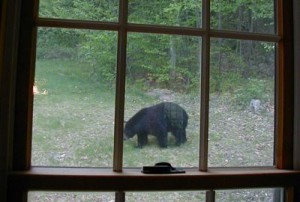
Dan Connors
View through Dan’s sunroom window
When he chased the solo in his car, lights flashing and horn honking, it retreated to the edge of the woods. When he backed up it emerged, more or less thumbing its snout.

Dan Connors
And Then it came for us
As Bill wrote to a friend on the 6th of May:
“This morning we awoke to find our beehives and bird feeders all torn asunder. I had just spent $170 for 2 packages of new bees and they had just released the queens and were just getting settled in their new homes when this happened.
I spent the day rebuilding the hives and installing an electric fence around the hives. If you hang some bacon on the wires, so we hear, the bears wrap their tongue and lips around it and get a good jolt.. We are eagerly awaiting their shocking bellows.
A mother and two cubs and another solo have been raising havoc in the neighborhood. DEC said that, since the bees are livestock, I can shoot the bears. They will give me a permit for and provide me with, rubber buckshot if I wish. They would also like to come and grab these animals so for to give them a collar… Once they have good data to justify a hunting season they will allow hunting for them in this county.
In 1990 there were @ 400 bears in the Catskills (across the river). By 2005 the population had grown to 4,000 to 5,000. @ 500 were taken there last fall….”
So far Bill’s fence has not been challenged – or at least we have heard no bellows and the bacon appears undisturbed. (More points for crow smarts? They are expert compost-pickers, ever alert for a bit of protein, but they haven’t come near those wires, even though they should be immune.)
Here are the fence details Bill sent to Dan, should you wish to build a solar powered electric bear deterrent around anything:
“ I went ahead with the more expensive unit (Zareba SP10). It also happened to be just about whatCornell and Bee Culture (via Cornell apiarist) recommend. It puts out just about 5,000 volts and 0.17 joules.
It is good to see it snapping sparks for @ 3/16 inch over the raindrops!!!
I strung my wires alternating hot (+) and ground (-) with the lowest wire 6″ above the ground and the top wire ground (-) for lightning protection. Since I used steel posts the ground wires are wrapped directly onto the posts. I used 12 gauge copper jump wire to connect the hot wires as well as for the lead from the controller. I suspect I could make a slight improvement if I grounded the unit to the steel posts as well as the usual ground rods.
Forty or fifty years ago, the owner of our house planted a LOT of peonies, and by the time we got the place they were huge. Also, in many cases, overtaken by shrubbery.
When we dug the shaded ones to move them we found huge giant knotted rootballs the size of refrigerators. So we divided them and had even more peonies. Three kinds of peonies: dark red, pink and white. (Read more about them – and get some growing tips here)
Theoretically you can’t have too many peonies but I’m here to tell you you can have enough – if they are all the same damn 3 colors. And having a few extra early ones that are magenta does not help, on account of their being magenta.
But we also inherited some fern leaf peonies (read about them – and the lowdown on ants – here) and the fern leafs, more properly Paeonia tenuifolia, were so beautiful and so different they opened an irresistible door.
At least that was my excuse 3 years ago, when I bought a nifty woodland peony at Trade Secrets.

Japanese Woodland Peony, P. japonica. At the time it had I think 4 leaves and zero flowers. It would be nice if this one also developed refrigerator sized roots, but it won’t. As soon as they’re bigger than produce drawers I’m going to divide them.

Those shirred silk petals really knock me out, and the foliage is nothing to sneeze at, either.
Lulled into hubris by this success, I thought last year I could get away with buying a moderately expensive seedling of P. mlokosewitschii, instead of a seriously expensive guaranteed division. The guarantee was that the flower would be pale yellow, a rare color in peonies.
And nonexistent in my plant. I was warned the seedling might turn out to be magenta and you can guess the rest. Bill thinks it’s beautiful. I do not. But the leaves are absolutely gorgeous and the flower is fleeting, so it’s not a total catastrophe.

Seedling of P. mlokosewitschii. The cheapskate’s reward. There is a better picture of a magenta flowered seedling – and one of the real deal – over at my almost neighbor Margaret Roach’s blog, A Way To Garden. But as you can see by comparing the pictures there is a lurking mystery; her seedling’s leaves look so different I’m not sure we have the same plant. (She got hers from Seneca Hill. I got mine from Hillside Nursery.
Next time I head for the hills I’ll pay full freight, though I may have to hock my toes to do it. There are around 2 dozen species peonies that could grow here, and more and more of them are making their way ( expensively) into commerce.
Hot then cold, dry then deluginal then dry again; it’s been a difficult spring. But this year the Northeast is having an excellent morel season, so there is definitely something good to be said, namely

Blonde morels, Morchella esculenta, get ’em while you can.
The place to get them is in open woodlands or hedgerows, where the soil is alkaline. They frequently keep company with dead elms and dying apples (and poison ivy, I’m sorry to say.)

Bill Bakaitis photo
Morels in a typical habitat. Look to the left and back of the one in the middle to see more. They hide.
Field cleaning ( shaking out bugs, trimming dirt from stems) is essential, and it can be enough if the morels are growing through matted leaves or thick new growth. But a lot of them are in sandy spots or open ground where dirt has splashed up. Always carry a separate bag or basket to put the dirty ones in, so they don’t contaminate the rest.

The little heap at left in front are the dirty ones from this expedition. The little heap at the right is trimmings. Morels last a long time in the fridge if you trim off anything nasty before you put them away, loosely wrapped in waxed paper so they can get air without drying up.
When you get this many, they will dry up before you can eat them all. We used to do this on purpose, threading them on string and hanging them in the greenhouse. Morels are thin fleshed and dry quickly, concentrating the flavor. But for the last decade or so we’ve been mostly stewing them in butter and storing them in the freezer. They keep better texture that way and are much more versatile.
The frost I feared last week (see below ) was a doozy all right; 25 degrees at 5AM on April 30th. Theoretically, that’s normal. Frost-free date for this area is supposed to be May 10th. What’s abnormal was the whole rest of April, which had very few frosty nights and many days with temperatures in the high 70’s to low 80’s.
That heat produced a premature explosion of new growth, tender young succulent stems, leaves and flowers defenseless against cell bursting ice.
Result? The magnolia of course got trashed – what was left of it. But the plum and apple blossoms were spared and to my everlasting surprise and delight, the Viburnum carlesii came through unscathed, every perfumed petal intact.
However. Carnage was visited upon: a large clump of trumpet lilies, wisteria almost in bud, the Miscanthus ‘giganteus’, which was already going great guns, and a beautiful Japanese maple, new last year, that has been my pride and joy.
It also made mush of the bleeding hearts,

Before frost, under the viburnum.

and heaven help us a peony. Just one, and not too badly, but still. A PEONY! Is nothing safe?
The answer, unfortunately is no. Most of the worry about global warming is focussed on droughts, floods and overhot summers, but there’s more to it than that. Unwanted warmth followed by VERY unwanted cold is going to be a fact of life from here on out. To deal with it:
* Plant new spring bloomers as though they were fruit trees: on a north slope, so heat comes late and frost drains away.
* When you remove winter mulch to avoid smothering fresh shoots, keep the mulch material nearby, so you can rake it back over them if/when frost threatens.
* Resist the temptation to prune the roses. You don’t want to encourage the new growth, and leaving the dead and weak stems in place helps keep frost-produced dieback above the wood you want to keep.
* be sure you have a supply of floating row cover aka spun-bonded crop-protector. It’s much lighter than bedsheets, far easier to use, and although it’s ungreenly made of plastic, it lasts practically forever if you take good care of it. Sources include Pinetree Garden Seeds and Johnny’s Selected Seeds
This doesn’t mean you can turn those sheets to rags; the row cover is only good down to about 28 degrees; if you fear even greater misery, use sheets. Either way, remember the purpose is mostly to trap ground heat; a hat that simply keeps frost from touching tops won’t help unless the frost is very light.
For more tips, see the advice posted last fall; a lot of it is useful at planting time.
Like every garden writer in the history of humankind, I’ve spent my entire career begging ” don’t blow the whole wad on spring. If everything in the yard is done blooming by the 4th of July, how boring is that.”
But then every year about this time I’m glad the people who owned this house before us – in some cases WAY before us – believed in planting the usual.
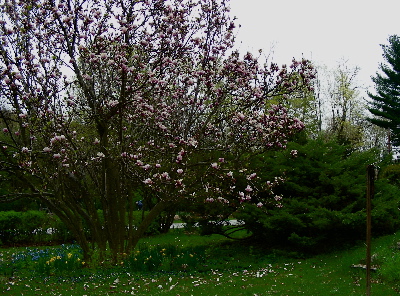
Actually, for our first decade or so I DID have mixed feelings about the magnolia, which would routinely just start opening into a huge glorious pink cloud and then there would be a frost and believe me a huge brown cloud is not glorious. Then things got warmer and it routinely escaped; we got a whole month of being happy that this giant unit eats about half the side yard. This year, however, after about 10 days of splendor it’s already going over. Eighty degrees is not a whole lot better than 29 from the magnolia longevity point of view.

The amazing thing about plum blossoms is that they smell exactly like the cheap plum incense that perfumed so many groovy abodes in the 60’s. Bees love them, though, so when you stand under the trees you see and hear a very cheering assortment of these threatened creatures.

In contrast to the plum, the viburnum ( carlesii) smells wonderful. Like itself and only like itself, a sweet, non-cloying New Englandish perfume that fills the entire yard on warm evenings and justifies the existence of an otherwise unexciting shrub and if it really does freeze on Tuesday night and clonk it when it’s only about half-open I’m going to put face in my hands and weep. This post hints at my addiction – and offers a few seasonally appropriate garden tips. (Appropriate if you’re in the lower Hudson valley, anyway. And it doesn’t up and snow)
Gotta hand it to eggs. You can use EVERYTHING, including the shells, an extremely sharp-edged material that is almost pure calcium.
In the house:
* great for cleaning narrow-necked bottles and vases. Crush a shell, working it between your fingers so the bits aren’t stuck together. Stuff it into the bottle, add a small amount of very hot water and swish/shake vigorously until all looks clean. Pour out, catching the shell in a strainer in case you missed a spot and have to shove it back in.
In the garden:
* Dig one or two thoroughly crushed shells into the soil around tomato plants. The lack of calcium that causes blossom end rot is usually a result of inconsistent watering but a little extra insurance never hurts.
* Rinse and dry shells, then crush to roughly rice grain size bits and spread a carpet of them under hostas and similar plants to discourage slugs and snails. Many advisors say “sprinkle” the bits, but a sprinkling won’t have much effect in the deterrent department. This carpet is not beautiful. You can make it a little less sock-in-the eye by soaking the crushed shells in strong tea for several days to stain the white parts brown.
* Excellent in the compost. No need to crush if you don’t want to bother, but as with everything else, the smaller the piece the sooner it rots.
* substitute for peat pots. NOT. In An Island Garden (1894), Celia Thaxter charmingly describes starting poppies in halved eggshells. It sounds like a great idea: Biodegradable, easy to transport and free. In my experience, however, it’s difficult to get the shell halves reasonably even, even when you hard boil the eggs so you can slice them across. Then you’ve got to bore a drainage hole ( darning needle better than icepick). They don’t hold much soilless mix, so they won’t support plants for long. And then you’ve got to fracture them before planting so the tiny roots can get out. Applying just the right force to the squeeze is an art all by itself.
Having just said goodbye to too many reminders that eggs are – or were – seasonal, and thus a symbol of spring rebirth, I won’t go into it except to point out that the best eggs still ARE seasonal, and that there’s a huge difference between an egg that’s as good as an egg can be and a conventional mass-produced egg.
Well-treated chickens that are not fed things you don’t want to think about produce tastier eggs year ‘round, but the eggs that are really worth crowing about are super-fresh local eggs from hens that spend a lot of time outdoors getting exercise and fresh air, eating bugs (concentrated protein, lots of minerals) and green vegetables. ( Many kinds of dark green leaves are rich in carotenes, precursors to vitamin A and a much better way to have deep yellow yolks than putting annato – a spice that acts as a yellow dye – in the chicken feed).
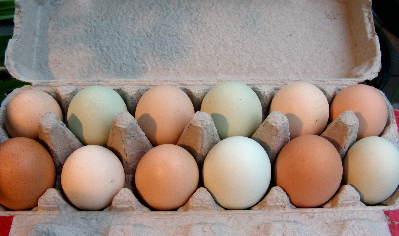
These eggs come from Ilana Nilsen, who sells her backyard eggs at farmers markets and at a store in Millbrook, NY called Best Creations. This is nice to know if you happen to live near Millbrook, but what’s nicer is that there are good local eggs just about everywhere, if you bother to look, and there are likely to be more and more because Ilana isn’t the only person who just wanted a few heirloom chickens and wound up with more than she bargained for.
Read More…
It’s spring! Time to evaluate, improve – or possibly discard – your current collection of houseplants. But it can be hard to see old friends clearly; loyalty gets in the way. The fix? A field trip to the nearest public conservatory. Botanic gardens, universities and colleges all over the country have greenhouses full of wonderful plants and these include (more often than not) humongous, obscenely healthy versions of those meek green units in the living room.

Your fiddleleaf fig could be 13 feet tall too, although you might be just as glad it’s not.
Tropical orchids, ferns on steroids, fragrant blossoms dripping from vines and trees – even the smallest of these places puts spring flower shows to shame. And small can be especially beautiful. Displays will be far less polished but publicity is nonexistent, which means they’re seldom crowded. Call ahead to find out the slow times and you might be the only visitor.
What a deal, especially in raw, cold March. What’s not to like about peaceful warm rooms filled with tropical beauties that somebody else has been taking good care of for years and years and years?
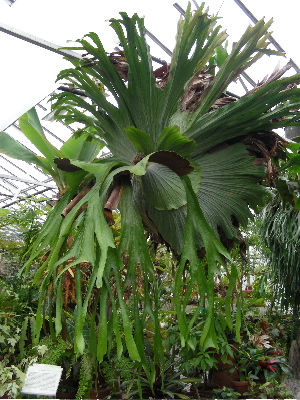
This staghorn fern, more than 6 feet across, was not built in a day.

It also takes more than a moment to grow a good sized flock of birds of paradise.
Oddly enough, seeing one’s familiar home companions in this new light is more energizing than depressing and there is almost always something to learn: When a fiddleleaf gets old, the bark gets gorgeous; dormant orchids don’t look any better when there are 60 pots of them; pruning matters as much indoors as it does in the yard; and whether camellias are worth the hassle may be a function of heritage. Could be you have to be southern.


Oh right, I forgot to mention fruit. In addition to proving dwarf citrus trees CAN produce something that looks like a crop (those are ponderosa lemons, not grapefruit), these places harbor edibles most of us can’t see without buying a plane ticket.
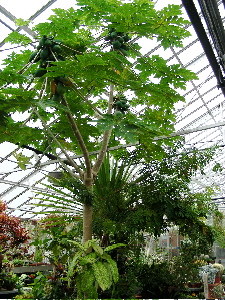
Papaya tree at @ 16 feet ( those dark footballs are the papayas)
The base of the tree is fat, gray and gnarly; the roots go right through the gravel floor, deep into the deeply alien Hudson Vally soil.
But not for much longer, and thus we come to the carpe diem part. These pictures were taken at the greenhouse that belongs to the Cary Institute of Ecosystem Studies, in Millbrook New York. It will be closed before the end of March, its collection dispersed, the building dismantled. Gone forever after more than 30 years.
And it’s not likely to be alone. Glasshouses cost a lot to heat; older models cost really a lot to heat. As the price of oil sails ever upward while funding for public institutions shrinks and those institutions start thinking about greenness in a different way …
A bit of creative googling is likely to turn up at least one that’s close to you, but you might as well start with the advanced garden search at the American Public Gardens Association and the international list at Gardening@Closerange.com.
Is it just wishful thinking or are there really somewhat fewer green glitter shamrocks (and similar) this year? Not that I have anything against the good Saint, and I know Irish immigrants have made huge contributions. But it’s always seemed like a bit of a stretch to make the thing into a National Holiday. The only reason I can see is that, Easter being a movable feast, you have to be sure there’s something you can celebrate in March.
On the other hand, it’s useful to be reminded of soda bread and potatoes, two splendid foodstuffs that get a lot less respect than they should.

Soda bread fresh out of the oven. The funny looking butter pat is because the very good cultured butter is packaged in a fat plastic tube (the better to preserve its freshness, I assume), by Vermont Butter and Cheese.
SODA BREAD
Properly made, with a good proportion of fresh whole wheat flour, without any fat or sugar, this is probably the loveliest, most intensely bread-tasting bread you can make without yeast: crisp crusted, tender crumbed, the partner for which butter was invented – or so it seems when you have that first chunk. It takes less than 5 minutes to prepare and about 40 minutes to bake, so adding in oven heating time you arrive at a one hour wonder. Admittedly, it doesn’t stay wonderful too much longer than that; but omigod, what terrific toast.
A word about oven-enhancement: Putting this on a flat pan and baking it will produce delicious bread. Putting it in a heated iron kettle and covering same with a hot iron lid will produce bread that is delicious plus. (The cast iron evens out oven heat and the lid traps steam, enabling you to get a crust that’s crisp without being hard. ) This technique got a recent boost from Mark Bittman, who uses it to good effect for a no-knead “European-style boule”, but of course it’s nothing new. They don’t call those kettles Dutch ovens for nothin.’
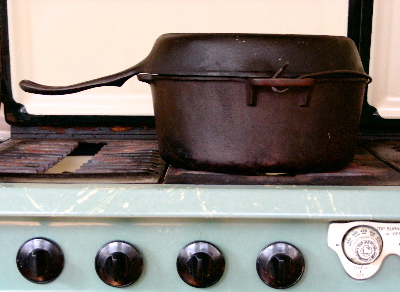
Actually, this is a chicken fryer – terrific pan, btw, just like a Dutch oven but shorter – given the necessary height with a make-do lid.
For one 8 to 9 inch round
1 ¼ cups unbleached flour
1 ½ tsp. salt
1 tsp baking soda
2 ¼ cups whole wheat flour*
@1 ½ cups buttermilk
cornmeal to sprinkle on the pan
1. Heat the oven to 425. If using an iron pot, put it and the lid in to heat up about 5 minutes before you start the dough.
2. Put the unbleached flour, soda and salt in a large bowl and stir with a wire whisk until well combined. Stir in the whole wheat flour.
3. Using a wooden spoon, make a well in the flour and pour in most of the buttermilk. Mix thoroughly, quickly, adding additional buttermilk as needed until you have a soft, slightly sticky dough. Lightly flour your hands, reach in and knead just enough to bring everything together, then form the dough into a round.
4. Sprinkle cornmeal on the baking sheet or the bottom of the hot heavy pot. Place the dough on it, seam side down. Use a sharp thin-bladed knife to cut a cross about ½ inch deep into the top of the bread. Put on the hot heavy lid, if using, and put the pan in the oven.

Ready to bake. You can’t really see it but the cornmeal is smoking slightly. Not to worry.
5. Check after 30 minutes. The bread should be well risen and brown. If it’s still on the pale gold side, give it a few more minutes, still under cover if you’re using a lid.
Tarting it up in traditional fashion: stir in 1 teaspoon caraway seeds when you stir in the whole wheat flour and stir in 3/4 cup of plump raisins when the dough is approaching complete but has not yet come together.

Eat it while it’s still hot, if possible
* Whole wheat flour is pretty much it in the flavoring department, so quality really matters. If yours has been sitting around for a while, treat yourself to a new sack. The bread in the picture was made with a combination of King Arthur Organic Whole Wheat, available ( mirabile dictu! Who’d have thought it in the old days) at large supermarkets, and Wild Hive Farm Wholegrain Soft White Winter Wheat, which we buy – along with the butter – at Adams.
POTATOES
A garden miracle, easy to plant, easy to care for, tremendous yields, and a terrific thing to plant with kids. More about planting at planting time ( soon but not yet) . Right now, the thing to know is that time is running out for ordering from one of my favorite sources, Moose Tubers (Fedco) 45 varieties to choose from but only until March 14th. After that, there’s always Wood Prairie Farm, a far slicker but no less trustworthy establishment.