In some ways this is really Part One, because although Bill’s set of instructions for building your own wood burning oven is thorough enough, the inspirational ovens of his childhood got only fleeting mention when he wrote it.
Now, thanks to the comments section, the story has its start. A simple query (from a fellow Lithuanian) has summoned those missing memories: of the outdoor brick ovens built by the southern Italians on Bill’s mother’s side, and of his apprenticeship with Willie Orban, his Lithuanian Godfather, who ran “the largest and the best bakery in town.”
Read More…

This picture (taken at Adams, in Poughkeepsie, NY) is actually a bit of a cheat - I buy almost all of my seeds online, from too many favorite suppliers.* But it does say "time to think about starting seeds” in an unmistakable way.
This year’s gigantic assortment of seeds has finally arrived, bringing with it the usual gigantic dose of buyer’s remorse. I had firmly decided against bulbing onions, for instance, having concluded that purchased plants – also available mail order, in convenient bunches of 50 to 75 – do much better than the plants I start myself.
Yet somehow, mysteriously, here is a packet of heirloom Australian Brown storage onion seeds, roughly 700 incipient plants. Here also are 8 kinds of peas, most of them the kinds that require poles. We cut way back last year and they were sorely missed, but this does not explain where the hell I’m going to put them all. As usual, too many tomatoes, but on the other hand I’m not going to start any eggplants.
Read More…
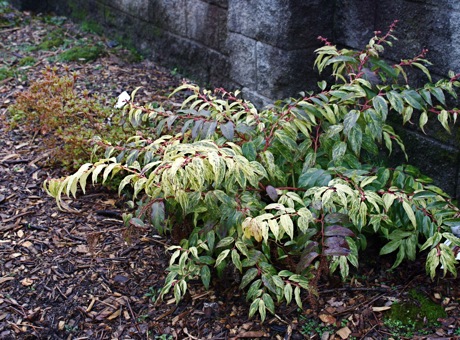
Eric’s young ‘Rainbow’ leucothoe, currently about 18 inches high with a spread of two-and-a-half feet, but already showing the graceful lines and drooping branches that add architectural interest to the shade garden.
Our friend Eric has what sometimes seems like an undue fondness for woody evergreens. But as he mildly points out from time to time, he likes to write about the plants he’s experimenting with as manager of Yale’s Marsh Gardens, and that means a lot of emphasis on plants of special value to Northeasterners. Even though New Haven is quite a bit warmer than our part of the Hudson Valley – or Maine – there’s still a lot of winter to contend with.
Read More…
I heard a new term the other day: songworm, the tune you can’t get out of your head. Happened just in time; ever since Valentines Day I’ve been hearing Frank Sinatra singing I Bought You Violets For Your Furs.

A classic bouquet of violets, tightly bound stems, galax leaf frame (no doily, however)
If that sounds more than a little old fashioned, that’s because it is. The song is only in my head because my father used to croon it to my mother and whether he ever bought her any I do not know. They did court in New York City in the late ‘30s, when nosegays of fragrant violets were still a staple of winter romance. But by the time I grew up the whole tradition – along with the violets – was long gone.
Or make that almost gone.
Read More…
Myself, I’m trying a blood orange version of the recent Shaker Lemon and Cherry Pie for Valentines Day, but this being a chocolate drenched holiday, I feel it incumbent to point you toward a couple of never-fail favorites.
Old Faithful, The Little Black Dress of Chocolate Cakes

This is the Almond Joy Variation of the chocolate cake. It's also just fine just plain with whipped cream, or with chocolate ice cream and fudge sauce if your dearly loved one is anything like mine.
Heath Bar Cookies, aka Chocolate Toffee Crunch
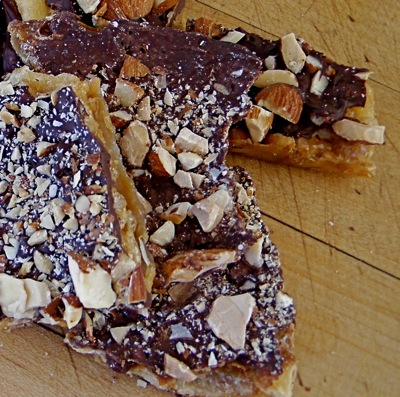
Heath Bar Cookies. All four major food groups: sugar, salt, fat and crunch. With chocolate on top. Most distressing part is how simple and quick it is to make rather a lot of it.
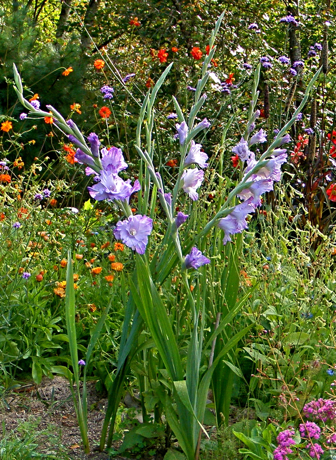
Zone 6 zone denial tip: standard hybrid gladioli are reliably hardy only to zone 9 - or 8b, maybe - but if you have well drained soil, plant them 5 or 6 inches deep and mulch heavily in fall (in this case before the ground freezes), there’s a good chance they’ll come back.
By now you’ve probably gotten the word: the long awaited, massively updated USDA Climate Zone map, the first revision since 1990, has finally arrived. And – insert giant snarky “this is news?” – it shows large swaths of the country have moved up at least a half zone.
In 1991, when I got together with Bill and began gardening in the Hudson Valley, I could joke that my new life didn’t net me a single climate zone, even though the NY garden is about 300 miles southwest of the one in Maine. Until a couple of weeks ago, they were both in zone 5b. Now, while New York remains 5b – by the skin of its teeth, from the looks of things – Maine has been promoted to 6a.
Read More…
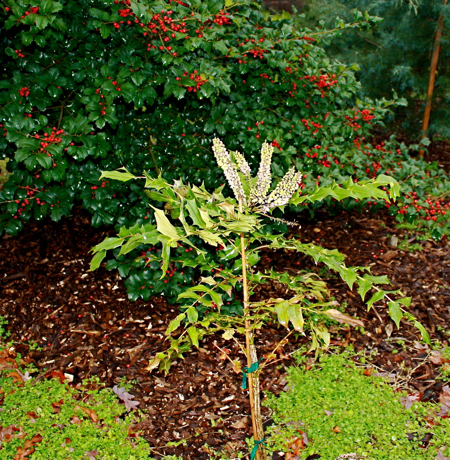
The young (only 3 feet tall) Leatherleaf Mahonia in full bloom at Marsh Gardens on January 27th. Eric has planted it near a red berried American holly, to make, as he puts it “a visual pun,” on the two plants’ quite similar leaflets
I was so pleased when Eric sent this – in my mind, Mahonias are associated with far more clement climates than either of mine. Eric’s place over at Yale IS a lot warmer than it is here, but with a bit of shopping around for a protected spot, it sounds as though I just might be able to plant a clump of these beautiful, fragrant winter bloomers.
Read More…
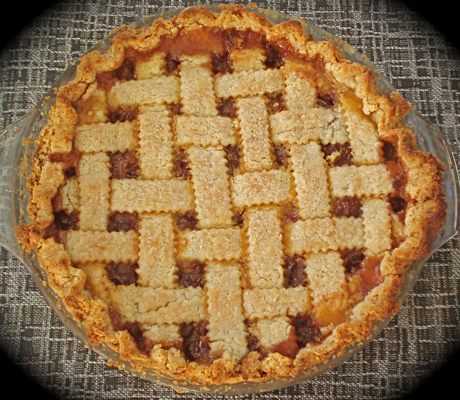
The lemon is underneath the cherries
This floated into the kitchen because Jan 23 was National Pie Day*, an event that got a surprising amount of PR, given that every day is pie day in most people’s estimations. It’s probably because good pie is still – compared to say, macarons – in woefully short supply.
Ok. Deciding to bake a pie was easy. Deciding what kind of pie to bake was not, fresh local fruit also being in short supply in the Northeast just now. We’ve gone through all the frozen berries already; we’re eating too much winter squash to make pumpkin appealing, and while apple might seem obvious, it’s not if you breakfast on baked apples with yogurt pretty much every mortal day of the winter.
Read More…
There’s probably somebody somewhere who refers to them as “microwave ovens,” but I don’t know this person. Instead, I know several persons, all of them very good cooks, many of them with quite spacious kitchens, who refuse to have a microwave in the house. And I’m not talking about the health nuts. I’m talking about people who insist that microwaves are at worst the end of culinary civilization, at best yet more kitchen clutter, good for nothing except reheating coffee and making popcorn.
Well Pooey on that, as stepdaughter Celia used to say. I wouldn’t be without one and I’m not particularly gadget prone. In fact most of my cooking equipment is either
Vintage:

Bill manning the Strand Universal kitchen stove.
Or primitive
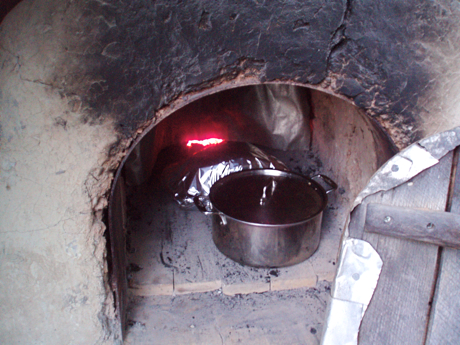
The outdoor clay oven. Beans in the pot, pork roast in the pan, coals banked at the back to boost heat for the first few hours of cooking. The wooden door is lined with flashing to keep it from getting burned.
Read More…

My take on King Cake, seasoned with thyme and marjoram, liberally studded with Gruyere, sprinkled with Parmesan instead of sugar but maybe next year I'll dye the cheese in the classic icing colors: green, yellow and purple
The classic King Cake of carnival season has many variations: coffee cake-ish, briochelike, or based on puff pastry. It may or may not include embellishments like candied fruit, frangipane, and colored icing. It may even be chocolate with coconut. But one thing will be for sure: it’ll be sweet.
Not around here. At this time of year I’m still recovering from the holiday cookie binge, and the idea of more of the same doesn’t hold much of a thrill. Yet I’ve always loved the idea of the thing, so our traditional King Cake is basically cheese studded brioche. Traditional tradition is honored in the ring shape and in the hidden token whose finder is the King.
Read More…