Actually, Triple Ginger was the first stop on a path that started with a yen for old fashioned hot water gingerbread: soft, spicy, homely, simple to make – the original brownie, if by “brownie” you mean a rich dark snack cake to eat out of hand. (The chocolate kind is a cake-come-lately compared to gingerbread.)
I don’t make gingerbread very often, and thus felt in need of a reminder recipe. But instead of consulting any of several dozen cookbooks or, of course, the net, I made the mistake of trolling about in my own published works, where I stumbled on
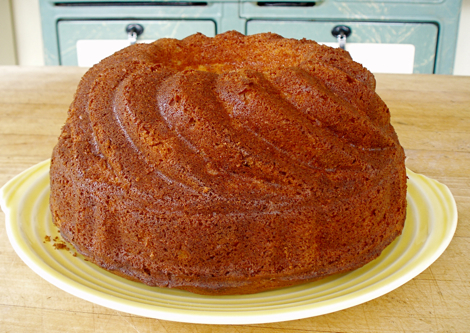
Triple Ginger Gingerbread*
Read More…
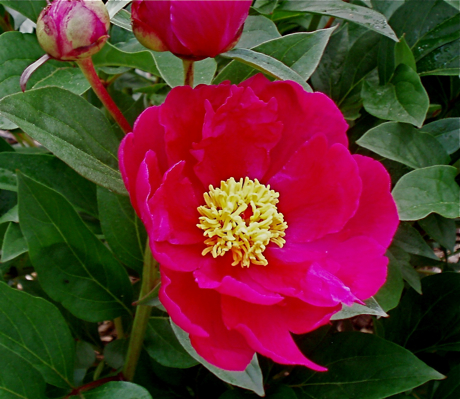
One of the peonies I bred myself (sorta)
Breeding peonies the way the pros do isn’t hugely difficult, but it takes a lot more care and attention than what might be called the
Go With The Flow Method of Breeding Peonies
Step one: Don’t get around to deadheading everything.
Step two: Don’t get so enthusiastic about weeding you inadvertently pull up the self-sown babies.
Read More…
for anyone who lives where it has been raining rather a lot lately. All this dampness, combined with cool temperatures, creates a perfect environment for the spread of Late Blight, Phytopthera infestans.
Just to refresh your memory, that’s the disease responsible for major crop devastations from the Irish potato famine of the 1840s to the Eastern US tomato catastrophe of 2009.
Although Late Blight isn’t a fungus, it’s like a fungus in that once you’ve got it, you’re cooked.
Read More…
Yesterday, Bill and I were out at the edge of the yard, between one of our big rhododendrons and our neighbor’s shed, rushing through a pushback against said neighbor’s ever-invading kerria. Wham, slam, whack at the long, pliable canes of the wretched thing and then as I parted the next clump – EEK! – right in the middle, a nest. Four beautiful robins’ egg blue blue eggs.
Something like this happens at least once every year. Last time around, my reminder to clean up in a more mindful way was comfortably nestled in a chunk of rotten firewood. I had the chunk in my hand, all ready to pick up and pitch into the weeds. Just happened to turn it over, and there was

An Eastern (aka Red-spotted) Newt, Notophthalmus viridescens
Read More…
Being a Maine person, I have a particular interest in lupines, which will be discussed at the end of the post. First, however, the word from Eric, who not surprisingly is fond of them even though he lives in Connecticut. He’s having an open house this weekend, btw, scroll on down for the invitation.

The spikes of multiple flowers are wonderful in the vase, but also a great show in the garden. Used as a focal point in the perennial bed, as a Derby Day sentinel at the gate to the terrace or in the cutting garden, you can’t go wrong with a good thrifty clump of lupines.
Read More…

Total Ramp tart. Similar to quiche, but with with less custard, more ramp (and crisper crust).
Having recently worried around at the ethical questions attendant on promoting wild foods to all and sundry, I offer this post with mixed emotions.
On the one hand, Have Ramps Will Cook. We are lucky enough to have access to several large patches; the spirit of experiment springs eternal and besides, people have been asking.
On the other hand, providing recipes is – I hope! – an invitation to use those recipes, so there we are with the ethics again, along with another reservation,
Read More…

Our garden is big. Yours doesn't have to be to yield lots of great food and flowers
I did not hear this in person. Bill did (on Marketplace Money on NPR last Friday). But he couldn’t resist telling me about it, chortling loudly the while.
As well he might. According to him, a garden advisor – whose name he didn’t catch – had pronounced that “if you can’t keep your room swept, you shouldn’t try to garden.”
This struck me as so wildly improbable I thought he must have heard wrong, so I looked it up.
Read More…

A bud cluster on our old Viburnum carlesii, cultivar unknown, just about to open and prove its worth to the world.
I usually agree with Eric about the plants he chooses as pets, but sometimes we really think as one and this is one of those times. Viburnum carlesii is a must-have shrub if you are moved by fragrance. There are other viburnums with lovelier forms, with handsomer leaves, with added fall interest from bright berries, but no other plant in the genus can hold a candle to its perfume.
Read More…
No news that the weather is pretty strange lately and that includes in the Hudson Valley, where we’re amassing broken records at a record-breaking pace: the hottest March, the hottest first quarter, and most recently, the hottest April 15th, when it was 91. Another all-timer (at least at our house) is the annual magnolia trashing, this year the earliest by a country mile.

Magnolia in usual late April mode
The pattern itself is always the same: 1) multi-week warm spell, 2) magnolia blooms, 3) seasonally-appropriate frost comes, 4) flowers turn brown. But it used to happen between late April and early May. Then the whole sequence moved back to April.
In 2012, all March. Bloom started around the 10th and was thoroughly whacked when the temperature dropped to 25 degrees on the night of the 26th.

April 18th, three weeks and change after the frost - just a few late-opening dots of pink.
Meanwhile, the combo of February and March was the 3rd driest on record and April is not shaping up well.
I could go on, among other things airing the usual caveat that this is weather, not climate. But I’d rather cut to this not-climate’s effect on the maple syrup industry, as described in the crop reports written by Arnold Coombs, a seventh generation maple syrup producer and packer in Vermont.
Read More…
Or not to find ramps – that is the question. More accurately, since simply finding them is fine, should one or should one not harvest them and if the answer is “Yes, they’re delicious!” at what point, if any, does the answer become “No, they’re endangered!” or again more accurately (and the reason for all this dithering), “No, they’re in danger of becoming endangered if people keep picking them at the current rate.

Ramps (Allium tricoccum) at home in typical habitat
We regularly hunt for and pick them, trying to be responsible about it. We frequently cook and eat them in season, trying not to be too piggy about it. And I, at least, have two sub-questions:
- Is the worry about over-harvesting* justified? And
- Is it possible to formulate a general rule for the ethical enjoyment of foraged wild foods?
Read More…