That’s chervil on the left, nestled up against dandelion, another delicious weed (harvesting and recipe tips below – in the entry for April 3rd). No pic of the coriander – yet. It’s too windy every time I think of it…
The first seeds we planted (peas) have barely broken the surface, but the coriander and chervil that planted themselves are off and running; chervil vinaigrettes have been on the menu for several weeks now and we had the first guacamole with homegrown cilantro about 10 days ago.
Having these two in abundance after a winter of pallid store cilantro* and no chervil at all, what a thrill!
The flavors are very different; clean-spicy anise-y chervil has nothing in common with the funky richness of cilantro except a penetrating greenness, but in the garden they are almost twins:
Both are cool weather plants that sprout early, go to flower in the summer and make a second crop in fall.
Both are rampant self-sowers; just let a few of those flowers ripen and drop seeds and you can have truly delicious weeds.
Both are easy to remove if they do show up in the wrong spot, in part because both are tap rooted, which means
Both will either die or bolt ( send up flower stalks) if you try to transplant seedlings. Same goes for dill, another annual herb that should always be grown from seed. Parsley is tap rooted, too, and often presents the same problem, but because it’s a biennial it’s tougher. Parsley seedlings can move successfully as long as they are still very small and young.
The not-twin part is in the seeds:
Chervil seed should be very fresh, it doesn’t keep well from year to year. Cilantro seed is much longer lived. Also much cheaper to buy in bulk as spice. It won’t germinate if it’s been irradiated, but it usually hasn’t, so there’s no reason to buy those little dinky packets. Seeds cost less than a dollar an ounce when they’re sold as flavoring – for chili / sweet yeast breads/ gin…
Chervil seed is no special culinary delight, but coriander is not only great dried ( the classic spice use), it’s also delicious when green and soft. The flavor is right between funky leaf and sweet-flowery dried , wonderful in sauces for fish, in potato salad…
*cilantro is the most common US name for the leaves of the coriander plant, and is used here for convenience.
I know this is the age of instant gratification, but – this being the season – let’s hear it for planting young trees. The rewards ( I speak from experience) are huge: a personal forest – or great big hedge, or both – isn’t simply a visual treat and haven for Our Friends The Birds, it’s also shelter from road noise, wind, and whatever lies next door. And as long as you don’t go overboard, trees are a terrific investment. Deposit a 4 to 6 footer now, enjoy a major increase in property value when it hits the 14 foot mark – or, of course, soars beyond.
Our hemlock hedge, for instance, is about a hundred trees long, so it had to start out as young ‘uns. We paid 5 or 10 bucks apiece – this being 12 years ago, more or less – for an assortment of rather spindly 4 to 5 footers. Two years later, when the tallest had barely hit 6 feet and were still more promise than performance I got antsy. Bought a bunch of 10 footers, at about 40 bucks a pop, to plant in front of the most grievous eyesore.
Sure enough it DID make an immediate difference, but the little guys only took 2 or 3 more years to catch up, and once they did that was it for the benefit – annual pruning evened it all out. Now that every tree in the hedge is 14 to 16 or more feet tall, you can’t tell which is which.
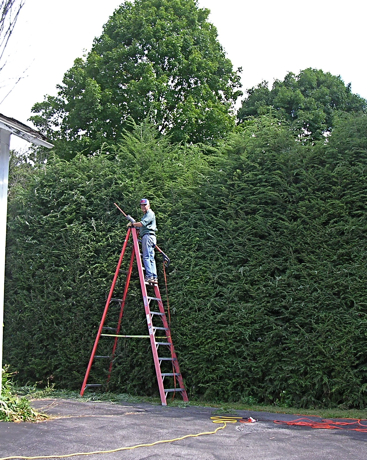
That’s Bill with the electric pruner, on a 12 foot ladder.
Other benefits of starting small:
* small trees suffer less damage when taken from the field, so they recover more quickly when planted ( big trees usually stay the same height for at least a couple of years ; they’re too busy repairing their roots to do much of anything else.).
* small trees are DIY, which matters huge when you’re talking about a lot of them. You can pick up a 4 footer without serious consequences for your back. You can dig a hole for it without taking all day, and you can keep it watered … even a skinny 8 foot tree needs about 20 gallons of water each week – more if the weather is hot and windy.
The alternative, if you’re planning to stay put for a long while or have truly extensive tree needs, is a whole bunch of the tiny trees sold super-cheaply by many soil and water conservation districts and slightly less cheaply but still bargainish by mail order tree-nurseries. These’re little sticks, about 18 inches tall… it’s gonna be a long time to glory; and you do have to spray ’em against deer for at least the first couple of years. But they’re certainly easy; one stroke of the shovel is all it takes. And the price is right: here in Dutchess County, NY, it’s $16.50 for a bundle of 10 Norway spruce, each of which will ( or more properly, can) grow 50 or more feet tall.
The pre-order period is over so there are no guarantees, but leftover bundles are usually available at the yearly plant sale at the Farm and Home center on Rte. 44 in Pleasant Valley. It’s April 21 and 22 ; be there early or be disappointed. For further details call 845 677 8011, extension 3, or see the website.
I’m seldom out ahead of the pack, but I did get fooled before April 1st. On the most recent podcast , to be exact, when Dean sidetracked my passionate defense of home cooking into a celebration of dandelions.
Well, okay. Not the best argument for home cooking. But a GREAT example of great food close to home. Dandelions are everywhere, first green of the season. They’re delicious (like endive, only more so) and almost obscenely good for you : tons of vitamin A, quantities of B complex, C, and D, plus iron, potassium, and zinc.
To say nothing of absolutely free,
BULLETIN: Just looked out at the feeder. The goldfinches are golden again, drab winter plumage all gone.
WILTED DANDELIONS
This is the way I learned to love them when I was a kid in Pennsylvania Dutch country. Italians have other ideas, which will be addressed another time.
For about 4 to 6 side dish servings or dinner for 2
A good sized heap – half a brown paper grocery bag full – of young dandelions ( see below) or other bitter greens, washed and coarsely chopped
½ pound bacon
1/3 cup cider vinegar
1/3 cup water
3 or 4 tablespoons brown sugar
Several turns of the pepper mill
A bit of minced garlic is not authentic but is tasty
2 hardboiled eggs
1. Let the greens come to room temperature in a large, heatproof bowl. Cook the bacon in a heavy skillet over low heat until very crisp.
2. Set the bacon aside to drain and pour off all but about 1/3 cup of the bacon fat. Put the pan aside, off the heat. Crumble the bacon and slice the eggs thinly.
3. Add the vinegar, water, sugar , pepper (and garlic) to the skillet and bring the mixture to a simmer, stirring to dissolve the sugar. When sugar is dissolved, bring dressing to a rolling boil and pour it over the greens. Toss thoroughly. Garnish with bacon and hard egg and serve.
(If the season is almost over and the greens are on the serious side, cook them briefly in the dressing … just until wilted.)
To Harvest and Clean Dandelions:
Size doesn’t matter – the older the root, the larger the rosette of leaves – but youth is crucial: go for plants with small, tight flowerbuds buried in the center. Once buds start swelling, greens turn bitter and tough.
Cut the rosette at ground level. Discard any discolored leaves and trim off the dirt-covered base before dropping the rest in your bag or basket.
Separate leaves and chop coarsely, then dump in a large bowl of cool water. Swish ’em around, then lift into a colander. Discard sandy water in bowl. Repeat until no more sand comes out. It almost always takes 3 passes and often takes more .
(Taste a leaf, bearing in mind that the dressing will gentle them quite a bit. If they still seem mindbendingly bitter, let them soak in cool water for an hour or two). Drain so they’re not sopping wet but don’t worry about drying them.
For the last 5 or 6 years, I’ve been building a crocus carpet in the narrow strip of lawn that leads from the kitchen door to a grape arbor in front of the tall hemlock hedge. Every fall, in go a couple of hundred bulbs, which is about what I have money and time for, idea being that they’d keep spreading and by and by before I was too ancient, there the thing would be, a glorious tapestry of mixed colors, shining in the spring sunlight. For maximum punch and longevity, there are as many threads as possible : mostly early, small species types like chrysanthus and tomasianus, but always with a few giant Dutch gobsmackers, just so it doesn’t get too tasteful.
For years, the plan worked great … every spring there were more little clumps of yellow and white and purple cheerfully popping through the brownish green, looking sort of like willing wildflowers, and every year a few of the clumps were a little bigger, crocus puddles instead of crocus clumps. But this year we’ve hit tilt. It’s finally a carpet all right, but it looks moth-eaten. There are now more flowers than lawn but not enough to cover it, so the patchiness is backward.
It would take at least three more years to really pave the place at the present rate, at least two ugly springs too many. It’s either spend the whole bulb budget on the stupid thing and plant about 600 this fall or else it’s elimination time. Removing instead of adding would restore the wildflower-popping through effect, which may turn out to be prettier anyway.
In terms of effort , it’s more or less a wash, so I’m kind of inclined to just go for it, and that brings us to today’s homily:
* Don’t forget to take snapshots of your bulb plantings. Put a few identifying markers in, too, like yardsticks or little signs that say “10 feet from porch door at 90 degree angle.” While you’re at it, make want/need lists. In June, when the fall catalogs start coming, offering tempting discounts to those who order by July 15th , you’ll be glad you did.
SNOWDROPS: Back when I was gassing on about how great snowdrops are ( on February 9th) , I promised instructions for how to divide them when the time came. The time has come – or is about to. Ideal moment is after flowers finish but before seedpods have started to harden.
* best planting sites are sheltered from high winds, in partial sun or light shade, in soil that retains some moisture in summer (but not heavy clay).
* Soil should be very moist on transplanting day; if the weather has been dry, water both the clumps to be divided and the destination sites several hours before the job.
* Working in the late afternoon, Use a digging fork to pry up established clumps. Separate ’em. Big bulbs and their leaves can move as onesies; if you have lots of threadlike seedlings all root-intertwined, move them in groups of 3 to 7 ( depending on just how threadlike they are).
* Replant at the same depth, keeping bulbs 2 bulb-widths apart, keeping clumps separated even more. Be sure the roots are well spread out.
* Clipping off seedheads is optional. It may help the plants re-establish, since roots can concentrate on the job at hand. But usually, they’ll be happy – or not – without this additional aid, so you might as well not bother.
* Don’t forget to keep the transplants watered until the leaves start dying down.
Enough. For this post let’s just say a tomato “canned” in glass is 300,000 times tastier than a tomato canned in a can and that’s partly because the home canned tomato is (usually) a tastier variety to start with. Be sure to leave room in the garden for plenty of plants.
Can’t say I never met a plant I didn’t like – there are hundreds you couldn’t pay me to grow – but I do love far too many. Plus I’m a patsy for garden porn, easily swayed by catalogs that look like Frederick’s of Sissinghurst. As a result, spring around here is a constant struggle, a tug of war between loving plants and loving the garden itself.
Recall the gardens that struck a chord and it’s likely you’ll think first of a long view, framed but unobstructed, or a wide slice of sky between trees, a smooth lawn bordered with flowers, or maybe a waving hedge of tall grasses next to a flagged patio – nary a blossom in sight … in all these cases, place trumps plants: great gardens are always edited .
Even crammed-in cottage gardens, famously places where plants are “riotous,” that riot has harmony and rhythm. One or two orange lilies popping up in the middle of a small bed filled with a haze of bluish perovskia and pale purple verbena would look great. But if in addition there were also a couple of white phlox, a magenta coneflower, and 2 or 3 red and white roses …
Well, trust me. No.
In other words, the mantra for today is: take out the things that stuck out last year, and try to think of where that sexy new black elderberry, red monarda or gold-leafed heuchera is going to go before you plonk down your money.
This week’s garden tips:
* Weed. Weed , and then weed some more. Roots come easily out of cool, wet soil, and if you get evil actors like garlic mustard now, before they get a chance to flower, you’re well on the road to control… at least in selected spots.
* Have you cut down your big grasses yet? Removed all the artistic dead stuff you left last fall to add winter interest? If you do it NOW, you can just use hedge shears to slice everything off at the base, a couple of inches from the ground. Wait two weeks – or one – or maybe five minutes, and the new growth will be in the way.
In theory, you should have a wheelbarrow with you, so you can haul away the debris, but screw that. It’s more important to just leap out there and get stuff done whenever you can spare a few minutes. The world is largely one big debris pile at the moment anyway, it’s not going to make much difference if there’s a bit more of it lying around for a few days.
Of course, you don’t want to leave it around for long, any more than you want to let blown leaves sit on the new grass and kill it. First non-windy day, get out there and rake.
* This is also a good time to renew what I call fountain-growers, pliable-stemmed shrubs that are prettiest when allowed to grow tall and drape over gracefully. Standard wisdom advises pruning in late spring or early summer, after whatever-it-is has bloomed, so you don’t lose any flowers. But that’s just when you have about 40,000 other things to do; and you won’t “lose” any of the flowers if you bring the pruned branches indoors and let them bloom in the vase.
Forsythia is the best-known fountain-grower, but this group also includes kerria, mock orange, wiegela, deutzia, and spirea. They all bloom on year old stems and on year old stems that grow from trunks that are 2 to 4 years old. Trunks older than 4 or 5 no longer send out much new growth, so you have to keep new trunks coming if you want fountains of flowers. ( Simply pruning part way back makes a bristly thicket with polka dots. Not pretty.)
*To manage an old, established shrub, simply cut one trunk at the base each year. Allow 2 or 3 strong new shoots to rise from the ground, choosing those that are reasonably close to the one you’re cutting. Remove the other sprouts so things don’t get crowded.
To manage younger plants, do nothing for the first 3 years, then start the oldest trunk routine.
* To force pruned branches indoors: In addition to those listed above, magnolia , apple, crabapple, flowering cherry, and plum ( which in bloom smells just like cheap incense) are all likely bets. When you get the branches indoors, use a sharp pruner or heavy knife to split the stems several times, then immerse in a bucket of room-temperature water and store in a cool – not cold – place, out of direct sun, until the buds swell and start to open. Change the water every few days.
When the branches are ready to display, rinse the stems and recut them before arranging. It is almost impossible to go wrong with these, big blowsy bunches in pitchers look great, small twigs in tiny bud vases look nifty too. But it’s hard to beat the Japanese effect, if you have those heavy, shallow flower-holders with the spikes on the bottom. One blooming branch arching upward therefrom is almost too beautiful to bear ( also too tempting to the kitten; this year all our branches are in – and then pulled from – the biggest, heaviest vases we’ve got.)
Before getting started on the virtues of angels’ trumpet, one of the most gorgeous, most rewarding, most pain-in-the-butt flowers available to the average gardener, let’s put in a good word for keeping a plant on the back of the toilet. Nothing fancy, a pot of ivy will do nicely, or ferns, which appreciate life in the bathroom. Point is simply that you get a big mood-boost when you see something green and growing every time you turn around – or reach over, as the case may be – to flush.
Okay, on to brugmansia, aka angels’ trumpet, a tender shrub with huge, well, trumpet shaped flowers and an amazing night time perfume. The angelic part may be that fragrance , one of the strongest in the garden, but it might also be because brugmansias are strongly poisonous – eat some and you could end up with the angels.
Flowers are huge, 8 to 10 inches long , and come in singles, doubles, and ruffled multi’s that look like quadruples, in yellow, apricot and pink as well as white, but the single white ones are the most fragrant and to my eye the loveliest. They used to be rare, but now they seem to be everywhere – or at least in every catalog and garden magazine photo shoot – and although they’re not cheap, they’re not that pricey, either.
What they are, the first year you buy them, is small. It takes several seasons to get the kind of height and mass that makes brugmansias so astonishing, and that means everyone north of zone 9 must be willing to keep them indoors in the winter. My biggest one ( now deceased) took 5 summers – admittedly, summers in Maine – to make it to 8 feet tall and 5 feet wide. Every March I vowed ” this year is the last,” and every September, faced with saying goodbye to the ever-larger tree, festooned with dozens and dozens of blooms, I said – and still say, to its descendants – ” Oh all right, back to the cellar with you. ”
Brugmansias bloom in cycles, though not always, as is sometimes said, with the full moon, covering themselves with flowers and your night garden with exotic scent that may or may not be psychoactive but is beyond intense… My first plant had 3 flowers on it when I brought it home from the nursery and I was so woozy by the time I got out of the car I had to go for a walk.
Years later, an Argentine visitor who saw the 8 footer told me the plants grow to tree size there, but people know never to fall asleep under them because ” the spirits will come to them in dreams… ” Moral of the story? Plant brugmansias by the path to the front door or somewhere else you’ll walk by them each evening, but DON’T plant any under the bedroom window. More on Brugmansia care below, and a sense of the range of what’s possible here but while we’re on the subject of save-worthy plants, don’t forget cannas and hot peppers.
CANNAS: Saving these over doesn’t give you much of a leg up on individual plant size; what it does is give you herds of them for very little money. Like dahlias, they increase obscenely each year, so you can get the dazzling effect created by huge patches without spending dazzling sums of money. And like dahlias, they’re easy to store – you just let the leaves die of frost in fall, cut them off, then store the rhizomes in a cool closet. Restart in mid-march for full sized plants in June.
HOT PEPPERS: We think of pepper plants as annuals, but they aren’t. And many of the tastiest, like habanero and aji amarillo, don’t start to bear significant crops until they’re about 6 months old. They don’t adore life as houseplants, but they will make it through on a sunny windowsill and your reward is a huge head start on the summer pepper season.
BRUGMANSIAS:
* Spring to Summer: Order or buy for late spring delivery, so you can put them outdoors right away. Plant where they will have plenty of room and think of Audrey 2, the ravenous plant in Little Shop of Horrors. ” Feed me!,” she cried, “! feeed meee!” If it is possible to overfeed or overwater a brugmansia, I have not yet found how much it would take.
* Fall: When frost threatens, dig the plants, transfer them to large pots (or plastic-lined bushel baskets) and bring them inside. If you happen to have a cool basement or other spot that stays around 45 degrees, put them there and don’t worry about light. Otherwise they need all they can get. Either way, they’ll drop lots of leaves ( if it’s dark, they’ll drop them all.) Water sparingly – hardly at all if they’re cool and dark, enough to keep the soil moist if they’re in light.
* Late Winter/Early Spring:
If they’ve been in light and slowly growing, by March they’ll be very leggy, and unless you’ve been faithful with the insecticidal soap, very buggy as well. Cut them back , clean them up and start fertilizing weakly every 3 weeks or so.
If they’ve been semi-dormant in the cool dark, the jig is up: next time you go down to put something in the dryer you’re gonna see ghost growth , creepily pale sprouts with a few wan leaves, groping blindly upward in search of light and – in all probability – already sporting a few aphids. Bring them into the light and proceed as above.
* Spring: Start hardening them off as soon as you can – cool weather ( 45-55 degrees) won’t hurt anything, and the sooner they can leave their pots and go back in the ground, the happier everyone is going to be. If you get overconfident and plant too early , protect them from light frosts with a thin sheet and just prune back anything that gets clonked.
Before getting started on the virtues of angels’ trumpet, one of the most gorgeous, most rewarding, most pain-in-the-butt flowers available to the average gardener, let’s put in a good word for keeping a plant on the back of the toilet. Nothing fancy, a pot of ivy will do nicely, or ferns, which appreciate life in the bathroom. Point is simply that you get a big mood-boost when you see something green and growing every time you turn around – or reach over, as the case may be – to flush.
Okay, on to brugmansia, aka angels’ trumpet, a tender shrub with huge, well, trumpet shaped flowers and an amazing night time perfume. The angelic part may be that fragrance , one of the strongest in the garden, but it might also be because brugmansias are strongly poisonous – eat some and you could end up with the angels.
Flowers are huge, 8 to 10 inches long , and come in singles, doubles, and ruffled multi’s that look like quadruples, in yellow, apricot and pink as well as white, but the single white ones are the most fragrant and to my eye the loveliest. They used to be rare, but now they seem to be everywhere – or at least in every catalog and garden magazine photo shoot – and although they’re not cheap, they’re not that pricey, either.
What they are, the first year you buy them, is small. It takes several seasons to get the kind of height and mass that makes brugmansias so astonishing, and that means everyone north of zone 9 must be willing to keep them indoors in the winter. My biggest one ( now deceased) took 5 summers – admittedly, summers in Maine – to make it to 8 feet tall and 5 feet wide. Every March I vowed ” this year is the last,” and every September, faced with saying goodbye to the ever-larger tree, festooned with dozens and dozens of blooms, I said – and still say, to its descendants – ” Oh all right, back to the cellar with you. ”
Brugmansias bloom in cycles, though not always, as is sometimes said, with the full moon, covering themselves with flowers and your night garden with exotic scent that may or may not be psychoactive but is beyond intense… My first plant had 3 flowers on it when I brought it home from the nursery and I was so woozy by the time I got out of the car I had to go for a walk.
Years later, an Argentine visitor who saw the 8 footer told me the plants grow to tree size there, but people know never to fall asleep under them because ” the spirits will come to them in dreams… ” Moral of the story? Plant brugmansias by the path to the front door or somewhere else you’ll walk by them each evening, but DON’T plant any under the bedroom window. More on Brugmansia care below, and a sense of the range of what’s possible here but while we’re on the subject of save-worthy plants, don’t forget cannas and hot peppers.
CANNAS: Saving these over doesn’t give you much of a leg up on individual plant size; what it does is give you herds of them for very little money. Like dahlias, they increase obscenely each year, so you can get the dazzling effect created by huge patches without spending dazzling sums of money. And like dahlias, they’re easy to store – you just let the leaves die of frost in fall, cut them off, then store the rhizomes in a cool closet. Restart in mid-march for full sized plants in June.
HOT PEPPERS: We think of pepper plants as annuals, but they aren’t. And many of the tastiest, like habanero and aji amarillo, don’t start to bear significant crops until they’re about 6 months old. They don’t adore life as houseplants, but they will make it through on a sunny windowsill and your reward is a huge head start on the summer pepper season.
BRUGMANSIAS:
* Spring to Summer: Order or buy for late spring delivery, so you can put them outdoors right away. Plant where they will have plenty of room and think of Audrey 2, the ravenous plant in Little Shop of Horrors. ” Feed me!,” she cried, “! feeed meee!” If it is possible to overfeed or overwater a brugmansia, I have not yet found how much it would take.
* Fall: When frost threatens, dig the plants, transfer them to large pots (or plastic-lined bushel baskets) and bring them inside. If you happen to have a cool basement or other spot that stays around 45 degrees, put them there and don’t worry about light. Otherwise they need all they can get. Either way, they’ll drop lots of leaves ( if it’s dark, they’ll drop them all.) Water sparingly – hardly at all if they’re cool and dark, enough to keep the soil moist if they’re in light.
* Late Winter/Early Spring:
If they’ve been in light and slowly growing, by March they’ll be very leggy, and unless you’ve been faithful with the insecticidal soap, very buggy as well. Cut them back , clean them up and start fertilizing weakly every 3 weeks or so.
If they’ve been semi-dormant in the cool dark, the jig is up: next time you go down to put something in the dryer you’re gonna see ghost growth , creepily pale sprouts with a few wan leaves, groping blindly upward in search of light and – in all probability – already sporting a few aphids. Bring them into the light and proceed as above.
* Spring: Start hardening them off as soon as you can – cool weather ( 45-55 degrees) won’t hurt anything, and the sooner they can leave their pots and go back in the ground, the happier everyone is going to be. If you get overconfident and plant too early , protect them from light frosts with a thin sheet and just prune back anything that gets clonked.
Update: I’m sure Mary (see comment) isn’t the only one who wonders how to manage all this in and out without damaging the roots. The answer is that it’s impossible. Roots will be damaged, in some cases – i.e. when you’re digging up huge ones – quite severely. No problem. Brugmansias are weeds, and pruning the roots, like pruning the tops, has no long term ill effect.
Loveliest of trees, the maple now
Is hung with
…buckets along the trunk, actually.
Thus the poetic rhythm of north-country life. No matter how cold it is, spring has arrived. We are in sap season, the alternation of freezing nights and warm, sunny days that brings sugar-laden “sweetwater” up through the dense wood of maple trees to nourish the swelling buds.
You can make syrup from the sap of many different maples – in fact, you can make it from birch – but the sweetest and most delicious comes from sugar maple ( Acer saccharum) and black maple ( A. nigrum), beautiful trees that glow like fire in autumn and, as if sweetness and light weren’t enough, are the “maple” of first class hardwood and figured wood like tiger maple.
These days, alas, sugar maples are also a flock of red-feathered canaries, weakening and dying in droves. Many factors are involved, but acid rain is one of the big ones. And because hard maples are cold climate plants, they’re on the sure victim list when it comes to global warming.
In other words: get it while you can. Buying from a local producer means sweet support for open space – and if you have access to a few trees, consider making your own. Our family did it for years when Celia, my stepdaughter, was small. The ritual was one of her favorites and she was always the first to notice the buckets on roadside trees.
Making maple syrup is ridiculously easy and doesn’t call for any expensive equipment. The most important thing you need – other than access to a few trees – is an outdoor heat source like a campfire to do the boiling down. It takes 40 gallons of sap to make a gallon of syrup, and that means a whole heap of steam, as we discovered the first year we tried it and incidentally stripped the wallpaper in the bedroom above the kitchen.
Every year, the syrup is syrup but every year it’s different. Sometimes smoky, sometimes honeylike , sometimes with a hint of fruit and sometimes a whiff of leather. The taste depends on how long the sap runs, on how much sun the trees got last summer. It depends on which trees gave much and which ones little, on the wind and the rain…
Celia is grown up and gone now; we haven’t made syrup for years. But we still have quite a bit of it left, a reminder of happy times; and every March those trees hung with buckets say ” remember, remember.”
Maple syrup is generally resistant to being used in recipes – the best thing to do with it is to just pour it over something ( or put a drop in some unblended scotch). But we are all big fans of Les Grandperes, an easy, down-home cottage pudding that’s basically biscuits on syrup. It’s good with vanilla ice cream and great with sheep’s milk yogurt.
Les Grandperes
This French Canadian recipe comes from Alice Perron, a fine home cook and the woman behind the stove at Bien Fait Fruitcakes
.
for 6 servings:
dough for Aunt Ida’s Biscuits ( below)
1-1/2 cups maple syrup
1/2 cup boiling water
1. Heat oven to 425 degrees. Lavishly butter an 8x8x2-inch baking dish and pour in the maple syrup. Pour in the water, then put the dish in the oven until the syrup is bubbling, about 8 to 10 minutes.
2. While syrup is heating, roll out dough 3/4 inch thick and use a biscuit cutter to cut out 9 1-1/2-inch discs. ( Refrigerate remaining dough. Use it to make biscuits within 24 hours)
3. Place the circles side by side, just barely touching, on the bubbling syrup. Bake for 10 minutes, then lower heat to 350 and bake until the biscuits are richly browned, about 5 minutes more.
Alice’s Aunt Ida’s Biscuits
For 12 large or 18 small biscuits:
2-1/4 cups all-purpose flour
1 tablespoon sugar (optional)
4 teaspoons baking powder
1/2 teaspoon cream of tartar
1/2 teaspoon salt
1/3 cup cold butter
1 egg, beaten
2/3 cup milk
1. Heat the oven to 425. Thoroughly combine the dry ingredients.
2. Cut in the butter until it resembles small peas. Beat the egg with the milk and stir it in, stopping as soon as all the flour is dampened.
3. Turn the dough onto a floured board and knead 2 or 3 times, then roll out 1/2 to 3/4 inch thick and cut with a sharp cutter. ( Scraps are lightest if baked as-is; re-rolling the dough makes it tough.)
4. Place biscuits, well separated, on an ungreased baking sheet and bake until risen and nicely browned, about 15 to 20 minutes.
It should probably be said at the outset that I’m more or less the dairy queen; if it’s got butterfat in it, I’m for it. But I’m particularly fond of cheese, which leads us to a recent party where Masako, a friend from the city, wandered into the kitchen as I was butchering a rather elderly Barat.
“What’s that? ” she asked. “It’s a local cheese, ” I said, “comes from a place called Sprout Creek Farm . It’s a cow cheese – nutty and mild, a bit on the dry side … (especially this one, I thought without saying) It’ll be great with the red wine you brought.”
Meanwhile the Barat is coming apart in very funny looking chunks – you can only cut it neatly when it’s very fresh – so of course I handed her a piece.
She chewed. I unwrapped crackers and went looking for the walnuts. ” Where IS this farm? ” she asked. ” Far from here? Do we have time to go there before dinner? ”
Point of story: it’s easy to forget how far American cheese has come in just the last little while. The Barat, for instance, is local in the Hudson Valley, which has lately become a hotbed ( coolbed ? ) of very tasty cheese. If you go to the website of the New York State Farmstead Artisan Cheese Makers Guild, you’ll find links to 20 farms, each of which makes multiple cheeses: cheddars and blues and gouda-types, ricottas and fetas…almost all from the milk of beasts that live outdoors in summer and eat grass, almost all cheese that tastes of this place and nowhere else.
Stop me before I swoon… Of course every one of these marvels is either pasteurized or aged for at least 60 days. It’s against the law to sell the kind of goozy, fresh raw milk cheeses that you eat in Europe and think, well, maybe I could buy a little apartment and just live here part of the year. But one Wisconsin cheesemaker has found a way around this problem and it’s such a lovely idea it deserves widespread dissemination.
The story comes by way of Steve Jenkins, one of the country’s best known cheesemongers, currently plying his trade – and blogging –at Manhattan’s famed Fairway market. The entry is for January 21st; the teller is one of Jenkins’ suppliers, a woman named Mary Falk. She sent him some splendid fresh raw milk cheese, he asked what it was called. And here in shortened form is what she said:
” The ‘cheese’ is currently called “Fishbait” since it is only 6 weeks old and made from raw Jersey cow’s milk… My customers have been routinely asking me for young, fresh, grassy raw milk cheeses. For the past 10 years I have dutifully told them that it is against the law in Wisconsin and Minnesota to sell raw milk cheese aged less than 60 days for human consumption. This has always been a sore spot for me since our farmstead milk is so darn clean.”
Then she explains and says a whole lot more ( it’s a long story, but well worth reading). Then she describes an aborted attempt to sell the raw milk cheese as cat food. THEN she says:
” I phoned the Department of Natural Resources and asked them what, if any, license requirements were necessary to produce fishbait. The DNR said that it would be nice if the product was bio-degradable. I said that we could do that.
So now we bring Fishbait to the St. Paul Farmers’ Market and we sell it with a sign that states that it is not legal to sell raw milk cheese aged less than 60 days for human consumption … so we bring it to the citizens of Minnesota, Land of Ten Thousand Lakes, as “Fishbait”.
We have been EXTENSIVELY inspected by the state of Wisconsin because of our Fishbait, and also by the USFDA, but it seems OK so far to sell the product in this manner as long as the public is properly notified that it is fishbait, and not legal cheese… ”
Ms. Falk has not copyrighted the name fishbait and is actually hopeful that cheesemakers elsewhere will follow her lead.
Me too. But while we’re waiting, there is plenty of great local cheese being made – in plenty of localities. For a partial – and very impressive – guide to what’s shaking nationwide, check out the member-locator map at the American Cheese Society.
Rereading Vita Sackville-West ( see below) reminds me to say a good word for spiraea, specifically the early bloomers that just had a sort of bloom-time preview because they were covered with snow. The ones in our yard are Spirea arguta, the old fashioned bridal wreath, and S. vanhouttei, which runs it a close second in the grandmother’s garden department. Soon enough they’ll be flowering in earnest, along with thousands of others just like them, in untidy great white arching hedges all over the Northeastern spring.
Like lilacs and forsythia, they lack a bit in year-round charm. But in their season, they’re glorious, they’re very easy to grow, and there are so many cultivars you’re bound to find one that will work at your place. ( One cultivar, that is. I can’t imagine one white spiraea looking like much except lonely.)
To get a better sense of what’s out there than any local nursery can provide, a sense more sensible than Google’s omnium-gatherum, go to Plantinfo online,
a service of the University of Minnesota. It provides access to:
” current sources in over 700 North American nurseries for over 88,000 plants, an estimated 250,000 – 300,000 citations to current plant science literature, listings for more than 2100 North American seed and nursery firms, and an evaluative review of 75 CD-ROMs and web sites of plant images.”
What you do not have is the human voice , which leads us back to Ms. Sackville-West, whose real name was Victoria Mary. She was a novelist and poet, a member of the British aristocracy, the lover and friend of Virginia Wolf and a whole lot else that we won’t go into now because I want to get right to her garden writing, and point you toward her white garden, at Sissinghurst, the most famous white garden in the West and inspiration for countless others.
Few of those others approach it in beauty, partly because they are not located on the grounds of Kentish castles and partly because – all too often – they’re just collections of white flowered items, rather than carefully designed gardens in which all flowers are white.
More on garden design to come, but for now, a few words from Vita Sackville-West. They come from A Joy of Gardening, a collection drawn from two of her books ( In Your Garden Again and More for Your Garden) published by Harper and Row in 1958 and now out of print. But that doesn’t mean much. Those books – and the others based on Sackville-West’s garden columns – have been and continue to be more or less continuously recycled, as a quick check at Amazon or your favorite used book store will reveal. Whatever form you find them in, these short pieces are inspiring and entertaining in equal measure and who can say fairer than that?
” One of the prettiest and easiest of spring flowering shrubs is surely spiraea arguta, more descriptively known as bridal wreath or foam of May. In a warm season it may well start foaming in April ; and foam it does, for every one of its black twiggy growths is smothered tight with innumerable tiny white flowers. In fact you cannot see the plant for the flowers…
Obviously the pure candor of its whiteness would look best against the dark background of a yew hedge, or any dark shrubs if yew is not available. There comes a moment at twilight when white plants gleam with a peculiar pallor or ghostliness. I dare to say of white, that neutral tint usually regarded as an absence of color, that it is every bit as receptive to changing light as the blues and reds and purples. It may perhaps demand a patiently observing eye, attuned to a subtlety less crude than the strong range of reds and purples that we get in, say, the herbaceous phloxes which miraculously alter their hue as the evening light sinks across them. I love color, and rejoice in it, but white is lovely to me forever…”