Around the House
Things that have not changed an iota in the last 3 decades:
* If you go by the standard Thanksgiving story, all the way back to 1622 (which in fairness to history you probably shouldn’t), tradition favors venison. But tradition as usually understood demands turkey. No other meat – or poultry – will do.
* It is impossible to roast a whole turkey and have both light and dark meat come out equally delicious.
* It is impossible to convince people that this means turkeys should not be roasted whole.
Things that have changed considerably:

* Wild turkeys are back, big time, although not yet back on the table
* Cooks have discovered that brining the turkey does a great deal to help keep the meat moist. (Best dissenting opinion award: Harold Magee in the New York Times).
* The USDA has discovered it’s not necessary to create bird-flavored sawdust, i.e. internal temperature of thigh 180 degrees. The agency now allows you to stop at 165, still around 10 degrees hotter than essential for safety, but only about 5 degrees hotter than best for succulence.
* It’s no longer enough that the turkey be fresh, unpolluted by “self-basting” additives and unpierced by pop up buttons. Fresh and local is now the gold standard, except when you can get fresh, local and heritage, the high end turkey trifecta.
tips for dealing w/heritage turkeys, whichtend to be leaner and smaller than the modern standard, can be found at the end of this post.
tips for dealing with the modern standard, and the stuffing recipe follow
Read More…
I’m lucky – there’s help. Always a good thing and especially a good thing when there are a lot of large plants and rather a lot of window surface.
Window surface?
You betcha. This is not about housekeeping points; cleaner they are, the better for the plants. It’s amazing how much light can be blocked by even a light coating of dust.

Bill clowning around with the equipment. ( Myself I wouldn't put the anti-static glasscloth in my mouth. But I would have it in hand - very useful)
It’s also nice to have someone who can do the heavier lifting.

the invaluable Kristi Niedermann's back - yes grammarians, I mean both of them.
The awkward, @ 15 pound pot is about at the height of my chin. I could have dealt with it by myself but I’m glad I didn’t have to.

Kristi and begonia, front view
That’s a Begonia fuchsiodes, named for the drooping, fuchsialike flowers.

begonia fuchsioides in red. It also comes in pink.
Read More…
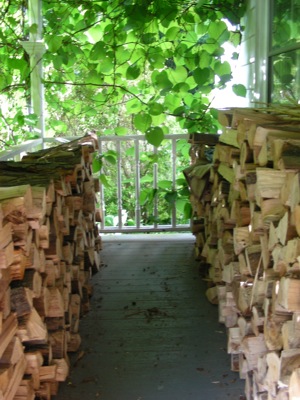
When firewood suppliers who sell by the cord or truckload say they’re selling dry wood, they mean the trees were cut down some time ago. They do not mean the wood was fitted: cut to length and split, more than about 5 minutes before it went on the truck. So if you want firewood dry enough to ignite easily and burn cleanly next winter, now is the time to order it and get it stacked out of the weather.
Gotta hand it to eggs. You can use EVERYTHING, including the shells, an extremely sharp-edged material that is almost pure calcium.
In the house:
* great for cleaning narrow-necked bottles and vases. Crush a shell, working it between your fingers so the bits aren’t stuck together. Stuff it into the bottle, add a small amount of very hot water and swish/shake vigorously until all looks clean. Pour out, catching the shell in a strainer in case you missed a spot and have to shove it back in.
In the garden:
* Dig one or two thoroughly crushed shells into the soil around tomato plants. The lack of calcium that causes blossom end rot is usually a result of inconsistent watering but a little extra insurance never hurts.
* Rinse and dry shells, then crush to roughly rice grain size bits and spread a carpet of them under hostas and similar plants to discourage slugs and snails. Many advisors say “sprinkle” the bits, but a sprinkling won’t have much effect in the deterrent department. This carpet is not beautiful. You can make it a little less sock-in-the eye by soaking the crushed shells in strong tea for several days to stain the white parts brown.
* Excellent in the compost. No need to crush if you don’t want to bother, but as with everything else, the smaller the piece the sooner it rots.
* substitute for peat pots. NOT. In An Island Garden (1894), Celia Thaxter charmingly describes starting poppies in halved eggshells. It sounds like a great idea: Biodegradable, easy to transport and free. In my experience, however, it’s difficult to get the shell halves reasonably even, even when you hard boil the eggs so you can slice them across. Then you’ve got to bore a drainage hole ( darning needle better than icepick). They don’t hold much soilless mix, so they won’t support plants for long. And then you’ve got to fracture them before planting so the tiny roots can get out. Applying just the right force to the squeeze is an art all by itself.
It’s spring! Time to evaluate, improve – or possibly discard – your current collection of houseplants. But it can be hard to see old friends clearly; loyalty gets in the way. The fix? A field trip to the nearest public conservatory. Botanic gardens, universities and colleges all over the country have greenhouses full of wonderful plants and these include (more often than not) humongous, obscenely healthy versions of those meek green units in the living room.

Your fiddleleaf fig could be 13 feet tall too, although you might be just as glad it’s not.
Tropical orchids, ferns on steroids, fragrant blossoms dripping from vines and trees – even the smallest of these places puts spring flower shows to shame. And small can be especially beautiful. Displays will be far less polished but publicity is nonexistent, which means they’re seldom crowded. Call ahead to find out the slow times and you might be the only visitor.
What a deal, especially in raw, cold March. What’s not to like about peaceful warm rooms filled with tropical beauties that somebody else has been taking good care of for years and years and years?

This staghorn fern, more than 6 feet across, was not built in a day.

It also takes more than a moment to grow a good sized flock of birds of paradise.
Oddly enough, seeing one’s familiar home companions in this new light is more energizing than depressing and there is almost always something to learn: When a fiddleleaf gets old, the bark gets gorgeous; dormant orchids don’t look any better when there are 60 pots of them; pruning matters as much indoors as it does in the yard; and whether camellias are worth the hassle may be a function of heritage. Could be you have to be southern.


Oh right, I forgot to mention fruit. In addition to proving dwarf citrus trees CAN produce something that looks like a crop (those are ponderosa lemons, not grapefruit), these places harbor edibles most of us can’t see without buying a plane ticket.
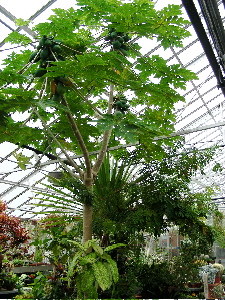
Papaya tree at @ 16 feet ( those dark footballs are the papayas)
The base of the tree is fat, gray and gnarly; the roots go right through the gravel floor, deep into the deeply alien Hudson Vally soil.
But not for much longer, and thus we come to the carpe diem part. These pictures were taken at the greenhouse that belongs to the Cary Institute of Ecosystem Studies, in Millbrook New York. It will be closed before the end of March, its collection dispersed, the building dismantled. Gone forever after more than 30 years.
And it’s not likely to be alone. Glasshouses cost a lot to heat; older models cost really a lot to heat. As the price of oil sails ever upward while funding for public institutions shrinks and those institutions start thinking about greenness in a different way …
A bit of creative googling is likely to turn up at least one that’s close to you, but you might as well start with the advanced garden search at the American Public Gardens Association and the international list at Gardening@Closerange.com.
( for the pizzelle recipe, please scroll down)
‘Twould seem the night has come and gone; that it’s time to get out that pile of catalogs and start planning the gardens. But not quite yet; the midwinter jamboree extends at least until New Year if not Twelfth Night and for many of us there is still a week or more of socializing and present-giving to go.
* Last Minute Gifts
If you’ve had it to here with shopping and dread the post-Christmas sales, there’s a very strong temptation to shop among the presents you just got, moving the ones that make you sigh from the inbox to the outbox.
If only. Unless it’s something absolutely wonderful and completely understandable like a third copy of On food and Cooking, by Harold Magee, regifting is usually out. Completely apart from the hurt-feelings aspect, if you don’t like it enough to keep it and it comes from a store that offers nothing you’d like to exchange it for, how can you let it represent your taste?
Mercifully, the best present for many adults is something expendable like food or flowers – assuming you could find responsibly-raised flowers which you mostly can’t. A rant for another day. The gifted will probably enjoy anything from a generous hunk of local cheese to a plate of homemade Moth cookies ( see below), but the real present is that expendables cannot possibly be stored in a closet and dutifully trotted out whenever you come over.
Not sure about food or wine or eaux de vie made from American fruit? Candles should do nicely as long as they’re chaste in the perfume and dye departments. Fragrance is a minefield of individual preference, and no matter what they say about beige it goes with almost everything. Conveniently, this means it’s classiest as well as greenest to give a large bundle of unscented, uncolored pure beeswax candles. Too late now to mail order but some natural food stores sell them.
* Tips for stylish gift wrapping and present opening with the environment in mind are at All Wrapped Up.
* Last Minute Cookies

One dough, many choices
MOTH COOKIES
Aka Vienna crescents and vanilla crescents
I never knew these were classic Christmas cookies until I was an adult. In our family they were simply the family cookie. (Moth is short for mother; it has nothing to do with bugs.) They take almost no time to make; the dough is extremely versatile; the recipe makes a lot, and everybody loves them – everybody who likes almonds, anyway.
For roughly 60 to 80 cookies:
1 cup whole almonds
½ cup sugar
½ pound butter, at room temperature
pinch of salt
1 teaspoon vanilla ( I often use 2)
1 cup cake flour
1 ½ cups all purpose flour
confectioners sugar, optional
If you have a nut grater, use it on the almonds. If you don’t, put them in a processor with 2 tablespoons of the sugar and pulse until reduced to a mixture of almond meal and tiny crumbs. In a large mixing bowl, cream the butter with the rest of the sugar, then beat in the salt, vanilla and cake flour. Stir in the all purpose flour, then the almonds. Dough will be stiff; Moth’s recipe says “ knead in the almonds,” which gives you an idea. Shape as desired and place slightly separated on ungreased baking sheet or parchment paper. Bake at 325 degrees until just touched with gold – 8 to 15 minutes, depending. The hot cookies are supposed to be rolled in confectioners sugar but Moth seldom did and I never do – too sweet and too messy, especially since there are other classics that really need this treatment.
Shaping:
Crescents. Moth’s preferred shape. Use a scant tablespoon of dough for each; they’re easy to form and they have a distinctive taste because the thinner parts get browner. They also have the merit of fitting many on one cookie sheet. This becomes a fault if you forget and overbake them.
Icebox cookies. Form the dough into rolls or squares about 1 ½ inches across. Wrap tightly in plastic wrap and chill for 3 or 4 hours to 3 or 4 days. Slice about 3/16ths inch thick. Rolls cut in half the long way make pretty one bite half-circles when sliced.You can also slice them super-thin and sandwich them with jam. Leave plain or decorate with small amounts of icing or chocolate.
Applying chocolate

Deco-ish geometry is easy and fun. So is the Jackson Pollack effect.
Coarsely chop an ounce or two of high quality bittersweet chocolate ( at least 50 percent cocoa). Put it in a freezer-weight plastic bag and close the bag. Lay it flat on the turntable and microwave at half power until most of the chocolate is melted but there are still a few lumps, about 75 seconds. Push the chocolate around in the bag until the lumps melt and the chocolate is completely smooth. Use a razor blade or sharp scissors to cut a very small hole in the corner of the bag. Remember to squeeze from the top.
Those candies? Chocolate truffles. Chocolate truffles that are not offensively immense. Mark Bittman just published a basic recipe in the New York Times that’s pretty much like mine.
These happen to be flavored with Frangelico, a hazelnut cordial. The ones with the chocolate drizzle cage – the lazy person’s dipped-in-chocolate – are plain. The white ones have a toasted hazelnut inside and are rolled in crunchy pearl sugar, sold by King Arthur Flour, among others.
PS. If you happen to have the little molds used for Scandinavian sandbakkelse, moth cookie dough works great in them, too. The chocolate ones below have truffle filling; the jam is peach. Lemon curd is terrific. Needless to say these are not swift. Talk about fiddling! Good though.

Part 1: Heirloom Pizzelle
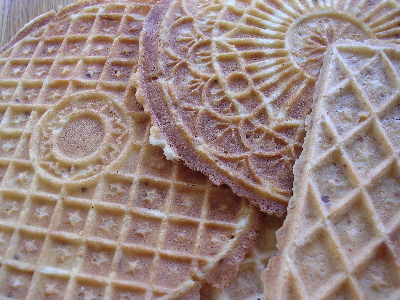
Most pizzelle baking irons are round, probably because it’s much easier to get lace-edged circles than any kind of rectangle. But regardless of shape or perfection thereof, these crisp, light not-too-sweet cookies look great on the plate – while they last. Scroll down to skip straight to the recipe.
In the middle of the Northeastern winter, when gardening consists largely of spraying insecticidal soap and looking out the window at the naked spot where you meant to plant a chamaecyparis ‘Filifera’ but didn’t, baking is a natural outlet for some of that thwarted creative energy, aka urge to potter around.
Said urge might be resistible if it weren’t for the Pavlovian aspect, but just as springtime is full of cues to get out there with trowel and pruning shears, the Let’s Banish Darkness season* is laden with near constant reminders that cookies should be made.
Some years we begin with gingerbread, adding the warm perfume of spices to old reliable butter + sugar + flour + oven = happiness; but we usually start with pizzelle, a family tradition from the Italian side of Bill, who arrived in my life equipped with his grandmother’s pizzelle iron.
That would be grandmother Josephine, the world’s greatest cook, born Giuseppa Cario in 1894, near Palermo, resident for most of her life in Washington, PA (near Pittsburgh).
The grandmotherly pizzelle iron IS iron, not the more modern cast aluminum. And it has both a very long handle and little feet, like the feet on old cast iron skillets, suggesting original design for use on an open hearth although they may simply be there to provide balance; the applied handle means the plates don’t lie flat.
Most importantly, the iron has grandma’s initials and those of grandpa Fidele engraved on one side. On the other is the date: 1931, the twentieth year of their marriage.
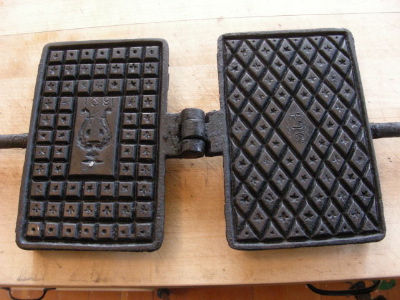
The personalized parts are not deeply cut, so they never show up as clearly as the patterns standard on the iron, but that just adds to the challenge. If the dough comes out just right, you can see ‘em. If it doesn’t, the pizzelle are still delicious and of course if you’ve gotten close enough to eat them, you don’t have to see the initials to know they’re there.
The basic batter is easy to make, and over the years I’ve tried many variations, some with vanilla, some with citrus rinds, some with crushed nuts and spices. Even chocolate, which is better than it sounds but not all that terrific unless you’re one of those people with a chocolate problem. Reception is always the same: Bill takes a bite and then says “My grandmother’s had anise in ‘em.”
E-bay is rich with vintage pizzelle irons, both stovetop and electric, but there are many modern versions, including several with non-stick coating (which is widely considered non-good). Fante’s in Philadelphia has a particularly broad selection, including a version of our family heirloom that you can engrave with YOUR initials and pass down to your grandchildren.

PIZZELLE
are ideally so thin they’re almost translucent, their intricate patterns picked out in the gold brown of perfect toast (middle top). But achieving this goal is not essential. Even when quite thick they’re still delicate, and tasty doneness can be anything from barely colored to almost burnt. In all of its manifestations homemade is so much better than commercial it’s like the difference between a twinkie and a Payard petit four.
What you’re making is basically a batch of extremely thin waffles and as with all waffles success is not instant; you generally have to discard the first couple. This was clearly no problem in former times; old fashioned recipes make 60 or more. This one yields far fewer, but it can be doubled effortlessly as long as you have a sturdy mixer.
For 18 to 24, depending on size:
2 large eggs, at room temperature
½ cup sugar
flavoring: either 1 1/2 teaspoons vanilla or the shredded rind of a lemon – or half orange – or about ¼ teaspoon anise oil (not anise extract) or for Bill a tablespoon of anise seeds
¼ pound butter, melted and cooled, plus more for the iron
1 heaping cup cake flour or 1 scant cup all purpose flour, plus a bit more if needed
1 teaspoon baking powder ( use only 1 ½ teaspoons if doubling the recipe)
½ teaspoon salt
a pizzelle iron is a must; a pastry brush (for buttering the iron) and a knife with a long narrow point (for cookie prying) are nice but not essential. A small wire brush is a good cleaning tool for vintage iron baking irons. Otherwise, consult instructions that come with the gizmo.
1. Beat the eggs and sugar at medium speed until the mixture is thick and pale and falls from the beaters in a fat ribbon. While this is happening, melt the butter and thoroughly mix the cup of flour with the baking powder and salt.
2. When the egg mixture is ready, beat in the flavoring, then slowly add the butter.
3. Gently fold in the flour mixture by hand and set the batter aside, loosely covered, for 15 to 30 minutes.
4. Heat the pizzelle iron on a medium flame until a drop of water sizzles vigorously, not quite dancing but almost. Brush the plates lightly with melted butter. ( Many recipes suggest cooking spray, not my idea of fun but if you use it all the time you probably like it).
5. Gently stir the batter/dough, which should be the texture of very stiff whipped cream. Add a bit more flour if it’s softer but err on the light side; it’s far easier to add more than try to compensate for too much. Put about a tablespoonful on the iron, spreading it out a bit as you deposit it. Slowly close the iron and use a table knife to remove anything that oozes out. Peek after about 30 seconds, the pizzelle should part from one side of the iron and the surface look dry. If it’s dark brown turn down the heat. Reclose iron (and turn if on stovetop) and cook about 30 seconds more.
6. Open iron, lift/pry off cookie and place on a cooling rack. If it’s too thin, add a bit more flour. If it doesn’t come off neatly, return iron to the heat to dry it out some more, then pry as necessary to clean the iron. Get the iron hotter and greasier next time; the pizzelle will tell you what it needs more succinctly than I can.
7. Attempt to prevent your husband from eating them all immediately. They keep well for 10 days or so in an airtight tin.
* The last time I addressed this subject I was in the throes of irritation at the people who are endlessly on about the meaning of Christmas trees and so neglected to mention things like Saturnalia and Hanukkah. Please consider them mentioned. That post also includes a recipe for shortbread, the world’s easiest holiday cookie and one of the very best.
But first you may wish to give yourself some carol-canceling earplugs. Bill gets mine though Cabela’s – which is where he gets just about everything he doesn’t get from Orvis – but there is also, it turns out, a place called The Earplug Super Store whose extensive selection suggests that noise pollution is every bit as much of a problem as you thought.
Earplugs are also widely available at bricks and mortar, of course. Sporting goods stores that cater to gun owners have the most effective models, but many drugstores also sell plugs rated at 30 decibels, the strength needed to muffle jolly shopping music without silencing the person who shouts “ Look out! That beam is falling!!”
Can’t Go Wrong Giving Any of These
* Stainless steel garden fork with synthetic handle, such as this ergonomic Radius available through Amazon. The fork is an essential tool, so many catalogs offer high end beauties with stainless steel tines and sturdy, well-made hardwood handles. Your garden friend will probably be even happier if the handle is made from less handsome but more useful synthetic. One of the great things about stainless steel is total freedom from rust, so it’s nice to be equally blithe about rot. Translation: never, ever worry again about leaving it out in the rain.
* Small snub nose pruner. Pretty sure I’ve extolled these before, since they are absolutely the best for light-duty general pruning and harvest of all things with stems from flowers to hot peppers to winter squash.I love them especially because I don’t wear belts and these don’t stab you through your pockets.
* Lightweight garden gloves with nylon backs and nitrile palms. The most common brands are Boss and Atlas, both of which I have in multiples because years ago when they were still difficult to find I compulsively bought another pair every time I saw them and they take forever to wear out, even under near constant rough use in soil that resembles gravel.
They won’t protect against major thorns and only the palms are waterproof, but other than that they are close to perfect because they combine their fabulous toughness with being so thin you can feel what you’re doing almost as well as you can barehanded.
*Japanese garden knife, aka soil knife. Kristi the hardworking garden helper wears hers in a holster on her belt when she’s wearing a belt and rather daringly just sort of shoved into the back of her waistband when beltless. Either way, don’t go into the garden without this workhorse saw/knife/all-purpose digger, especially handy in tight spots and among rocks. Might as well get it from Fedco and put your seed order in at the same time.
* Membership in the Garden Conservancy – for design lovers – or the Maine Organic Farmers and Gardeners Association – for food growers everywhere in spite of its name. Or both, since it’s impossible to choose between food and culture.
Warning: Once you start in the dot-org direction it’s easy to fall down the slippery slope and start thinking that donating to worthy causes “in the name of” is a gift to the namee. This is of course completely bogus unless that noble person has already asked Santa for brownie points. Nothing hugely wrong with it – assuming you also give them a present that actually resembles a present – but please don’t forget that if part of the deal is a grateful acknowledgement from the cause, the other thing you have given your friend is a mailbox polluted with pleas for more, for the indefinite future.
After you’ve “established a relationship,” there’s no way to block these mailings without asking each individual organization to please stop. And the same is true for catalogs sent by any store that you’ve bought something from. But as you already know if you have ever, even in the distant past, subscribed to a magazine, the bulk of the catalog avalanche comes from companies that bought you (or at least your name and address). An outfit called the Privacy Council promises to turn back a lot of this tide, conveniently all at once, but they also promise to remove you from Stop Political Calls, which may or may not be a good thing – the Privacy Council service is sponsored by the very people sending you all this junk. Stop Political Calls seems to be a lobbying non-profit which may or may not keep robocalls at bay. Never heard of it until I saw it on the Privacy Council’s otherwise no-brainer say goodbye list, so I don’t know how well it works.
* Gift Certificates can be great when they’re for something specific: spring delivery of a truckload of compost, say, or a dozen massages at Betty’s Backsaving Boutique.
But gift certificates good only for shopping at a particular store have all the impersonality of money with far less of its convenience. And the fact that they’re sold in rounded amounts makes problems of its own. There is probably someone living who chooses things that cost less than the gift and walks away from a few bucks in change; but most people end up with something that costs more, paying the difference out of their own pockets. Nice deal for the store. James Surowiecki wrote a terrific piece about this, The Gift Right Out, back in 2006 and it’s still a terrific read.
Note to bakers and would be bakers: Only a few baking days until Christmas. To make them less stressful (and more likely), I stock up on large quantities of probable ingredients before I choose the recipes. Butter, eggs, chocolate, nutmeats, dried fruits, flour and spices all keep fine , and having them on hand makes it easier to use them when a crumb of free time appears.
SOME PLACES TO PUT FOOD BY
(so you can eat locally all year long)
Upstairs: Food Historian Sandy Oliver keeps winter squash under the bed. Bottom of the linen closet is also good; just don’t forget they’re there.
Downstairs: An unheated basement ( 35 to 45 degrees) , a second refrigerator ( or the back of the one in the kitchen) is almost a root cellar. Things to keep in it from harvest to spring: Beets, Carrots, Cabbages, Onions, Wine, Beer, Cheese.
In a cool back bedroom or similar: Potatoes. They like to be cold, but not quite as cold as other roots.
In the pantry/ food cupboard:
Dried: Wild bolete mushrooms, wild or cultivated agaricus mushrooms, tomatoes, shell beans.
Canned: Applesauce, fruit spreads, ketchup, tomatoes, roasted tomatoes for instant sauce.
In the garden: lightly mulched Parsley and Kale will survive until a very hard freeze (@ 26 degrees); the more slowly it gets cold, the more cold they can take. Chard, Brussels sprouts and Broccoli raab aren’t quite as hardy but still can stand – indeed benefit from – repeated light freezes. Many gardening and country food books, including some of mine, suggest leaving beets and carrots in the ground under a heavy mulch and then harvesting as needed. It works fine if you don’t have voles.
In the freezer: Wild mushrooms (morel, chanterelle, sulfur shelf, blewit, hen of the woods) sautéed in enough butter to be a sauce for the pasta, baked potato, winter squash or other starch that is then dinner; Toasted almond pesto or other pesto to use like the mushrooms ; Berries; Whole tomatoes for soup and sauce; Full-meal soups like Minestrone and Corn chowder, Harvest Vegetable Stews like corn, squash and pepper/ tomato, pepper and onion/ snap and shell beans with summer squash. Chickens. Your quarter of a local lamb, pig or steer, divided into the cuts you’ve ordered. Make an inventory and keep it near the freezer!( along with a pen on a string for crossing off)
I’ve spent years evangelizing, insisting that the fruitcake-resistant have never eaten the real thing, and given that “real thing” means “good candied fruit,” an item that pretty much must be home made if not purchased from purveyors like Fauchon ($60.00 per pound, not including shipping), I’m reasonably sure that’s true.
But perhaps you are saying, “no, no, for years home bakers and first-class commercial makers like good ol’ Alice Perron up there in Vermont at Bienfait have simply omitted the candied part. They just mix classic, no-fakery batter with lots and lots of succulent dried fruit and generous quantities of fresh nuts and …
Well, okay. It’s good. But it still lacks a certain chewy, aromatic, sweet but not too sweet component, a component that’s easy to make by defining “candied fruit” as “candied citrus peel”: lemon, orange, and grapefruit , each delicious in a slightly different way.
There’s a detailed step by step recipe here and about 8 zillion more floating around on the web ( see below for cautionary notes), but the bottom line is that candying peel is no more difficult than cooking pasta – and no more expensive, either, since the peels come free with the fruit.
After reading this introduction, you may be expecting a fruitcake recipe. But then who’d eat it besides you? Better to make the always popular
Universal Suit Yourself Fruit and Nut Bars
Everything that’s good about fruitcake but not so damned much of it, all on a buttery, crumbly crust that cuts the opulent sweetness.

Crust:
1 ¾ cup all purpose flour
1 tsp. baking powder
1/3 cup sugar
pinch salt
½ cup butter, plus more for the pan
1 lightly beaten egg
Topping:
2 ½ cups fruit, cut in @ 1/3 inch dice. Any combination of : raisins; currants; prunes; dates; dried apricots, pineapple, figs, or cherries; candied ginger and candied citrus peel.
½ cup rum or brandy
2 eggs
1/3 cup each white and dark brown sugar
2 tablespoons flour
½ teaspoon baking powder
1 teaspoon vanilla
1/2 teaspoon each cinnamon, cloves, ginger and nutmeg
2 ½ cups lightly toasted whole nutmeats. Any combination of: almonds, walnuts, pecans , hazelnuts, pistachios, pine nuts and macadamias. Cashews and peanuts overwhelm all else, so either eschew them or rename the bars.
1. Mix the topping fruits and alcohol in a small bowl, cover tightly and set aside in a warm place until all the liquid is absorbed, overnight, more or less.
2. Heat the oven to 350 (325 for a glass pan) and thickly butter a 9x13x2 inch baking pan.
3. Put crust dry ingredients in a shallow bowl and mix thoroughly with a wire whisk. Cut or pinch in the butter until you have coarse meal, then make a well in the center and add the egg.
4. Pinch in the egg – or stir with a fork – just until the mixture is clumpy and holds together when pressed (resist the impulse to keep squeezing). Dump it into the pan, gently spread it around, then press it into an even layer on the bottom. Bake until pale gold, 12 to 15 minutes.
5. While the crust is baking, beat the topping eggs until frothy, then beat in everything else except the fruit and nuts. Stir them in last.
6. When the crust is ready, recombine the topping and spread it evenly, being careful not to cheat the corners. Return to the oven and bake until set and browned on top, about 30 to 35 minutes. Let cool completely before cutting in small – @ 1.5 inch – squares.
Yield: about 30 squares, depending on your cutting and on the true measurements of your pan ( “9×13” is precise on the page, but it means quite different things to different pan-manufacturers).
Judging a candied peel recipe:
* It’s probably wise to choose organic citrus; just don’t assume – as I did for years – that certified organic citrus is innocent of wax.
* The thick white pith is essential. Recipes that tell you to remove it are actually recipes for candied zest.
* Bitterness varies, which should be noted/allowed for.
* not all recipes stress the necessity of having the peel completely tender before adding sugar, but if it isn’t tender before you add sugar it will be tough for all time.