Great Plants

This passionflower is one of about 30 blossoms (if you count the buds), on a vine at least 15 long, woven through the blue border’s sand cherry, lilac and golden elder. Very soon – before frost comes – it will have to be cut back, untangled, dug up and taken from Maine to NY where it will be repotted and put in the greenhouse for winter. It is 3 years old. Every year the same story, twice, if you count bringing it up in spring. Not difficult, but not fun.
in a cast iron urn on garden tour day.

Thunbergia grandiflora is the blue flowered vine, Melianthus major ‘Purple Haze’ is the plant with the toothy leaves. Please scroll down or hit coming attractions for a plant list –and write if you’re curious about something you saw that’s not there.
( For coming attractions, please scroll down)
There are about 22 species of Digitalis, all of them known as foxgloves, but today’s special is D. purpurea, the common foxglove, a weed of the English hedgerows and a weed in its willingness in gardens across the US northern tier. ( The farther south you go, the less delighted they are.)
They’ll bloom for months if kept deadheaded, but are most glorious in early summer, just reaching their maximum 5 or 6 feet as the peonies start declining. And foxgloves can be almost as permanent as peonies, even though they are biennials (or short-lived perennials), because they self-sow so prolifically.
Each flower is good for at least a hundred seeds – usually, there are far more – and a happy plant will produce anywhere from 60 to more than 100 flowers on its roughly 5 to 9 spikes. (The woodland world is not paved with foxgloves for the same reason that the woodland streams are not paved with trout; most of the babies don’t make it. )

As D. purpurea suggests, the species flower is purple ( purple-pink, actually, with maroon spots – scroll down to see). But there is a selection: D. purpurea f. albiflora that is, as ITS name suggests, white, and it does pretty well at staying white through generations of mixed breeding.
Foxglove growing tips:
* Alkaline soil helps, but is not essential. What really counts is good drainage. Foxgloves like a lot of moisture but rot swiftly if roots stay wet.
* Foxgloves are often on lists of shade-bloomers, but that doesn’t mean deep shade. They do best where they get filtered light all day or plenty of morning sun.
* Fertilizer makes large plants gigantic, but also makes them more prone to fungus diseases. Don’t use it in damp years or where the plants are crowded ( which is where they are most charming).
* Because plants bloom in their second year and frequently die at the end of same, you have to plant from seed 2 years running to get a good stand of them going. Not difficult, but seed must be fresh for good results. If you have a friend with foxgloves, just ask them to let a stalk go to seed. If you don’t , buy a blooming-size plant from a garden center and do the same. When most of the seedpods have dried ( those on the bottom will have already split) just cut the stalk and wave it around where you want foxgloves. Seed forms in August or September, and baby plants should be up by the end of the season.
* Foxgloves are shallow rooted and frequently heave out of the soil in winter. But it’s hard to get around that with mulch because the plants spring back to life long before the freeze-thaw cycle is over. They’re also prone to rot in prolonged spring damps. The moral: do not move or thin them until after soil settles and weather warms and you know how many you have.
* The secondary spikes will be stronger if you cut those giant lead ones well before all the flowers open, when about a third are still in bud. It’s painful and I don’t always do it but when I do I just put them in a vase. They keep opening for quite a while, though after 5 or 6 days the purple ones start getting paler and paler.
Nomenclature Department: The dominant explanation seems to be that foxglove is a corruption of folksglove, idea being that the flowers are gloves for faeries but faeries do not like to have you say their name and will retaliate unpleasantly. They must be called “the little folk,” preferably in a soft voice that does not attract their attention.
Pretty story but unlikely to be true, given that the earliest use is Old English foxes glofa, which means just what it sounds like it means. Foxes, like faeries, inhabit the hedgerows where these flowers grow, and foxes have smaller paws than you might think.
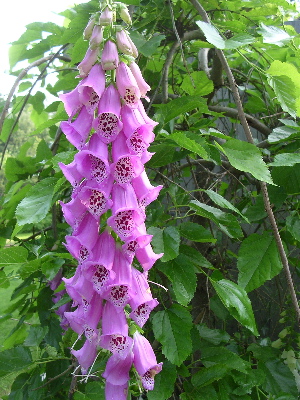
This is old-fashioned Digitalis purpurea and there will be tips on growing it as soon as I finish weeding the white garden or the mosquitoes drive me in, whichever comes sooner.
“In peaceful old gardens that remain unfretted by changing fashions and modern introductions we are apt to find huge bushes of the old May-flowering peony… ”
thus Louise Beebe Wilder, in Color in My Garden, published in 1918.
Still true in 1991, when we bought this house. Its peonies must have been planted by old Miss Wells, last of the line that built the place in the 1870’s and, by the evidence, a demon gardener. By the time we got here, she’d been gone for a dozen years and the gardens were pretty much rack and ruin, but the peonies were everywhere : lined up along the side of the barn, half-hidden under the overgrown hedges, buried in the weed-choked flowerbeds…

Survivors : Antique peonies and blue flag iris, undaunted by ladies bedstraw, milkweed, and rampant bittersweet.
There are some early magenta bombs and even earlier bright red fernleaf ones, but most of them are lactifloras, famously known as memorial day peonies because that’s when they start blooming.
After dividing and moving the ancient clumps, we wound up with – I just went out the other day and counted: 61plants, each of which is about 3 feet wide, covered with dozens of flowers and buds. But do we have single reds with twisted clusters of gold-tipped petaloids in the middle? silky white semi-doubles right out of Japanese prints? perfect apricot coral cups?
Nope. There are literally hundreds of possible peonies, but Ms. Wells was keen on repetition: we have one pink, one dark magenta and one white.
Can’t place the dark one, but I’m pretty sure the silvery pinks are Sarah Bernhardt , a fragrant double with ruffled center petals that made its debut in 1906. The white, a bomb with shell pink outer petals and red streaks at its heart is probably Queen Victoria, called the “Old Farmstead ” peony by Hollingsworth Nursery , which describes this flower’s extensive travels from the East into the Midwest in the early 20th century.
It’s clearly a child of Festiva Maxima, pretty much the same but with more fragrance and without the pink petals and the one peony to have if you’re having only one. Festiva Maxima was introduced in 1851 and I wouldn’t be surprised if the original plant were still alive somewhere.
Peonies are TOUGH, which is part of their charm. Also very handsome when not flowering; the leaves make a lovely hedge behind later blooming flowers and are also a good screen to mask the ripening foliage of spring bulbs. Deer and rabbits do not eat them. They do not need dividing
They are also a great comfort in a difficult world, a link with the past, a bet on the future and big huge silky fragrant luxurious joy in the morning – at least until it rains.
Peony Tips:
*They do need sun, but not that much; with most varieties, you can get decent flowers from a half day’s worth and the farther south you are, the more the peonies can use a break from broiling afternoons.
* Be sure to plant shallowly – those fat growth buds should be no more than an inch and a half below ground. The number one cause of bloom failure is over-deep planting… or, over time, the gradual movement of compost and mulch that buries those buds as effectively as if you had done it yourself.
* They don’t like acid soil; if your rhododendrons are doing great, it’s a sign you should add some lime to the peony bed before you start planting.
Now is a good time to do it, since fall is the best time to plant. Potted peonies can go in the ground now, but the bare root kind must be planted in fall … and the bare root kind is where all the goodies are.
* Never in the compost! The Botrytis blight that plagues them – their own personal fungus: Botrytis paeoniae – is ever present, even on apparently healthy growth, so everything that leaves the peony bed should stay gone: discarded bouquets , the fall cleanup pile, Everything. Burn it if you can, toss it deep into the woods where no peonies will ever grow, or be deeply retrogressive and send it to the landfill.
* Peonies last a long time as cut flowers and can be held in bud stage for a month or more – if you have the room in the refrigerator. For an exhaustive and very useful treatment of cut-flower choices and procedures, download this useful guide, from Kansas State University.
I hate to gush – ok, I don’t hate to gush – only giving fair warning that paragraphs are about to be spent swooning over the forsythia. It’s spectacular in the Hudson Valley, friends tell me the same is (was) true at least as far south as Pennsylvania and if the buds are any indication; it’s going to be amazing in Maine, any minute now.
Every spring is wonderful – how can a plant be so blindingly sunny – but I think this is the best I’ve ever seen it… seems like every single bud came through the winter unscathed.
Forsythia as a plant is tough, but the buds often get frozen; that’s why after a hard winter you often see bushes with only a skirt of flowers, all the color close to the ground where it was protected by snow.
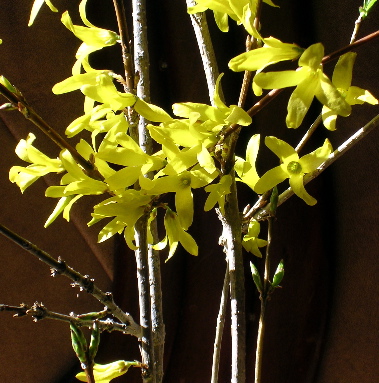
Common Forsythia (F. x intermedia), unknown cultivar from a friend
In theory, forsythia can be attacked by bugs and diseases, but the only problem I’ve ever seen is age. Best bloom comes on 2nd, 3rd and 4th year stems , so when the bush is choked with ancient trunks that can’t manage much in the way of new sprouts, total bloom begins to decline. The standard rule is to prune yearly, after the 4th year, by removing the oldest stems at the base, but I’ve never been that fanatical. It’s easier to just look at the bush and see what’s blooming well and what’s not. Unbranched young shoots won’t be flowering, but their youth is obvious, so there’s not much chance of making mistakes.
There is, however, a chance to make a great many more plants: common forsythia is as easy to propagate as willow. Just keep the stems in water – changing it every week or so – until root initials form along the submerged part.
Forsythia spreads like a weed, and a lot of ’em ARE weedy, but there are at least seven species and more than 40 cultivars, including many dwarf types, several that are variegated, and one : Forsythia viridissima var koreana ‘Kumson,’ that has white veins in its dark green leaves and looks like a real stunner. It’s rated hardy to zone 6, so it ought to be ok in the mid and lower Hudson Valley, and I intend to give it a try in Maine, too…
The widest choice is by mail-order , from sources like Rare Find Nursery and Forestfarm, but the more alert local nurseries also offer good selections, and many of them will special order if you ask, especially if you ask when they aren’t crazy-busy. Wholesalers sell far more
goodies than retailers have room to display
Department of Just in Case You Were Wondering: There is a European species (from the Balkans), but most forsythias are native to Asia. Plant hunter Robert Fortune is credited with bringing them to the West, in 1844, but the botanical name honors Scottish botanist William Forsyth (1737-1804), a major player in British horticulture who ran the Chelsea physic garden, started an international seed and plant exchange, and wound up as King George 3rd’s chief superintendent of the royal gardens at Kensington and St James’s.
For the last 5 or 6 years, I’ve been building a crocus carpet in the narrow strip of lawn that leads from the kitchen door to a grape arbor in front of the tall hemlock hedge. Every fall, in go a couple of hundred bulbs, which is about what I have money and time for, idea being that they’d keep spreading and by and by before I was too ancient, there the thing would be, a glorious tapestry of mixed colors, shining in the spring sunlight. For maximum punch and longevity, there are as many threads as possible : mostly early, small species types like chrysanthus and tomasianus, but always with a few giant Dutch gobsmackers, just so it doesn’t get too tasteful.
For years, the plan worked great … every spring there were more little clumps of yellow and white and purple cheerfully popping through the brownish green, looking sort of like willing wildflowers, and every year a few of the clumps were a little bigger, crocus puddles instead of crocus clumps. But this year we’ve hit tilt. It’s finally a carpet all right, but it looks moth-eaten. There are now more flowers than lawn but not enough to cover it, so the patchiness is backward.
It would take at least three more years to really pave the place at the present rate, at least two ugly springs too many. It’s either spend the whole bulb budget on the stupid thing and plant about 600 this fall or else it’s elimination time. Removing instead of adding would restore the wildflower-popping through effect, which may turn out to be prettier anyway.
In terms of effort , it’s more or less a wash, so I’m kind of inclined to just go for it, and that brings us to today’s homily:
* Don’t forget to take snapshots of your bulb plantings. Put a few identifying markers in, too, like yardsticks or little signs that say “10 feet from porch door at 90 degree angle.” While you’re at it, make want/need lists. In June, when the fall catalogs start coming, offering tempting discounts to those who order by July 15th , you’ll be glad you did.
SNOWDROPS: Back when I was gassing on about how great snowdrops are ( on February 9th) , I promised instructions for how to divide them when the time came. The time has come – or is about to. Ideal moment is after flowers finish but before seedpods have started to harden.
* best planting sites are sheltered from high winds, in partial sun or light shade, in soil that retains some moisture in summer (but not heavy clay).
* Soil should be very moist on transplanting day; if the weather has been dry, water both the clumps to be divided and the destination sites several hours before the job.
* Working in the late afternoon, Use a digging fork to pry up established clumps. Separate ’em. Big bulbs and their leaves can move as onesies; if you have lots of threadlike seedlings all root-intertwined, move them in groups of 3 to 7 ( depending on just how threadlike they are).
* Replant at the same depth, keeping bulbs 2 bulb-widths apart, keeping clumps separated even more. Be sure the roots are well spread out.
* Clipping off seedheads is optional. It may help the plants re-establish, since roots can concentrate on the job at hand. But usually, they’ll be happy – or not – without this additional aid, so you might as well not bother.
* Don’t forget to keep the transplants watered until the leaves start dying down.
Enough. For this post let’s just say a tomato “canned” in glass is 300,000 times tastier than a tomato canned in a can and that’s partly because the home canned tomato is (usually) a tastier variety to start with. Be sure to leave room in the garden for plenty of plants.
Before getting started on the virtues of angels’ trumpet, one of the most gorgeous, most rewarding, most pain-in-the-butt flowers available to the average gardener, let’s put in a good word for keeping a plant on the back of the toilet. Nothing fancy, a pot of ivy will do nicely, or ferns, which appreciate life in the bathroom. Point is simply that you get a big mood-boost when you see something green and growing every time you turn around – or reach over, as the case may be – to flush.
Okay, on to brugmansia, aka angels’ trumpet, a tender shrub with huge, well, trumpet shaped flowers and an amazing night time perfume. The angelic part may be that fragrance , one of the strongest in the garden, but it might also be because brugmansias are strongly poisonous – eat some and you could end up with the angels.
Flowers are huge, 8 to 10 inches long , and come in singles, doubles, and ruffled multi’s that look like quadruples, in yellow, apricot and pink as well as white, but the single white ones are the most fragrant and to my eye the loveliest. They used to be rare, but now they seem to be everywhere – or at least in every catalog and garden magazine photo shoot – and although they’re not cheap, they’re not that pricey, either.
What they are, the first year you buy them, is small. It takes several seasons to get the kind of height and mass that makes brugmansias so astonishing, and that means everyone north of zone 9 must be willing to keep them indoors in the winter. My biggest one ( now deceased) took 5 summers – admittedly, summers in Maine – to make it to 8 feet tall and 5 feet wide. Every March I vowed ” this year is the last,” and every September, faced with saying goodbye to the ever-larger tree, festooned with dozens and dozens of blooms, I said – and still say, to its descendants – ” Oh all right, back to the cellar with you. ”
Brugmansias bloom in cycles, though not always, as is sometimes said, with the full moon, covering themselves with flowers and your night garden with exotic scent that may or may not be psychoactive but is beyond intense… My first plant had 3 flowers on it when I brought it home from the nursery and I was so woozy by the time I got out of the car I had to go for a walk.
Years later, an Argentine visitor who saw the 8 footer told me the plants grow to tree size there, but people know never to fall asleep under them because ” the spirits will come to them in dreams… ” Moral of the story? Plant brugmansias by the path to the front door or somewhere else you’ll walk by them each evening, but DON’T plant any under the bedroom window. More on Brugmansia care below, and a sense of the range of what’s possible here but while we’re on the subject of save-worthy plants, don’t forget cannas and hot peppers.
CANNAS: Saving these over doesn’t give you much of a leg up on individual plant size; what it does is give you herds of them for very little money. Like dahlias, they increase obscenely each year, so you can get the dazzling effect created by huge patches without spending dazzling sums of money. And like dahlias, they’re easy to store – you just let the leaves die of frost in fall, cut them off, then store the rhizomes in a cool closet. Restart in mid-march for full sized plants in June.
HOT PEPPERS: We think of pepper plants as annuals, but they aren’t. And many of the tastiest, like habanero and aji amarillo, don’t start to bear significant crops until they’re about 6 months old. They don’t adore life as houseplants, but they will make it through on a sunny windowsill and your reward is a huge head start on the summer pepper season.
BRUGMANSIAS:
* Spring to Summer: Order or buy for late spring delivery, so you can put them outdoors right away. Plant where they will have plenty of room and think of Audrey 2, the ravenous plant in Little Shop of Horrors. ” Feed me!,” she cried, “! feeed meee!” If it is possible to overfeed or overwater a brugmansia, I have not yet found how much it would take.
* Fall: When frost threatens, dig the plants, transfer them to large pots (or plastic-lined bushel baskets) and bring them inside. If you happen to have a cool basement or other spot that stays around 45 degrees, put them there and don’t worry about light. Otherwise they need all they can get. Either way, they’ll drop lots of leaves ( if it’s dark, they’ll drop them all.) Water sparingly – hardly at all if they’re cool and dark, enough to keep the soil moist if they’re in light.
* Late Winter/Early Spring:
If they’ve been in light and slowly growing, by March they’ll be very leggy, and unless you’ve been faithful with the insecticidal soap, very buggy as well. Cut them back , clean them up and start fertilizing weakly every 3 weeks or so.
If they’ve been semi-dormant in the cool dark, the jig is up: next time you go down to put something in the dryer you’re gonna see ghost growth , creepily pale sprouts with a few wan leaves, groping blindly upward in search of light and – in all probability – already sporting a few aphids. Bring them into the light and proceed as above.
* Spring: Start hardening them off as soon as you can – cool weather ( 45-55 degrees) won’t hurt anything, and the sooner they can leave their pots and go back in the ground, the happier everyone is going to be. If you get overconfident and plant too early , protect them from light frosts with a thin sheet and just prune back anything that gets clonked.
Before getting started on the virtues of angels’ trumpet, one of the most gorgeous, most rewarding, most pain-in-the-butt flowers available to the average gardener, let’s put in a good word for keeping a plant on the back of the toilet. Nothing fancy, a pot of ivy will do nicely, or ferns, which appreciate life in the bathroom. Point is simply that you get a big mood-boost when you see something green and growing every time you turn around – or reach over, as the case may be – to flush.
Okay, on to brugmansia, aka angels’ trumpet, a tender shrub with huge, well, trumpet shaped flowers and an amazing night time perfume. The angelic part may be that fragrance , one of the strongest in the garden, but it might also be because brugmansias are strongly poisonous – eat some and you could end up with the angels.
Flowers are huge, 8 to 10 inches long , and come in singles, doubles, and ruffled multi’s that look like quadruples, in yellow, apricot and pink as well as white, but the single white ones are the most fragrant and to my eye the loveliest. They used to be rare, but now they seem to be everywhere – or at least in every catalog and garden magazine photo shoot – and although they’re not cheap, they’re not that pricey, either.
What they are, the first year you buy them, is small. It takes several seasons to get the kind of height and mass that makes brugmansias so astonishing, and that means everyone north of zone 9 must be willing to keep them indoors in the winter. My biggest one ( now deceased) took 5 summers – admittedly, summers in Maine – to make it to 8 feet tall and 5 feet wide. Every March I vowed ” this year is the last,” and every September, faced with saying goodbye to the ever-larger tree, festooned with dozens and dozens of blooms, I said – and still say, to its descendants – ” Oh all right, back to the cellar with you. ”
Brugmansias bloom in cycles, though not always, as is sometimes said, with the full moon, covering themselves with flowers and your night garden with exotic scent that may or may not be psychoactive but is beyond intense… My first plant had 3 flowers on it when I brought it home from the nursery and I was so woozy by the time I got out of the car I had to go for a walk.
Years later, an Argentine visitor who saw the 8 footer told me the plants grow to tree size there, but people know never to fall asleep under them because ” the spirits will come to them in dreams… ” Moral of the story? Plant brugmansias by the path to the front door or somewhere else you’ll walk by them each evening, but DON’T plant any under the bedroom window. More on Brugmansia care below, and a sense of the range of what’s possible here but while we’re on the subject of save-worthy plants, don’t forget cannas and hot peppers.
CANNAS: Saving these over doesn’t give you much of a leg up on individual plant size; what it does is give you herds of them for very little money. Like dahlias, they increase obscenely each year, so you can get the dazzling effect created by huge patches without spending dazzling sums of money. And like dahlias, they’re easy to store – you just let the leaves die of frost in fall, cut them off, then store the rhizomes in a cool closet. Restart in mid-march for full sized plants in June.
HOT PEPPERS: We think of pepper plants as annuals, but they aren’t. And many of the tastiest, like habanero and aji amarillo, don’t start to bear significant crops until they’re about 6 months old. They don’t adore life as houseplants, but they will make it through on a sunny windowsill and your reward is a huge head start on the summer pepper season.
BRUGMANSIAS:
* Spring to Summer: Order or buy for late spring delivery, so you can put them outdoors right away. Plant where they will have plenty of room and think of Audrey 2, the ravenous plant in Little Shop of Horrors. ” Feed me!,” she cried, “! feeed meee!” If it is possible to overfeed or overwater a brugmansia, I have not yet found how much it would take.
* Fall: When frost threatens, dig the plants, transfer them to large pots (or plastic-lined bushel baskets) and bring them inside. If you happen to have a cool basement or other spot that stays around 45 degrees, put them there and don’t worry about light. Otherwise they need all they can get. Either way, they’ll drop lots of leaves ( if it’s dark, they’ll drop them all.) Water sparingly – hardly at all if they’re cool and dark, enough to keep the soil moist if they’re in light.
* Late Winter/Early Spring:
If they’ve been in light and slowly growing, by March they’ll be very leggy, and unless you’ve been faithful with the insecticidal soap, very buggy as well. Cut them back , clean them up and start fertilizing weakly every 3 weeks or so.
If they’ve been semi-dormant in the cool dark, the jig is up: next time you go down to put something in the dryer you’re gonna see ghost growth , creepily pale sprouts with a few wan leaves, groping blindly upward in search of light and – in all probability – already sporting a few aphids. Bring them into the light and proceed as above.
* Spring: Start hardening them off as soon as you can – cool weather ( 45-55 degrees) won’t hurt anything, and the sooner they can leave their pots and go back in the ground, the happier everyone is going to be. If you get overconfident and plant too early , protect them from light frosts with a thin sheet and just prune back anything that gets clonked.
Update: I’m sure Mary (see comment) isn’t the only one who wonders how to manage all this in and out without damaging the roots. The answer is that it’s impossible. Roots will be damaged, in some cases – i.e. when you’re digging up huge ones – quite severely. No problem. Brugmansias are weeds, and pruning the roots, like pruning the tops, has no long term ill effect.
We are back in the cold again, but there’s something temporary about it and the snowdrops are here already, earlier this year than ever before in our 15 years in this house. They must have came up sometime around New Years’, because they were in full bloom when we first saw them, on January 31st.
It’s just one valiant little clump – over on the north side of the yard, underneath a group of tall hemlocks, beside the now- pointless privet hedge that used to screen a patio. That little slope will soon sprout creeping phlox and forget-me-nots and columbines and willowy hyacinths from the forced pots of years and years gone by, but in the early season it’s just green – or brown or white , depending – and those chaste-looking little flowers: white bells with dots or strokes of green that you must tip them up to see.
They’re probably Galanthus nivalis, or elwesii, I’ve never taken the time to see for sure. There are about 13 species of Galanthus, whose name comes from Greek words for milk and flower, and dozens and dozens of cultivars. Most of them bloom super-early, often through the snow. But according to the RHS , ” snowdrop” is not an environmental reference; it comes to us from the German Schneetropfen, a style of earring popular in the 16th and 17th centuries.
I’m not sure I believe this. Germans have been plant-conscious for a lot longer than a few centuries and it wouldn’t be a surprise to learn the earrings were named for the flowers. * In any case, the Society also says: “Several English vernacular names pre-date the name snowdrop, including Candlemas bells and fair maids of February, both of which are associated with Candlemas Day, 2 February, which is the peak of the flowering season.”
American bulb-sellers don’t offer anything like the assortment available to the Brits, but for a look at the possibilities, check out http://www.judyssnowdrops.co.uk. When you do, you’ll see dozens of subtle differences. You’ll also see that they’re all little white bells, and will probably be reconciled to the selections offered by http://www.munchkinnursery.com. http://www.brentandbeckysbulbs.com and http://www.johnscheepers.com/.
Because snowdrops bloom in spring, catalog sellers often put them in the autumn offerings and they often sell dry bulbs to plant along with the tulips and things. But most authorities agree that snowdrops should be planted “in the green,” and that is certainly when you should divide them, if you have access to a patch. I’ll post instructions here in early March.
Snowdrops are long lived and seldom bothered, though in wet years they get a fungus disease related to the one that whacks peonies, and in places where early spring is warm, they’re vulnerable to the narcissus bulb fly – a pernicious creature that should be called the amaryllis bulb fly. (Galanthus, like Narcissus, is in the Amaryllidaceae.) If you summer your amaryllis outside and have had trouble with bulbs that went hollow in the middle, it’s likely you’d see a fat hideous bulb-fly grub if you cut one in half. To avoid this problem in future, don’t put your amaryllis out until July, after the flies have laid their eggs.
*Note: After the podcast, my German friend Ilse wrote in to say that she grew up calling snowdrops Schneeglöckchen (snow bells). But she is only in her 80’s, so that may be the (comparatively) modern name.