Great Plants
As lilac lovers go, I’m a very small timer: there are 8 of them in the New York yard; 10 in Maine, a mere token compared to big public collections like Highland Park, in Rochester NY, where 500 different lilacs – 1200 plants – are blooming right this minute.
But even our tiny assortment gives us a full six weeks of fragrant delight because it includes a few season stretchers: bushy, pale purple ‘Miss Kim’ (Syringa patula), pink-flowered ‘James Macfarlane’ (S. x prestoniae) and a 20 foot tall pair of Japanese tree lilacs (S. reticulata), all of which bloom later than the old fashioned French kind (S. vulgaris).

I wish I could tell you. I bought it at a clearance sale at an Agway now long gone and it was supposed to be a plain old single flowered purple lilac, the sort used for hedging in an ampler age.
Hence this bit of lilac advice: keep the sales slip until you see flowers. Mislabeling is fairly common and it’s vexing – take it from my experience – to get a dark purple-red that looks like ‘Charles Joly’ when you thought you bought a white ‘Miss Willmott’.
One way to know what you’re getting is to join up with the National Phenology Network and request one of their lilac clones. Follow the” submit data” links and you’ll be sent to the application form.
The lilac will be a ‘Red Rothomagensis’ (S. x chinensis) a somewhat gangly, fragrant early bloomer with reddish buds that open to dark pink flowers. There is a picture of one here.
And why is the National Phenology Network sending you this present? Because they want your help. Phenology is the art/science of measuring climate with biological events like frog song, fish migration and plant bloom; and lilacs were chosen, way back in the 1950’s, to be standard measuring instruments. Gardeners all over the country have been watching lilacs, sending in data and, as citizen scientists, helping to document the process of climate change. (In the Midwest, where the Network was born, spring – as measured by lilac – is now almost a week earlier than it was 50 years ago).

For now, we’re watching this common lilac, which is already in place in Maine. As long as you monitor the same plant, year after year, you can contribute useful data by watching any lilac you choose. But we will ask for a ‘Red Rothomagensis’ and start watching that one too, because that’s even better. By eliminating the variations of species, cultivar and individual plant, clones make it easier to measure accurately.
For more on this communal effort, read the short history of the project that was broadcast on National Public Radio or go directly to Project Budburst, where there are full instructions and a long list of alternate watch plants. If lilacs aren’t your thing – and for some reason you’re still reading – the list includes ocotillo, redbud, wild strawberry and many other common plants.
One warning about the clone: Can’t say for sure about RR, but most Chinese lilacs are very mildew prone, and although the fungus does no long-term harm it isn’t very attractive. Try to plant your contribution to science in an inconspicuous place.
PS: Losing your local Agway isn’t phenological, but it’s just as reliable as a measure of change. Our county in Maine ( Knox) has fewer and fewer farms and truck gardens, more and more suburban sprawl.
And their sisters and their cousins whom they reckon up by dozens… no, no, just joking, but there are all kinds of nifty peonies.
And all of them have ants. Long ago, some observant gardener noticed that ants on peony buds always meant the flowers would open soon. Always. And so a bit of folk wisdom was born: Peonies cannot open until ants eat away the seal that keeps the buds closed.
I grew up believing this, my mother went to her grave believing it, and just the other day I heard it repeated again. But it isn’t true. The thing the ants are eating is nectar, not glue, and what this does for the peony is make sure there are plenty of ants around to eat any soft-bodied insects that might like to eat peonies.

This bud belongs to a super-early short peony that opens almost a month before the common (lactiflora) kind. It was here when we got the house and all we know about it is that it’s tough. The double flowers last a long time, too, a mixed blessing given that they are – to put it kindly – magenta.

When these fern leaf peony buds open the flowers will be single, in a clear true red. They’ll last about 35 seconds. And that nifty foliage will disappear by midsummer. Catalogs that describe fern leafs ( P. tenuifolia ) as rare and special seldom mention these attributes, but it’s something to bear in mind before plunking down large dollars. Oh, also they take several years to settle in and start blooming well. On the good side, they’re indestructible, even in acid soil that gets only a few hours of sun. And once you have them, you have them. Even small bits of root make new plants.

Ok, ok, here’s a picture of an actual peony, probably Queen Victoria, one of the antique varieties that came with the place.
Peony Tips Worth Repeating:
*They do need sun, but not that much; with most varieties you can get decent flowers from a half day’s worth and the farther south you are, the more the peonies can use a break from broiling afternoons.
* Be sure to plant shallowly – those fat growth buds should be no more than an inch and a half below ground. The number one cause of bloom failure is over-deep planting… or, over time, the gradual movement of compost and mulch that buries those buds as effectively as if you had done it yourself.
* They don’t like acid soil; if rhododendrons are doing great, better you add some lime to the peony bed before you start planting.
* Fall is the best time to plant. Potted peonies can go in the ground now, but the bare root kind – the kind with all the dazzling choices – must be planted in fall.
* No peony parts in the compost! The Botrytis blight that plagues them – their own personal fungus: Botrytis paeoniae – is ever present, even on apparently healthy growth, so everything that leaves the peony bed should stay gone: discarded bouquets , the fall cleanup pile, Everything. Burn it if you can, toss it deep into the woods where no peonies will ever grow, or be deeply retrogressive and send it to the landfill.
* Peonies last a long time as cut flowers and can be held in bud stage for a month or more – if you have the room in the refrigerator. For an exhaustive and very useful treatment of cut-flower choices and procedures, download Fresh Cut Peonies, from Kansas State University.
“The rose and herb garden outside our kitchen door” sounds poetic, but it’s really just a small sloping rectangle with a row of old roses at the bottom and a middle full of thyme and sage, cilantro, chives, tarragon, basil, parsley, oregano, lovage, fennel – and quite a few more roses. It was planted (in the Hudson Valley) in 1994, has always been managed organically, and has turned out to be quite a teacher.
Big lesson number 1: herbs do not repel pests as well as organic gardening advisors would have you believe. This includes garlic, unfortunately.
2: Some roses really are tougher than others and there are many to choose from besides the squatty, bland, scentless “foolproof” types (Knockout, I’m talking about you) that offer so little of roses’ splendor you might as well grow something else and be done with it. See below for sources that offer hundreds of handsome, hardy roses that can thrive without noxious chemicals.
3. There will always be at least one “must have” that’s a challenge to earth-friendly ideals. Mine is Reine des Violettes, an antique beauty (introduced in 1860) that cannot endure both crowded conditions and the Hudson Valley’s hot summers.
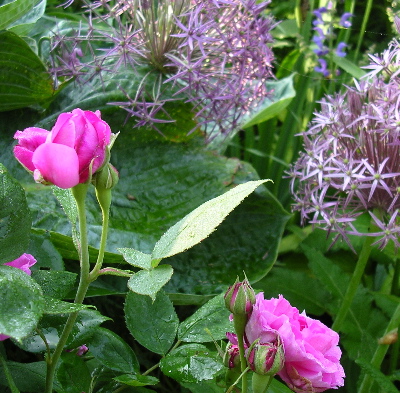
Here she is in Maine, where the cool summers we used to enjoy made it easy to grow even fussbudgets with relative ease. The fragrant flowers open dusky pink, then fade to the pale purple of the name, and the foliage has a distinct smell of pepper. The hosta in the background is Sum and Substance, unfazed by our current plague of imported snails, which brings us to
4. Japanese beetles, perhaps the greatest test of will in the organic rose department. Not counting milky spore, there are basically two ways to deal: with products derived from the tropical neem tree, or with calm acceptance and screening.
A) Neem: Attacks on mulitple fronts, discouraging beetles from feeding, interfering with their growth chemistry, and with !hooray! their mating behaviour. It only works when applied biweekly, but then it works very well indeed , as proved not only by us but also by a study done at Perdue and reported in the invaluable Hortideas newsletter. Insects must eat it to be affected; it seldom kills beneficials; and it’s relatively harmless to other creatures – except fish. But too much neem coated pollen can hurt bees, so we try not to spray open flowers.

B) That would be open flowers of potatoes. The roses we enjoy in spring before the beetles emerge, and in fall after they’re gone. In between, we let the garden go wild. Not so good for low-growing herbs, but excellent for drawing the eye away from devastated roses.

In person, columbines are not blurry. And because they cross so freely, new colors are always opening up, the gift of surprise every year.
Shopping for low-input roses:
Most of them are modern developments like hybrid rugosas, the Canadian Explorer and Parkland series, and recent introductions from Kordes. But there are also antiques, including beauties like Mutabilis, as changeable (from pale yellow through orange-pink to red) as its name suggests, and thornless, super-perfumed Zepherine Drouhin, a deep pink with no candy in it. Roses are highly climate sensitive – I’ve been tripped up more than once by the optimistic words “hardy to zone 5.” But that’s because I didn’t talk to the rose grower before placing my order; all the good ones are glad to help you fall in love with something you can actually live with.
North Creek Farm- run by Suzy Verrier, an expert in all things Rugosa
Antique Rose Emporium – exactly what its name promises
High Country Roses – for a large assortment of tough roses both elderly and brand new
Roses Unlimited – a good selection of modern Kordes roses, which until recently have been difficult to find in the US. Growers in the know have been ordering from Palatine, up in Ontario.
Most gardeners know how it is with lilies – you have enough; you definitely have enough. And then it’s March and it’s extremely dreary and here – surprise! – is a pile of summer bulb catalogs with extremely yummy pictures of lilies and you think, well, there’s always room for a few more in the cutting garden and they do make such effortless bouquets

And then, in an increasing number of cases, you think: well, nah; the wretched lily beetles will just get these too and make me feel terrible.

Gilles Gonthier
The scarlet lily beetle, Lilioceris lilii, is marching across New England, laying waste to all lilies in its path. Not everybody has them yet, but everybody who does has gone through the same dispiriting sequence: First there are only a couple and you hand pick them and it’s no big deal. Then there are a dozen or two and a combination of picking and neem sprays seems to do the trick. Then it’s many dozen and pyrethrin, and then it aint pretty.
It’s hard to think of anything good to say about these voracious creatures, but there is in fact one Giant Ray of Sunshine: they don’t travel far on their own. Unlike, for instance, Japanese beetles, which can fly considerable distances, lily beetles spread mostly by way of infected soil, and that means control is possible.
Our Lilioceris Strategy:
1. Prevention: No new ones! We don’t buy potted lilies (or fritillarias, their preferred host). When new bulbs arrive, we throw all the packing material in the trash and gently rinse the roots in tepid water if there is soil clinging to them. There shouldn’t be – and haven’t been – any of the oval, yellow eggs, which are deposited on the leaves, but we always check, just in case.
2. Constant Vigilance: overwintered adults are supposed to emerge from the soil in June. We assume ours might be precocious and start expecting them as soon as the lilies come up. I try to stay ever-alert for beetles or signs that they’ve been chewing, and a couple of times a week I scrunch down and look up. Eggs are deposited on leaf undersides and the black larvae tend to stay there until they’ve oozed out to the leaf tips and started chomping inwards. (Ragged leaf tips are a dead giveaway) .
3. Paranoiac Vigilance: They aren’t always on the lilies. Kristi found the very first one we saw on a tomato leaf. Alas, it was not the first one we had, and thus we come to
4. Kill, Kill, Kill:
a) Adults drop from the plants when disturbed, teach yourself to grab upward so they don’t get away. Crush thoroughly or drop in a jar of soapy water.
b) Larvae are disgusting – gooey and black because covered in their own shit, to keep predators at bay ( aint nature grand?), and they do much more damage than the adults. Removing them is unpleasant but easy; just wipe them from the plants with a rag or a glove covered hand. If you start at the base of the stem, wrap your hand around it under the first set of leaves and stroke gently but firmly upward, you can usually get most of them with one or two passes. People who make lewd remarks may be approached with the working hand, which will shut them up in a hurry. Be sure to revisit affected plants frequently, new larvae are likely to show up.
c). Don’t slack off. Many descriptions of L. lilii say there is only one generation per year. Hah! There are at least two, even in Maine.
5. Perseverance Furthers. It’s probably impossible to eradicate them, but our experience suggests you can keep them to small numbers without working too hard. Reducing them to small numbers from large ones does take a season of of all-out war, but after that it’s easy.
6. Oh, did I mention? The price of lilies is eternal vigilance.
Late July Addendum: When it became clear my torn knee would keep me from Maine all spring, I asked Kristi to put some diatomaceous earth on the leaves as well as on the ground ( see comments), and it looks like Peggy is on to something. It didn’t get rid of them completely and it did look horrible; but allied with the stuff on the ground it kept the population in check until I was back on patrol.
It was 4 degrees and quiet when we woke at 6:30. Now at noon it’s up to 10 and blowing like a bandit, with merry tinkling of ice pellets against the windows and the occasional loud whoosh of something that would be granita if it had flavoring.
Inside, two harbingers of spring:
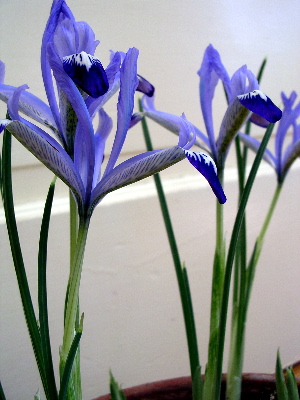
Iris reticulata is easy to force and unlike tulips, daffodils and I. versicolor (old-fashioned blue flag) it’s seldom sold by florists. This is Clairette, which is not like its picture both because it’s much more purple and because it’s much more fragrant. Catalogs seldom mention the perfume of these little charmers, but it’s definitely there and far easier to appreciate when the garden is on the tabletop.

The beans in the bag are Dr. Martin limas. !Delicious! Sweet and lima-beany and creamy, not mealy even at full huge size of over an inch wide. Didn’t used to be able to grow them in the Hudson Valley. Would cheerfully trade them for less global warming but let’s not forget the ill wind part … Seed is comparatively rare and well-worth saving; we got the original batch from Rohrer’s

Thanksgiving daécor from the vegetable garden: Gigante di Romagna cardoon, Bright Lights chard and Redbor kale.
It’s tough to grow artichokes if you don’t have a Mediterranean climate; either the growing season is too short ( Maine) or the summer is too hot (New York, and increasingly Maine, too, but that’s another story). In any case, the best you can usually do is about 6 artichokes per 5×4 foot plant; and while of course they are your own, they aren’t so splendidly wonderful they justify the space.
But cardoons, well cardoons seem possible. You don’t have to get as far as flowerbuds and because you’re eating the leaf ribs, big fat ribs from leaves that can be 3 feet long and more, yield is not a problem. Only catch is that you have to blanch them before harvest to keep them from being bitter.
Or at least that’s what all the growing instructions say. But in my experience – years and years of experience because some people are pigheaded about giving up on exotic comestibles – it doesn’t work. The standard blanching technique, unchanged for centuries ( loosely bind the leaves into a bundle, then exclude light with a wrapping of straw) makes the silver leaves even paler. But it does nothing else noteworthy, even when pressed past the suggested 2 or 3 weeks into 4 and even 5, the outer limit before rot sets in.
You do get a suggestion of artichoke, in that everything you eat afterwards tastes sweet and faintly metallic, but about the cardoons themselves suffice it to say that gall isn’t usually stringy.
Next year ( once more unto the breech), we’ll try a different variety: maybe “Large Smooth” instead of “Gigante di Romagna,” our current plants of which are now 3 years old.
We’ll probably leave the few oldsters around too, assuming they do come back again. Cardoons are beautiful, terrific bouquet material all summer long and especially welcome at season’s end, when they are among the last plants standing.
Last spring, we decided to go for — if not broke at least financially depleted – and plant the 700 hundred more bulbs required to fill the bare patches in the crocus carpet.
Essential to mark where they were needed. Didn’t want to make a map (lazy, mostly). Already knew big nails anchoring little bows of surveyor tape wouldn’t work because I tried it years ago. The tape disappeared into the grass, as planned, and then disappeared.
So THIS time I stuck the big nails through the centers of metal washers roughly the size of silver dollars. No way those big shiny disks were going to get lost…
You can perhaps guess the next part. It’s early November, no time to lose. Bill mows the grass and fallen leaves, using the bagger so no debris will obscure the view. I peer down. Nada. I rake , gently. Rien. I get down on my knees and claw with my fingertips, covering an area I KNOW must have at least one washer in it. Gone.
So we went next door and borrowed our neighbor’s metal detector and the moral of this little story is a giant reinforcement of the new(er) understanding of soil improvement: spread compost right at the surface, don’t dig it in deeply; it’s headed down fast enough as it is. The washers were buried almost an inch in just one season and the only thing that rises is rocks.

Bill finding the crocus planting spots and marking them with stakes.
We don’t do it during the season; always too many buds coming and the urge to see ” how big can it get THIS year?”
But when the plants have to be cut back for winter…

This vaseful sat by the door in Cushing for over 2 weeks, constantly opening new flowers, perfuming the entryway, and giving me a chance to use one of the large vases made years and years ago by our friend Paul Heroux. ( He was getting rid of old work that no longer pleased him; I rescued it from certain death on the shard pile and have been enjoying it ever since). To see what he’s been up to lately, check out the show at Howard Yezerski Gallery, in Boston, from November 17th to December 23rd.
three warnings about brugmansia bouquets:
* Fragrance can be overpowering if the vase is in a small room.
* Cut branches are almost as willing as willows to root while they’re on display, so by the time the flowers are finished, you can have a whole herd of incipient plants. Good (ish) in spring. Not Good in fall; be strong and throw them away.
* Brugmansias are poisonous, even in quite small amounts. If your cat treats the bouquet as salad, adios Puffkins. One of the reasons we favor the porch is Mr. Earl, who was more or less normal as a kitten

but has grown up to be a vegetable hound.

If you don’t count chives, the first allium flower I planted was a leek that didn’t get harvested. Next spring there was a flower spike and not long after that, in early summer, a great big ball of little white stars that lasted about 2 weeks.
After that, the deluge. Every year there are more of the genuinely ornamental kind (the kind in the back of the bulb catalogs, after you go past the tulips and daffodils and crocuses and lilies and just about everything else), because even though they come back reliably it’s very hard to stop buying.
Favorites include:
* the fireworks special A. schubertii (not the composer. A 19th century naturalist/plant collector named Gotthilf Heinrich von Schubert). It has pink stars that shoot out on long stems from a tight ball of other pink stars; a truly amazing effect.
* The graceful yellow A. flavum, which blooms in midsummer and is always in peril of being weeded out…until the flower stalk comes up it looks an awful lot like tall onion grass.
* A. bulgaricum, now Nectaroscordum bulgaricum. It has pink and green striped white bells instead of the more usual allium stars.

Allium christophii, the Star of Persia, is almost as lovely in the dried state as when fresh (and pale purple). This stem is about 3 years old and has been being used as outhouse daécor. I just stuck it in the pachysandra next to the barn in order to take the mugshot.
Christophii is an exception; most alliums don’t have common names. What they do have is one big flaw: leaves start turning yellow and dying just as the flowers bloom. Bulgaricum sometimes stays green throughout , but you can’t count on it. And most of the others are worse.
Solution? Plant alliums where the the leaves will be hidden by more obliging plants – even pachysandra will do. Just keep them out of the front of the border unless you want to see the gorgeous blossoms rising from decidedly unpoetic ruins.

The cimicifuga under the apple tree has beautiful big dark purple-green leaves all summer, then in late August and September a host of 6 foot purple stems topped with purple buds that open to plumes of sweetly fragrant white flowers. Completely hardy in Maine, bigger and bigger every year – and deer munch the apples under it without showing any interest in cimicifuga salad.