mushrooms
After 2 months of solid drought followed by 2 weeks of solid rain, we finally have actual August in the produce department: potatoes, beets and basil, tomatoes, summer squash and beans…Plus way more lettuce than we can eat which must be harvested before it bolts but where to put it is a problem because the refrigerator is full of mushrooms.
I try to be disciplined and process everything we’ve picked before going out for more, but I don’t do any better with that than with taking out a plant for every new plant I acquire.
There are still some boletes left from last week, for instance, because I got sidetracked dealing with the chanterelles.
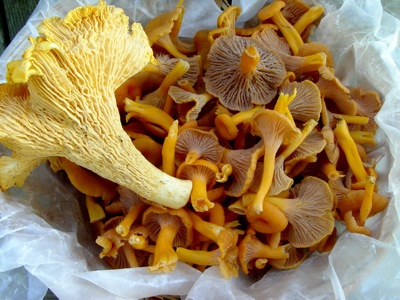
Bakaitis photo
The big one is the classic chanterelle of commerce, Cantharellus cibarius. The little guys (no common names) are a mixture of C. ignicolor – the all-yellow ones – and fragrant, tasty C. tubaeformis, which is unusually abundant this year. *
Read More…
Actually, I just said that to get your attention. What we really had was a Bolete taste-off, comparing a few of the Northeast’s many edible boletes ( all from recent hauls) to the gold standard, Boletus edulis, aka porcino, cep, steinpilz and King bolete.
We know edulis is good. We crow with delight whenever we find them. But we have eaten others that came close, and now that the rains are bringing us so many others… well, how could I resist?
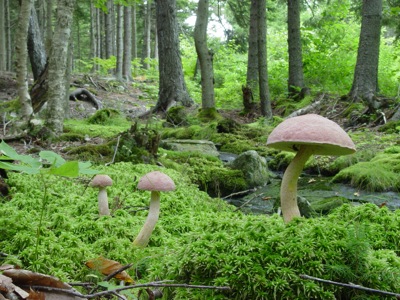
Bill took this photo of one of the contenders, Tylopilus chromapes, the day we did the test.
It wasn’t a completely fair fight, because the mushrooms weren’t all at the same stage of development. Read More…
This guest post is by Bill Bakaitis, founder of the Mid-Hudson Mycological Association, consultant to the New York and New England Poison Control networks, wild mushroom guru for the Culinary Institute of America (and, full disclosure, my husband). Although collecting is over for this year, morel hunting is not. A big part of success next spring is learning to find their haunts now, as Bill describes in:
A Successful Strategy for Finding Morels
by Bill Bakaitis
As seasons go, 2008 was a pretty good one for Morels. I investigated only a small fraction of the potential collecting sites near my home and was able to pick a peck or so at each visit.

A Peck of Morchella esculenta
Others had the same success. The best collector I know, Dennis Aita, wowed Coma members in May with his large flat of pristine fist to corncob sized esculenta collected only hours before the evening’s lecture.
As it happened, several digital images of collections circulated in emails and I soon received calls and questions from curious mushroomers. “Just how do you manage to find all of those Morels?” they wanted to know. “I have looked and looked and still come back empty handed.” Read More…
Hot then cold, dry then deluginal then dry again; it’s been a difficult spring. But this year the Northeast is having an excellent morel season, so there is definitely something good to be said, namely

Blonde morels, Morchella esculenta, get ’em while you can.
The place to get them is in open woodlands or hedgerows, where the soil is alkaline. They frequently keep company with dead elms and dying apples (and poison ivy, I’m sorry to say.)

Bill Bakaitis photo
Morels in a typical habitat. Look to the left and back of the one in the middle to see more. They hide.
Field cleaning ( shaking out bugs, trimming dirt from stems) is essential, and it can be enough if the morels are growing through matted leaves or thick new growth. But a lot of them are in sandy spots or open ground where dirt has splashed up. Always carry a separate bag or basket to put the dirty ones in, so they don’t contaminate the rest.

The little heap at left in front are the dirty ones from this expedition. The little heap at the right is trimmings. Morels last a long time in the fridge if you trim off anything nasty before you put them away, loosely wrapped in waxed paper so they can get air without drying up.
When you get this many, they will dry up before you can eat them all. We used to do this on purpose, threading them on string and hanging them in the greenhouse. Morels are thin fleshed and dry quickly, concentrating the flavor. But for the last decade or so we’ve been mostly stewing them in butter and storing them in the freezer. They keep better texture that way and are much more versatile.
Now that it’s over it’s safe to say that this was not the best of morel years in the mid Hudson Valley. Early fruitings were poor, late ones abundant but caught by the rain. Dedicated (i.e. constant) hunters did ok, but we were able to go out only 8 or 10 times and thus ended up with only a few meal’s worth and nothing to put by. Over and over we either found nothing or found the ultimate frustration: carpets of riches too old and rain-ruined to be worth gathering. Fortunately, Bill the determined never quits and on his final trip of the season came home with about 7 pounds of gigantic blondes.
Which we have of course been eating and eating in all of the usual ways, and some less usual ones too, including as a rich saucelike mélange of morels and corn. The combo is an affront to freshness – corn and morels are at opposite ends of abundance season – and I can’t vouch for how this would taste with supermarket corn, but frozen home-grown Silver Queen from last fall was great.
We used it to blanket pork chops and still had quite a bit left over, so the next night when it was Bill’s turn to cook he used it as stuffing for an enormous honker morel almost 8 inches long. ( He halved the thing, egg-and-crumbed the pieces, shallow-fried them crisp and then applied the reheated sauce mixture at the very last minute).
CORN AND MOREL SAUCE
For 4 generous portions:
Slowly cook a diced medium onion in 2 tablespoons of butter until it is semi-caramelized, starting to get deep brown around the edges. Add about 4 loosely-packed cups of coarsely chopped mature morels (3 cups would probably be enough if they were young and less copiously juicy). Let stew uncovered, stirring from time to time, until the morels are fully cooked and liquid is reduced to a few tablespoons. Add a slug of Madeira , simmer for a minute or two, then add 1 ½ cups of very tender cooked corn and about 1/3 cup of heavy, not-ultrapasteurized cream. As soon as these items are hot, it’s done. Taste, add salt if needed and serve.

One of Bill’s finds, with the proper cooking fat.