All Recipes
Many people grow eggplants, but after long years of struggle I am no longer one of them. Two reasons:
1). Eggplants need warm nights as well as warm days. This means our garden on the Maine coast is not a hospitable environment, eggplant-wise.
2). Eggplants have a short window of peak splendor on the plant. Pick them too soon; they’re undersized and bland. Pick them too late; they’re seedy and bitter. So although the plants do pretty well down at the place in the Hudson Valley, I can never count on being there at the optimum time.

freshly harvested eggplants
But in order to make caponata, the delicious Sicilian conserve of eggplant, capers and olives in thick sweet and sour tomato sauce, it is necessary to have eggplants. Off to Beth’s Farm Market “All Produce Sold Here is Grown Here,” right down the road in Warren, Maine (I’ve never asked, but as you drive up you see many huge greenhouses which may well be relevant).
Read More…

people waiting for something besides food, please be patient. I’ll be with you in a minute, but right now
It’s Tomato Time!
although only because we have two gardens. The plants in Maine are pathetic – it was just too cold, too dry for too long when they were young. But the tomatoes in New York. Omigosh.

Bill ( 5’ 9 or so) in the tomato patch. Note the naked bases, disease-prevention at work.
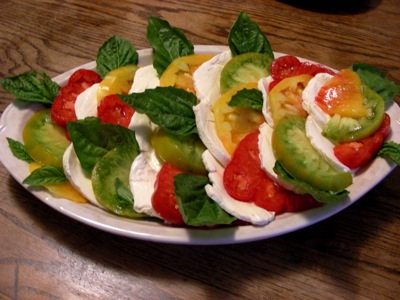
heirloom tomatoes and mozzarella, with lettuce leaf basil
The summer classic, with Pruden’s Purple (red), Malakhitovaya Shkatulla (green), and Hillbilly Potato Leaf (yellow with red streaks)
They’re all different sizes, as usual, but a larger number than usual are larger than usual
Read More…
After 2 months of solid drought followed by 2 weeks of solid rain, we finally have actual August in the produce department: potatoes, beets and basil, tomatoes, summer squash and beans…Plus way more lettuce than we can eat which must be harvested before it bolts but where to put it is a problem because the refrigerator is full of mushrooms.
I try to be disciplined and process everything we’ve picked before going out for more, but I don’t do any better with that than with taking out a plant for every new plant I acquire.
There are still some boletes left from last week, for instance, because I got sidetracked dealing with the chanterelles.
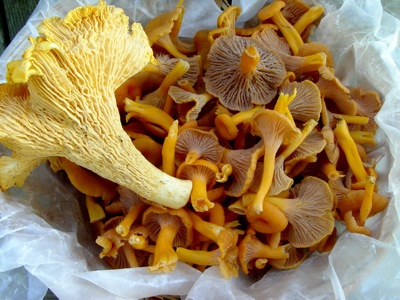
Bakaitis photo
The big one is the classic chanterelle of commerce, Cantharellus cibarius. The little guys (no common names) are a mixture of C. ignicolor – the all-yellow ones – and fragrant, tasty C. tubaeformis, which is unusually abundant this year. *
Read More…
Actually, I just said that to get your attention. What we really had was a Bolete taste-off, comparing a few of the Northeast’s many edible boletes ( all from recent hauls) to the gold standard, Boletus edulis, aka porcino, cep, steinpilz and King bolete.
We know edulis is good. We crow with delight whenever we find them. But we have eaten others that came close, and now that the rains are bringing us so many others… well, how could I resist?
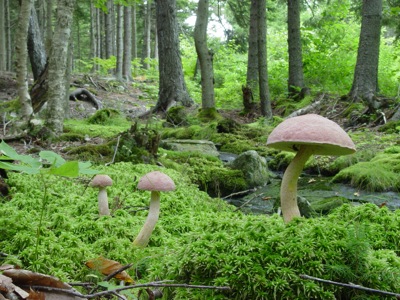
Bill took this photo of one of the contenders, Tylopilus chromapes, the day we did the test.
It wasn’t a completely fair fight, because the mushrooms weren’t all at the same stage of development. Read More…

aka Chenopodium album, tender, nutlike, easy to cook — and of course very easy to grow. All you need to do is stop pulling it up and start harvesting the tender stems and leaves to sauté in olive oil with garlic, steam in lemony chicken stock, cream just like creamed spinach or make killer lambsquarter quesadillas.

Read More…
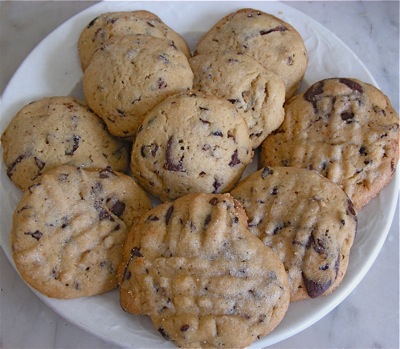
What’s to say? Leigh asked for my chocolate chip cookie recipe, so here it is: my personal no compromises not suitable for publication in general interest magazines favorite soft center or crisp or both
Extremely High End Chocolate Chip Cookies
Read More…
is the one making its debut in today’s New York Times , according to David Leite, who is responsible for it. Well, maybe. Although I prefer my own ( which include roasted cacao nibs), there is much baking wisdom in Leite’s story, including the use of high quality couverture chocolate disks, which really ARE the consummate chocolate chips.
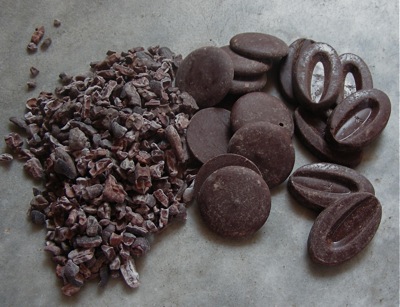
Roasted cacao nibs, couverture chocolates from El Rey (round) and Valrhona (oval). The dusty coating on the nibs is just a bit of cocoa butter that rose to the surface in storage. Read More…

If you must store strawberries for more than a couple of hours, spread them out on a paper-towel lined plate so mold and bruises can’t travel.
The Theory Part
“ Doubtless God could have made a better berry, but doubtless God never did.” (Samuel Butler, at some point in the late 16th century.*)
“Doubtless the cooks who have gone before could have devised a better strawberry dessert, but doubtless they never did.” ( me, at this point in 2008, after trying many vintage recipes before settling on the shortcake that follows). Read More…
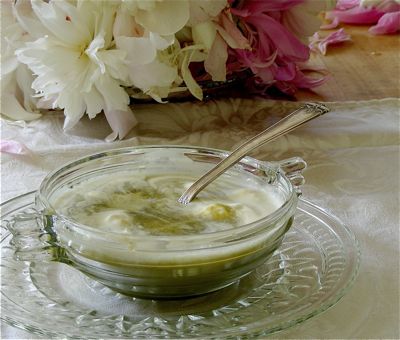
A smooth puree, accented with tender-crisp asparagus coins. Just the thing for these oxymoronic hot spring days, when it’s officially asparagus season but experientially August. We’ve stopped cutting but I see there’s still reasonably local asparagus in the stores. Read More…
Hot then cold, dry then deluginal then dry again; it’s been a difficult spring. But this year the Northeast is having an excellent morel season, so there is definitely something good to be said, namely

Blonde morels, Morchella esculenta, get ’em while you can.
The place to get them is in open woodlands or hedgerows, where the soil is alkaline. They frequently keep company with dead elms and dying apples (and poison ivy, I’m sorry to say.)

Bill Bakaitis photo
Morels in a typical habitat. Look to the left and back of the one in the middle to see more. They hide.
Field cleaning ( shaking out bugs, trimming dirt from stems) is essential, and it can be enough if the morels are growing through matted leaves or thick new growth. But a lot of them are in sandy spots or open ground where dirt has splashed up. Always carry a separate bag or basket to put the dirty ones in, so they don’t contaminate the rest.

The little heap at left in front are the dirty ones from this expedition. The little heap at the right is trimmings. Morels last a long time in the fridge if you trim off anything nasty before you put them away, loosely wrapped in waxed paper so they can get air without drying up.
When you get this many, they will dry up before you can eat them all. We used to do this on purpose, threading them on string and hanging them in the greenhouse. Morels are thin fleshed and dry quickly, concentrating the flavor. But for the last decade or so we’ve been mostly stewing them in butter and storing them in the freezer. They keep better texture that way and are much more versatile.