Tips
“In peaceful old gardens that remain unfretted by changing fashions and modern introductions we are apt to find huge bushes of the old May-flowering peony… ”
thus Louise Beebe Wilder, in Color in My Garden, published in 1918.
Still true in 1991, when we bought this house. Its peonies must have been planted by old Miss Wells, last of the line that built the place in the 1870’s and, by the evidence, a demon gardener. By the time we got here, she’d been gone for a dozen years and the gardens were pretty much rack and ruin, but the peonies were everywhere : lined up along the side of the barn, half-hidden under the overgrown hedges, buried in the weed-choked flowerbeds…

Survivors : Antique peonies and blue flag iris, undaunted by ladies bedstraw, milkweed, and rampant bittersweet.
There are some early magenta bombs and even earlier bright red fernleaf ones, but most of them are lactifloras, famously known as memorial day peonies because that’s when they start blooming.
After dividing and moving the ancient clumps, we wound up with – I just went out the other day and counted: 61plants, each of which is about 3 feet wide, covered with dozens of flowers and buds. But do we have single reds with twisted clusters of gold-tipped petaloids in the middle? silky white semi-doubles right out of Japanese prints? perfect apricot coral cups?
Nope. There are literally hundreds of possible peonies, but Ms. Wells was keen on repetition: we have one pink, one dark magenta and one white.
Can’t place the dark one, but I’m pretty sure the silvery pinks are Sarah Bernhardt , a fragrant double with ruffled center petals that made its debut in 1906. The white, a bomb with shell pink outer petals and red streaks at its heart is probably Queen Victoria, called the “Old Farmstead ” peony by Hollingsworth Nursery , which describes this flower’s extensive travels from the East into the Midwest in the early 20th century.
It’s clearly a child of Festiva Maxima, pretty much the same but with more fragrance and without the pink petals and the one peony to have if you’re having only one. Festiva Maxima was introduced in 1851 and I wouldn’t be surprised if the original plant were still alive somewhere.
Peonies are TOUGH, which is part of their charm. Also very handsome when not flowering; the leaves make a lovely hedge behind later blooming flowers and are also a good screen to mask the ripening foliage of spring bulbs. Deer and rabbits do not eat them. They do not need dividing
They are also a great comfort in a difficult world, a link with the past, a bet on the future and big huge silky fragrant luxurious joy in the morning – at least until it rains.
Peony Tips:
*They do need sun, but not that much; with most varieties, you can get decent flowers from a half day’s worth and the farther south you are, the more the peonies can use a break from broiling afternoons.
* Be sure to plant shallowly – those fat growth buds should be no more than an inch and a half below ground. The number one cause of bloom failure is over-deep planting… or, over time, the gradual movement of compost and mulch that buries those buds as effectively as if you had done it yourself.
* They don’t like acid soil; if your rhododendrons are doing great, it’s a sign you should add some lime to the peony bed before you start planting.
Now is a good time to do it, since fall is the best time to plant. Potted peonies can go in the ground now, but the bare root kind must be planted in fall … and the bare root kind is where all the goodies are.
* Never in the compost! The Botrytis blight that plagues them – their own personal fungus: Botrytis paeoniae – is ever present, even on apparently healthy growth, so everything that leaves the peony bed should stay gone: discarded bouquets , the fall cleanup pile, Everything. Burn it if you can, toss it deep into the woods where no peonies will ever grow, or be deeply retrogressive and send it to the landfill.
* Peonies last a long time as cut flowers and can be held in bud stage for a month or more – if you have the room in the refrigerator. For an exhaustive and very useful treatment of cut-flower choices and procedures, download this useful guide, from Kansas State University.
Now that it’s over it’s safe to say that this was not the best of morel years in the mid Hudson Valley. Early fruitings were poor, late ones abundant but caught by the rain. Dedicated (i.e. constant) hunters did ok, but we were able to go out only 8 or 10 times and thus ended up with only a few meal’s worth and nothing to put by. Over and over we either found nothing or found the ultimate frustration: carpets of riches too old and rain-ruined to be worth gathering. Fortunately, Bill the determined never quits and on his final trip of the season came home with about 7 pounds of gigantic blondes.
Which we have of course been eating and eating in all of the usual ways, and some less usual ones too, including as a rich saucelike mélange of morels and corn. The combo is an affront to freshness – corn and morels are at opposite ends of abundance season – and I can’t vouch for how this would taste with supermarket corn, but frozen home-grown Silver Queen from last fall was great.
We used it to blanket pork chops and still had quite a bit left over, so the next night when it was Bill’s turn to cook he used it as stuffing for an enormous honker morel almost 8 inches long. ( He halved the thing, egg-and-crumbed the pieces, shallow-fried them crisp and then applied the reheated sauce mixture at the very last minute).
CORN AND MOREL SAUCE
For 4 generous portions:
Slowly cook a diced medium onion in 2 tablespoons of butter until it is semi-caramelized, starting to get deep brown around the edges. Add about 4 loosely-packed cups of coarsely chopped mature morels (3 cups would probably be enough if they were young and less copiously juicy). Let stew uncovered, stirring from time to time, until the morels are fully cooked and liquid is reduced to a few tablespoons. Add a slug of Madeira , simmer for a minute or two, then add 1 ½ cups of very tender cooked corn and about 1/3 cup of heavy, not-ultrapasteurized cream. As soon as these items are hot, it’s done. Taste, add salt if needed and serve.

One of Bill’s finds, with the proper cooking fat.
Just realized I promised – on the vhv podcast – to post a list of summer annuals that it makes sense to buy as seedlings, either because they’re fussy to start, because they have timing issues related to light-levels, or because they take a long time between seed-in-the-ground and bloom. For those that do better directly-seeded, see the post below.
In no particular order: petunias, snapdragons, impatiens, stock, tall marigolds and giant zinnias (shorter plants and smaller flowers are pretty swift), cosmos, China asters, bells of Ireland, lisianthus, scabiosa – aka pincushion-flower, statice, and crested celosia – the cockscomby ones. Plume type celosias are faster and can be started from seed.
In spite of the persistent cold, the annual annual fever is on me: can’t resist mop-headed China asters, tall snapdragons (I love old fashioned black prince, the one with the black green leaves and deep, velvety red flowers), fragrant little yellow Lemon Gem marigolds, cosmos, petunias – and let’s hear a good word for petunias, hey. Not the doubles that look squirted out of a can, like the whipped cream on a cheap sundae, but those like the Wave hybrids that have decently small, simple flowers with some of the old fashioned petunia fragrance but not the old fashioned petunia tendency to collapse utterly at the first raindrop. And…
You know how it goes: take a quick trip to the garden center to get a new pair of gloves or a half-pound of grass seed and the next thing you know you’re wandering down the aisles, drawn by that patchwork carpet of bright colors, each teeny plant in its tiny cell putting out flowers that call, “buy me, buy me, buy ME!”
It can be hard to ignore them, but it’s better to buy the ones that are still more potential than performance, stocky little guys with multiple stems and healthy-looking leaves. And when I say little I do mean little. Best trick is to mutter “roots, roots” while shopping . After all, with constant water and fertilizer an annual can grow 8, 10 inches – a foot and more – tall in a pot the size of an ice cube, but that plant is going to have major adjustment problems when it moves into the garden.
And while we’re on the subject of seedlings, I see to my horror some places are selling baby sunflowers. SUNFLOWERS! There are gazillions of terrific sunflowers – classic yellows with one huge flower, like Russian Giant, not classic dark reds like Velvet Queen, that makes a huge, flower covered bush, and just about everything in between although as yet none are purple ( thank heaven for small mercies).
Point of rant: all of them will make MUCH better plants if you start them from seed. Nasturtiums , too, which are also more and more sold as seedlings but phooey on that, and here are a few more
Things that should be started from seed: poppies, evening-scented stock (Matthiola bicornis) coriander, annual phlox (Phlox drummondii), larkspur, annual lupine, morning glories… I’d say sweet peas , too. But those should be in by now.
Is easy, asparagus being a crop that offers fabulous returns for very little work. Admittedly, it’s a project to plant, involving the preparation of a deep trench and lots of good soil to fill same. But you only do THAT once every 15 to 20 years; in between there is nothing but semi – yearly maintenance: spring mulching; fall cleanup and fertilizing. That’s it, unless you count harvesting.
I don’t. Picking asparagus is not work. Neither is cutting the beautiful tall ferns to enhance summer bouquets.
In short, assuming you plan to stay put for a while, there is just one thing about asparagus that can be a deal breaker: It isn’t small. A row generous enough for 4 people to pig out all season takes about 30 x 3 feet and that’s a substantial chunk of real estate.
On the other hand, asparagus needn’t be in the vegetable garden. The ferns are handsome enough to make it a suitable background for roses, say, or you could use it to mask a pool fence… or
Anything that lets you grow your own. Truly fresh asparagus is right up there with truly fresh peas, a vegetable apart.
Variety also matters, though this is one case where just about all of them are tasty – differences mostly come in looks , yield, and disease resistance. Only one, the new(ish) Purple Passion, is substantially sweeter than the others. It’s also reputed to contain less of the compounds that some smell in urine ( Not everyone pees asparagus pee; and of those who do, not all of them can smell it. )
I asked Bill what kind he planted when he set ours, 13 years ago. “Whatever they were selling at the Agway,” he said. “Jersey King, maybe, or maybe it was Martha Washington.” So much for being fussy about varieties. Whatever we have is plenty tasty enough, but it is highly variable… and there are so many female plants I think it’s probably old standard Martha, even though early releases of J. King were not as all-male as promised.
More serious truck gardeners would have dug up and discarded the less spear-productive females – easy to distinguish because they have berries – but we have so many plants (about 75 feet of row; it’s a long story, mostly about greed) that we haven’t bothered. Even now when I’m getting ready to plant some Purple Passion, I’ll just put it at the end of one of the rows we already have.
We’ll get our Purple Passion from Nourse Farms , the same place we got the strawberries extolled back on May 1st. An alternative source is Pinetree Garden Seeds. The Nourse website has good planting instructions, complete with diagrams.

Our neighbor Dan’s Purple Passion, just starting
He offered to weed when he saw the camera, but I told him the unexpurgated version was probably more inspiring. Once it gets well established, asparagus is not easily discouraged by a little competition.
When it comes to strawberries, I’ve been a yoyo gardener for years. They do come under the heading of “one more thing,” and the Northeast is gratifyingly full of pick your own farms that grow decent varieties. Result: the patch languishes and by and by I take it out. Then I taste something delicious, or write a story and remember how easy they are to grow. Next thing you know, I’m out there setting a small bed – just enough to, you know, make sure there are enough to nibble on.
Any more, all we grow is Tristar, best tasting of the day neutrals, varieties that can bear from spring to fall because they don’t depend on day length to trigger flowering. ( This year I was going to try Everest, supposedly even better. But by the time I got around to ordering, they were all sold out…
Many strawberry connoisseurs feel about day neutrals the way I feel about “early” tomatoes, namely: ” so what? I’d rather just eat great ones in season and let it go at that.” But early tomatoes are always followed by more wonderful tomatoes, whereas day neutral strawberries just keep coming, long after the spring wonderfuls are gone. With day neutrals, the smallish spring crop starts a season that runs through summer, peaks in early fall, then continues at a modest pace until stopped by hard frost.
That said, the fussbudgets are right about flavor – the tastiest action is all in old fashioned June bearers, original fruit of the 18th century cross between tiny, super sweet North American Fragaria virginiana and bland but big F. chiloensis, from the continent to the south.
There are several hundred named June bearers, though you’d never know it by shopping – whether for fruit OR for plants. Strawberries are still 2 or 3 decades behind tomatoes in the heirloom awareness/ variety savvy department.
Yet – let’s all fall over with surprise – there are umptillion kinds of home garden strawberries that beat out most commercial fruit, for the usual home garden reasons: no need for durability, no need to turn red before ripening, no need to whap out large crops all at once to cut down on field labor…
June bearers that have been delicious for us include ‘Northeaster’, somewhat shy bearing but very flavorful; ‘Fairfax’, which spoils in less than a day from the plant – too juicy! – and is close to wild strawberries for the fragaria part, and good old fashioned ‘Sparkle’, on the small side but otherwise yummy and grown by several pick your owns, the fact that frees us to focus on Tristar.
For more – far far more – about garden strawberries, check out the excellent strawberry site put up by let’s hear it for a GOOD use of tax dollars! the National Agricultural Library
I get my plants from Nourse Farms
Strawberries in the kitchen to come – after they’re better in market.
Meanwhile, possibly under the influence of the buzz about “Feeding Desire” the Cooper-Hewitt’s new utensil show (new show, old utensils), I started hankering after an – I confess, second – silver berry spoon, for the ultimate in dishing ’em out. On eBay: 12089 “strawberry” items; 542 in home daécor; 1 – one! – silver berry spoon. At google: 11,600 responses to a request for “silver berry spoon.” In the garden, fortunately for my budget: 11,600 things that need planting/weeding/mulching… and picking. The asparagus is up! (while you’re cruising the Victorian silverware, get a load of all those nifty asparagus tongs)
I hate to gush – ok, I don’t hate to gush – only giving fair warning that paragraphs are about to be spent swooning over the forsythia. It’s spectacular in the Hudson Valley, friends tell me the same is (was) true at least as far south as Pennsylvania and if the buds are any indication; it’s going to be amazing in Maine, any minute now.
Every spring is wonderful – how can a plant be so blindingly sunny – but I think this is the best I’ve ever seen it… seems like every single bud came through the winter unscathed.
Forsythia as a plant is tough, but the buds often get frozen; that’s why after a hard winter you often see bushes with only a skirt of flowers, all the color close to the ground where it was protected by snow.
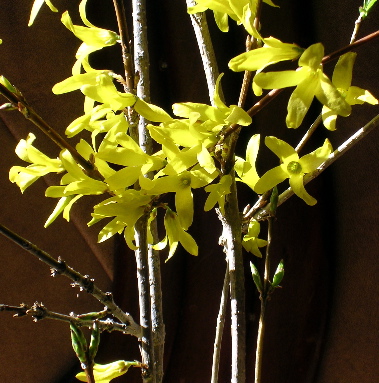
Common Forsythia (F. x intermedia), unknown cultivar from a friend
In theory, forsythia can be attacked by bugs and diseases, but the only problem I’ve ever seen is age. Best bloom comes on 2nd, 3rd and 4th year stems , so when the bush is choked with ancient trunks that can’t manage much in the way of new sprouts, total bloom begins to decline. The standard rule is to prune yearly, after the 4th year, by removing the oldest stems at the base, but I’ve never been that fanatical. It’s easier to just look at the bush and see what’s blooming well and what’s not. Unbranched young shoots won’t be flowering, but their youth is obvious, so there’s not much chance of making mistakes.
There is, however, a chance to make a great many more plants: common forsythia is as easy to propagate as willow. Just keep the stems in water – changing it every week or so – until root initials form along the submerged part.
Forsythia spreads like a weed, and a lot of ’em ARE weedy, but there are at least seven species and more than 40 cultivars, including many dwarf types, several that are variegated, and one : Forsythia viridissima var koreana ‘Kumson,’ that has white veins in its dark green leaves and looks like a real stunner. It’s rated hardy to zone 6, so it ought to be ok in the mid and lower Hudson Valley, and I intend to give it a try in Maine, too…
The widest choice is by mail-order , from sources like Rare Find Nursery and Forestfarm, but the more alert local nurseries also offer good selections, and many of them will special order if you ask, especially if you ask when they aren’t crazy-busy. Wholesalers sell far more
goodies than retailers have room to display
Department of Just in Case You Were Wondering: There is a European species (from the Balkans), but most forsythias are native to Asia. Plant hunter Robert Fortune is credited with bringing them to the West, in 1844, but the botanical name honors Scottish botanist William Forsyth (1737-1804), a major player in British horticulture who ran the Chelsea physic garden, started an international seed and plant exchange, and wound up as King George 3rd’s chief superintendent of the royal gardens at Kensington and St James’s.

That’s chervil on the left, nestled up against dandelion, another delicious weed (harvesting and recipe tips below – in the entry for April 3rd). No pic of the coriander – yet. It’s too windy every time I think of it…
The first seeds we planted (peas) have barely broken the surface, but the coriander and chervil that planted themselves are off and running; chervil vinaigrettes have been on the menu for several weeks now and we had the first guacamole with homegrown cilantro about 10 days ago.
Having these two in abundance after a winter of pallid store cilantro* and no chervil at all, what a thrill!
The flavors are very different; clean-spicy anise-y chervil has nothing in common with the funky richness of cilantro except a penetrating greenness, but in the garden they are almost twins:
Both are cool weather plants that sprout early, go to flower in the summer and make a second crop in fall.
Both are rampant self-sowers; just let a few of those flowers ripen and drop seeds and you can have truly delicious weeds.
Both are easy to remove if they do show up in the wrong spot, in part because both are tap rooted, which means
Both will either die or bolt ( send up flower stalks) if you try to transplant seedlings. Same goes for dill, another annual herb that should always be grown from seed. Parsley is tap rooted, too, and often presents the same problem, but because it’s a biennial it’s tougher. Parsley seedlings can move successfully as long as they are still very small and young.
The not-twin part is in the seeds:
Chervil seed should be very fresh, it doesn’t keep well from year to year. Cilantro seed is much longer lived. Also much cheaper to buy in bulk as spice. It won’t germinate if it’s been irradiated, but it usually hasn’t, so there’s no reason to buy those little dinky packets. Seeds cost less than a dollar an ounce when they’re sold as flavoring – for chili / sweet yeast breads/ gin…
Chervil seed is no special culinary delight, but coriander is not only great dried ( the classic spice use), it’s also delicious when green and soft. The flavor is right between funky leaf and sweet-flowery dried , wonderful in sauces for fish, in potato salad…
*cilantro is the most common US name for the leaves of the coriander plant, and is used here for convenience.
I know this is the age of instant gratification, but – this being the season – let’s hear it for planting young trees. The rewards ( I speak from experience) are huge: a personal forest – or great big hedge, or both – isn’t simply a visual treat and haven for Our Friends The Birds, it’s also shelter from road noise, wind, and whatever lies next door. And as long as you don’t go overboard, trees are a terrific investment. Deposit a 4 to 6 footer now, enjoy a major increase in property value when it hits the 14 foot mark – or, of course, soars beyond.
Our hemlock hedge, for instance, is about a hundred trees long, so it had to start out as young ‘uns. We paid 5 or 10 bucks apiece – this being 12 years ago, more or less – for an assortment of rather spindly 4 to 5 footers. Two years later, when the tallest had barely hit 6 feet and were still more promise than performance I got antsy. Bought a bunch of 10 footers, at about 40 bucks a pop, to plant in front of the most grievous eyesore.
Sure enough it DID make an immediate difference, but the little guys only took 2 or 3 more years to catch up, and once they did that was it for the benefit – annual pruning evened it all out. Now that every tree in the hedge is 14 to 16 or more feet tall, you can’t tell which is which.
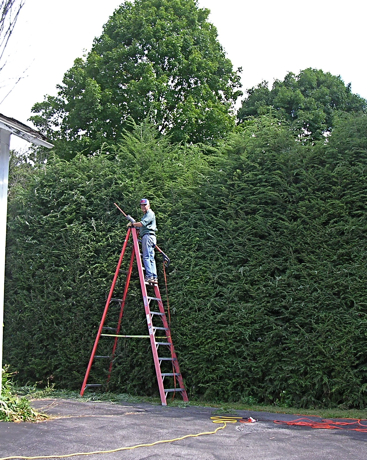
That’s Bill with the electric pruner, on a 12 foot ladder.
Other benefits of starting small:
* small trees suffer less damage when taken from the field, so they recover more quickly when planted ( big trees usually stay the same height for at least a couple of years ; they’re too busy repairing their roots to do much of anything else.).
* small trees are DIY, which matters huge when you’re talking about a lot of them. You can pick up a 4 footer without serious consequences for your back. You can dig a hole for it without taking all day, and you can keep it watered … even a skinny 8 foot tree needs about 20 gallons of water each week – more if the weather is hot and windy.
The alternative, if you’re planning to stay put for a long while or have truly extensive tree needs, is a whole bunch of the tiny trees sold super-cheaply by many soil and water conservation districts and slightly less cheaply but still bargainish by mail order tree-nurseries. These’re little sticks, about 18 inches tall… it’s gonna be a long time to glory; and you do have to spray ’em against deer for at least the first couple of years. But they’re certainly easy; one stroke of the shovel is all it takes. And the price is right: here in Dutchess County, NY, it’s $16.50 for a bundle of 10 Norway spruce, each of which will ( or more properly, can) grow 50 or more feet tall.
The pre-order period is over so there are no guarantees, but leftover bundles are usually available at the yearly plant sale at the Farm and Home center on Rte. 44 in Pleasant Valley. It’s April 21 and 22 ; be there early or be disappointed. For further details call 845 677 8011, extension 3, or see the website.
I’m seldom out ahead of the pack, but I did get fooled before April 1st. On the most recent podcast , to be exact, when Dean sidetracked my passionate defense of home cooking into a celebration of dandelions.
Well, okay. Not the best argument for home cooking. But a GREAT example of great food close to home. Dandelions are everywhere, first green of the season. They’re delicious (like endive, only more so) and almost obscenely good for you : tons of vitamin A, quantities of B complex, C, and D, plus iron, potassium, and zinc.
To say nothing of absolutely free,
BULLETIN: Just looked out at the feeder. The goldfinches are golden again, drab winter plumage all gone.
WILTED DANDELIONS
This is the way I learned to love them when I was a kid in Pennsylvania Dutch country. Italians have other ideas, which will be addressed another time.
For about 4 to 6 side dish servings or dinner for 2
A good sized heap – half a brown paper grocery bag full – of young dandelions ( see below) or other bitter greens, washed and coarsely chopped
½ pound bacon
1/3 cup cider vinegar
1/3 cup water
3 or 4 tablespoons brown sugar
Several turns of the pepper mill
A bit of minced garlic is not authentic but is tasty
2 hardboiled eggs
1. Let the greens come to room temperature in a large, heatproof bowl. Cook the bacon in a heavy skillet over low heat until very crisp.
2. Set the bacon aside to drain and pour off all but about 1/3 cup of the bacon fat. Put the pan aside, off the heat. Crumble the bacon and slice the eggs thinly.
3. Add the vinegar, water, sugar , pepper (and garlic) to the skillet and bring the mixture to a simmer, stirring to dissolve the sugar. When sugar is dissolved, bring dressing to a rolling boil and pour it over the greens. Toss thoroughly. Garnish with bacon and hard egg and serve.
(If the season is almost over and the greens are on the serious side, cook them briefly in the dressing … just until wilted.)
To Harvest and Clean Dandelions:
Size doesn’t matter – the older the root, the larger the rosette of leaves – but youth is crucial: go for plants with small, tight flowerbuds buried in the center. Once buds start swelling, greens turn bitter and tough.
Cut the rosette at ground level. Discard any discolored leaves and trim off the dirt-covered base before dropping the rest in your bag or basket.
Separate leaves and chop coarsely, then dump in a large bowl of cool water. Swish ’em around, then lift into a colander. Discard sandy water in bowl. Repeat until no more sand comes out. It almost always takes 3 passes and often takes more .
(Taste a leaf, bearing in mind that the dressing will gentle them quite a bit. If they still seem mindbendingly bitter, let them soak in cool water for an hour or two). Drain so they’re not sopping wet but don’t worry about drying them.