Tips
After 2 months of solid drought followed by 2 weeks of solid rain, we finally have actual August in the produce department: potatoes, beets and basil, tomatoes, summer squash and beans…Plus way more lettuce than we can eat which must be harvested before it bolts but where to put it is a problem because the refrigerator is full of mushrooms.
I try to be disciplined and process everything we’ve picked before going out for more, but I don’t do any better with that than with taking out a plant for every new plant I acquire.
There are still some boletes left from last week, for instance, because I got sidetracked dealing with the chanterelles.
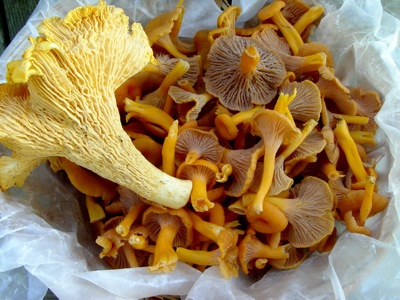
Bakaitis photo
The big one is the classic chanterelle of commerce, Cantharellus cibarius. The little guys (no common names) are a mixture of C. ignicolor – the all-yellow ones – and fragrant, tasty C. tubaeformis, which is unusually abundant this year. *
Read More…
Actually, I just said that to get your attention. What we really had was a Bolete taste-off, comparing a few of the Northeast’s many edible boletes ( all from recent hauls) to the gold standard, Boletus edulis, aka porcino, cep, steinpilz and King bolete.
We know edulis is good. We crow with delight whenever we find them. But we have eaten others that came close, and now that the rains are bringing us so many others… well, how could I resist?
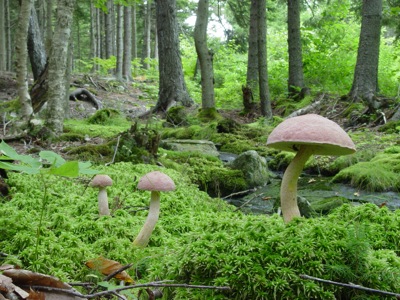
Bill took this photo of one of the contenders, Tylopilus chromapes, the day we did the test.
It wasn’t a completely fair fight, because the mushrooms weren’t all at the same stage of development. Read More…
This guest post is by Bill Bakaitis, founder of the Mid-Hudson Mycological Association, consultant to the New York and New England Poison Control networks, wild mushroom guru for the Culinary Institute of America (and, full disclosure, my husband). Although collecting is over for this year, morel hunting is not. A big part of success next spring is learning to find their haunts now, as Bill describes in:
A Successful Strategy for Finding Morels
by Bill Bakaitis
As seasons go, 2008 was a pretty good one for Morels. I investigated only a small fraction of the potential collecting sites near my home and was able to pick a peck or so at each visit.

A Peck of Morchella esculenta
Others had the same success. The best collector I know, Dennis Aita, wowed Coma members in May with his large flat of pristine fist to corncob sized esculenta collected only hours before the evening’s lecture.
As it happened, several digital images of collections circulated in emails and I soon received calls and questions from curious mushroomers. “Just how do you manage to find all of those Morels?” they wanted to know. “I have looked and looked and still come back empty handed.” Read More…
How dry we are! It’s just the worst – our sliver of the Maine coast has had less than a half inch of rain in the last 5 weeks and we have only a shallow well, barely enough for dishes and showers. I’m watering the joint with my tears, and when friends complain they’ve been stuck dragging hoses around for eversolong, it’s hard for me to dredge up much sympathy.
Some crops are going to be all right, and there’s still plenty going on – Lois had no trouble finding something to paint the other day
but if you look a little closer Read More…
Over the years, we’ve grown at least a dozen kinds of strawberries, mostly standard garden varieties (Fragaria x ananassa) like Sparkle and Tristar, and so-called “wild” strawberries, aka fraises de bois and alpine strawberries (F. vesca), like these Mignonettes being used as an edging in the lower garden.
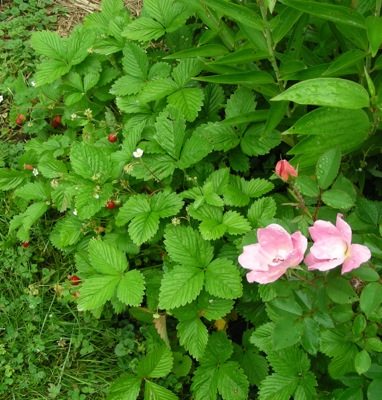
Cultivated strawberries are easy to grow, almost always tasty and sometimes very tasty. But none of them – yet; I keep trying – are as good as genuinely wild strawberries (F. virginiana), the intensely flavorful, amazingly aromatic gift that grows freely in woodland edges all over the northeast and beyond.
Read More…
is the one making its debut in today’s New York Times , according to David Leite, who is responsible for it. Well, maybe. Although I prefer my own ( which include roasted cacao nibs), there is much baking wisdom in Leite’s story, including the use of high quality couverture chocolate disks, which really ARE the consummate chocolate chips.
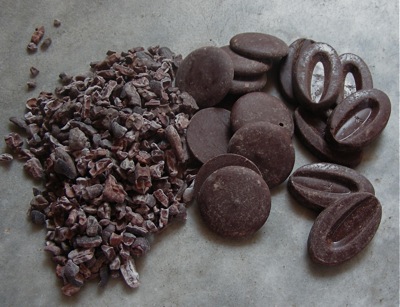
Roasted cacao nibs, couverture chocolates from El Rey (round) and Valrhona (oval). The dusty coating on the nibs is just a bit of cocoa butter that rose to the surface in storage. Read More…

If you must store strawberries for more than a couple of hours, spread them out on a paper-towel lined plate so mold and bruises can’t travel.
The Theory Part
“ Doubtless God could have made a better berry, but doubtless God never did.” (Samuel Butler, at some point in the late 16th century.*)
“Doubtless the cooks who have gone before could have devised a better strawberry dessert, but doubtless they never did.” ( me, at this point in 2008, after trying many vintage recipes before settling on the shortcake that follows). Read More…
are the happiest tomatoes. Well, not really. Gentle, consistent warmth is what tomato plants want – not only on their leaves and flowers ( tomato pollen is sterilized by temperatures over 85), but also around their roots, which by the way – news flash! – prefer to stay moist.
Tomato Planting Tips
By now your seedlings are probably planted, so it’s too late (for this year) to say the first line of defense is deep planting – set the baby so 1/3 to 1/2 of the stem is underground. Useful new roots will form all along the buried portion.
I used to think it was important to remove leaves and suckers before burial. Bill made fun of me. We did a side by side experiment. He was right; didn’t matter a whit. One less thing.
Ok. They’re in there. Now what? Two things
1. Mulch, really a lot of mulch. We use a thin layer of newspaper – just one fold – under a largish pile of straw. This holds moisture in the soil and helps keep roots from frying. I put my hand down on the uncovered earth when I was weeding yesterday and it was HOT. Not warm. Hot. Not good.
 Tomato mulching in progress. The brown paper grocery bags are a thicker weed (and water) barrier. Helpful if your raised beds are really raised. These are about a foot above the paths.
2. Limb them up. If you have no problems with fungus diseases you can stop right here, but if blight has ever visited you, read on.

The scar is difficult to find, but if you look closely at the left side of the stem you’ll see the scar where a branch used to be.
Removing lower leaves and suckers so the stem is naked at the base accomplishes two things:
1. It provides good air circulation, an absolute necessity ( crowding is the mother of disease).
2. It deprives the fungus spores of handy landing spots from which to travel upward. In theory, a timely application of mulch will block spores so they cannot splash up. In practice, it helps but not enough to be relied on exclusively.
Actually, one of the earliest isn’t a peony – and it’s late: it’s a peony flowered tulip, one of the last to bloom.

Kristi Niedermann
This photo of ‘Mount Tacoma’ was taken just a couple of days ago in Maine, where the peonies themselves are still a (semi) distant promise.
Here in the Hudson Valley – functionally about 2 weeks south – the real deal is starting to pop, beginning as usual with one of our inherited mysteries.
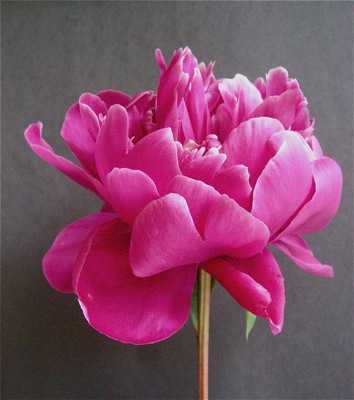
It looks a lot like ‘Cincinnati’. But ‘Cincinnati’ is midseason and this is among the earliest lactifloras to open. ‘Magenta Moon’ seemed likely until I looked up the date (on the Peony Checklist , provided by The American Peony Society). No good. ‘Magenta Moon’ didn’t rise until 1995, by which time the peony had been in place at least 15 years.
Truth is I haven’t done much research – scrolling though peony pictures is far too dangerous. No matter how swiftly you move the cursor, to look at peonies is to want peonies, especially at places like Klehm’s and La Pivoinerie D’Aoust,
One good thing about peony lust is that it tends to supplant tulip lust, so I probably shouldn’t mention it, but here’s an aspect of ‘Mount Tacoma’ that isn’t part of the usual descriptions: Given very well drained soil and not too much fertilizer it comes back – at least in Maine, where mine have been returning faithfully for at least a decade.
More often than not the deer eat them (that’s why I stopped planting more in 1997) but that’s no knock on their longevity. ‘Mount Tacoma’ was introduced in 1924 and is still one of the most common whites, available almost everywhere, but just for the record I got mine from Scheepers.
Back last November, after going on at some length about leaf sweepers, I promised to discuss growing chrysanthemums like this football – ‘Ticonderoga’ –
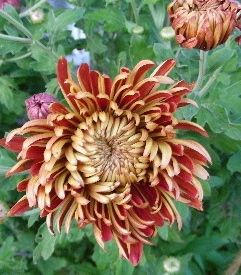
at the proper time. Which it more or less is.
For growing instructions:
Read More…