Garden
It’s spring! Time to evaluate, improve – or possibly discard – your current collection of houseplants. But it can be hard to see old friends clearly; loyalty gets in the way. The fix? A field trip to the nearest public conservatory. Botanic gardens, universities and colleges all over the country have greenhouses full of wonderful plants and these include (more often than not) humongous, obscenely healthy versions of those meek green units in the living room.

Your fiddleleaf fig could be 13 feet tall too, although you might be just as glad it’s not.
Tropical orchids, ferns on steroids, fragrant blossoms dripping from vines and trees – even the smallest of these places puts spring flower shows to shame. And small can be especially beautiful. Displays will be far less polished but publicity is nonexistent, which means they’re seldom crowded. Call ahead to find out the slow times and you might be the only visitor.
What a deal, especially in raw, cold March. What’s not to like about peaceful warm rooms filled with tropical beauties that somebody else has been taking good care of for years and years and years?
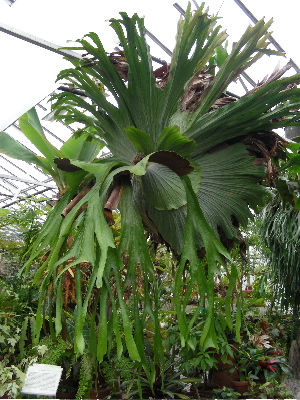
This staghorn fern, more than 6 feet across, was not built in a day.

It also takes more than a moment to grow a good sized flock of birds of paradise.
Oddly enough, seeing one’s familiar home companions in this new light is more energizing than depressing and there is almost always something to learn: When a fiddleleaf gets old, the bark gets gorgeous; dormant orchids don’t look any better when there are 60 pots of them; pruning matters as much indoors as it does in the yard; and whether camellias are worth the hassle may be a function of heritage. Could be you have to be southern.


Oh right, I forgot to mention fruit. In addition to proving dwarf citrus trees CAN produce something that looks like a crop (those are ponderosa lemons, not grapefruit), these places harbor edibles most of us can’t see without buying a plane ticket.
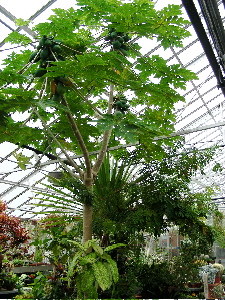
Papaya tree at @ 16 feet ( those dark footballs are the papayas)
The base of the tree is fat, gray and gnarly; the roots go right through the gravel floor, deep into the deeply alien Hudson Vally soil.
But not for much longer, and thus we come to the carpe diem part. These pictures were taken at the greenhouse that belongs to the Cary Institute of Ecosystem Studies, in Millbrook New York. It will be closed before the end of March, its collection dispersed, the building dismantled. Gone forever after more than 30 years.
And it’s not likely to be alone. Glasshouses cost a lot to heat; older models cost really a lot to heat. As the price of oil sails ever upward while funding for public institutions shrinks and those institutions start thinking about greenness in a different way …
A bit of creative googling is likely to turn up at least one that’s close to you, but you might as well start with the advanced garden search at the American Public Gardens Association and the international list at Gardening@Closerange.com.
Is it just wishful thinking or are there really somewhat fewer green glitter shamrocks (and similar) this year? Not that I have anything against the good Saint, and I know Irish immigrants have made huge contributions. But it’s always seemed like a bit of a stretch to make the thing into a National Holiday. The only reason I can see is that, Easter being a movable feast, you have to be sure there’s something you can celebrate in March.
On the other hand, it’s useful to be reminded of soda bread and potatoes, two splendid foodstuffs that get a lot less respect than they should.

Soda bread fresh out of the oven. The funny looking butter pat is because the very good cultured butter is packaged in a fat plastic tube (the better to preserve its freshness, I assume), by Vermont Butter and Cheese.
SODA BREAD
Properly made, with a good proportion of fresh whole wheat flour, without any fat or sugar, this is probably the loveliest, most intensely bread-tasting bread you can make without yeast: crisp crusted, tender crumbed, the partner for which butter was invented – or so it seems when you have that first chunk. It takes less than 5 minutes to prepare and about 40 minutes to bake, so adding in oven heating time you arrive at a one hour wonder. Admittedly, it doesn’t stay wonderful too much longer than that; but omigod, what terrific toast.
A word about oven-enhancement: Putting this on a flat pan and baking it will produce delicious bread. Putting it in a heated iron kettle and covering same with a hot iron lid will produce bread that is delicious plus. (The cast iron evens out oven heat and the lid traps steam, enabling you to get a crust that’s crisp without being hard. ) This technique got a recent boost from Mark Bittman, who uses it to good effect for a no-knead “European-style boule”, but of course it’s nothing new. They don’t call those kettles Dutch ovens for nothin.’
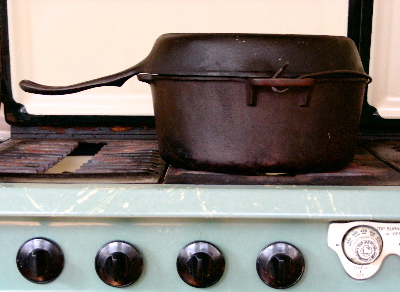
Actually, this is a chicken fryer – terrific pan, btw, just like a Dutch oven but shorter – given the necessary height with a make-do lid.
For one 8 to 9 inch round
1 ¼ cups unbleached flour
1 ½ tsp. salt
1 tsp baking soda
2 ¼ cups whole wheat flour*
@1 ½ cups buttermilk
cornmeal to sprinkle on the pan
1. Heat the oven to 425. If using an iron pot, put it and the lid in to heat up about 5 minutes before you start the dough.
2. Put the unbleached flour, soda and salt in a large bowl and stir with a wire whisk until well combined. Stir in the whole wheat flour.
3. Using a wooden spoon, make a well in the flour and pour in most of the buttermilk. Mix thoroughly, quickly, adding additional buttermilk as needed until you have a soft, slightly sticky dough. Lightly flour your hands, reach in and knead just enough to bring everything together, then form the dough into a round.
4. Sprinkle cornmeal on the baking sheet or the bottom of the hot heavy pot. Place the dough on it, seam side down. Use a sharp thin-bladed knife to cut a cross about ½ inch deep into the top of the bread. Put on the hot heavy lid, if using, and put the pan in the oven.

Ready to bake. You can’t really see it but the cornmeal is smoking slightly. Not to worry.
5. Check after 30 minutes. The bread should be well risen and brown. If it’s still on the pale gold side, give it a few more minutes, still under cover if you’re using a lid.
Tarting it up in traditional fashion: stir in 1 teaspoon caraway seeds when you stir in the whole wheat flour and stir in 3/4 cup of plump raisins when the dough is approaching complete but has not yet come together.

Eat it while it’s still hot, if possible
* Whole wheat flour is pretty much it in the flavoring department, so quality really matters. If yours has been sitting around for a while, treat yourself to a new sack. The bread in the picture was made with a combination of King Arthur Organic Whole Wheat, available ( mirabile dictu! Who’d have thought it in the old days) at large supermarkets, and Wild Hive Farm Wholegrain Soft White Winter Wheat, which we buy – along with the butter – at Adams.
POTATOES
A garden miracle, easy to plant, easy to care for, tremendous yields, and a terrific thing to plant with kids. More about planting at planting time ( soon but not yet) . Right now, the thing to know is that time is running out for ordering from one of my favorite sources, Moose Tubers (Fedco) 45 varieties to choose from but only until March 14th. After that, there’s always Wood Prairie Farm, a far slicker but no less trustworthy establishment.
At first glance, it seems like a no-brainer: If you’re going to be an organic gardener, you ought to plant organic seeds. But it would really be better to say: if you’re going to buy organic products, put organic seeds on your shopping list. For home gardeners, the reason – a very good reason – to choose organic seeds is to support organic agriculture. It has very little to do with the seeds themselves.
Why does this matter? Because it means you can organically grow whatever you want. From the garden’s point of view, one bundle of genetic material is pretty much like another (assuming said bundle is good of its kind and has not been treated with fungicide or otherwise messed-with post harvest).* So although organic seed is preferable when available, insisting on its exclusive use is a little like cutting off your nose in order to spite your face.
In many cases, the organic version is available, especially if it’s a common vegetable. But uncommon heirlooms are another story; vast numbers of interesting flowers have not yet been included, and the number of organically grown hybrids is still mighty petite.
I shall stand back now and wait for the anti-hybrid avalanche to roll by, hating hybrids being all the rage these days. Well, ok. Hybrid seeds cannot be saved from year to year; you have to keep buying new ones.** Like many organic seeds, they are mostly produced by large corporations whose interest in sustainability is entirely market-driven, to the extent that it exists. But this doesn’t make hybrids Darth Vader.
In fact, hybrids bred for disease resistance are an environmental plus when they help you use less biocide. Pesticides and fungicides approved for organic gardening are still a long way from benign.
And while it’s true that a great many hybrids don’t taste very good, flavor having been sacrificed for qualities like heavy cropping and long shelf life, it’s also true that some of the tastiest vegetables in all creation are hybrid varieties: Sun Gold cherry tomatoes, Silver Queen corn, Confection winter squash – we just had some for dinner last night. It was terrific.

Spring is just around the corner, time to get ordering.
For the full seed spectrum: open pollinated, hybrid, conventional and organic, try
Johnny’s Selected Seeds, and Territorial Seeds,
For a good sized list of companies that offer organic seeds, potato sets and garlic bulbs, go to ATTRA, the National Sustainable Agriculture Information Service.
* Seeds from plants that thrived under organic management should produce plants that fare better when grown organically in their turn, but as far as I know there has been no scientific trial of this thesis. It would probably take several generations before any differences were evident and my guess is that even then a grower’s abilities – or lack thereof – would far outweigh any advantage conferred in the seed-production stage. Work is being done to create varieties tailored for organic production ( a very different thing), but this whole branch of plant breeding is still in its infancy.
** Actually, it is sometimes possible to “save” hybrid seeds, essentially by selecting and selecting and selecting again, over several generations of large grow-outs. It’s called stabilizing a hybrid and it’s a lot of work.
The cut flower industry is finally beginning to wake up and smell the roses, reports the New York Times. There is money to be made selling organic and sustainably raised flowers.
Lovely, as far as it goes, but like the organic spinach that goes from California to New York, most of those flowers are going a lot farther than necessary.
And of course choices are severely limited; Do not look to online flower sources for combinations like this

Bonica rose and old fashioned lady’s mantle(in garden, but it could have been in vase)
As local tomatoes and strawberries make clear, splendor and short travel time go hand in hand. Same deal with flowers: the closer you can get to homegrown the tastier your options will be.
This is not news to most of you, including Rachael and Jesse, who wrote in last week looking for
“someone in the Hudson valley – Orange, Putnam or Rockland or Westchester – that sells or uses organic or locally grown flowers. We’re having an event early July/late June and would love to support local.”
Having been out of the event racket for over 25 years, I have zip in the way of firsthand info. (if you have any, send it in!), but I can suggest something almost as good and a great deal more widely useful: a visit to Local Harvest, where the national database is searchable by location, crop and type of vendor. A trial request for farms + flowers + Warwick ( the first place I could think of in Orange county) brought up 57 listings and there was a flower farm on the first page so it’s probably one of many.
Finding your perfect match is unlikely to be instant , especially if you use the shopping tips below. It’ll take even longer if you take my advice and cover your posterior by ordering everything you need from two different farms. It’ll cost more too, obviously, but when the event is important it’s worth having insurance.
Most retail flower farms are small; weather is highly variable – a hailstorm might hit one location and leave one 10 miles away unscathed – and in real life, manure happens. Worst case, you’ll have done even more for local farms and will have extras to give away. Flowers for those who’ve helped with the event is always nice, or you could donate them to your local food bank. People who can’t afford enough to eat have probably gone without cut flowers for quite a while.
Flower Farm Shopping Tips:
* Does the grower sell by single variety or single color or, ideally, both? If so, is the price per stem or per bunch and if the latter how large is a bunch?
* Does the grower offer unusual fillers like the lady’s mantle above or the artemisia below?

That’s Queen Anne’s lace being a weed in the artemisia ‘Silver King’, an equally pernicious invader. Plant it once, have it for all time.
* Be sure timing is agreed upon. It’s best to cut flowers in the morning and keep them cool, but the grower may not have much in the way of ideal storage space. The sooner you can pick them up, the sooner you can get them home for proper conditioning.
Last Minute LOCAL Flowers for Valentine’s Day in the Hudson Valley
Yes we can! Rhinebeck’s famous violets have gone the way of les neiges d’antan, but there are two surviving hothouses that grow beautiful anemones and sell them retail, first come first served:
Battenfeld’s and Ralph Pitcher & Sons, (845) 876-3974

An anemone at Battenfeld’s
If you are a gardener with limited space and time whose primary goal is the largest amount of tasty, organic food for the smallest amount of effort, these crops are winners: easy to plant, easy to care for, easy to pick, easy to prepare and in some cases, all four:
* INDETERMINATE TOMATOES are so named because the vines keep getting bigger and producing new fruit until they are felled by frost. The choice of varieties used to be small for those who were starting with purchased seedlings, but these days there’s quite an assortment at farmers markets and garden centers. I even saw baby Brandywines at our local Shaw’s supermarket last year, so something is definitely happening.
In fact, the market for painless exotica has become so large it’s spawned a whole new industry: mail order tomato – and pepper and eggplant – seedlings from nurseries like Laurel’s Heirloom Tomato Plants and Cross Country Nurseries. Choices galore, more than enough to thrill most gardeners, at prices that may also keep them from getting too thrilled for the space available. (The whole idea of mail-ordering annuals takes some getting used to; and importing instead of buying local costs green points as well as dollars. Call a few likely local sources to find out what they plan to offer before ordering from away.)
* NON-HYBRID POLE BEANS. Like indeterminate tomatoes, old fashioned pole beans keep growing and producing ‘til frost – assuming you keep them picked. They may seem like more work than bush beans because you have to provide supports, but bush beans peter out much sooner; picking them is arduous (there’s a reason stoop labor is a synonym for work nobody wants to do); and unlike pole beans, the bush kind must be washed. If they’re mulched, most of them don’t get dirty, but at least a few in every picking need a rinse, so it comes to the same thing.
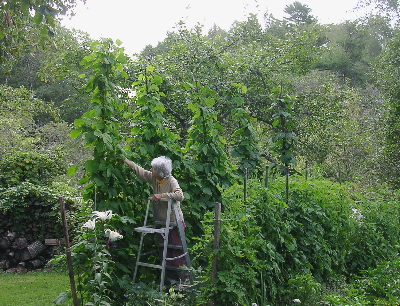
Lois is picking Rattlesnake pole beans, our favorite for some years now. Vines are disease resistant, drought tolerant and hugely prolific once they start bearing. The purple speckled green beans have great flavor. They stay tender even when quite large, so any given bean can hang in there lookin’ good for at least a week – depending on the weather, of course. And as if that weren’t enough , rattlesnakes hold their quality in the ‘fridge far longer than most snap beans, a virtue that comes in handy at peak season, when the beans are really cranking and there’s a lot of other stuff to eat. All these encomiums apply to Maine and the Hudson Valley, but most catalogs describe the beans as good for growing in the south. From ( among many) JL Hudson.
* ZUCCHINI. Everything they say about avalanches of zucchini is true, especially of hybrid varieties none of which unfortunately is as delicious as Costata Romanesco. This heirloom takes longer to start bearing than modern zucchinis; it has the prickly leaves characteristic of “unimproved” varieties; and it makes big sprawly plants instead of tidy bushes. Not good for containers or planting beside the front walk. The high return is the flavor; if space is tight pass it by and go for a hybrid – most of them are fine if you pick them young.
* SWISS CHARD. Plants hold without bolting from spring through fall in all but the hottest summer areas. There’s no need to harvest whole plants; you can keep breaking off outer leaves for months and every picking will be tender as long as plants get enough water. Unlike, for instance, curly kales, even the crumpled-leaf varieties tend to grow clean because they grow so stiffly upright. Break the leaves off carefully and place them in the basket ditto and all you have to do is rinse the bases maybe.
You are supposed to wash everything, btw, even if you have grown it organically and there is not a smidgeon of dirt anywhere to be seen. (We don’t do this; we never have; we are not young. We may just have been lucky, however, so don’t say I didn’t give you the official advice).
* GARLIC. You plant it in the fall, after most of the garden chores are over; you can get a lot of it into a small space; and it’s beyond simple to plant: Just separate the garlic cloves, shove ‘em into the prepared soil, root end down and mulch the bed with straw. Come spring, weed once and renew the mulch. First come beautiful curly green garlic scapes, good both for the kitchen and in bouquets, then presto bingo in mid-summer there’s the garlic, just in time for the tomatoes and basil and beans.
* Tall varieties of SNOW PEAS AND SUGARSNAPS squeeze onto the list because they’re so easy to pick and prepare, plus the homegrown ones are SO much tastier than any other kind including the ones in farmers markets. But they take the same setup work as pole beans without having nearly as long a season and they’re done in the middle of the summer so you have to take down the supports – unless you want to take down just the spent vines and replace them with the baby morning glories you grew in peat pots so you would be ready when the time came.
GROWING CORN
It’s easy, if you have the space. The hard part is ignoring the latest megasweetamazing hybrids featured in seed catalogs, each a new breakthrough in orgasmic splendor. Please try. It’s better to buy that kind of sweet corn directly – or at one remove – from a farmer, assuming the farmer is growing it somewhere near you which they probably are if you have enough space to grow corn.
+ The farmers are pros. They actually do know what they’re doing.
+ All these yummy modern hybrids hold quite well after picking, especially if kept chilled. The old rule about getting the water boiling before you pick the corn can safely be set aside for sugar-enhanced and supersweet varieties.
+ Help keep small farms from turning into subdivisions by purchasing the food they produce. (If they produce it sustainably, so much the better, but growing corn takes up so much real estate “local” trumps almost everything else.)
+ You need the space for the wonderful sweet corns that cannot be bought at any price, even from boutique organic farms at the cutting edge of fashion. Stowell’s Evergreen! Country Gentleman! And the subject for today: Black Mexican, an incredibly flavorful variety that’s tender and juicy when immature, then still delicious as it grows increasingly starchy and finally winds up being the best cornbread you ever baked.
In spite of its name, Black Mexican is a New York State heirloom, introduced in the mid-19th century and probably given its exotic name as a marketing ploy. And in spite of the fact that it’s usually listed as sweet corn, I have my doubts. True sweet corn eventually gets starchy, but it never develops enough starch to make credible cornmeal.
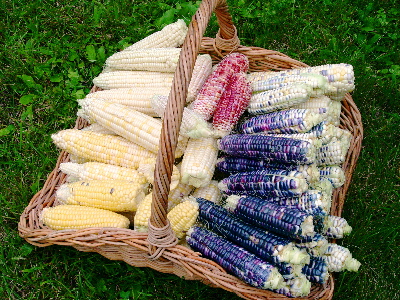
Bakaitis photo
The Black Mexican is on the right. We’ll discuss the other varieties – and the cross-pollination that leads to those dots – some other time.
Whatever class you put it in, Black Mexican’s life as great corn on the cob is pretty limited. The pure white tender and juicy stage ( maybe one ear of it, underneath at the back) only lasts a few days. The unique splendor is that it remains outstanding
When it’s still very sweet but slightly starchy (more white than black): curried corn soup; summer succotash with fresh green beans; creamy corn pudding spiked with jalapenos…
When it’s very starchy but still slightly sweet (more black than white): any place fresh shell beans would be good; in marinated salads; in pilafs with rice; in tomato-based fish stews…
and
When it’s meal corn that hasn’t dried yet (not shown. kernels are completely black and starting to stiffen but are still soft enough to puncture with a fingernail). You need a grain mill to grind it after it’s fully dried, but if you catch it at this stage you can use the processor to make a sort of proto-cornmeal that works fine in most recipes. All you have to do is use a little bit less liquid and boost the still-developing starch with a small amount of flour or cornmeal.
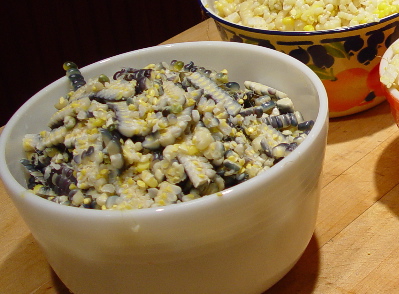
Bakaitis photo
Blanched, cut from the cob and ready for freezing, this batch is a little past “slightly starchy” because that’s when Bill was down to harvest it. The yellow spots are the germ, which reminds me to point out that blue corns tend to be the highest in protein.
Seed for Black Mexican, aka Black Aztec and Aztec Black, is sold by Southern Exposure Seed Exchange and Seeds Of Change, among others, I’m glad to say. When we started growing it about 15 years ago it was difficult to find, and saving corn seed is a lot harder than saving tomatoes: varieties must be separated by at least a quarter mile unless you’re up for considerable fiddling.
(Opinion is divided on whether Black Mexican and Black Aztec are the same thing. We have grown both – or at least both as available retail – without seeing significant differences)

That dark green and orange line in the middle distance is a stand of hybrid feed corn; all plants as close to identical as human ingenuity can manage.
TASTY MOVIE
The documentary King Corn gets that rating because it’s not only fun to watch, it’s also – if there can be such a thing – a refreshingly gentle polemic. The narrators, a savvy pair of quasi-innocents deeply influenced by Michael Pollan, revisit their distant Iowa roots and through a year of growing the stuff discover how subsidized feed corn, sold to the public as a fine idea: more food for everyone! at low prices! turns out to be a taxpayer milking, fossil fuel guzzling threat to public health that’s dismantling farm communities all over the Midwest. Take a look. Even if you think there’s no connection between America’s weight problem and an average daily consumption of 200 to 400 calories’ worth of high fructose corn syrup,* you might want to see how much of its cost is coming straight out of your wallet.
* Amounts we eat of anything are notoriously difficult to measure. This range is based on pounds of HFCS per person per year as conceded by the Corn Refiners Association (41, citing the USDA) and asserted in King Corn’s press kit (73, citing the American Journal of Clinical Nutrition).
Bunch of Dahlias:

Bunch of talk about food gardening
with Sally Spillane on The Garden Show
Sunday January 13 at 8AM
on radio staion WKZE
98.1 on the dial in the Hudson Valley. Here on the computer everywhere else (but not everywhen else; it’s live broadcast only)
( For the pizzelle recipe, please scroll down)
It’s hard to think coldly about the garden just now, when the catalog stack is approaching tilt and there’s not much else to think about warmly, but this is an ideal time to take a hard look at your return on garden investment. A little abstract evaluation helps ensure high-performing options are not overlooked, and that the resources locked up in losers will be re-allocated to something more profitable.
And we will stop here with the analogy; finance not being my long suit.
Nevertheless. It really helps to list assets and liabilities before you plunge in, and it helps the most to write it down, however roughly, instead of just thinking about it in the shower for a couple of mornings. Unless your garden is confined to 3 or 4 containers, human nature more or less ensures you’re not counting everything. (Think how few calories most of us think we eat and how wrong we are about it almost all the time).
Items It’s Useful to Reassess Yearly:
Space: Not only is there never enough, what there is is not usually tabula rasa. For instance, there’s a 3 X 10 foot strip in the front shade garden completely open for something new, but that something must remain no more than four feet tall without any help from me. By writing this down, I am reminded that it’s not happening with witch hazels, and that time spent mooning over Fire Charm (brilliant red fall leaves, copper-red winter flowers) and the super-fragrant Moonlight should be devoted to the hunt for plants that will actually fit.
You probably have a rough layout of the annual/vegetable garden – or so I hope – so the allocational trick here is simply to fill it all in, in as much detail as possible, before looking through the saved seeds or ordering any new ones. Our roughly 4000 square feet sounds huge, but given how much of it must support tomatoes, corn, garlic, greens, etc. ( including flowers) there’s only a rather small area for the winter squash. As most of it will be filled by super-sweet, long-keeping Cha Cha, from Johnny’s, and Tetsakabuto, from Pinetree, it would be better if I didn’t even LOOK at the Baker Creek catalog (85 winter squash and 80 even more tempting – and space-hogging – melons).
Time: it’s not that writing the truth on paper reveals anything new about “not enough,” but rubbing it in can be bracing. Almost all our new plantings have been and will be shrubs because last year I finally inventoried the gardens, assigning each the time it should have to be at its best. Duh of the week? Even under ideal conditions, it’s impossible for someone with a day job to have more than one complex tapestry of annuals, perennials, vines, grasses, bulbs and shrubs and small trees.
Mulch keeps weeds down and drought at bay; healthy plants resist pests and disease. But some weeds always make it through – that’s why they’re weeds; baby vegetables must be watered by us if nature is disobliging; resistant doesn’t mean immune and anyone who says organic pest control takes no more time and attention than blanketing everything with noxious pollutants is lying. Plus if you don’t formally assign some time to simply enjoying the damn thing, you may find when you look back at season’s end that all you did – however enjoyably – was work.

The bed that used to hold these cheerful perennials now features a dwarf Chinese Elm (Ulmus parvifolia), with white-edged leaves on lacy branches and patchy bark that will grow more and more lovely with time. It is nicely surrounded with mulch and very little else. The carefree echinaceas went to the rough edge of the field, where they’ll be fine, and the yellow Asiatic lilies have been consigned to the compost. They were nice, but not THAT nice, and getting rid of them makes it easier to keep the evil lily beetles from doing in the far rarer L. henrii (barely visible at the far right and slightly more visible below).

Money: a yacht is famously defined as a hole in the ocean into which one pours money. A garden is a hole in the ground which serves the same purpose – except that you have to dig the hole before throwing the money in. Less than romantic necessities like pest control products, compost, twine, fertilizer(s) and gloves are inexpensive individually but they do add up. Add them up before the season starts and you may be unpleasantly surprised, but you’ll also have a better idea of when it’s time to start saying “ I really shouldn’t, ” when visiting the nursery.
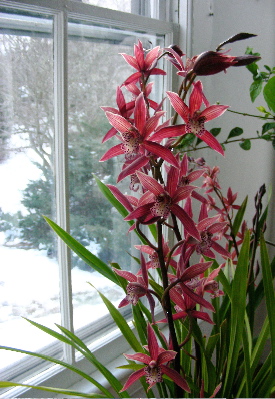
When it comes to impulse purchased winter orchids, my advice is to buy ‘em in bloom and then throw them out when they’re done, a great saving of space and time if not, admittedly, money. But I don’t always listen to me. This cymbidium came home with the groceries in February last year, and when it finally finished flowering 2 months later went into the enclosed porch we keep at about 40 degrees to use as a walk-in refrigerator. Come spring, we stuck it in the vegetable garden. In fall it returned to the porch, where it remained until a couple of weeks ago and thereby hangs the tale. With these increasingly common orchids, finding a winter home that’s cool enough is often harder than finding one with enough light, so if you have a reasonably bright spot that stays between 45 and 55 degrees you might as well give it a shot, especially if the spot is somewhere out of sight. Non- blooming cymbidiums aren’t as ugly as non-blooming phalaenopsis,but they’re not all that lovely, either.
But first you may wish to give yourself some carol-canceling earplugs. Bill gets mine though Cabela’s – which is where he gets just about everything he doesn’t get from Orvis – but there is also, it turns out, a place called The Earplug Super Store whose extensive selection suggests that noise pollution is every bit as much of a problem as you thought.
Earplugs are also widely available at bricks and mortar, of course. Sporting goods stores that cater to gun owners have the most effective models, but many drugstores also sell plugs rated at 30 decibels, the strength needed to muffle jolly shopping music without silencing the person who shouts “ Look out! That beam is falling!!”
Can’t Go Wrong Giving Any of These
* Stainless steel garden fork with synthetic handle, such as this ergonomic Radius available through Amazon. The fork is an essential tool, so many catalogs offer high end beauties with stainless steel tines and sturdy, well-made hardwood handles. Your garden friend will probably be even happier if the handle is made from less handsome but more useful synthetic. One of the great things about stainless steel is total freedom from rust, so it’s nice to be equally blithe about rot. Translation: never, ever worry again about leaving it out in the rain.
* Small snub nose pruner. Pretty sure I’ve extolled these before, since they are absolutely the best for light-duty general pruning and harvest of all things with stems from flowers to hot peppers to winter squash.I love them especially because I don’t wear belts and these don’t stab you through your pockets.
* Lightweight garden gloves with nylon backs and nitrile palms. The most common brands are Boss and Atlas, both of which I have in multiples because years ago when they were still difficult to find I compulsively bought another pair every time I saw them and they take forever to wear out, even under near constant rough use in soil that resembles gravel.
They won’t protect against major thorns and only the palms are waterproof, but other than that they are close to perfect because they combine their fabulous toughness with being so thin you can feel what you’re doing almost as well as you can barehanded.
*Japanese garden knife, aka soil knife. Kristi the hardworking garden helper wears hers in a holster on her belt when she’s wearing a belt and rather daringly just sort of shoved into the back of her waistband when beltless. Either way, don’t go into the garden without this workhorse saw/knife/all-purpose digger, especially handy in tight spots and among rocks. Might as well get it from Fedco and put your seed order in at the same time.
* Membership in the Garden Conservancy – for design lovers – or the Maine Organic Farmers and Gardeners Association – for food growers everywhere in spite of its name. Or both, since it’s impossible to choose between food and culture.
Warning: Once you start in the dot-org direction it’s easy to fall down the slippery slope and start thinking that donating to worthy causes “in the name of” is a gift to the namee. This is of course completely bogus unless that noble person has already asked Santa for brownie points. Nothing hugely wrong with it – assuming you also give them a present that actually resembles a present – but please don’t forget that if part of the deal is a grateful acknowledgement from the cause, the other thing you have given your friend is a mailbox polluted with pleas for more, for the indefinite future.
After you’ve “established a relationship,” there’s no way to block these mailings without asking each individual organization to please stop. And the same is true for catalogs sent by any store that you’ve bought something from. But as you already know if you have ever, even in the distant past, subscribed to a magazine, the bulk of the catalog avalanche comes from companies that bought you (or at least your name and address). An outfit called the Privacy Council promises to turn back a lot of this tide, conveniently all at once, but they also promise to remove you from Stop Political Calls, which may or may not be a good thing – the Privacy Council service is sponsored by the very people sending you all this junk. Stop Political Calls seems to be a lobbying non-profit which may or may not keep robocalls at bay. Never heard of it until I saw it on the Privacy Council’s otherwise no-brainer say goodbye list, so I don’t know how well it works.
* Gift Certificates can be great when they’re for something specific: spring delivery of a truckload of compost, say, or a dozen massages at Betty’s Backsaving Boutique.
But gift certificates good only for shopping at a particular store have all the impersonality of money with far less of its convenience. And the fact that they’re sold in rounded amounts makes problems of its own. There is probably someone living who chooses things that cost less than the gift and walks away from a few bucks in change; but most people end up with something that costs more, paying the difference out of their own pockets. Nice deal for the store. James Surowiecki wrote a terrific piece about this, The Gift Right Out, back in 2006 and it’s still a terrific read.
Note to bakers and would be bakers: Only a few baking days until Christmas. To make them less stressful (and more likely), I stock up on large quantities of probable ingredients before I choose the recipes. Butter, eggs, chocolate, nutmeats, dried fruits, flour and spices all keep fine , and having them on hand makes it easier to use them when a crumb of free time appears.
No doubt about it, backyard leaf blowers are powerful players in the anti-social sweepstakes. Although they’ll never be as good as ATVs at damaging land while abetting childhood obesity and shattering the public peace, pound for pound they’re unbeatable for noise pollution, noxious emissions, and the erosion of ordinary civility.
On the other hand, there’s also no doubt that raking is the yard work equivalent of ironing, possibly because it’s equally taxing on the back. Even people who love gardening hate raking, even my friend and helper Kristi, a woman up for ANY outdoor task that doesn’t involve chemicals or power tools.
So I shouldn’t have been surprised when she looked at the leaf-covered Maine lawn, looked at me ( I was holding 2 rakes) and said “ I wish you had a leaf sweeper.”
“ A what?”
Next thing you know, she’d gone home and gotten hers. Turns out the hand powered leaf sweeper is the autumnal third way: a leaf gathering machine that taxes neither the body nor the environment. It looks and works about like a lawn mower except that instead of blades it has brushes. Push it along and the brushes sweep leaves up and back into a collecting sling that holds about 7 cubic feet and is very easy to empty.
Kristi’s is a 26 inch Agri-Fab which sells for around 135 bucks. There are other, ostensibly sturdier, brands but differences – except in price – appear to be pretty minor.
Good Things about hand powered leaf sweepers:
* Easy to use, after you practice for a while and learn best adjustments of brush height and handle-angle.
* Quiet, only a gentle whirr and the whoosh of leaves headed for the sling.
* Useful for other kinds of picking-up. Kristi takes hers onto the drive through her pine woods to collect the needles we use to mulch strawberries and pack dahlias.
* Comparatively inexpensive, even the deluxe 31 inch model sold by People Powered Machines is only $270.00 ( I know, I know; but it’s 2 or 3 times faster than raking and far less ache-producing.)
The Nothing is Perfect part:
* Forget it if your lawn is mostly uneven, with many little hills and minor undulations. Kristi’s works great at her place, which is more or less flat. Not great at our place, a festival of irregularity.
* Seven cubic feet is not a lot if you have a lot of leaves. Kristi puts a sheet at the edge of each lawn section and empties the collector into it several times before gathering the sheet edges and hauling the contents to the leaf pile.

Just a bit of autumnal eye candy; the leaf sweeper is on view at the sales sites and is not a thing of beauty. Chrysanthemums like these are easy to grow, about which more next spring when it’s time to order rooted cuttings.