Garden
are the happiest tomatoes. Well, not really. Gentle, consistent warmth is what tomato plants want – not only on their leaves and flowers ( tomato pollen is sterilized by temperatures over 85), but also around their roots, which by the way – news flash! – prefer to stay moist.
Tomato Planting Tips
By now your seedlings are probably planted, so it’s too late (for this year) to say the first line of defense is deep planting – set the baby so 1/3 to 1/2 of the stem is underground. Useful new roots will form all along the buried portion.
I used to think it was important to remove leaves and suckers before burial. Bill made fun of me. We did a side by side experiment. He was right; didn’t matter a whit. One less thing.
Ok. They’re in there. Now what? Two things
1. Mulch, really a lot of mulch. We use a thin layer of newspaper – just one fold – under a largish pile of straw. This holds moisture in the soil and helps keep roots from frying. I put my hand down on the uncovered earth when I was weeding yesterday and it was HOT. Not warm. Hot. Not good.
 Tomato mulching in progress. The brown paper grocery bags are a thicker weed (and water) barrier. Helpful if your raised beds are really raised. These are about a foot above the paths.
2. Limb them up. If you have no problems with fungus diseases you can stop right here, but if blight has ever visited you, read on.

The scar is difficult to find, but if you look closely at the left side of the stem you’ll see the scar where a branch used to be.
Removing lower leaves and suckers so the stem is naked at the base accomplishes two things:
1. It provides good air circulation, an absolute necessity ( crowding is the mother of disease).
2. It deprives the fungus spores of handy landing spots from which to travel upward. In theory, a timely application of mulch will block spores so they cannot splash up. In practice, it helps but not enough to be relied on exclusively.
Actually, one of the earliest isn’t a peony – and it’s late: it’s a peony flowered tulip, one of the last to bloom.

Kristi Niedermann
This photo of ‘Mount Tacoma’ was taken just a couple of days ago in Maine, where the peonies themselves are still a (semi) distant promise.
Here in the Hudson Valley – functionally about 2 weeks south – the real deal is starting to pop, beginning as usual with one of our inherited mysteries.
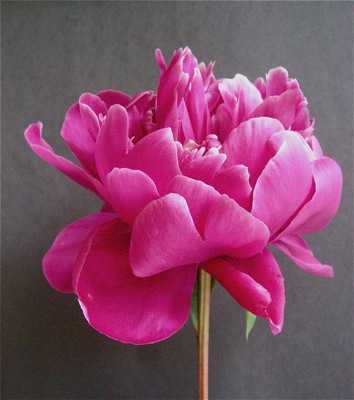
It looks a lot like ‘Cincinnati’. But ‘Cincinnati’ is midseason and this is among the earliest lactifloras to open. ‘Magenta Moon’ seemed likely until I looked up the date (on the Peony Checklist , provided by The American Peony Society). No good. ‘Magenta Moon’ didn’t rise until 1995, by which time the peony had been in place at least 15 years.
Truth is I haven’t done much research – scrolling though peony pictures is far too dangerous. No matter how swiftly you move the cursor, to look at peonies is to want peonies, especially at places like Klehm’s and La Pivoinerie D’Aoust,
One good thing about peony lust is that it tends to supplant tulip lust, so I probably shouldn’t mention it, but here’s an aspect of ‘Mount Tacoma’ that isn’t part of the usual descriptions: Given very well drained soil and not too much fertilizer it comes back – at least in Maine, where mine have been returning faithfully for at least a decade.
More often than not the deer eat them (that’s why I stopped planting more in 1997) but that’s no knock on their longevity. ‘Mount Tacoma’ was introduced in 1924 and is still one of the most common whites, available almost everywhere, but just for the record I got mine from Scheepers.
Back last November, after going on at some length about leaf sweepers, I promised to discuss growing chrysanthemums like this football – ‘Ticonderoga’ –
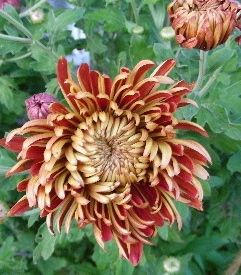
at the proper time. Which it more or less is.
For growing instructions:
Read More…
Being the part(s) I should have mentioned last post. The azalea is a very early bloomer, and it’s growing in the mid Hudson Valley, zone 5b, where many very spiffy azaleas are – at least theoretically – not hardy. According to the USDA, our average winter lows are somewhere around 10 below. According to recent history, it’s more like 2 or 3 below, max. But still.
Also neglected to show a mugshot in which the freckles were easy to see, so here they are:

Can Anybody?

Here’s what we know about it:
It was here – and huge – when we got the house, 17 years ago.
It’s evergreen.
It blooms reliably every year (and abundantly, now that we have deer fencing).
It is fragrant, more in some years than others. Always with a very light, sweet clean laundry perfume that completely suits the flowers.
It has very long internodes, even when I prune it which I usually don’t.
the leaves are fuzzy
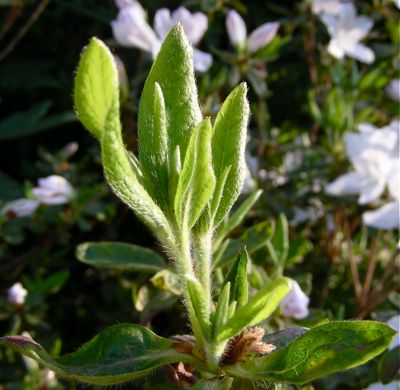
and they get occasional splotches of some kind of rusty fungus that doesn’t bother them. It doesn’t bother us, either, because the bush is on the far side of the yard, and we don’t cut the flowers for the vase.
Every spring when I go plant shopping I bring along a flowering branch. No nursery I’ve visited has had a clue. Everybody just says ” it must be something old.”
The closest thing I can find is R. mucronatum, but that’s described as a semi-evergreen that blooms midseason and is hardy only to zone 7, so it’s a case of “close but no cigar.”
I’d love to know what it is. I’d also love to know why it was planted next to a bunch of leucothoe, the stinkiest bloomer in all shrubdom whatever its other virtues.

It has been several years since bears first came through our yard, knocking down the birdfeeders and leaving unmistakably bearlike deposits to corroborate the neighbors’ sightings: a mother and 2 cubs. The beehives remained untouched so we remained unconcerned, even though we should have known better.
As summers passed and nothing else happened, we stayed (relatively) unconcerned, even though Dan right down the road reported several ursine visits that played hell with his hives.
This year, the Dan reports were scary: a mom and cubs and a singleton, presumably male. In the yard. In the hives. On his porch.
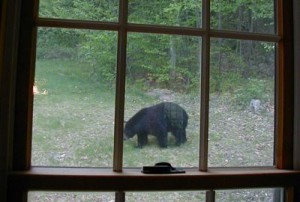
Dan Connors
View through Dan’s sunroom window
When he chased the solo in his car, lights flashing and horn honking, it retreated to the edge of the woods. When he backed up it emerged, more or less thumbing its snout.

Dan Connors
And Then it came for us
As Bill wrote to a friend on the 6th of May:
“This morning we awoke to find our beehives and bird feeders all torn asunder. I had just spent $170 for 2 packages of new bees and they had just released the queens and were just getting settled in their new homes when this happened.
I spent the day rebuilding the hives and installing an electric fence around the hives. If you hang some bacon on the wires, so we hear, the bears wrap their tongue and lips around it and get a good jolt.. We are eagerly awaiting their shocking bellows.
A mother and two cubs and another solo have been raising havoc in the neighborhood. DEC said that, since the bees are livestock, I can shoot the bears. They will give me a permit for and provide me with, rubber buckshot if I wish. They would also like to come and grab these animals so for to give them a collar… Once they have good data to justify a hunting season they will allow hunting for them in this county.
In 1990 there were @ 400 bears in the Catskills (across the river). By 2005 the population had grown to 4,000 to 5,000. @ 500 were taken there last fall….”
So far Bill’s fence has not been challenged – or at least we have heard no bellows and the bacon appears undisturbed. (More points for crow smarts? They are expert compost-pickers, ever alert for a bit of protein, but they haven’t come near those wires, even though they should be immune.)
Here are the fence details Bill sent to Dan, should you wish to build a solar powered electric bear deterrent around anything:
“ I went ahead with the more expensive unit (Zareba SP10). It also happened to be just about whatCornell and Bee Culture (via Cornell apiarist) recommend. It puts out just about 5,000 volts and 0.17 joules.
It is good to see it snapping sparks for @ 3/16 inch over the raindrops!!!
I strung my wires alternating hot (+) and ground (-) with the lowest wire 6″ above the ground and the top wire ground (-) for lightning protection. Since I used steel posts the ground wires are wrapped directly onto the posts. I used 12 gauge copper jump wire to connect the hot wires as well as for the lead from the controller. I suspect I could make a slight improvement if I grounded the unit to the steel posts as well as the usual ground rods.
Forty or fifty years ago, the owner of our house planted a LOT of peonies, and by the time we got the place they were huge. Also, in many cases, overtaken by shrubbery.
When we dug the shaded ones to move them we found huge giant knotted rootballs the size of refrigerators. So we divided them and had even more peonies. Three kinds of peonies: dark red, pink and white. (Read more about them – and get some growing tips here)
Theoretically you can’t have too many peonies but I’m here to tell you you can have enough – if they are all the same damn 3 colors. And having a few extra early ones that are magenta does not help, on account of their being magenta.
But we also inherited some fern leaf peonies (read about them – and the lowdown on ants – here) and the fern leafs, more properly Paeonia tenuifolia, were so beautiful and so different they opened an irresistible door.
At least that was my excuse 3 years ago, when I bought a nifty woodland peony at Trade Secrets.

Japanese Woodland Peony, P. japonica. At the time it had I think 4 leaves and zero flowers. It would be nice if this one also developed refrigerator sized roots, but it won’t. As soon as they’re bigger than produce drawers I’m going to divide them.

Those shirred silk petals really knock me out, and the foliage is nothing to sneeze at, either.
Lulled into hubris by this success, I thought last year I could get away with buying a moderately expensive seedling of P. mlokosewitschii, instead of a seriously expensive guaranteed division. The guarantee was that the flower would be pale yellow, a rare color in peonies.
And nonexistent in my plant. I was warned the seedling might turn out to be magenta and you can guess the rest. Bill thinks it’s beautiful. I do not. But the leaves are absolutely gorgeous and the flower is fleeting, so it’s not a total catastrophe.

Seedling of P. mlokosewitschii. The cheapskate’s reward. There is a better picture of a magenta flowered seedling – and one of the real deal – over at my almost neighbor Margaret Roach’s blog, A Way To Garden. But as you can see by comparing the pictures there is a lurking mystery; her seedling’s leaves look so different I’m not sure we have the same plant. (She got hers from Seneca Hill. I got mine from Hillside Nursery.
Next time I head for the hills I’ll pay full freight, though I may have to hock my toes to do it. There are around 2 dozen species peonies that could grow here, and more and more of them are making their way ( expensively) into commerce.
The frost I feared last week (see below ) was a doozy all right; 25 degrees at 5AM on April 30th. Theoretically, that’s normal. Frost-free date for this area is supposed to be May 10th. What’s abnormal was the whole rest of April, which had very few frosty nights and many days with temperatures in the high 70’s to low 80’s.
That heat produced a premature explosion of new growth, tender young succulent stems, leaves and flowers defenseless against cell bursting ice.
Result? The magnolia of course got trashed – what was left of it. But the plum and apple blossoms were spared and to my everlasting surprise and delight, the Viburnum carlesii came through unscathed, every perfumed petal intact.
However. Carnage was visited upon: a large clump of trumpet lilies, wisteria almost in bud, the Miscanthus ‘giganteus’, which was already going great guns, and a beautiful Japanese maple, new last year, that has been my pride and joy.
It also made mush of the bleeding hearts,

Before frost, under the viburnum.

and heaven help us a peony. Just one, and not too badly, but still. A PEONY! Is nothing safe?
The answer, unfortunately is no. Most of the worry about global warming is focussed on droughts, floods and overhot summers, but there’s more to it than that. Unwanted warmth followed by VERY unwanted cold is going to be a fact of life from here on out. To deal with it:
* Plant new spring bloomers as though they were fruit trees: on a north slope, so heat comes late and frost drains away.
* When you remove winter mulch to avoid smothering fresh shoots, keep the mulch material nearby, so you can rake it back over them if/when frost threatens.
* Resist the temptation to prune the roses. You don’t want to encourage the new growth, and leaving the dead and weak stems in place helps keep frost-produced dieback above the wood you want to keep.
* be sure you have a supply of floating row cover aka spun-bonded crop-protector. It’s much lighter than bedsheets, far easier to use, and although it’s ungreenly made of plastic, it lasts practically forever if you take good care of it. Sources include Pinetree Garden Seeds and Johnny’s Selected Seeds
This doesn’t mean you can turn those sheets to rags; the row cover is only good down to about 28 degrees; if you fear even greater misery, use sheets. Either way, remember the purpose is mostly to trap ground heat; a hat that simply keeps frost from touching tops won’t help unless the frost is very light.
For more tips, see the advice posted last fall; a lot of it is useful at planting time.
Like every garden writer in the history of humankind, I’ve spent my entire career begging ” don’t blow the whole wad on spring. If everything in the yard is done blooming by the 4th of July, how boring is that.”
But then every year about this time I’m glad the people who owned this house before us – in some cases WAY before us – believed in planting the usual.
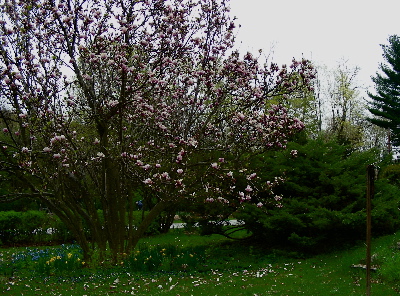
Actually, for our first decade or so I DID have mixed feelings about the magnolia, which would routinely just start opening into a huge glorious pink cloud and then there would be a frost and believe me a huge brown cloud is not glorious. Then things got warmer and it routinely escaped; we got a whole month of being happy that this giant unit eats about half the side yard. This year, however, after about 10 days of splendor it’s already going over. Eighty degrees is not a whole lot better than 29 from the magnolia longevity point of view.

The amazing thing about plum blossoms is that they smell exactly like the cheap plum incense that perfumed so many groovy abodes in the 60’s. Bees love them, though, so when you stand under the trees you see and hear a very cheering assortment of these threatened creatures.

In contrast to the plum, the viburnum ( carlesii) smells wonderful. Like itself and only like itself, a sweet, non-cloying New Englandish perfume that fills the entire yard on warm evenings and justifies the existence of an otherwise unexciting shrub and if it really does freeze on Tuesday night and clonk it when it’s only about half-open I’m going to put face in my hands and weep. This post hints at my addiction – and offers a few seasonally appropriate garden tips. (Appropriate if you’re in the lower Hudson valley, anyway. And it doesn’t up and snow)
Gotta hand it to eggs. You can use EVERYTHING, including the shells, an extremely sharp-edged material that is almost pure calcium.
In the house:
* great for cleaning narrow-necked bottles and vases. Crush a shell, working it between your fingers so the bits aren’t stuck together. Stuff it into the bottle, add a small amount of very hot water and swish/shake vigorously until all looks clean. Pour out, catching the shell in a strainer in case you missed a spot and have to shove it back in.
In the garden:
* Dig one or two thoroughly crushed shells into the soil around tomato plants. The lack of calcium that causes blossom end rot is usually a result of inconsistent watering but a little extra insurance never hurts.
* Rinse and dry shells, then crush to roughly rice grain size bits and spread a carpet of them under hostas and similar plants to discourage slugs and snails. Many advisors say “sprinkle” the bits, but a sprinkling won’t have much effect in the deterrent department. This carpet is not beautiful. You can make it a little less sock-in-the eye by soaking the crushed shells in strong tea for several days to stain the white parts brown.
* Excellent in the compost. No need to crush if you don’t want to bother, but as with everything else, the smaller the piece the sooner it rots.
* substitute for peat pots. NOT. In An Island Garden (1894), Celia Thaxter charmingly describes starting poppies in halved eggshells. It sounds like a great idea: Biodegradable, easy to transport and free. In my experience, however, it’s difficult to get the shell halves reasonably even, even when you hard boil the eggs so you can slice them across. Then you’ve got to bore a drainage hole ( darning needle better than icepick). They don’t hold much soilless mix, so they won’t support plants for long. And then you’ve got to fracture them before planting so the tiny roots can get out. Applying just the right force to the squeeze is an art all by itself.