Garden
I doubt there's a gardener living who can contemplate an ice storm without deeply mixed emotions. On the one hand, it's beautiful, possibly the most beautiful thing the winter landscape offers. Trees that have been encased in ice, that shimmer and twinkle in the least light and shine with their own cold brilliance are winter trees at their best - line drawings electrified.
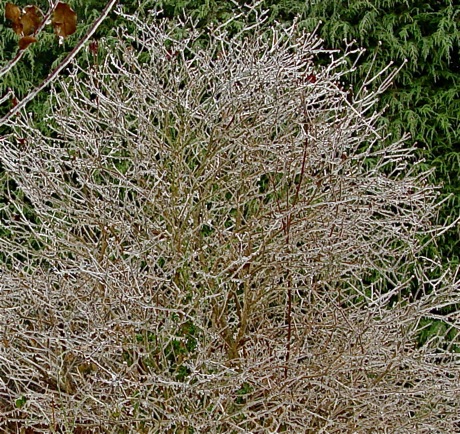
Iced viburnum
On the other hand, that’s “best” in a strictly visual sense. Unless you count being covered with ice while still in leaf, there’s no greater stress for a tree’s crown than having to bear great weight on frozen, unbendable branches.
Unless you count ice plus wind.
Our friend Eric over at Yale isn’t mentioning any woes that may have befallen Marsh Gardens, but he does have a lot of good advice in the “how to save your trees” department.
Read More…
Resolved (year after year, but this year I’m really going to do it): make the garden smarter – not necessarily smaller, but easier to care for – and more stylishly built around shrubs and grasses instead of herbaceous perennials.
For starters, I’m cutting way back on the bearded iris. Not ripping it out root and branch
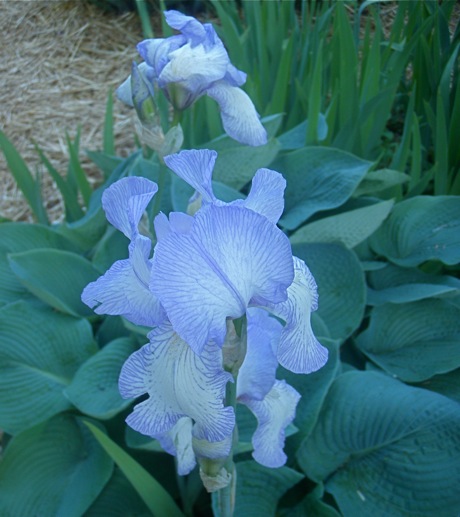
The fragrant, impervious-to-snails-so-their-leaves-look-lovely-all-summer blue ones in the blue border are staying, but

the not-fragrant purple ones, whose moment of glory is even briefer than that of the hesperis in the background, after which their snail ravaged leaves look worse and worse until put out of their misery, are destined for removal.
Read More…
I don’t know what the weatherpundits are going to call it, but around here it’s already The Boxing Day Blizzard of 2010; most of our roughly 20 inch blanket arrived on the 26th. Lunchtime’s lazy flakes started swirling toward whiteout at about 4 PM and the hours between dark and dawn were thick with a howling northeaster.
Although snow was still falling and blowing all morning on the 27th, the blowing showed a great deal more enthusiasm. No way to start shoveling much before noon, by which time the snow was what one might call “formerly fluffy.” It wasn’t heavy, exactly, compared to some snows I’ve hefted in my time, but it was already closer to igloo material than the original thistledown.
And there was a lot of it, so both of us were out there for hours. Bill started by clearing a path around the greenhouse and down to the bird feeder
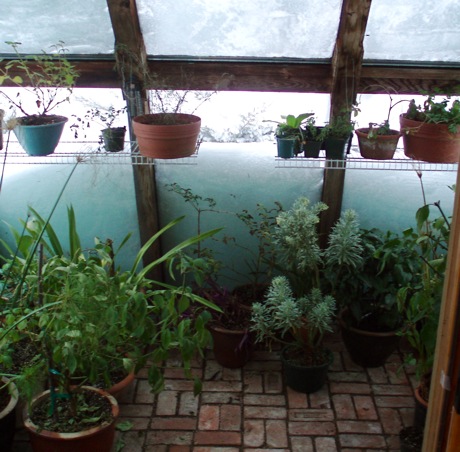
The greenhouse from inside (those shelves are 4 feet off the floor)

First chunk of first south window cleared
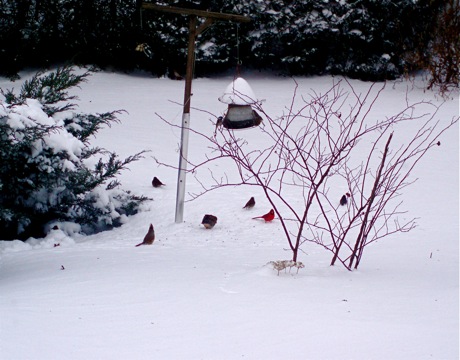
Birds, feeding
And that was the easy part. Next came
Read More…

The words are the recipe; heat the squash, then top with cheese and peppers. The initials stand for Very Nearly Instant: about 2 minutes in the microwave, because we almost always have some baked winter squash around.
It’s one of our favorite vegetables: in the garden, where it’s quite easy to grow if you have the space, in the kitchen, of course, and up in the bedroom under the bureaus, where it’s the first thing I see – other than Bill – every morning when I awake.
Terrific way to start the day, actually. No matter how gloomy the weather or discouraging the news, here’s this good sized supply of a beautiful winter staple that’s filling, flavorful, versatile AND (blare of trumpets) requires no refrigeration, canning, freezing or other special preservation. It stays perfectly good at room temperature for an entire season.
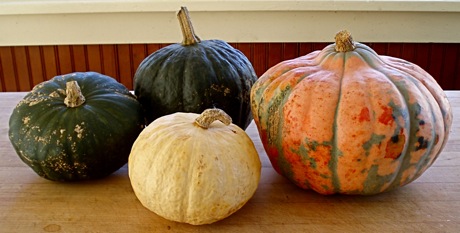
Down from the bedroom for their closeup, clockwise from left: Buttercup, Tetsukabuto, Candy Roaster Melon Squash, Queen of Smyrna.
Read More…
As usual, it’s on the bush beside the barn, a bush that was here (and already venerable) when we arrived 20 years ago.

Mr. Lincoln, I presume?
I think it may be Mr. Lincoln, but then again not being a rose person I tend to think all fragrant deep red/black long stemmed hybrid teas are Mr. Lincoln, aka Mister Lincoln, which again not being a rose person I usually call Abraham Lincoln, even though – thank you Rogers Roses – there is no rose by that name.
Whatever it is, I offer it as evidence that plants can sometimes thrive where they have no business living at all, something to keep in mind when attending end-of-year plant sales.
Read More…

These aren’t they, but next year...
I’m not sure I’m really all that worried about it. Between the bacon and the barbeque we’re no doubt consuming enough carcinogenic material to make it a bit bogus to get all het up about the lids on the catsup – especially since after the jars are opened I switch to one of my favorite products: plastic reusable caps like the one on the strawberry jam (reasonably easy to find although not, for reasons that elude me, available wherever canning supplies are sold).
Where was I?
About to say something about “better safe,” no doubt. BPA – free canning supplies do exist.
Read More…
Choosing the date for “first frost” is always tricky – do I count a tiny brush of wilt on the lowest dahlia in the lowest spot? Or do I wait for the day when the basil turns black, summer squash – what’s left of it – goes transparent and the zinnias are no more?

Goodbye to all that.
Either way, this year “first frost” is now in the record books.
Read More…
Nobody talks much about it, but the truth is the damn things tend to multiply.

While this is going on above ground, extension is transpiring underneath.
In the space of a single summer, one wizened little dahlia tuber can become a clutch of potatolike lumps the size of a basketball and the cannas are even worse – or better, if you’ve got a spot that could use a mass of something. Just because they got overused in the days of carpet bedding shouldn’t consign using cannas as hedging to the dustbin of horticultural history.

A section of the side yard hedge (as seen from the driveway) at the Hudson Valley house. The canna is 'Tropicana;' the neat black grass is millet 'Purple Majesty.'
This is by way of saying that – assuming you’ve got room in the cellar or garage – too much of a good thing may be just enough. And of course a bit more of an expensive thing is its own kind of gratification.
Read More…

Autumn leaf time coming right up. This is Oakleaf hydrangea (Hydrangea quercifolia) demonstrating a quarter of its 4-season appeal.
It was warm when we got to the Hudson Valley the other day. Then it got warmer, and warmer, topping out yesterday – I hope! – at about eighty-five. “ September is the new August,” said Bill, with more than a little justification.

August/September-blooming Lespedeza thunbergii, in full regalia in front of the barn.
But there’s more to seasons than temperature, and (so far) the Earth’s orbit hasn’t changed. The solstice is behind us and apples are ripening, whether we like it or not.
Read More…
Yesterday afternoon’s garden work was all in tight focus: harvesting the endless beans, sorting as I went; thinning and transplanting young beets and greens; deadheading hardy annuals. Yet hour after hour scarcely looking up, I could still hear the size of the garden, soft buzzing nearby, bright chirping around the feeder, territorial shouts all over – hummingbirds have really big lungs.
I could smell it, too. No matter where I was, no matter what was under my nose, there was the perfume of late summer’s fragrance factory, Cimicifuga racemosa (or Actaea racemosa, if you want to be au courant), aka black snakeroot, bugbane, black cohosh and fairy candles.
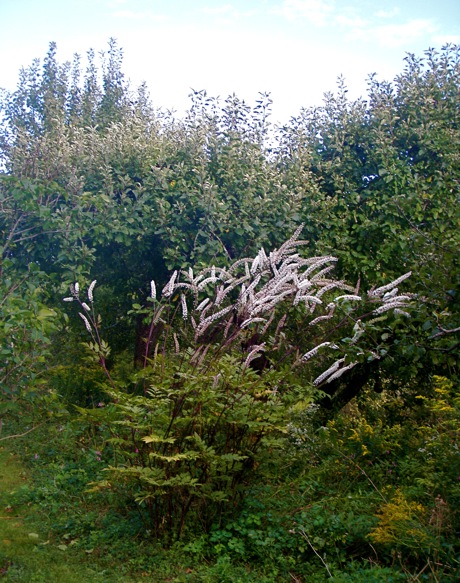
The clump of black snakeroot is down beyond the lower garden, nestled against the apple tree hedge/edge, but the fragrance is so intense it floats a very long way.
Read More…