Garden
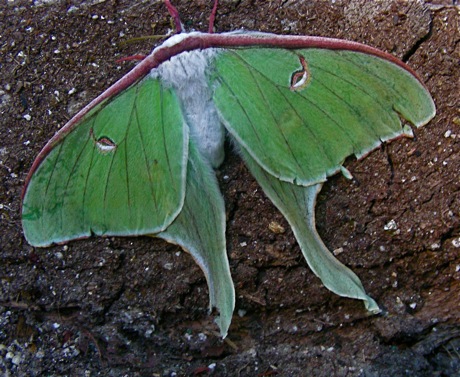
A Luna moth (Actias luna). Not the enemy, even though its children are very large and green.
I don’t have a picture of a hawkmoth, aka sphinx moth or hummingbird moth (so named for its ability to hover and its very long tongue). But if you see one of these gray-brown creatures, almost big enough to pass for a small bird, you’re seeing disaster on the wing. The Hawkmoth’s very large green children are hornworms.

Tomato – or more likely tobacco - hornworm (Manduca quinquemaculata or M. sexta), both voracious consumers of tomato, pepper, petunia, tobacco and other plants in the nightshade family.
In our New York and Maine gardens, hornworms usually show up in late July or August. But I’m thinking about them early this year because a Facebook friend in Virginia is already beset.
“Hornworms are eating my tomato plants,” she wrote, “anyone have advice on how to get rid of them?”
But of course!
Try the tips on Hornworm eradication at the end of this post, I replied, and if you get the chance, employ these two major organic defenses:
Read More…
After years and years of happy harvests, garden mainstays like heirloom tomatoes, squash blossoms and armloads of fresh herbs are as familiar as breathing, but every spring I get surprised all over again by the lettuces: how beautiful they are, how delicious, how willing…
And how different from the lettuce at the market, whether super or farmers.’ Being both extremely bulky and highly perishable, first class lettuce is a perfect poster child for home-grown.

Panisse (left) and Forellensclhuss – one modern, one heirloom. One toothsome, one super-tender. Neither suitable for any but the most local commercial cultivation.
It’s an ever-changing parade, with overlapping performers. First come the mild, mid-green frills of Black Seeded Simpson, dotted around in self-sown clumps, offspring of last year’s late summer’s crop. Then close behind them the classics of spring planting, including our favorite: buttery thick-leafed Webb’s Wonderful.

Self-sown Black Seeded Simpson, being permitted to stay in place beside the tomato patch. It grows so fast we ignore Rule # 1 and just cut the crowded seedlings by handfuls until we’ve used them up.
Read More…

I first saw this thing around Easter time, took a photograph (finding it almost uniquely eekworthy), then realized I couldn’t excoriate it here because I’d forgotten to take a closeup of the label.
And when I went back it had disappeared.
Or so I thought. No such luck. It has returned. The greenhouse/nursery at Adams is a reputable outfit and has therefore posted a warning

But the distributors of this abomination
Read More…
Oh dear, HOW has the time passed so quickly (as if gardeners didn’t know). I have now planted 6 kinds of peas, multititudinous onions and leeks, beets and lettuces and other comestibles galore, as well as the first flowers. Also pruned and deadheaded and mowed and edged and…
Result: blog silence. And here it is time for the next spring fling recipe swap.

If asparagus comes, can rhubarb be far behind?
This time it’s rhubarb, about which I have had a lot to say over the years on account of because I love it. Please use the search to find everything or go directly to the Rhubarb Custard Pie pictured above.
That post has links to other pies, but if you’re interested in the garden angle
Read More…
The very first spears came up two days ago – and promptly got clonked by last night’s frost – but it won’t be long until we’ve got plenty; there’s a 100 foot row at the back of our truck garden here in the Hudson Valley.

When I got out the butter I was thinking "have a measure to show the lengths," but it doesn't hurt to remember you don't HAVE to cook it in olive oil.
It was planted 20 years ago, which means 16 years of bountiful harvests and about 5 years of asparagus posts, most recently Tips for Choosing, Storing, Preparing and Growing. Want recipes? I seem to have called it a day at Cream of Asparagus Soup (made from the otherwise discarded tough ends) and Spring On Toast, with asparagus, morels and eggs. So I was feeling faintly remiss when
Read More…
As you may be noticing long about now, we are surrounded by spring flowers, their heart-lifting color everywhere – in the landscape, on garden blogs, at nurseries, in omigodheretheycome fall bulb catalogs.
But there’s one branch of the spring flower shower that doesn’t get as much notice as it deserves, the one that doesn’t have any petals (At least not petals the way forsythia has petals, and certainly not the way daffodils have petals).
So right here I want to put in a good word for catkins, the fuzzy flowering parts of birches, beeches, mulberries, hazels and of course pussy willows.
In a moment, our friend Eric will be extolling the Black Pussy Willows he grows over at Yale, but first a glimpse of our own backyard thrill, the contorted hazel, in full chandelier mode:
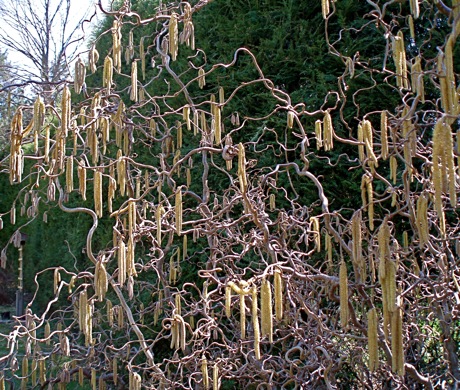
Corylus avellana 'Contorta' in flower
The stems look a lot like the curly branches offered at some high end florists, but those are usually the faster growing curly willow, which brings us back to Eric and his fashionably
Read More…
March came in with a gorgeous ice storm. Greening up on hold.
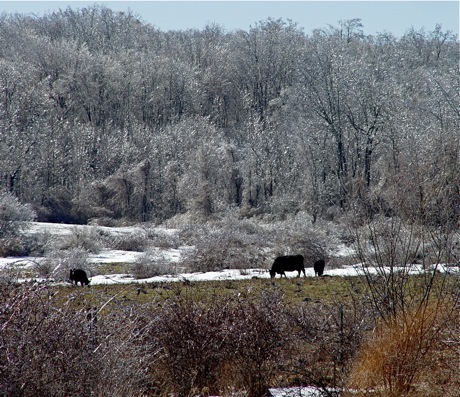
The view on March 8th.
Shortly afterward it got warmer – pleasant even – although there were still large heaps of dispirited snow in the shady spots. But gradually (very gradually), the heaps diminished to tiny piles. We heard peepers. The crocus, early iris and eranthus began to bloom.

One thing I love about eranthus are those frilly skirts. Another is their cheerful willingness to multiply.
As further encouragement, we have now had St Patrick’s day, aka Make Soda Bread day and the first day of spring and the arrival of two of my favorite fall catalogs – Brent and Becky’s Bulbs and Adelman peonies. Definitely planting time, even if it is going to be 14 – 16 degrees at night for most of the coming week.
Read More…
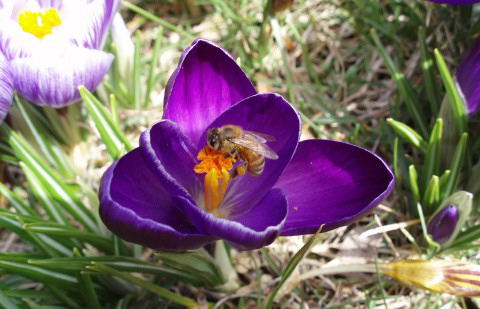
Where there are shoots, there will soon be flowers. Also bees.
I’m sure I’m not alone in feeling overwhelmed with imminent spring. It’s just so inspiring to see those fleets of tender crocus shoots pushing up; so inspiring ( in a slightly different way) to see those fleets of last autumn’s canned goods still lining the shelves.
Haven’t started raking yet, but I have been making Honey Bars, playing around with assorted vintages, pairing the perfumes of the honeys with different nuts: floral with hazelnuts, herbal with pecans, smoky with black walnuts.
That’s the thing about keeping bees: if you get any honey at all, you generally get a lot, so even though last year was a total bust we’re in no danger of running out.
The thing that’s in danger is the bees. And as Bill points out in this guest post, the first wave of threats is already pawing away at the doorstep.
Read More…
It’s that time of year again: every morning I look at the mirror, sternly, and say “ Leslie, you cannot grow everything.” Everything meaning vegetables and annual flowers. Even I know I can’t do much about my fantasies in the tree and shrub department.
Sitting cuddled up with a big pile of catalogs and a ballpoint (felt tips bleed through) is one of the best cheap thrills going, and buying way too many seeds isn’t all that much more expensive, at least compared to the trouble you can get into at an outfit like forestfarm. But this is not about that, it’s about remembering to leave room for the seeds that plant themselves.
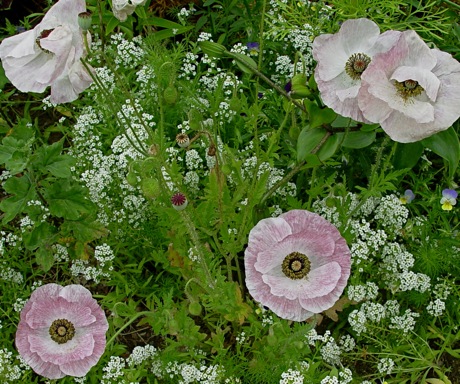
Although all colors of alyssum self-sow, white is not only the most prolific but also the most fragrant. The poppies are not fragrant, just about their only flaw.
Read More…
Acording to reputable measurements, fifty three inches of snow have fallen – so far – on our corner of the Hudson Valley. Fine with me, especially because I’m not the one shoveling (see below). But also fine with the gardens, safely insulated beneath a protective blanket that keeps roots from heaving, shelters essential microorganisms, and helps prevent excessive breakdown of nutrients.
None of this is news to long time plant people, but even as a very long time plant person I was amazed at the extent to which snow matters in the larger environment. If you wish to be amazed too, check out Colder Soils in a Warmer World: Snow Depth, Soil Freezing and Nitrogen losses in the Northern Hardwood Forest. We learned about it at Snow is Good, a lecture given by Dr. Peter Groffman (last Friday, at Cary Institute of Ecosystem Studies), a lecture we were only able to attend because Bill thinks snow shoveling is good.
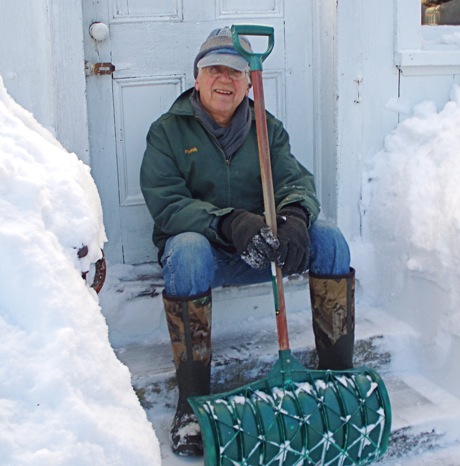
Bill, mover of tons (and tons) of snow. You will notice that he is smiling.
Read More…