
Wild (about wild) Strawberries
Over the years, we’ve grown at least a dozen kinds of strawberries, mostly standard garden varieties (Fragaria x ananassa) like Sparkle and Tristar, and so-called “wild” strawberries, aka fraises de bois and alpine strawberries (F. vesca), like these Mignonettes being used as an edging in the lower garden.
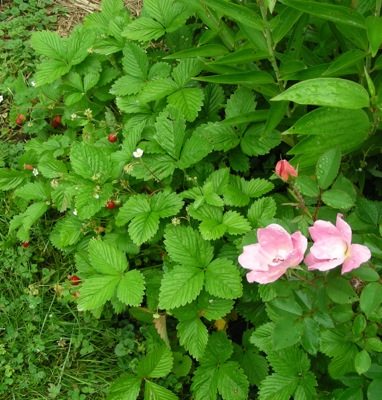
Cultivated strawberries are easy to grow, almost always tasty and sometimes very tasty. But none of them – yet; I keep trying – are as good as genuinely wild strawberries (F. virginiana), the intensely flavorful, amazingly aromatic gift that grows freely in woodland edges all over the northeast and beyond.
Unfortunately, as many before me have discovered, you can bring the strawberry into the garden but you can’t bring the garden into the strawberry.
Horticultural reason suggests that selecting the plants that bear the largest quantity of the largest fruit and giving them good soil, adequate water and filtered sunshine ought to lead, gradually, to better crops than could be gathered on any summer visit to a good picking spot.
It doesn’t, no matter how many times you try. In this frustrating bit of poetic justice F. virgiania is completely democratic – anyone who bothers to pick them gets the same splendid reward: the very best strawberry in existence, in ( nothing is completely free) the very smallest package.
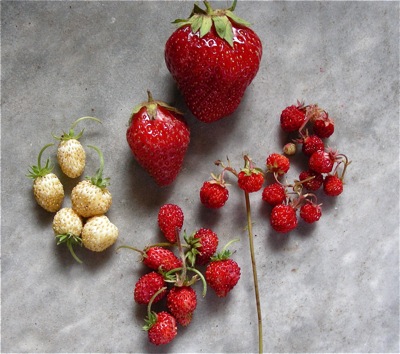
Clockwise from top: local garden strawberry from u-pick operation, variety unknown; true wild strawberry, from up the road; Mignonette, from the garden; Pineapple, a “white” alpine (supposedly less attractive to birds) that has gone wild in the side yard; and one of the u-pick strawberries standing in for the size of a Tristar because right now our chipmunk-in-Tristar- patch problem has reached crisis proportions.
More on Alpines: my relationship with alpines and the rarer but also much praised hautbois is one of those love/hate deals. On the plus side, they’re falling-down-easy to grow, long lived and pretty… and you get all kinds of gourmet points for having them. On the down side they take forever to pick while being far less wonderful than you’d think from all the hoopla. At least that’s how they strike me. For the opposing viewpoint – and a very large selection of seeds and plants – check out Alpine Strawberries.

Share this




My cousin has a variety of wild strawberry growing as a weed in a bed I put in for her last year (they predate the bed) in East Texas.
But . . . horrors . . . they have NO TASTE at all! The plant is hardy, the yield good, the berries a lovely red . . . but completely worthless.
I’ve enriched the soil a lot with organic matter . . . it was originally sugar sand . . . so I’ve been hoping they’d improve. But so far, no luck. She’d love to have something worth picking. In fact, she wouldn’t let me eradicate them at the outset. Maybe I’ll try seeds from a “real” wild strawberry next year.
Hi Leigh,
it sounds as though your sister’s weeds might be mock strawberry, Duchesnea indica, a look-alike plant often used as a ground cover and often found covering ground to which it has not been invited. The berries aren’t poisonous, but that’s about all that can be said for them. Easiest way to tell the difference is the color of the flowers: duchesnea’s are yellow, fragaria’s are white.
But what it is matters less than what it isn’t, which is tasty enough to bother with. Rip it out and plant something else – you can tell your sister I made you do it. F. vesca seeds usually sprout easily; but it can sometimes take quite a while. Keep the seedbed weeded while waiting or start the plants in flats and transplant them after they have about 6 leaves.
In fact, flats are definitely the way to go if you’re planting the same area. The current incumbent already has plenty of seeds in that ground and you don’t want any confusion about which baby is which.
Are Wild strawberries poisenious?
And also do they help with alergies?
What about warts?
Thank you
And may God bless You.
Ariana
A belated Hi Arianna,
and please forgive my tardy response ( just realized the answer I wrote you somehow failed to get posted).
Wild strawberries are not poisonous, though they will set off allergies in those who are allergic to the garden kinds. ” Strawberry warts” are named for their appearance, not their cause, and as far as I have been able to figure out, there is no scientific evidence to back up the claims that strawberries are an effective wart cure.
what variety of strawberry easiest to plant at a planter??
what the best season to planted it??
thankyou
My wild strawberries do not get berries. is there male and female strawberry plants? My plants get beautiful white flowers , but no berries. Someone told me the male and female parts can be identified in the flower. What do you think? Do you know where i can get the right plants to make this plant bear fruit?
Strawberry Planter
This post must be jinxed – I never got the “you have a comment” message, sorry!
Anyway, best strawberries for a planter are the Alpine kind – the plants are pretty, they stay neat and tidy and they bear all season. You can plant them pretty much any time; just be sure they get plenty of water… and some shade until they’re established. Lots of choices at the “alpine strawberries” link at the bottom of the post.
Linda,
strawberry sexuality is complicated, but the true wild ones, F. virginiana can be either female or bisexual, pretty much at random (go figure). The bisexual ones can pollinate themselves but usually don’t; so a pollinator is needed no matter which kind they are. That means the “right” plants are just several different ones, “different” meaning not only separate but also genetically distinct; the plants formed by runners will all be clones of the original plant.
all this is pretty much true of “wild” strawberries that are actually tame; the F. vesca that’s in the post and suggested in response to Strawberry Planter’s comment.
Can fragaria ananassa (garden strawbrries) be grown in the same patch as fragaria vesca (Alpine strawberries) without them being cross pollinated and becoming hybridized ?
Hi Justin
Good question. Spontaneous cross species hybrids are possible. Supposedly, that’s how garden strawberries ( Fragaria x ananassa) arose.
But it’s not hugely likely. You wouldn’t know until you grew plants from the seeds, and garden strawberries are typically propagated by runners. So the only cross you might get would be in next-generation vescas. I have a lot of self-sown ones and they do exhibit some variety, but nothing that suggests influence from the garden strawberries grown not right next door but plenty close enough for cross-pollination.
Still, you never know. It sounds as though you’re not keen to have this happen, but if something interesting does develop please write back and tell us!
Hello I have an Alpine strawberry plant in a hanging basket that I started from seed. On some of the leaves the edges are turning dark brown but other than that its growing perfectly. What am I doing wrong??
Thanks Nicole
I live in Scotland, and I have that “pineapple” white strawberry growing wild all over my garden. In fact, it’s become quite a weed, the little monster! I’m allowing it to grow in one semi-wild patch, and pulling it out of all the others. It has a really nice flavour and smells delicious too, but strangely enough, it’s not appealing as a fruit. Who wants to eat a dish full of white strawberries, or make white strawberry jam? It’s correct that birds aren’t interested and even the Eat-Everything-In-Sight gray squirrels seem unenthusiastic, and only nibble occasionally. I can’t grow any kind of red strawberries in my garden because they all get eaten before they’re fully ripe, by mice, birds AND squirrels …but the white berries don’t get touched. So it’s got to be the colour that puts everybody off!
Wild strawberries have taken over my garden! How do I get rid of them.The problem has gotten worse over the past three years. Each year I try different weed killers but they are back again and worse then ever. Also, how did they ever get there? I have a flower garden and never planted them.
Send them to me! I can’t find any, even up north. No one seems to gather them anymore. Have you ever tasted them? Makes the best jam in the world!
To discourage nibblers from eating all my strawberries, I frequently dust the patch with cayenne pepper. I’m in the process of adding chives and other garlicky-oniony plants as companions to the strawberries.
Today I dug some wild strawberry and blueberry plants from my parents’ camp in PA. I have cultivars of these berries, but I am hoping the wild ones will flourish as well.
I am hoping you can solve a mystery for me. I have several thriving plants that in every way look like strawberries, spread like strawberries. But here it is almost August and not one of the plants has bloomed. My normal strawberry bed is pretty much done for the season. These just grow and spread. Is there a real strawberry that waits until the end of summer to bloom and produce, or possibly one that never produces flowers?
I have finally pulled them because they were taking over. But should I put them in the strawberry bed or the compost?
Thanks so much!
There are a few strawberrylike weeds and it sounds as though that’s what you’ve got. Even the ones that do flower don’t produce good fruit. The wild strawberries you’d want to keep (F. virginiana) don’t spread as fast as the plants you’re describing and they are much smaller in all regards than garden strawberries.
Does wild strawberries, since they are a perennial, take 2 years to flower and fruit?
Fraises des bois sometimes fruit the first season if you start the seeds in mid-winter. F. virginiana I don’t know; some plants in wild patches do appear fruitless, which may indicate a first year (and may not).
It is so great to find someone who loves “wild strawberries”. As a kid in the UP we had plenty of them in an open field. It would take you all day to pick a small bucket full, but we did. Mom would make jam and pies! OMG, they are so good! I am now in the southeast and people here have never heard of them! I would pay anything to have one jar of Wild Strawberry jam! There is nothing that can compare to the taste. My friends and relatives that are still in the north don’t seem overly impressed but that’s because they have never eaten any. There is no other that tastes as good. You seem to enjoy these as much as I do and PLEASE tell me where I can find either the jam or the berries. The plants won’t grow here, but I will go anywhere to get some berries. The last time I had 6 small jars of jam and I drove 200 miles to get them, ate almost all of it, I put it on EVERYTHING! Well about two weeks later I broke out with hives all over. Doctor asked me if I had eaten anything new and I said about 6 jars of strawberry jam! That was 40 years ago and would do it again today. Enjoyed your web site, loved reading about the strawberries and hope there is a person out there who loves these as much as I do!
Thank you for listening,
Linda Holton
You say that the very tiny wild strawberries have no taste but are not poisonous. Are the weed stawberries? My dog I think has eaten some is is very sick. Do you think its poisonous or an allergy for her?
Hi Linda,
I think the tiny wild strawberries you mean must be the false strawberries noted in the top comments,which as far as I know are not poisonous… but that’s to people. I’m not a dog expert and they DO have different reactions to things. You might try calling the vet just to check, but as far as I know the “phrase “sick as a dog,” does have good basis in the tendency of our canine friends to be indiscriminate eaters (without lasting ill effect). One unpleasant possibility: If she was eating from an area recently sprayed with pesticide/weedkiller that might be an issue.Hope by the time you see this she’s better!