Around the House

Sunshine cookies, my new name for Figolli, with semi-traditional Figolli decoration. (It’s semi-traditional because there should be a foil-wrapped chocolate egg somewhere on each cookie. I compromised with (one) golden Jordan almond.
Why sunshine? Because they’re full of citrus zest – lemon, orange and lime – and they have a rich almond filling spiked with orange flower water. These are all things that say “Mediterranean” to me, plus Figolli are from Malta.
And why ignore their perfectly good name to create another one? Because “Figolli” is totally married to Easter and I think the cookies are way too good to make only once a year.
Read More…
That’s “funny” as in “peculiar.” Found it years ago in a junk shop, when I still had time/inclination to rummage about in the old postcards. The writing side is blank. There is a box for the stamp: One Cent Domestic, Two Cents Foreign.
The sentiment in the lower right – difficult to photograph – is “I Do Love Violets; They Tell The History Of Woman’s Love.”

I can only suppose the purple flowers are violets, although the artist appears to have taken considerable liberties. The white ones are clearly lilies of the valley.
Needless to say, there is no WAY I’d ever give it to anyone, including my adored husband (who, in any case, fails to appreciate this sort of thing for the wonderfulness it is).

Maple Pecan Pumpkin Pie – what is there to say but read on?
As I was saying only a moment ago, here comes Thanksgiving. Time for the Turkey Roundup. Time also for the pumpkin pie – but the Squash Roundup, while rich in recipes (see end of post) does not contain this necessary part of the finale.
Enter my dear friend Sandy Oliver, food writer, culinary historian and vegetable grower supreme, who just happens to have a great recipe for pumpkin pie in her new book, Maine Home Cooking, published, fittingly, by Downeast Books
Read More…

The turkey gets transferred to a cookie sheet and put in a VERY low oven to rest while I make the gravy. (Not wise to put it on the antique ironstone serving platter until the last minute.)
Ok, not right away for the cooking part. But Thanksgiving is coming at us at an alarming rate, earlier this year than ever, and it’s none too soon to be ordering a suitable turkey.
I am of course extremely grateful to be worrying about things like “what kind of turkey?” rather than things like “ will I have a home to cook the turkey in?” But no amount of gratitude solves the question of the hour: do I want a heritage turkey or just a plain old organic free range turkey?
While I’m making up my mind:
* My not very scientific comparison of heritage vs. (semi) conventional birds, along with a detailed explanation of why heritage costs so much, is here.
* Advice on special cooking techniques for heritage birds is in the second section of Wild Turkeys, Thanks but no Thanks.
* My detailed guide to size selection, brining, roasting, and gravy making, along with a recipe for wild mushroom and chestnut stuffing, is here.
* Local Harvest is the place to search a national database for (duh) a local bird.
and of course – VERY important, as far as my family is concerned – there’s
* Fresh Chestnuts: Roasting them, Peeling them, Putting them in the Stuffing. (Especially useful for vegetarians and vegans, who may wish to move the chestnuts into a starring role).
Myself, I’m trying a blood orange version of the recent Shaker Lemon and Cherry Pie for Valentines Day, but this being a chocolate drenched holiday, I feel it incumbent to point you toward a couple of never-fail favorites.
Old Faithful, The Little Black Dress of Chocolate Cakes

This is the Almond Joy Variation of the chocolate cake. It's also just fine just plain with whipped cream, or with chocolate ice cream and fudge sauce if your dearly loved one is anything like mine.
Heath Bar Cookies, aka Chocolate Toffee Crunch
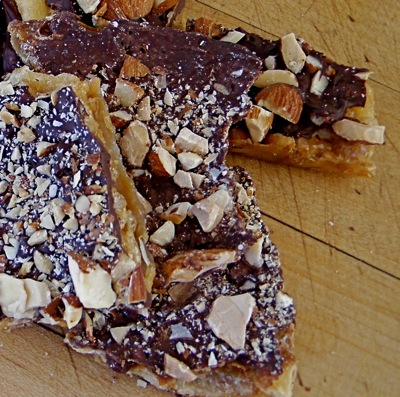
Heath Bar Cookies. All four major food groups: sugar, salt, fat and crunch. With chocolate on top. Most distressing part is how simple and quick it is to make rather a lot of it.
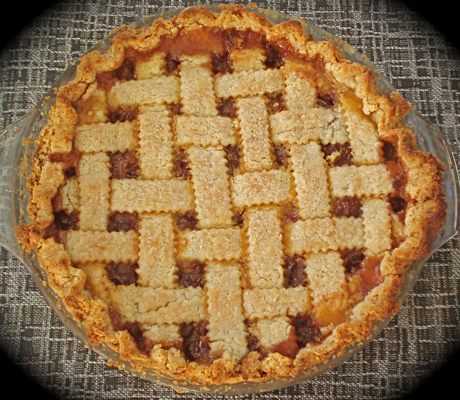
The lemon is underneath the cherries
This floated into the kitchen because Jan 23 was National Pie Day*, an event that got a surprising amount of PR, given that every day is pie day in most people’s estimations. It’s probably because good pie is still – compared to say, macarons – in woefully short supply.
Ok. Deciding to bake a pie was easy. Deciding what kind of pie to bake was not, fresh local fruit also being in short supply in the Northeast just now. We’ve gone through all the frozen berries already; we’re eating too much winter squash to make pumpkin appealing, and while apple might seem obvious, it’s not if you breakfast on baked apples with yogurt pretty much every mortal day of the winter.
Read More…

My take on King Cake, seasoned with thyme and marjoram, liberally studded with Gruyere, sprinkled with Parmesan instead of sugar but maybe next year I'll dye the cheese in the classic icing colors: green, yellow and purple
The classic King Cake of carnival season has many variations: coffee cake-ish, briochelike, or based on puff pastry. It may or may not include embellishments like candied fruit, frangipane, and colored icing. It may even be chocolate with coconut. But one thing will be for sure: it’ll be sweet.
Not around here. At this time of year I’m still recovering from the holiday cookie binge, and the idea of more of the same doesn’t hold much of a thrill. Yet I’ve always loved the idea of the thing, so our traditional King Cake is basically cheese studded brioche. Traditional tradition is honored in the ring shape and in the hidden token whose finder is the King.
Read More…
As a general rule, recycling the tree starts being an issue after the holiday, when a use must be found for a large, suddenly useless dead conifer. But this year we had a large dead conifer well before Christmas, thanks to the Halloween snowstorm that toppled the 15 foot arbor vitae in the southeast corner of the back yard.

Our holiday tree, 2011, aka the top of the former arborvitae. There’s a bucket of water inside the pedestal.
Putting it up was extremely easy; taking it down wasn’t much harder and now we have the same pile of long branches anyone with a regular tree will have as soon as they saw them from the trunk, first step in successful home recycling.
Read More…
Or, to put it another way: Stop her before she bakes again.

The decorated dark ones are gingerbread; pale stars are sugar cookies. Little round coconut covered jobs are rum balls; crescents are vanilla crescents (known as Moth cookies in our family). Round ones in the back are two kinds of jumbles and the dark rounds in the middle are Mexican chocolate chocolate chip.
I expect to discuss the Christmas Ham in the very near future, and may also pony up a picture of The Tree.
But first, even without cues from the weather, little miss knee jerk has responded to the usual stimulae in the usual fashion. Five or six pounds of butter, along with a similar weight of nuts but vastly less sugar – one of the reasons home made cookies taste so much better than store bought – have already been put to use and I can tell there’s more to come.
Read More…

Holiday chocolate cookie-candies, everything easy except what to call them.
These classic holiday goodies are almost perfect: Only one (processor) bowl to wash; no cooking; deeply chocolate flavored without calling for obscene amounts of expensive high-end chocolate. Very simple to form and they keep for a long time. Just one small problem: their name.
You can’t really call them Hooch-soaked Crumbs with Chocolate and Nuts, but Bourbon, Rum or Brandy Balls doesn’t exactly do the job either. Maybe they should be called Poor Man’s Truffles. Please consider this an invitation, all suggestions cheerfully considered.
What we need is something that says Small, Rich, Alcoholic* and Chocolate, without getting any more specific. After deliciousness, lack of specificity is the distinguishing merit of let’s temporarily call them SRAC’s; they’re the pasta casserole of cookies. You can make them out of almost any dry sweet you happen to have around.
Read More…