looking ahead
to catalog plant lust. Always useful to remember they have to be interesting in context.

The Black Pearl pepper is in a tall urn that’s set in the middle of a clump of Artemisia Silver King. The sedum is good old Autumn Joy.

to catalog plant lust. Always useful to remember they have to be interesting in context.
The Black Pearl pepper is in a tall urn that’s set in the middle of a clump of Artemisia Silver King. The sedum is good old Autumn Joy.

Yours for only $499.99, and maybe it's just as well I can't figure out how to make it bigger.
Never would have known the thing exists if yesterday hadn’t been such a slow mail day I actually looked through a Hammacher Schlemmer catalog before putting it on the recycle pile.
And there was our festive Eek of the Week. It’s 7.5 feet tall, made of powder coated steel, lit with 1150 little red lights that “create a scarlet luminescence.”
Shooting fish in a barrel, I know, but still…
Ok, team, time to get shopping. As mentioned last year on the way to the big chunky apple cake, even diehard farmstands will be shutting down soon, and it won’t be long before specialty groceries revert to the same yawnworthy array, much of it much travelled, offered by supermarkets.
Makes me sad just to think of it, or would if we hadn’t been apple hunting for months, munching, baking and – three cheers for an old fashioned farmhouse with side porches! – stocking up. Some of what’s currently stashed in a small space we try to keep right above freezing (heirlooms with approximate intro date):

Left to right: Wolf River (1875), Cameo, Winesap (1817), Northern Spy (1800), Pink Lady, Stayman (1895), Zabergau Reinette (1885), Tolman Sweet (pre-1822), Golden Russet (pre-1845)
Apple collecting tips and pie recipe after the jump
No need for a digital measurement ( or the morning weather report) when you look out and see this.

rhododendron leaves in self-protective mode; it's 20 degrees F.
Could be a cold truth about global warming: 15 below normal means nothing when normal itself is up for grabs.
Things that have not changed an iota in the last 3 decades:
* If you go by the standard Thanksgiving story, all the way back to 1622 (which in fairness to history you probably shouldn’t), tradition favors venison. But tradition as usually understood demands turkey. No other meat – or poultry – will do.
* It is impossible to roast a whole turkey and have both light and dark meat come out equally delicious.
* It is impossible to convince people that this means turkeys should not be roasted whole.
Things that have changed considerably:
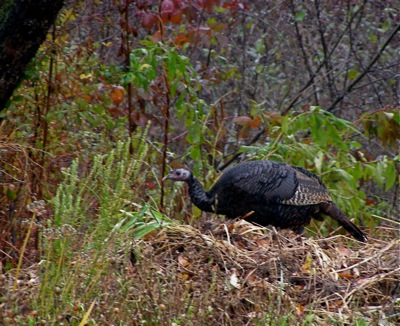
* Wild turkeys are back, big time, although not yet back on the table
* Cooks have discovered that brining the turkey does a great deal to help keep the meat moist. (Best dissenting opinion award: Harold Magee in the New York Times).
* The USDA has discovered it’s not necessary to create bird-flavored sawdust, i.e. internal temperature of thigh 180 degrees. The agency now allows you to stop at 165, still around 10 degrees hotter than essential for safety, but only about 5 degrees hotter than best for succulence.
* It’s no longer enough that the turkey be fresh, unpolluted by “self-basting” additives and unpierced by pop up buttons. Fresh and local is now the gold standard, except when you can get fresh, local and heritage, the high end turkey trifecta.
tips for dealing w/heritage turkeys, whichtend to be leaner and smaller than the modern standard, can be found at the end of this post.
tips for dealing with the modern standard, and the stuffing recipe follow
Old Faithful, the tropical passionflower (species unknown) that has been going from greenhouse to windowbox and back again for years has brought us a great deal of pleasure. The thing’s an unkillable blooming fool that makes about 14 feet of growth each summer.
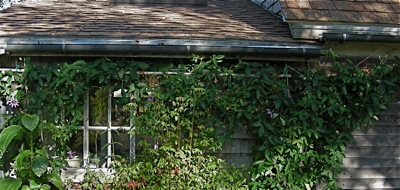
it's all one vine, base at lower right
But it’s also brought us a great deal of aggravation. Moving large plants back and forth between the Maine coast and the Hudson Valley is not my favorite thing.
So wouldn’t it be great to have a passionflower that was willing to live outdoors? YES! Passionflowers are almost all denizens of zones 9 and south, but there is one, the native Passiflora incarnata, rated hardy to Zone 6 or 7 – and we are almost 6.
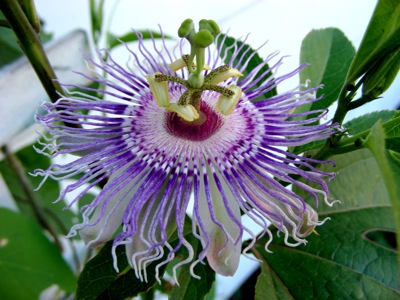
Passiflora incarnata, aka Maypop
No heating season complete without a startup drama, in this case a very loud eek! coming from the woodstove. Bill rescued the source and sent a picture, along with an explanation of why the thing doesn’t look quite right.
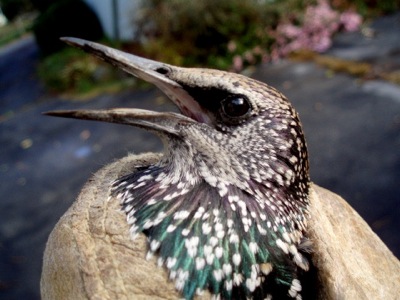
immature starling, bound for freedom
“The starling that came down the stovepipe. By spring the white tips on the feathers wear off and the stronger dark fibers (with melanin) give the metallic coloration.”
It may be bundle up time ( we’ve had temps in the mid-20’s on several nights at this point) but there are still delicious wild mushrooms to be found. Here’s the latest from our resident expert.
THE MUSHROOMS OF AUTUMN
After The Leaf fall
story and photos by Bill Bakaitis
As the days shorten the trees shed their leaves, openings begin to appear in the canopy, and more light penetrates to the understory. Mild frosts will have singed the outer tips of the garden plants and the edges of the forest, but mushrooms such as Honeys can still be found poking through the thin cover of leaves under the thickest forest canopies.
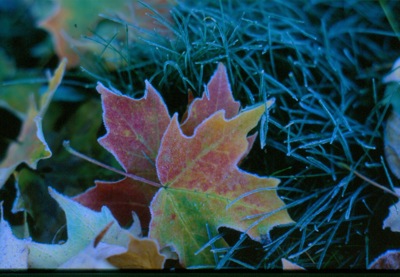
Light frost on Maple Leaves
By mid-Autumn, a month after equinox, It’s a different story. Read More…
I was supposed to be planting the new peonies… and unpacking about 2000 files. But I wanted to experiment with the heirloom apples – Tolman Sweet and Zabergau Reinette – from MOFGA‘s Great Maine Apple Day. And when I got down to the Hudson Valley the fruit bowl was filled with quinces from Karen, she of the splendid strawberries.” We can get more if you’d like to use these to make a pie,” Bill said hopefully.
Usually, I’d just make apple quince, but as Bill had also rather overbought in the pear department it seemed sensible and perhaps interesting fill a pie with 3 parts apple, 2 parts pear and one of quince. Did not add spices on account of not wanting to obscure any nuances from the unusual apples. Did add a little rosewater, in the spirit of the more the merrier.
Roses and apples – and pears and quinces – are all in the family Rosaceae, a relationship you can read all about here, if you have a mind. But you might be better employed making pie. Quince season is short.

The pink dice are the quince pieces
recipe after the jump Read More…
10/23
Kristi and I are discussing the last bits of putting the garden to bed. We’re wondering about the winter rye, our standard cover crop for the Maine vegetable plots. She planted it 10 days ago but nothing seems to be coming up. Big Mystery. Seed was fresh, there has been rain…
10/24
Mystery solved first thing in the morning. I look out the bedroom window into the rosy dawn and there in the garden is a flock of wild turkeys, busily scratching and eating.

wild turkey breakfasting on rye and clover