Well, the summer squash actually, because that’s all we plant in Maine.

cousa squash plant hit by frost
The winter squash is – or more accurately was – down in the much larger Hudson Valley vegetable garden. Bill got it all harvested before frost descended, reminding me yet again that the (once) well-known poem, The Frost is On the Punkin, by James Whitcomb Riley, makes absolutely NO sense unless “squash” means “squash vines.” If you let frost land on the fruits themselves, rot will spread from the frosted part and the squash won’t keep. Click here for more about winter squash, including recipe tips, here to read the poem, relic of another time in many ways yet not without its virtues. The second stanza gives you the flavor:
| They’s something kindo’ harty-like about the atmusfere |
|
| When the heat of summer’s over and the coolin’ fall is here— |
|
| Of course we miss the flowers, and the blossoms on the trees, |
|
| And the mumble of the hummin’-birds and buzzin’ of the bees; |
|
| But the air’s so appetizin’; and the landscape through the haze |
|
| Of a crisp and sunny morning of the airly autumn days |
|
| Is a pictur’ that no painter has the colorin’ to mock— |
|
| When the frost is on the punkin and the fodder’s in the shock. |
|
|
But before we get all excited and start spending zillions on gorgeous new ones, it’s peony cleaning up time. The fungus diseases that plague peonies overwinter on dead peony leaves and flowers, so getting rid of all traces of same is the best defense against future infection. There is no applied control, organic or otherwise, as effective as simply being tidy to the nth degree.
Cut stems down to an inch or so above ground, preferably while the leaves are still firmly attached. It’s always a wrench to remove a whole bush full of beautiful fall foliage, but snipping off all of this year’s growth before it falls apart makes the subsequent raking of leftovers far less of a chore.

Making bouquets helps; peony leaves and fall flowers are pretty much foolproof
Needless to say, none of the detritus should go on the compost. Sending it to the landfill is ungreen. Burning it is against the law in many places. Fortunately, there is almost always some dumping spot – in the woods for instance – where peonies will not be planted in the foreseeable future.
It doesn’t hurt to get rid of the mulch, too. Very small bits of former peony are undoubtedly embedded in it. And as a side benefit, mulch removal exposes the plant bases so you can get a good look at them. Everything is probably fine, but if you see humped up crowns you know it would be wise to divide and reset the plants.
Breaking news: the three people left on the planet who didn’t know kid’s sweetened cereals are almost as much sugar as grain have now been clued in, thanks to a study just published by Consumer Reports.
But the spin that makes MY head spin is this, from a Kellogg’s spokeswoman quoted by Reuters:
Read More…
This post is coming to you because reader Lennie recently asked for the caponata recipe from Good Food, a syndicated column I wrote in a former life (from 1976 to 1994). Hadn’t used the recipe in years. Had to go back and look though hard copy. While looking came across a column that’s scarily relevant – and the cookies are delicious.
Excerpted from Goodies to Win or Lose By, Good Food, October 29th, 1980
“ I never wonder to see men wicked, but I often wonder to see them not ashamed.” – Jonathan Swift.
…Watching TV is notorious for inclining one to munch, and there is something about a quadrennial spectacle based simultaneously on inanity and calamity that just about forces the more nervous among us to eat. Something, anything – fingernails even, all else failing. But more often something fattening.
With Gingerfingers , you can have both. (Plus Halloween is coming. Giving homemade treats seems to be out, but kids do have fun making these….)

walnut gingerbread finger cookies
Read More…
I take it back. Can’t talk too much about mushrooms when there are so many delicious all-stars popping up all over, so here’s our resident wild mushroom guru, Bill Bakaitis, on what may be the holy grail. I used the haul from Lois’ lawn to make a wild mushrom and caramelized onion focaccia, and the recipe for that will be coming soon. But first you’ve got to catch your porcini!
PORCINI: THE WHAT, THE WHERE, THE HOW TO FIND THEM
by Bill Bakaitis

Boletus edulis, the Porcino, cèpe de Bordeaux or Steinpilz
PORCINI, THE WHAT: These mushrooms are best thought of as a “species complex”, a group of rather similar Boletes that have a bun-shaped cap, a stem which tends to be stout and swollen in shape and which bears a white chicken wire like reticulation at its apex. The colors of the cap run from off white through the tans and browns to reddish. The taste is usually described as ‘nutty”. Read More…
Catalogs and garden centers sell you dahlias in the spring, at planting time. Friends and neighbors give you dahlias in the fall, at dig-up-the-tubers time.

Could the red and white one be dahlia 'Mary Eveline'?
This dahlia surely has an official name (might be ‘Mary Eveline’), but as far as I’m concerned it’s ‘Carol’s Wine,’ because my dear friend Carol gave me the start tubers now many years ago.
Like potatoes, dahlias multiply. First one tuber becomes two or three, which is nice. Next spring you can plant them all together and get a big fat bush. By fall the bush has made seven or eight. Not so convenient but still ok; dahlias are easy to divide and there’s usually room for another plant. Read More…
In Part 1 of the fall planting series, I seem to have neglected to mention that many of the herbs and flowers that can be left to plant their own seeds should be grown directly from seed no matter who does the planting, so letting them do the job themselves is not only easy but wise.
Giant red amaranth, for instance, is very easy to transplant. It has such a great will to live that unwanted seedlings ripped out and thrown aside will pick up their heads and forge onward with no help at all. But transplants never achieve the great heights that make this thing such a head-turner. Even when coddled they seldom get more than about 4 feet tall, whereas plants that have never been disturbed…
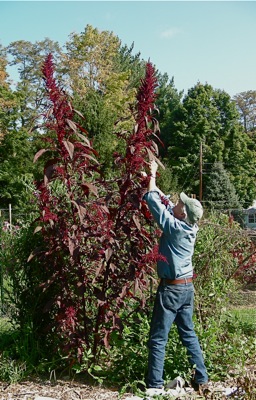
Bill showing you that the Giant Red Amaranth is about 9 feet tall right now. I can't show you the hedge of it in the other garden because he cut it down so it wouldn't shade the chrysanthemums and broccoli raab.
I know, I know. Enough already with the mushrooms. And just as Bill is confident I’ll want to weigh in with recipes for hen of the woods (see below), I’m reasonably sure he’ll have guidance on finding porcini.
This is just a reminder that if you already know a good place, now would be a good time to check. We found a bunch the other day in a favorite Hudson Valley spot and this morning, my first back in Maine in a week, look what was growing in Lois’ lawn! I’d normally pick everything, to forestall insect infestation. But even the big ones were – amazingly – almost bug free, so I’m leaving the little guy to get bigger.

Boletus edulis, from porcino grosso to porcinettino. Button in the middle is dime sized, honker on the lower left weighed 3/4 pound, after I cut off the base.
OK, mushroom fans, another guest post from Bill Bakaitis, on another of the all time great delicious wild mushrooms, the hen of the woods ( Grifola frondosus), now appearing on an oak tree – or on a shelf at a high end market- somewhere near you.

time to look for hen of the woods
by Bill Bakaitis
September. The days grow shorter. For mycologists, gone are the languid days of summer when we would slowly, patiently, and gently try to identify those interesting mushrooms that grow singly here and there. The photographs, spore prints, the keys, the chemical and microscopic analysis, the process that might take hours or days for us to determine even the genus are luxuries we can no longer afford. The sap that now flows through our veins and that of the world around us cries out for haste. There is so much to do in so little time: the garden, the house and yard, the movement of game in the forests, fall migrations of fishes in the ocean. Each claims its hegemony over our lives and the dwindling hours available. As for mushrooms, we have not time for the tiny, the new, the tantalizing odd; we long instead for the truly substantial. Enter frondosus!

Polyporus (Grifola) frondosus
Frondosus – call it Polyporus frondosus, or Grifola frondosus, Maitake, Sheep’s Head, or Hen of the Woods. Here is the mushroom that answers the question, “Where’s the meat?” It is large in size and fruits reliably in the same locations year after year, allowing us to take a twenty minute detour from our hectic lives to collect a year’s supply. And it is one of the best tasting of all wild mushrooms, appearing on every mycologist’s top ten list. Read More…
Many people grow eggplants, but after long years of struggle I am no longer one of them. Two reasons:
1). Eggplants need warm nights as well as warm days. This means our garden on the Maine coast is not a hospitable environment, eggplant-wise.
2). Eggplants have a short window of peak splendor on the plant. Pick them too soon; they’re undersized and bland. Pick them too late; they’re seedy and bitter. So although the plants do pretty well down at the place in the Hudson Valley, I can never count on being there at the optimum time.

freshly harvested eggplants
But in order to make caponata, the delicious Sicilian conserve of eggplant, capers and olives in thick sweet and sour tomato sauce, it is necessary to have eggplants. Off to Beth’s Farm Market “All Produce Sold Here is Grown Here,” right down the road in Warren, Maine (I’ve never asked, but as you drive up you see many huge greenhouses which may well be relevant).
Read More…