At first glance, it seems like a no-brainer: If you’re going to be an organic gardener, you ought to plant organic seeds. But it would really be better to say: if you’re going to buy organic products, put organic seeds on your shopping list. For home gardeners, the reason – a very good reason – to choose organic seeds is to support organic agriculture. It has very little to do with the seeds themselves.
Why does this matter? Because it means you can organically grow whatever you want. From the garden’s point of view, one bundle of genetic material is pretty much like another (assuming said bundle is good of its kind and has not been treated with fungicide or otherwise messed-with post harvest).* So although organic seed is preferable when available, insisting on its exclusive use is a little like cutting off your nose in order to spite your face.
In many cases, the organic version is available, especially if it’s a common vegetable. But uncommon heirlooms are another story; vast numbers of interesting flowers have not yet been included, and the number of organically grown hybrids is still mighty petite.
I shall stand back now and wait for the anti-hybrid avalanche to roll by, hating hybrids being all the rage these days. Well, ok. Hybrid seeds cannot be saved from year to year; you have to keep buying new ones.** Like many organic seeds, they are mostly produced by large corporations whose interest in sustainability is entirely market-driven, to the extent that it exists. But this doesn’t make hybrids Darth Vader.
In fact, hybrids bred for disease resistance are an environmental plus when they help you use less biocide. Pesticides and fungicides approved for organic gardening are still a long way from benign.
And while it’s true that a great many hybrids don’t taste very good, flavor having been sacrificed for qualities like heavy cropping and long shelf life, it’s also true that some of the tastiest vegetables in all creation are hybrid varieties: Sun Gold cherry tomatoes, Silver Queen corn, Confection winter squash – we just had some for dinner last night. It was terrific.

Spring is just around the corner, time to get ordering.
For the full seed spectrum: open pollinated, hybrid, conventional and organic, try
Johnny’s Selected Seeds, and Territorial Seeds,
For a good sized list of companies that offer organic seeds, potato sets and garlic bulbs, go to ATTRA, the National Sustainable Agriculture Information Service.
* Seeds from plants that thrived under organic management should produce plants that fare better when grown organically in their turn, but as far as I know there has been no scientific trial of this thesis. It would probably take several generations before any differences were evident and my guess is that even then a grower’s abilities – or lack thereof – would far outweigh any advantage conferred in the seed-production stage. Work is being done to create varieties tailored for organic production ( a very different thing), but this whole branch of plant breeding is still in its infancy.
** Actually, it is sometimes possible to “save” hybrid seeds, essentially by selecting and selecting and selecting again, over several generations of large grow-outs. It’s called stabilizing a hybrid and it’s a lot of work.
The cut flower industry is finally beginning to wake up and smell the roses, reports the New York Times. There is money to be made selling organic and sustainably raised flowers.
Lovely, as far as it goes, but like the organic spinach that goes from California to New York, most of those flowers are going a lot farther than necessary.
And of course choices are severely limited; Do not look to online flower sources for combinations like this

Bonica rose and old fashioned lady’s mantle(in garden, but it could have been in vase)
As local tomatoes and strawberries make clear, splendor and short travel time go hand in hand. Same deal with flowers: the closer you can get to homegrown the tastier your options will be.
This is not news to most of you, including Rachael and Jesse, who wrote in last week looking for
“someone in the Hudson valley – Orange, Putnam or Rockland or Westchester – that sells or uses organic or locally grown flowers. We’re having an event early July/late June and would love to support local.”
Having been out of the event racket for over 25 years, I have zip in the way of firsthand info. (if you have any, send it in!), but I can suggest something almost as good and a great deal more widely useful: a visit to Local Harvest, where the national database is searchable by location, crop and type of vendor. A trial request for farms + flowers + Warwick ( the first place I could think of in Orange county) brought up 57 listings and there was a flower farm on the first page so it’s probably one of many.
Finding your perfect match is unlikely to be instant , especially if you use the shopping tips below. It’ll take even longer if you take my advice and cover your posterior by ordering everything you need from two different farms. It’ll cost more too, obviously, but when the event is important it’s worth having insurance.
Most retail flower farms are small; weather is highly variable – a hailstorm might hit one location and leave one 10 miles away unscathed – and in real life, manure happens. Worst case, you’ll have done even more for local farms and will have extras to give away. Flowers for those who’ve helped with the event is always nice, or you could donate them to your local food bank. People who can’t afford enough to eat have probably gone without cut flowers for quite a while.
Flower Farm Shopping Tips:
* Does the grower sell by single variety or single color or, ideally, both? If so, is the price per stem or per bunch and if the latter how large is a bunch?
* Does the grower offer unusual fillers like the lady’s mantle above or the artemisia below?

That’s Queen Anne’s lace being a weed in the artemisia ‘Silver King’, an equally pernicious invader. Plant it once, have it for all time.
* Be sure timing is agreed upon. It’s best to cut flowers in the morning and keep them cool, but the grower may not have much in the way of ideal storage space. The sooner you can pick them up, the sooner you can get them home for proper conditioning.
Last Minute LOCAL Flowers for Valentine’s Day in the Hudson Valley
Yes we can! Rhinebeck’s famous violets have gone the way of les neiges d’antan, but there are two surviving hothouses that grow beautiful anemones and sell them retail, first come first served:
Battenfeld’s and Ralph Pitcher & Sons, (845) 876-3974

An anemone at Battenfeld’s
If you are a gardener with limited space and time whose primary goal is the largest amount of tasty, organic food for the smallest amount of effort, these crops are winners: easy to plant, easy to care for, easy to pick, easy to prepare and in some cases, all four:
* INDETERMINATE TOMATOES are so named because the vines keep getting bigger and producing new fruit until they are felled by frost. The choice of varieties used to be small for those who were starting with purchased seedlings, but these days there’s quite an assortment at farmers markets and garden centers. I even saw baby Brandywines at our local Shaw’s supermarket last year, so something is definitely happening.
In fact, the market for painless exotica has become so large it’s spawned a whole new industry: mail order tomato – and pepper and eggplant – seedlings from nurseries like Laurel’s Heirloom Tomato Plants and Cross Country Nurseries. Choices galore, more than enough to thrill most gardeners, at prices that may also keep them from getting too thrilled for the space available. (The whole idea of mail-ordering annuals takes some getting used to; and importing instead of buying local costs green points as well as dollars. Call a few likely local sources to find out what they plan to offer before ordering from away.)
* NON-HYBRID POLE BEANS. Like indeterminate tomatoes, old fashioned pole beans keep growing and producing ‘til frost – assuming you keep them picked. They may seem like more work than bush beans because you have to provide supports, but bush beans peter out much sooner; picking them is arduous (there’s a reason stoop labor is a synonym for work nobody wants to do); and unlike pole beans, the bush kind must be washed. If they’re mulched, most of them don’t get dirty, but at least a few in every picking need a rinse, so it comes to the same thing.
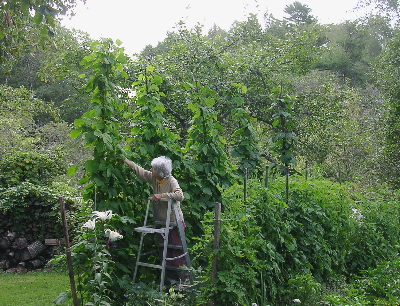
Lois is picking Rattlesnake pole beans, our favorite for some years now. Vines are disease resistant, drought tolerant and hugely prolific once they start bearing. The purple speckled green beans have great flavor. They stay tender even when quite large, so any given bean can hang in there lookin’ good for at least a week – depending on the weather, of course. And as if that weren’t enough , rattlesnakes hold their quality in the ‘fridge far longer than most snap beans, a virtue that comes in handy at peak season, when the beans are really cranking and there’s a lot of other stuff to eat. All these encomiums apply to Maine and the Hudson Valley, but most catalogs describe the beans as good for growing in the south. From ( among many) JL Hudson.
* ZUCCHINI. Everything they say about avalanches of zucchini is true, especially of hybrid varieties none of which unfortunately is as delicious as Costata Romanesco. This heirloom takes longer to start bearing than modern zucchinis; it has the prickly leaves characteristic of “unimproved” varieties; and it makes big sprawly plants instead of tidy bushes. Not good for containers or planting beside the front walk. The high return is the flavor; if space is tight pass it by and go for a hybrid – most of them are fine if you pick them young.
* SWISS CHARD. Plants hold without bolting from spring through fall in all but the hottest summer areas. There’s no need to harvest whole plants; you can keep breaking off outer leaves for months and every picking will be tender as long as plants get enough water. Unlike, for instance, curly kales, even the crumpled-leaf varieties tend to grow clean because they grow so stiffly upright. Break the leaves off carefully and place them in the basket ditto and all you have to do is rinse the bases maybe.
You are supposed to wash everything, btw, even if you have grown it organically and there is not a smidgeon of dirt anywhere to be seen. (We don’t do this; we never have; we are not young. We may just have been lucky, however, so don’t say I didn’t give you the official advice).
* GARLIC. You plant it in the fall, after most of the garden chores are over; you can get a lot of it into a small space; and it’s beyond simple to plant: Just separate the garlic cloves, shove ‘em into the prepared soil, root end down and mulch the bed with straw. Come spring, weed once and renew the mulch. First come beautiful curly green garlic scapes, good both for the kitchen and in bouquets, then presto bingo in mid-summer there’s the garlic, just in time for the tomatoes and basil and beans.
* Tall varieties of SNOW PEAS AND SUGARSNAPS squeeze onto the list because they’re so easy to pick and prepare, plus the homegrown ones are SO much tastier than any other kind including the ones in farmers markets. But they take the same setup work as pole beans without having nearly as long a season and they’re done in the middle of the summer so you have to take down the supports – unless you want to take down just the spent vines and replace them with the baby morning glories you grew in peat pots so you would be ready when the time came.
GROWING CORN
It’s easy, if you have the space. The hard part is ignoring the latest megasweetamazing hybrids featured in seed catalogs, each a new breakthrough in orgasmic splendor. Please try. It’s better to buy that kind of sweet corn directly – or at one remove – from a farmer, assuming the farmer is growing it somewhere near you which they probably are if you have enough space to grow corn.
+ The farmers are pros. They actually do know what they’re doing.
+ All these yummy modern hybrids hold quite well after picking, especially if kept chilled. The old rule about getting the water boiling before you pick the corn can safely be set aside for sugar-enhanced and supersweet varieties.
+ Help keep small farms from turning into subdivisions by purchasing the food they produce. (If they produce it sustainably, so much the better, but growing corn takes up so much real estate “local” trumps almost everything else.)
+ You need the space for the wonderful sweet corns that cannot be bought at any price, even from boutique organic farms at the cutting edge of fashion. Stowell’s Evergreen! Country Gentleman! And the subject for today: Black Mexican, an incredibly flavorful variety that’s tender and juicy when immature, then still delicious as it grows increasingly starchy and finally winds up being the best cornbread you ever baked.
In spite of its name, Black Mexican is a New York State heirloom, introduced in the mid-19th century and probably given its exotic name as a marketing ploy. And in spite of the fact that it’s usually listed as sweet corn, I have my doubts. True sweet corn eventually gets starchy, but it never develops enough starch to make credible cornmeal.
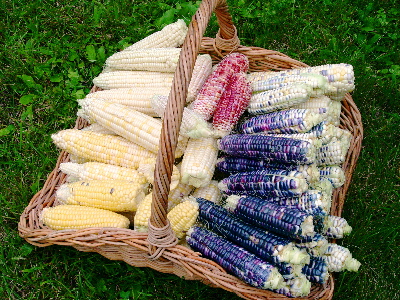
Bakaitis photo
The Black Mexican is on the right. We’ll discuss the other varieties – and the cross-pollination that leads to those dots – some other time.
Whatever class you put it in, Black Mexican’s life as great corn on the cob is pretty limited. The pure white tender and juicy stage ( maybe one ear of it, underneath at the back) only lasts a few days. The unique splendor is that it remains outstanding
When it’s still very sweet but slightly starchy (more white than black): curried corn soup; summer succotash with fresh green beans; creamy corn pudding spiked with jalapenos…
When it’s very starchy but still slightly sweet (more black than white): any place fresh shell beans would be good; in marinated salads; in pilafs with rice; in tomato-based fish stews…
and
When it’s meal corn that hasn’t dried yet (not shown. kernels are completely black and starting to stiffen but are still soft enough to puncture with a fingernail). You need a grain mill to grind it after it’s fully dried, but if you catch it at this stage you can use the processor to make a sort of proto-cornmeal that works fine in most recipes. All you have to do is use a little bit less liquid and boost the still-developing starch with a small amount of flour or cornmeal.
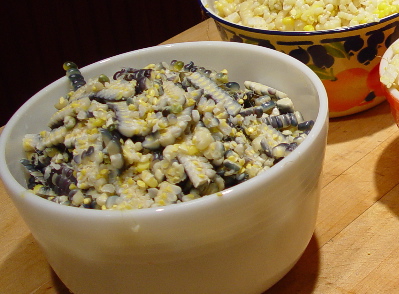
Bakaitis photo
Blanched, cut from the cob and ready for freezing, this batch is a little past “slightly starchy” because that’s when Bill was down to harvest it. The yellow spots are the germ, which reminds me to point out that blue corns tend to be the highest in protein.
Seed for Black Mexican, aka Black Aztec and Aztec Black, is sold by Southern Exposure Seed Exchange and Seeds Of Change, among others, I’m glad to say. When we started growing it about 15 years ago it was difficult to find, and saving corn seed is a lot harder than saving tomatoes: varieties must be separated by at least a quarter mile unless you’re up for considerable fiddling.
(Opinion is divided on whether Black Mexican and Black Aztec are the same thing. We have grown both – or at least both as available retail – without seeing significant differences)

That dark green and orange line in the middle distance is a stand of hybrid feed corn; all plants as close to identical as human ingenuity can manage.
TASTY MOVIE
The documentary King Corn gets that rating because it’s not only fun to watch, it’s also – if there can be such a thing – a refreshingly gentle polemic. The narrators, a savvy pair of quasi-innocents deeply influenced by Michael Pollan, revisit their distant Iowa roots and through a year of growing the stuff discover how subsidized feed corn, sold to the public as a fine idea: more food for everyone! at low prices! turns out to be a taxpayer milking, fossil fuel guzzling threat to public health that’s dismantling farm communities all over the Midwest. Take a look. Even if you think there’s no connection between America’s weight problem and an average daily consumption of 200 to 400 calories’ worth of high fructose corn syrup,* you might want to see how much of its cost is coming straight out of your wallet.
* Amounts we eat of anything are notoriously difficult to measure. This range is based on pounds of HFCS per person per year as conceded by the Corn Refiners Association (41, citing the USDA) and asserted in King Corn’s press kit (73, citing the American Journal of Clinical Nutrition).
Bunch of Dahlias:

Bunch of talk about food gardening
with Sally Spillane on The Garden Show
Sunday January 13 at 8AM
on radio staion WKZE
98.1 on the dial in the Hudson Valley. Here on the computer everywhere else (but not everywhen else; it’s live broadcast only)
( For the pizzelle recipe, please scroll down)
It’s hard to think coldly about the garden just now, when the catalog stack is approaching tilt and there’s not much else to think about warmly, but this is an ideal time to take a hard look at your return on garden investment. A little abstract evaluation helps ensure high-performing options are not overlooked, and that the resources locked up in losers will be re-allocated to something more profitable.
And we will stop here with the analogy; finance not being my long suit.
Nevertheless. It really helps to list assets and liabilities before you plunge in, and it helps the most to write it down, however roughly, instead of just thinking about it in the shower for a couple of mornings. Unless your garden is confined to 3 or 4 containers, human nature more or less ensures you’re not counting everything. (Think how few calories most of us think we eat and how wrong we are about it almost all the time).
Items It’s Useful to Reassess Yearly:
Space: Not only is there never enough, what there is is not usually tabula rasa. For instance, there’s a 3 X 10 foot strip in the front shade garden completely open for something new, but that something must remain no more than four feet tall without any help from me. By writing this down, I am reminded that it’s not happening with witch hazels, and that time spent mooning over Fire Charm (brilliant red fall leaves, copper-red winter flowers) and the super-fragrant Moonlight should be devoted to the hunt for plants that will actually fit.
You probably have a rough layout of the annual/vegetable garden – or so I hope – so the allocational trick here is simply to fill it all in, in as much detail as possible, before looking through the saved seeds or ordering any new ones. Our roughly 4000 square feet sounds huge, but given how much of it must support tomatoes, corn, garlic, greens, etc. ( including flowers) there’s only a rather small area for the winter squash. As most of it will be filled by super-sweet, long-keeping Cha Cha, from Johnny’s, and Tetsakabuto, from Pinetree, it would be better if I didn’t even LOOK at the Baker Creek catalog (85 winter squash and 80 even more tempting – and space-hogging – melons).
Time: it’s not that writing the truth on paper reveals anything new about “not enough,” but rubbing it in can be bracing. Almost all our new plantings have been and will be shrubs because last year I finally inventoried the gardens, assigning each the time it should have to be at its best. Duh of the week? Even under ideal conditions, it’s impossible for someone with a day job to have more than one complex tapestry of annuals, perennials, vines, grasses, bulbs and shrubs and small trees.
Mulch keeps weeds down and drought at bay; healthy plants resist pests and disease. But some weeds always make it through – that’s why they’re weeds; baby vegetables must be watered by us if nature is disobliging; resistant doesn’t mean immune and anyone who says organic pest control takes no more time and attention than blanketing everything with noxious pollutants is lying. Plus if you don’t formally assign some time to simply enjoying the damn thing, you may find when you look back at season’s end that all you did – however enjoyably – was work.

The bed that used to hold these cheerful perennials now features a dwarf Chinese Elm (Ulmus parvifolia), with white-edged leaves on lacy branches and patchy bark that will grow more and more lovely with time. It is nicely surrounded with mulch and very little else. The carefree echinaceas went to the rough edge of the field, where they’ll be fine, and the yellow Asiatic lilies have been consigned to the compost. They were nice, but not THAT nice, and getting rid of them makes it easier to keep the evil lily beetles from doing in the far rarer L. henrii (barely visible at the far right and slightly more visible below).

Money: a yacht is famously defined as a hole in the ocean into which one pours money. A garden is a hole in the ground which serves the same purpose – except that you have to dig the hole before throwing the money in. Less than romantic necessities like pest control products, compost, twine, fertilizer(s) and gloves are inexpensive individually but they do add up. Add them up before the season starts and you may be unpleasantly surprised, but you’ll also have a better idea of when it’s time to start saying “ I really shouldn’t, ” when visiting the nursery.

When it comes to impulse purchased winter orchids, my advice is to buy ‘em in bloom and then throw them out when they’re done, a great saving of space and time if not, admittedly, money. But I don’t always listen to me. This cymbidium came home with the groceries in February last year, and when it finally finished flowering 2 months later went into the enclosed porch we keep at about 40 degrees to use as a walk-in refrigerator. Come spring, we stuck it in the vegetable garden. In fall it returned to the porch, where it remained until a couple of weeks ago and thereby hangs the tale. With these increasingly common orchids, finding a winter home that’s cool enough is often harder than finding one with enough light, so if you have a reasonably bright spot that stays between 45 and 55 degrees you might as well give it a shot, especially if the spot is somewhere out of sight. Non- blooming cymbidiums aren’t as ugly as non-blooming phalaenopsis,but they’re not all that lovely, either.
( for the pizzelle recipe, please scroll down)
‘Twould seem the night has come and gone; that it’s time to get out that pile of catalogs and start planning the gardens. But not quite yet; the midwinter jamboree extends at least until New Year if not Twelfth Night and for many of us there is still a week or more of socializing and present-giving to go.
* Last Minute Gifts
If you’ve had it to here with shopping and dread the post-Christmas sales, there’s a very strong temptation to shop among the presents you just got, moving the ones that make you sigh from the inbox to the outbox.
If only. Unless it’s something absolutely wonderful and completely understandable like a third copy of On food and Cooking, by Harold Magee, regifting is usually out. Completely apart from the hurt-feelings aspect, if you don’t like it enough to keep it and it comes from a store that offers nothing you’d like to exchange it for, how can you let it represent your taste?
Mercifully, the best present for many adults is something expendable like food or flowers – assuming you could find responsibly-raised flowers which you mostly can’t. A rant for another day. The gifted will probably enjoy anything from a generous hunk of local cheese to a plate of homemade Moth cookies ( see below), but the real present is that expendables cannot possibly be stored in a closet and dutifully trotted out whenever you come over.
Not sure about food or wine or eaux de vie made from American fruit? Candles should do nicely as long as they’re chaste in the perfume and dye departments. Fragrance is a minefield of individual preference, and no matter what they say about beige it goes with almost everything. Conveniently, this means it’s classiest as well as greenest to give a large bundle of unscented, uncolored pure beeswax candles. Too late now to mail order but some natural food stores sell them.
* Tips for stylish gift wrapping and present opening with the environment in mind are at All Wrapped Up.
* Last Minute Cookies

One dough, many choices
MOTH COOKIES
Aka Vienna crescents and vanilla crescents
I never knew these were classic Christmas cookies until I was an adult. In our family they were simply the family cookie. (Moth is short for mother; it has nothing to do with bugs.) They take almost no time to make; the dough is extremely versatile; the recipe makes a lot, and everybody loves them – everybody who likes almonds, anyway.
For roughly 60 to 80 cookies:
1 cup whole almonds
½ cup sugar
½ pound butter, at room temperature
pinch of salt
1 teaspoon vanilla ( I often use 2)
1 cup cake flour
1 ½ cups all purpose flour
confectioners sugar, optional
If you have a nut grater, use it on the almonds. If you don’t, put them in a processor with 2 tablespoons of the sugar and pulse until reduced to a mixture of almond meal and tiny crumbs. In a large mixing bowl, cream the butter with the rest of the sugar, then beat in the salt, vanilla and cake flour. Stir in the all purpose flour, then the almonds. Dough will be stiff; Moth’s recipe says “ knead in the almonds,” which gives you an idea. Shape as desired and place slightly separated on ungreased baking sheet or parchment paper. Bake at 325 degrees until just touched with gold – 8 to 15 minutes, depending. The hot cookies are supposed to be rolled in confectioners sugar but Moth seldom did and I never do – too sweet and too messy, especially since there are other classics that really need this treatment.
Shaping:
Crescents. Moth’s preferred shape. Use a scant tablespoon of dough for each; they’re easy to form and they have a distinctive taste because the thinner parts get browner. They also have the merit of fitting many on one cookie sheet. This becomes a fault if you forget and overbake them.
Icebox cookies. Form the dough into rolls or squares about 1 ½ inches across. Wrap tightly in plastic wrap and chill for 3 or 4 hours to 3 or 4 days. Slice about 3/16ths inch thick. Rolls cut in half the long way make pretty one bite half-circles when sliced.You can also slice them super-thin and sandwich them with jam. Leave plain or decorate with small amounts of icing or chocolate.
Applying chocolate

Deco-ish geometry is easy and fun. So is the Jackson Pollack effect.
Coarsely chop an ounce or two of high quality bittersweet chocolate ( at least 50 percent cocoa). Put it in a freezer-weight plastic bag and close the bag. Lay it flat on the turntable and microwave at half power until most of the chocolate is melted but there are still a few lumps, about 75 seconds. Push the chocolate around in the bag until the lumps melt and the chocolate is completely smooth. Use a razor blade or sharp scissors to cut a very small hole in the corner of the bag. Remember to squeeze from the top.
Those candies? Chocolate truffles. Chocolate truffles that are not offensively immense. Mark Bittman just published a basic recipe in the New York Times that’s pretty much like mine.
These happen to be flavored with Frangelico, a hazelnut cordial. The ones with the chocolate drizzle cage – the lazy person’s dipped-in-chocolate – are plain. The white ones have a toasted hazelnut inside and are rolled in crunchy pearl sugar, sold by King Arthur Flour, among others.
PS. If you happen to have the little molds used for Scandinavian sandbakkelse, moth cookie dough works great in them, too. The chocolate ones below have truffle filling; the jam is peach. Lemon curd is terrific. Needless to say these are not swift. Talk about fiddling! Good though.

Part 1: Heirloom Pizzelle
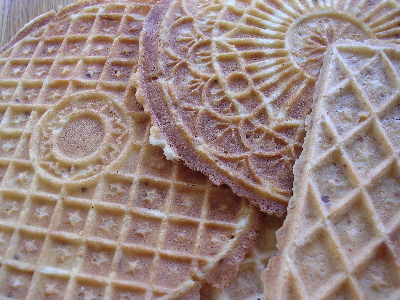
Most pizzelle baking irons are round, probably because it’s much easier to get lace-edged circles than any kind of rectangle. But regardless of shape or perfection thereof, these crisp, light not-too-sweet cookies look great on the plate – while they last. Scroll down to skip straight to the recipe.
In the middle of the Northeastern winter, when gardening consists largely of spraying insecticidal soap and looking out the window at the naked spot where you meant to plant a chamaecyparis ‘Filifera’ but didn’t, baking is a natural outlet for some of that thwarted creative energy, aka urge to potter around.
Said urge might be resistible if it weren’t for the Pavlovian aspect, but just as springtime is full of cues to get out there with trowel and pruning shears, the Let’s Banish Darkness season* is laden with near constant reminders that cookies should be made.
Some years we begin with gingerbread, adding the warm perfume of spices to old reliable butter + sugar + flour + oven = happiness; but we usually start with pizzelle, a family tradition from the Italian side of Bill, who arrived in my life equipped with his grandmother’s pizzelle iron.
That would be grandmother Josephine, the world’s greatest cook, born Giuseppa Cario in 1894, near Palermo, resident for most of her life in Washington, PA (near Pittsburgh).
The grandmotherly pizzelle iron IS iron, not the more modern cast aluminum. And it has both a very long handle and little feet, like the feet on old cast iron skillets, suggesting original design for use on an open hearth although they may simply be there to provide balance; the applied handle means the plates don’t lie flat.
Most importantly, the iron has grandma’s initials and those of grandpa Fidele engraved on one side. On the other is the date: 1931, the twentieth year of their marriage.
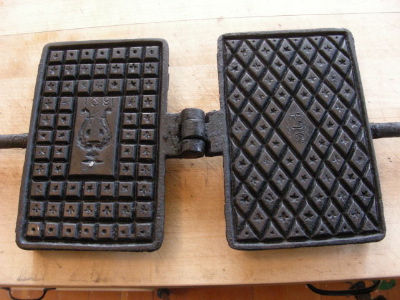
The personalized parts are not deeply cut, so they never show up as clearly as the patterns standard on the iron, but that just adds to the challenge. If the dough comes out just right, you can see ‘em. If it doesn’t, the pizzelle are still delicious and of course if you’ve gotten close enough to eat them, you don’t have to see the initials to know they’re there.
The basic batter is easy to make, and over the years I’ve tried many variations, some with vanilla, some with citrus rinds, some with crushed nuts and spices. Even chocolate, which is better than it sounds but not all that terrific unless you’re one of those people with a chocolate problem. Reception is always the same: Bill takes a bite and then says “My grandmother’s had anise in ‘em.”
E-bay is rich with vintage pizzelle irons, both stovetop and electric, but there are many modern versions, including several with non-stick coating (which is widely considered non-good). Fante’s in Philadelphia has a particularly broad selection, including a version of our family heirloom that you can engrave with YOUR initials and pass down to your grandchildren.

PIZZELLE
are ideally so thin they’re almost translucent, their intricate patterns picked out in the gold brown of perfect toast (middle top). But achieving this goal is not essential. Even when quite thick they’re still delicate, and tasty doneness can be anything from barely colored to almost burnt. In all of its manifestations homemade is so much better than commercial it’s like the difference between a twinkie and a Payard petit four.
What you’re making is basically a batch of extremely thin waffles and as with all waffles success is not instant; you generally have to discard the first couple. This was clearly no problem in former times; old fashioned recipes make 60 or more. This one yields far fewer, but it can be doubled effortlessly as long as you have a sturdy mixer.
For 18 to 24, depending on size:
2 large eggs, at room temperature
½ cup sugar
flavoring: either 1 1/2 teaspoons vanilla or the shredded rind of a lemon – or half orange – or about ¼ teaspoon anise oil (not anise extract) or for Bill a tablespoon of anise seeds
¼ pound butter, melted and cooled, plus more for the iron
1 heaping cup cake flour or 1 scant cup all purpose flour, plus a bit more if needed
1 teaspoon baking powder ( use only 1 ½ teaspoons if doubling the recipe)
½ teaspoon salt
a pizzelle iron is a must; a pastry brush (for buttering the iron) and a knife with a long narrow point (for cookie prying) are nice but not essential. A small wire brush is a good cleaning tool for vintage iron baking irons. Otherwise, consult instructions that come with the gizmo.
1. Beat the eggs and sugar at medium speed until the mixture is thick and pale and falls from the beaters in a fat ribbon. While this is happening, melt the butter and thoroughly mix the cup of flour with the baking powder and salt.
2. When the egg mixture is ready, beat in the flavoring, then slowly add the butter.
3. Gently fold in the flour mixture by hand and set the batter aside, loosely covered, for 15 to 30 minutes.
4. Heat the pizzelle iron on a medium flame until a drop of water sizzles vigorously, not quite dancing but almost. Brush the plates lightly with melted butter. ( Many recipes suggest cooking spray, not my idea of fun but if you use it all the time you probably like it).
5. Gently stir the batter/dough, which should be the texture of very stiff whipped cream. Add a bit more flour if it’s softer but err on the light side; it’s far easier to add more than try to compensate for too much. Put about a tablespoonful on the iron, spreading it out a bit as you deposit it. Slowly close the iron and use a table knife to remove anything that oozes out. Peek after about 30 seconds, the pizzelle should part from one side of the iron and the surface look dry. If it’s dark brown turn down the heat. Reclose iron (and turn if on stovetop) and cook about 30 seconds more.
6. Open iron, lift/pry off cookie and place on a cooling rack. If it’s too thin, add a bit more flour. If it doesn’t come off neatly, return iron to the heat to dry it out some more, then pry as necessary to clean the iron. Get the iron hotter and greasier next time; the pizzelle will tell you what it needs more succinctly than I can.
7. Attempt to prevent your husband from eating them all immediately. They keep well for 10 days or so in an airtight tin.
* The last time I addressed this subject I was in the throes of irritation at the people who are endlessly on about the meaning of Christmas trees and so neglected to mention things like Saturnalia and Hanukkah. Please consider them mentioned. That post also includes a recipe for shortbread, the world’s easiest holiday cookie and one of the very best.
But first you may wish to give yourself some carol-canceling earplugs. Bill gets mine though Cabela’s – which is where he gets just about everything he doesn’t get from Orvis – but there is also, it turns out, a place called The Earplug Super Store whose extensive selection suggests that noise pollution is every bit as much of a problem as you thought.
Earplugs are also widely available at bricks and mortar, of course. Sporting goods stores that cater to gun owners have the most effective models, but many drugstores also sell plugs rated at 30 decibels, the strength needed to muffle jolly shopping music without silencing the person who shouts “ Look out! That beam is falling!!”
Can’t Go Wrong Giving Any of These
* Stainless steel garden fork with synthetic handle, such as this ergonomic Radius available through Amazon. The fork is an essential tool, so many catalogs offer high end beauties with stainless steel tines and sturdy, well-made hardwood handles. Your garden friend will probably be even happier if the handle is made from less handsome but more useful synthetic. One of the great things about stainless steel is total freedom from rust, so it’s nice to be equally blithe about rot. Translation: never, ever worry again about leaving it out in the rain.
* Small snub nose pruner. Pretty sure I’ve extolled these before, since they are absolutely the best for light-duty general pruning and harvest of all things with stems from flowers to hot peppers to winter squash.I love them especially because I don’t wear belts and these don’t stab you through your pockets.
* Lightweight garden gloves with nylon backs and nitrile palms. The most common brands are Boss and Atlas, both of which I have in multiples because years ago when they were still difficult to find I compulsively bought another pair every time I saw them and they take forever to wear out, even under near constant rough use in soil that resembles gravel.
They won’t protect against major thorns and only the palms are waterproof, but other than that they are close to perfect because they combine their fabulous toughness with being so thin you can feel what you’re doing almost as well as you can barehanded.
*Japanese garden knife, aka soil knife. Kristi the hardworking garden helper wears hers in a holster on her belt when she’s wearing a belt and rather daringly just sort of shoved into the back of her waistband when beltless. Either way, don’t go into the garden without this workhorse saw/knife/all-purpose digger, especially handy in tight spots and among rocks. Might as well get it from Fedco and put your seed order in at the same time.
* Membership in the Garden Conservancy – for design lovers – or the Maine Organic Farmers and Gardeners Association – for food growers everywhere in spite of its name. Or both, since it’s impossible to choose between food and culture.
Warning: Once you start in the dot-org direction it’s easy to fall down the slippery slope and start thinking that donating to worthy causes “in the name of” is a gift to the namee. This is of course completely bogus unless that noble person has already asked Santa for brownie points. Nothing hugely wrong with it – assuming you also give them a present that actually resembles a present – but please don’t forget that if part of the deal is a grateful acknowledgement from the cause, the other thing you have given your friend is a mailbox polluted with pleas for more, for the indefinite future.
After you’ve “established a relationship,” there’s no way to block these mailings without asking each individual organization to please stop. And the same is true for catalogs sent by any store that you’ve bought something from. But as you already know if you have ever, even in the distant past, subscribed to a magazine, the bulk of the catalog avalanche comes from companies that bought you (or at least your name and address). An outfit called the Privacy Council promises to turn back a lot of this tide, conveniently all at once, but they also promise to remove you from Stop Political Calls, which may or may not be a good thing – the Privacy Council service is sponsored by the very people sending you all this junk. Stop Political Calls seems to be a lobbying non-profit which may or may not keep robocalls at bay. Never heard of it until I saw it on the Privacy Council’s otherwise no-brainer say goodbye list, so I don’t know how well it works.
* Gift Certificates can be great when they’re for something specific: spring delivery of a truckload of compost, say, or a dozen massages at Betty’s Backsaving Boutique.
But gift certificates good only for shopping at a particular store have all the impersonality of money with far less of its convenience. And the fact that they’re sold in rounded amounts makes problems of its own. There is probably someone living who chooses things that cost less than the gift and walks away from a few bucks in change; but most people end up with something that costs more, paying the difference out of their own pockets. Nice deal for the store. James Surowiecki wrote a terrific piece about this, The Gift Right Out, back in 2006 and it’s still a terrific read.
Note to bakers and would be bakers: Only a few baking days until Christmas. To make them less stressful (and more likely), I stock up on large quantities of probable ingredients before I choose the recipes. Butter, eggs, chocolate, nutmeats, dried fruits, flour and spices all keep fine , and having them on hand makes it easier to use them when a crumb of free time appears.
Shopping Alert: If you love apples, it’s smart to see Thanksgiving as the deadline. Many orchard farmstands make that closing day and many more close soon after, shutting the window on neat choices for most of us.
We went on the annual stock-up outing about 10 days ago – across the river to New Paltz, to Jenkins-Lueken’s, where we’ve been going for years. But we didn’t notice until we got home that the cider is UV treated. That means we’re still on the hunt; you need raw cider to get fizzy cider. Next stop, the listings at pickyourown.org, a national orchard locator searchable by state.
Meanwhile, there is a big box in the barn containing about a bushel of apples and right here it should be admitted that the barn is our enabler. Apples MUST be stored very cold, nothing ruins quality as fast as warm temperatures. If all you have is a refrigerator, fill it with varieties that will not be found after the orchards close.
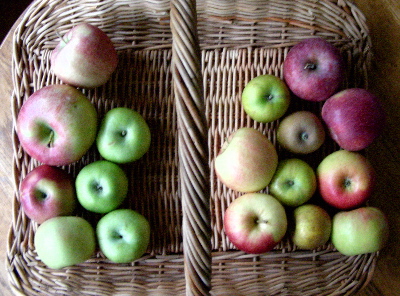
Representatives from our current stockpile. On the left of the handle, clockwise from green:(3)Rhode Island Greening, (2) Honeycrisp, (2) Cameo. Right of the handle, clockwise from red: (2) Stayman Winesap, (2) Northern Spy, (4) Golden Russet – in a line up the middle – and (2) Jonagold.
Golden Russet : Born in New York, already well known in 1848. Described by the invaluable Seed Savers Exchange Fruit, Berry and Nut Inventory as “ The champagne of cider apples,” it’s delicious for just about any use except (unless you peel it) eating out of hand. An excellent apple to stock up on; it keeps very well.
Jonagold: A marriage performed by New York’s Geneva experiment station, introduced in 1968. The sweetness of Golden Delicious combined with Jonathan’s size, juiciness and slightly sharper flavor. Not always as tart as ideal for best flavor but usually yummy. Tough skin, though.
Rhode Island Greening: ! Pie ! And thus it has been for about 400 years. A tad on the sharp side for fresh eating but ideal in savory applications such as sautéed apples and onions to go with winter’s roast pork.
Northern Spy: Can’t say I grew up with this; it’s more popular in New England than in Pennsylvania. But it has that remembered from childhood quality, fuller flavored than modern fruit – or so it seems. Both crisp and tender, both sweet and tart, good both fresh and cooked. My desert island “if you could only have one.”
Honeycrisp: New kid on the block ( 1991) cross of Macoun and Honeygold, from the University of Minnesota. A good compromise for fresh eating if your family is, like mine, divided on the sweet vs. sharp question.
Cameo : Also recent (1987), a lucky find chance seedling from Washington state. Crisp and balanced in the manner of Honeycrisp but more aromatic and frequently huge.
Stayman Winesap – labeled “Stamen” at the stand where we got it, with no indication which of the 4 variations on Stayman Winesap it might be. And I’m actually guessing at the Winesap since there is also a Stayman apple, grown mostly in the south and considerably less red if its pictures are any indication. Assuming they are some kind of Winesap they should make dandy applesauce.
The grumble and cake part
is because the New York Times magazine recently addressed the subject of apple cake with, I suppose not surprisingly, the mandate to be as contemporary and hip as possible. Net result, no fault of the Times’ sensible Amanda Hesser? A chef who was determined to improve an easy, tasty, but the recipe already exists cake, came up with a no doubt delicious but utterly uncakelike fruit-bottomed “soufflé crepe.” Shelf life of original cake, which could be eaten out of hand: a few days, and then toward the end you could probably toast it. Shelf life of chef’s goodie – several minutes; so be sure to have that plate and fork handy before you start.
Well ok, but was it really impossible to make an old fashioned everyday cake sort of cake that would be interesting to eat? And could one not make it with butter instead of oil?
Distantly remembered a long-ago struggle to find – and then when I couldn’t find, develop – a carrot cake based on butter instead of the usual oil. Checked out the recipe (it’s in Reading Between the Recipes). Unfortunately, it’s a layer cake, with frosting and other non-everyday aspects, and although the apple one could be a sheet cake something prettier would be nicer.

the experiment. Left to right: Cakes 2, 3 and 4
Four cakes ensued, one that we will not discuss and three that were different primarily because I kept screwing up. Cake # 2 was heavy and damp, because I couldn’t find the bundt pan and tried to bake it in a tube pan.
I know this was the problem because the bit of extra batter baked in a little glass bowl was very close to just fine. But did I pay attention? I did not. Cavalierly choosing to keep messing around I omitted the touch of oil, reduced the sugar, and upped the pecans for cake #3. And then, it being quite late by this time, just forged ahead after discovering the only white flour on hand was unbleached.
Commonly available unbleached flour makes tougher, heavier cakes than bleached flour. Simple fact. More nuts sat on the apple flavor; sugar and oil were both missed. Cake # 4 was back to formula #2, this time in the right pan with the right flour, for a long-keeping, velvety butter cake studded with apples and nuts. Big, too, so there’s plenty for all the relatives or you could freeze half and have it on hand for cake emergencies.
Chunky Apple Cake with Pecans
More like dice than chunks, truth be told, if you want the cake to resemble cake instead of steamed pudding. On the other hand, the rather steamed puddingy cake #2 was Bill’s favorite, so it’s hard to go completely wrong.
3 ½ cups roughly 1/2 inch dice or slightly larger chunks of peeled crisp tart cooking apple (see above for variety suggestions. Granny Smith will do in a pinch)
2 ¼ cups sugar
1 ½ tsp. kosher salt
3 1/4 cups bleached all purpose flour
1 tsp. baking soda
scant ½ tsp. baking powder
8 ounces unsalted high fat butter such as Plugra, at cool room temperature
3 eggs and 1 egg white
1 tbl. bland vegetable oil
2 teaspoons vanilla
½ cup sour cream
1 cup chopped pecans
1. In a non-reactive bowl, mix the apple dice with 1 cup of the sugar and 1 teaspoon of the salt. Set aside for an hour and a half. Stir when you think of it. (Pulling juice out ahead of time this way minimizes the holes-around-the-cooked-fruit effect that otherwise plagues these cakes.)
2. While apples sit, get everything else lined up. Let eggs and sour cream come to room temperature. Butter and flour a standard (10 cup) bundt pan. In a large bowl, thoroughly mix the flour with the remaining ½ tsp. salt, the soda and the baking powder, either by repeated siftings or much stirring with a wire whip. Heat the oven to 350.
3. When apple sitting time is about up, cream the butter, then add the remaining 1 ¼ cups sugar and cream again until pale and fluffy. Lightness of cake is directly related to whether you’re doing this with a stand mixer for about 8 minutes or your own personal arm ‘till you’ve had enough.
4. Beat in the eggs and white, one at a time, scraping the bowl from time to time. Beat in oil, vanilla and sour cream, again scraping right to the bottom of the bowl. Beat in free liquid from apples.
5. Make a well in the dry ingredients, scrape the wet mixture into it and stir together as gently and briefly as possible. Batter will be very thick. Stir in the apples and remaining juices and the pecans, then turn into the prepared pan. Thump the bottom of the pan on the work surface to reduce large air bubbles.
6. Bake until all the usual done signals: well risen, browned, pulling away from the sides of the pan and a toothpick comes out clean, anywhere from 55 to 70 minutes. Cool in the pan on a rack for 10 minutes, then turn out and cool completely before slicing. Cake will be most delicate and cakelike on the first day but still tender on days 2 and 3. Maybe more but I just made it 3 days ago so who knows?