Great Plants
But before we get all excited and start spending zillions on gorgeous new ones, it’s peony cleaning up time. The fungus diseases that plague peonies overwinter on dead peony leaves and flowers, so getting rid of all traces of same is the best defense against future infection. There is no applied control, organic or otherwise, as effective as simply being tidy to the nth degree.
Cut stems down to an inch or so above ground, preferably while the leaves are still firmly attached. It’s always a wrench to remove a whole bush full of beautiful fall foliage, but snipping off all of this year’s growth before it falls apart makes the subsequent raking of leftovers far less of a chore.

Making bouquets helps; peony leaves and fall flowers are pretty much foolproof
Needless to say, none of the detritus should go on the compost. Sending it to the landfill is ungreen. Burning it is against the law in many places. Fortunately, there is almost always some dumping spot – in the woods for instance – where peonies will not be planted in the foreseeable future.
It doesn’t hurt to get rid of the mulch, too. Very small bits of former peony are undoubtedly embedded in it. And as a side benefit, mulch removal exposes the plant bases so you can get a good look at them. Everything is probably fine, but if you see humped up crowns you know it would be wise to divide and reset the plants.
Tulip or not tulip? That is the question. Happens every year, as dazzlers never seen at the florist beckon from the glossy catalogs, page after page after page.
In addition to being beautiful (and frequently fragrant), tulips are inexpensive; the more you buy the cheaper they are. They’re easy to grow – in fact almost impossible to screw up – and in spite of the general wisdom, they often come back.
These Giant Darwin hybrids have been around for so many years I no longer remember what they are. Probably ‘Parade,’ famous for returning almost as dependably as daffodils.
On the other hand Read More…
Think of Chet Baker in a mellow mood on a summer night, the music drifting in your direction against a background of insects chirping and the sometmes rumble of trucks on the highway and you’ll get a faint approximation of what it’s like to be in our Hudson Valley house when the trumpet lilies are blooming.
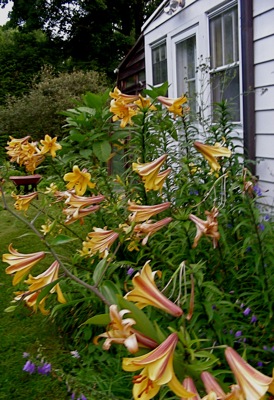
Their heavy, classic lily fragrance has a distinct undernote of spice, and while a bouquet’s worth of it indoors would be so intoxicating you’d have a hangover in the morning, having it waft in from the bed under the dining room window is just about perfect.
So much pleasure from so little work!
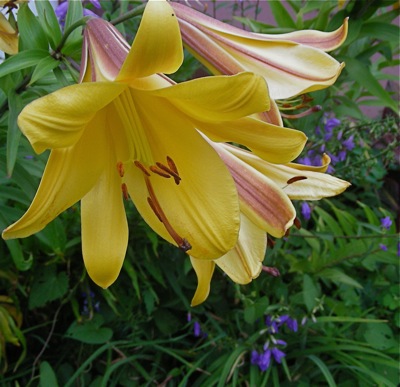
Close up, you can see why they’re called ‘Golden Splendor’. Good As Gold would be appropriate too; this cultivar is one of the most vigorous.
Read More…
Actually, one of the earliest isn’t a peony – and it’s late: it’s a peony flowered tulip, one of the last to bloom.

Kristi Niedermann
This photo of ‘Mount Tacoma’ was taken just a couple of days ago in Maine, where the peonies themselves are still a (semi) distant promise.
Here in the Hudson Valley – functionally about 2 weeks south – the real deal is starting to pop, beginning as usual with one of our inherited mysteries.
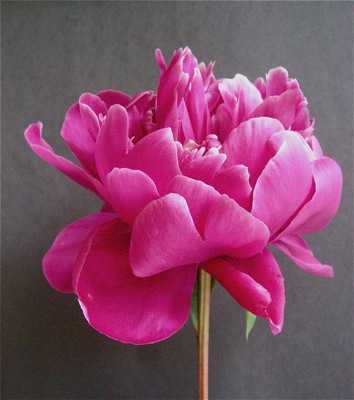
It looks a lot like ‘Cincinnati’. But ‘Cincinnati’ is midseason and this is among the earliest lactifloras to open. ‘Magenta Moon’ seemed likely until I looked up the date (on the Peony Checklist , provided by The American Peony Society). No good. ‘Magenta Moon’ didn’t rise until 1995, by which time the peony had been in place at least 15 years.
Truth is I haven’t done much research – scrolling though peony pictures is far too dangerous. No matter how swiftly you move the cursor, to look at peonies is to want peonies, especially at places like Klehm’s and La Pivoinerie D’Aoust,
One good thing about peony lust is that it tends to supplant tulip lust, so I probably shouldn’t mention it, but here’s an aspect of ‘Mount Tacoma’ that isn’t part of the usual descriptions: Given very well drained soil and not too much fertilizer it comes back – at least in Maine, where mine have been returning faithfully for at least a decade.
More often than not the deer eat them (that’s why I stopped planting more in 1997) but that’s no knock on their longevity. ‘Mount Tacoma’ was introduced in 1924 and is still one of the most common whites, available almost everywhere, but just for the record I got mine from Scheepers.
Being the part(s) I should have mentioned last post. The azalea is a very early bloomer, and it’s growing in the mid Hudson Valley, zone 5b, where many very spiffy azaleas are – at least theoretically – not hardy. According to the USDA, our average winter lows are somewhere around 10 below. According to recent history, it’s more like 2 or 3 below, max. But still.
Also neglected to show a mugshot in which the freckles were easy to see, so here they are:

Can Anybody?

Here’s what we know about it:
It was here – and huge – when we got the house, 17 years ago.
It’s evergreen.
It blooms reliably every year (and abundantly, now that we have deer fencing).
It is fragrant, more in some years than others. Always with a very light, sweet clean laundry perfume that completely suits the flowers.
It has very long internodes, even when I prune it which I usually don’t.
the leaves are fuzzy
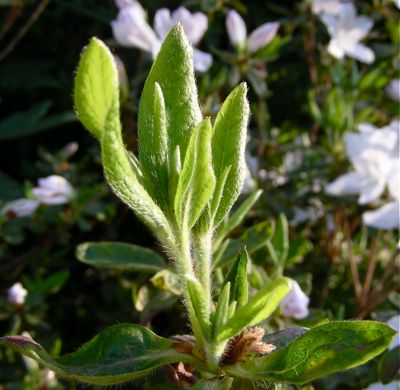
and they get occasional splotches of some kind of rusty fungus that doesn’t bother them. It doesn’t bother us, either, because the bush is on the far side of the yard, and we don’t cut the flowers for the vase.
Every spring when I go plant shopping I bring along a flowering branch. No nursery I’ve visited has had a clue. Everybody just says ” it must be something old.”
The closest thing I can find is R. mucronatum, but that’s described as a semi-evergreen that blooms midseason and is hardy only to zone 7, so it’s a case of “close but no cigar.”
I’d love to know what it is. I’d also love to know why it was planted next to a bunch of leucothoe, the stinkiest bloomer in all shrubdom whatever its other virtues.

Forty or fifty years ago, the owner of our house planted a LOT of peonies, and by the time we got the place they were huge. Also, in many cases, overtaken by shrubbery.
When we dug the shaded ones to move them we found huge giant knotted rootballs the size of refrigerators. So we divided them and had even more peonies. Three kinds of peonies: dark red, pink and white. (Read more about them – and get some growing tips here)
Theoretically you can’t have too many peonies but I’m here to tell you you can have enough – if they are all the same damn 3 colors. And having a few extra early ones that are magenta does not help, on account of their being magenta.
But we also inherited some fern leaf peonies (read about them – and the lowdown on ants – here) and the fern leafs, more properly Paeonia tenuifolia, were so beautiful and so different they opened an irresistible door.
At least that was my excuse 3 years ago, when I bought a nifty woodland peony at Trade Secrets.

Japanese Woodland Peony, P. japonica. At the time it had I think 4 leaves and zero flowers. It would be nice if this one also developed refrigerator sized roots, but it won’t. As soon as they’re bigger than produce drawers I’m going to divide them.

Those shirred silk petals really knock me out, and the foliage is nothing to sneeze at, either.
Lulled into hubris by this success, I thought last year I could get away with buying a moderately expensive seedling of P. mlokosewitschii, instead of a seriously expensive guaranteed division. The guarantee was that the flower would be pale yellow, a rare color in peonies.
And nonexistent in my plant. I was warned the seedling might turn out to be magenta and you can guess the rest. Bill thinks it’s beautiful. I do not. But the leaves are absolutely gorgeous and the flower is fleeting, so it’s not a total catastrophe.

Seedling of P. mlokosewitschii. The cheapskate’s reward. There is a better picture of a magenta flowered seedling – and one of the real deal – over at my almost neighbor Margaret Roach’s blog, A Way To Garden. But as you can see by comparing the pictures there is a lurking mystery; her seedling’s leaves look so different I’m not sure we have the same plant. (She got hers from Seneca Hill. I got mine from Hillside Nursery.
Next time I head for the hills I’ll pay full freight, though I may have to hock my toes to do it. There are around 2 dozen species peonies that could grow here, and more and more of them are making their way ( expensively) into commerce.
Like every garden writer in the history of humankind, I’ve spent my entire career begging ” don’t blow the whole wad on spring. If everything in the yard is done blooming by the 4th of July, how boring is that.”
But then every year about this time I’m glad the people who owned this house before us – in some cases WAY before us – believed in planting the usual.
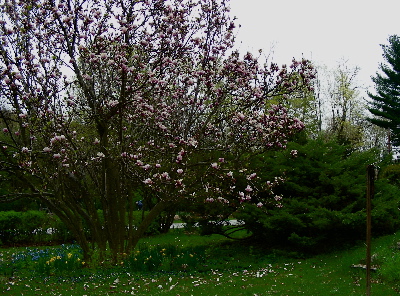
Actually, for our first decade or so I DID have mixed feelings about the magnolia, which would routinely just start opening into a huge glorious pink cloud and then there would be a frost and believe me a huge brown cloud is not glorious. Then things got warmer and it routinely escaped; we got a whole month of being happy that this giant unit eats about half the side yard. This year, however, after about 10 days of splendor it’s already going over. Eighty degrees is not a whole lot better than 29 from the magnolia longevity point of view.

The amazing thing about plum blossoms is that they smell exactly like the cheap plum incense that perfumed so many groovy abodes in the 60’s. Bees love them, though, so when you stand under the trees you see and hear a very cheering assortment of these threatened creatures.

In contrast to the plum, the viburnum ( carlesii) smells wonderful. Like itself and only like itself, a sweet, non-cloying New Englandish perfume that fills the entire yard on warm evenings and justifies the existence of an otherwise unexciting shrub and if it really does freeze on Tuesday night and clonk it when it’s only about half-open I’m going to put face in my hands and weep. This post hints at my addiction – and offers a few seasonally appropriate garden tips. (Appropriate if you’re in the lower Hudson valley, anyway. And it doesn’t up and snow)
Brewer, Maine, October 11, 2007, a slide talk for the Maine Herb Society. We get to the part where the sky comes in, as an important part of garden design.
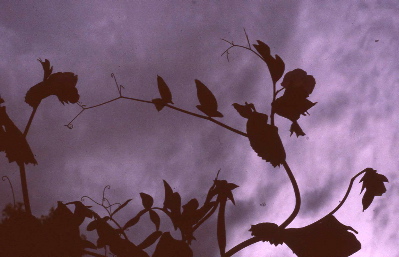
And the illustrative images include

Not surprisingly, people want to know what it is. Also not surprisingly, I have brain melt and forget until I’m driving home.
So. The bright red poppy is Papaver bracteatum, sometimes called the Persian Poppy or Great Scarlet Poppy. It’s a perennial, very similar in appearance, needs and habits to old fashioned Oriental poppy (P. orientale).
But Great Scarlet is accurate: flower stems are 4 or more feet tall, thicker and stiffer than Oriental stems; the flowers are a good 6 inches across and the scarlet is truly breathtaking, even redder than the Oriental ‘Beauty of Livermere’ ( or Livermore), with which P. bracteatum is often confused.
Plants of the Beauty, itself well worth having, are sold by Bluestone Perennials and High Country Gardens, but if you want true bracteatum you must – as far as I can tell – grow it from seeds. J.L. Hudson sells them, but I didn’t know that when I bought mine, from Thompson and Morgan, the seed company everyone loves to hate. T&M is expensive, especially in view of how few seeds you get, and germination problems are common. But they have a stupefying variety of nifty stuff not available elsewhere and in fairness it must be said that many of those nifty things are difficult to grow from seed. Caveat garden dreamer when browsing through the too-tempting catalog.
Happily, P. bracteatum is comparatively easy. Sowing where it is to grow is wise, and that should be in very well drained, sandy soil, in bright sun, somewhere in (roughly) zones 3-8. It will do better at the low end; winter cold doesn’t faze it but heat and humidity are not its friends. Remember that like P. orientale it is huge in spring and absent in summer.
Our old house came with a yard full – and I do mean full – of old fashioned plants, things like yews and lilacs and peonies, a big magnolia and a truly hideous orange azalea that has long since gone to its just reward.
Among the plants we class as riches is a tree-sized autumn olive, Elaeagnous umbellata. It may have been planted when they were still on the OK list. Or, in the manner of autumn olives it may have arrived naturally, delivered by a passing bird.
In any event it’s here now, a late spring star whose clouds of starry white flowers perfume the entire lower yard. Beneath it, looking like fallen petals, is a carpet of tender white violets. Pick a bouquet of both and you see the olive blossoms are in fact pale cream.
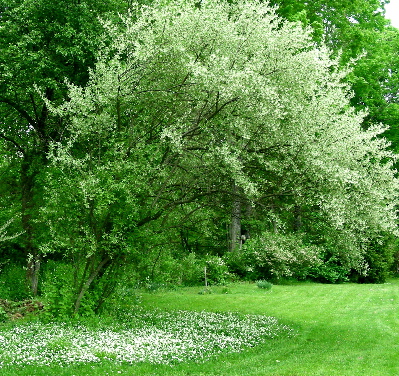
Both plants are invasive weeds, though only the olive seems to excite strong passions among preservationists. ( Plenty of people hate violets in the lawn. Another whole story.)
Because it is now tree-size, we thought for years it was a Russian olive, E. angustifolia. This made us feel slightly less guilty: the Russian kind seems marginally less inclined to cover the earth.
But only slightly, both olives are on the don’t plant this list and any day now we will cut ours down. Right after we fertilize the poison ivy, an unimpeachably native vine of which we have a great deal more than either Elaeagnous.
In the meantime, we’ll remember that these “olives” feed many wild creatures including but by no means limited to: Ruffed Grouse, Wild Turkey, Cedar Waxwing, Northern Mockingbird, Cardinal, Wood Thrush, Yellow-rumped Warbler, assorted sparrows, Black Bear, opossum and skunk).
Of course they also feed fellow-invasives like starlings. And deer are fond of them. These things are never simple.

These are the flowers that convinced me it was E. umbellata, after I read about the difference here.