Garden
Or is it The Seven Pillars of Horticultural Wisdom, or the Ten All-time Top Garden Tips?
As everyone’s resolutions remind us, something there is that loves a number attached to advice, a number smaller than the one I regard as most realistic: The Twenty Three Thousand, Four Hundred and Sixty Two Things It’s Important to Remember Before Getting Out of Bed.
So be warned. I haven’t really honed it down to only seven; these are just the first seven essentials that came to mind when I decided to do this. And not in order, either. (details after the jump)
* Make Compost The compost bins at Stonecrop
* Use Compost
* Plant Crops in Wide Beds
* Mulch
* Feed the Soil, not the Plants
* Share Something
* Be There
Read More…
This was a day of cold and high wind: trees and tall grasses swaying, the black mesh deer fence rippling in waves, a low roar waxing and waning outside the office window, which being old kept admitting the sort of drafts that make you think of Dickens. Snow coming tonight, with wind chills we will not discuss.
But just last Sunday it was above 60, the moving air a balmy breeze, the kind of day that says “come out and garden,” even though there’s frost below the mud and a lot of dream-over-catalogs-duty between here and the bloom of the harebell

Hensol Harebell, a favorite columbine
Yet if all the early pruning is done, if it’s too snowy to rake and the holiday evergreenery has already been laid protectively over the sleeping perennial beds, what exactly is there to do?
I don’t know about you, but what I did was tidy the (temporarily) pleasant to occupy garden shed.
In some ideal universe, that task has also been accomplished: all tools were cleaned and sharpened in fall. Every size pot was neatly stacked, Read More…
Years of garden observation have given me a firm belief in 4-S ( Spare the Shears, Spoil the Shrub), but I still don’t do all that much pruning. Sometimes it’s because there’s simply too much else to do (see the original Heap, a spiraea of monumental untidiness) and sometimes it’s because the pruning is Bill’s department (see Fruit Tree Pruning Time).
But sometimes it’s because I’m reluctant to mess with something gorgeous, even when its increasing gorgeousness starts causing traffic problems.

This is one of the junipers that came with the house. That angled object over on the far left is the edge of the greenhouse. Between them is – theoretically – a path that’s 3 feet wide. Between them is – actually – a gap of about 13 inches.
You can see why Bill warned me that if I didn’t get it out of the way he would lop off all offending branches in a straight line.
But here’s the thing about juniper pruning; Read More…
First the good news: There’s no bad news. Dahlias are easy to grow from seed; dark foliage gives Bishop’s Children a striking presence that doesn’t depend on the flowers; and a single packet of seeds is a plant explorer’s cheap thrill: you never know what you’re going to get but you’re bound to get something worth keeping and keeping dahlias is easy too.

In my experience, flowers come mostly in red-orange and deep reds like the one above the rock wall. Foliage is mostly that same purple and mostly dahlia shaped.

a typical Bishops Child dahlia
But
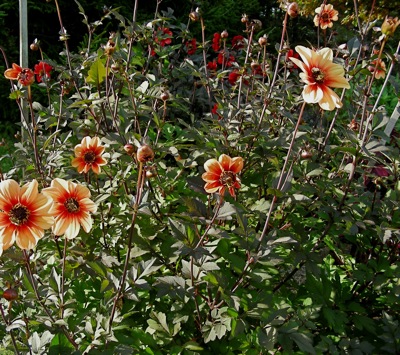
Came from the same packet, so you never know. You can’t really tell from the picture but the leaves on this plant are deeply cut, almost scalloped, and as you can tell they’re a lot paler.
To get flowers the first year, start seeds early (mid-March if you’re in zone 5). Read More…
And so do butterflies — a big vote for single dahlias, is why I mention it.
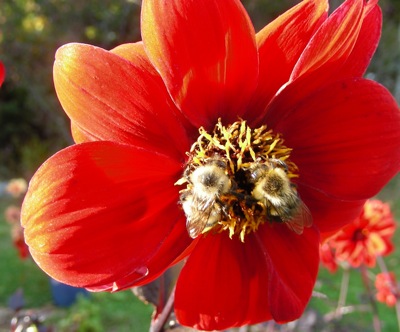
This is one of the Bishop's Children, more about them soon
to catalog plant lust. Always useful to remember they have to be interesting in context.

The Black Pearl pepper is in a tall urn that’s set in the middle of a clump of Artemisia Silver King. The sedum is good old Autumn Joy.
No need for a digital measurement ( or the morning weather report) when you look out and see this.

rhododendron leaves in self-protective mode; it's 20 degrees F.
Could be a cold truth about global warming: 15 below normal means nothing when normal itself is up for grabs.
Old Faithful, the tropical passionflower (species unknown) that has been going from greenhouse to windowbox and back again for years has brought us a great deal of pleasure. The thing’s an unkillable blooming fool that makes about 14 feet of growth each summer.
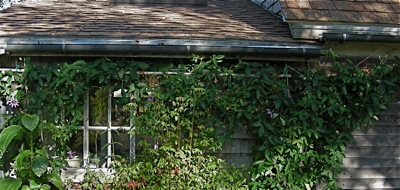
it's all one vine, base at lower right
But it’s also brought us a great deal of aggravation. Moving large plants back and forth between the Maine coast and the Hudson Valley is not my favorite thing.
So wouldn’t it be great to have a passionflower that was willing to live outdoors? YES! Passionflowers are almost all denizens of zones 9 and south, but there is one, the native Passiflora incarnata, rated hardy to Zone 6 or 7 – and we are almost 6.
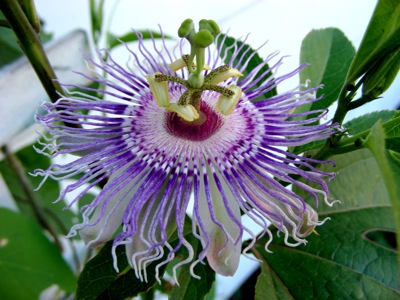
Passiflora incarnata, aka Maypop
Read More…
It may be bundle up time ( we’ve had temps in the mid-20’s on several nights at this point) but there are still delicious wild mushrooms to be found. Here’s the latest from our resident expert.
THE MUSHROOMS OF AUTUMN
After The Leaf fall
story and photos by Bill Bakaitis
As the days shorten the trees shed their leaves, openings begin to appear in the canopy, and more light penetrates to the understory. Mild frosts will have singed the outer tips of the garden plants and the edges of the forest, but mushrooms such as Honeys can still be found poking through the thin cover of leaves under the thickest forest canopies.
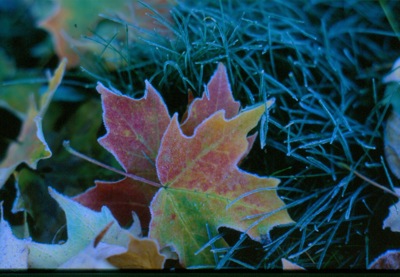
Light frost on Maple Leaves
By mid-Autumn, a month after equinox, It’s a different story. Read More…
Our Hudson Valley house came with a lot of heirloom peonies buried in the weeds and shade, so many huge old root masses that after rescue and division we had enough to string them all along the front borders of the vegetable gardens: 100 running feet of peonies, divided in half by a grassy path roughly 6 feet wide.

I'm standing at the halfway point
It’s wonderful to be able to pick andpick without making a dent.

Vincent ignoring part of the morning harvest
But it’s slightly less wonderful to have the overflow using up a non-trivial chunk of the fenced space that should be devoted to food.
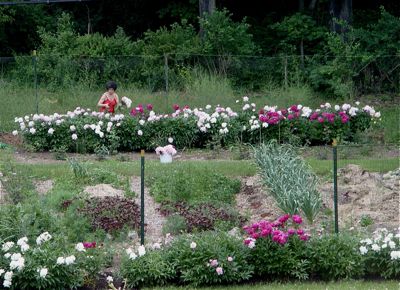
After all, one of the things that’s great about peonies is that deer really do seem to leave them alone. So this year, finally, we’re movin’ ‘em on out. And I’ve bought new different peonies to plant closer to the house. Read More…