Garden
Just in case that might be on your mind, today’s heartfelt plea is

Not yet!!
At least not in the Mid-Hudson Valley or most places north of here.
Having just been in the cutting garden getting an eyeful of dead material, I know the temptation is huge.
Resist. It isn’t yet time to encourage new growth. And I know ( having more than once said ” oh, it won’t hurt”) that if you prune properly, cutting past anything that looks weak, all the way down to a strong node, that node now has a wounded tip exposed directly to any hard frost that happens to come along.
This doesn’t keep me from removing ( and burning) the bulk of the dead stuff. I just make sure to stay well away from anything living, no matter how weak and wimpy, until safe pruning time comes. It’ll only be a couple of weeks — let us hope!
In our part of the Hudson Valley there’s still snow on hard ground in all the low places. But Sunday morning is clock-switching time and the forecast is for everything that’s usually loathsome about March. Furthermore, the stores are festooned with shamrocks and leprechaun hats and green crepe paper ribbons. Two good things to be said for the decor:
1. It reminds you to make soda bread.
2. You are warned that it’s almost pea-planting time, since tradition says you’re supposed to plant peas on St. Patrick’s Day. Where this tradition began nobody seems to know, but where this tradition makes sense are places – like Ireland – where March 17th really IS (more or less) what seed catalogs and garden guides call “ as early in spring as the ground can be worked.”
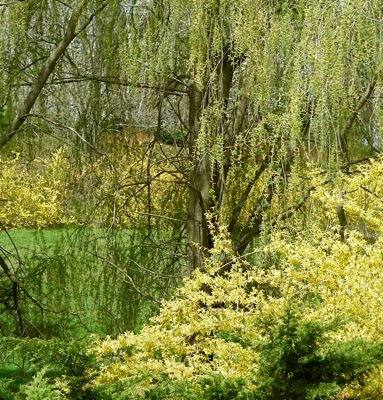
Not folkloric enough? How about “when the forsythia starts blooming?”
Read More…
isn’t the one that’s most delicious or the one with the prettiest kernels. In fact it tastes terrible and you can’t see the kernels at all, because the corn I have in mind is Zea mays var. japonica, usually sold as Zea japonica or Japanese ornamental corn.
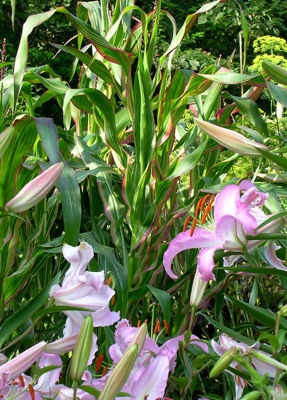
Zea mays var. japonica
Whatever you call it, it produces brilliantly striped green, white and pink foliage, starting quite early in the season. First growth is plain green, but as long as the leaves get plenty of sun, they start coloring up when the plants are about 3 feet tall.
Read More…
Thought for the day, on the arrival of the final shipment of vegetable seeds: What made me think I had room to plant 7 varieties of peas?
Thought for the week, on lusting after a truly gorgeous, frighteningly minimalist modern garden seen in a magazine: What makes me think I could ever give up summer bulbs?
Even a brief pass through the catalogs of Willow Creek Gardens and Corralitos Gardens is enough to produce a wish list of gladioli, eucomis, tuberoses and dahlias that would fill about a quarter acre I don’t happen to have.
But how to choose? If your dahlia collection included

Babylon Bronze
and you were not all that into dahlias, would you really need

Blown Dry
Read More…
By Joe Eck and Wayne Winterrowd, illustrated by Bobbi Angell (with the accuracy, sensitivity and elegance she always brought – full disclosure – to our collaboration at the New York Times Garden Q&A.)
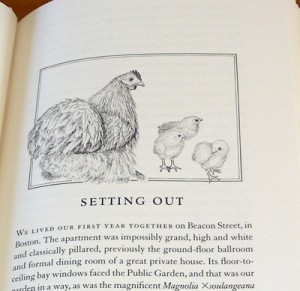
This is the first page of the first chapter; you’ll be seeing the cover all over the place if you haven’t seen it already.
When Joe Eck and Wayne Winterrowd decided to call their third book Our Life in Gardens, they probably didn’t mean “our” to include everyone who ever fell for a plant. But that’s the way they made me feel.
No matter that my gardens will never be a patch on theirs, that they have taken zone defiance beyond art into legerdemain and amassed a collection of rare plants that puts most public gardens to shame, they share discoveries, admit obsessions and air plenty of strong opinions as though their readers were their equals on a level playing field of horticultural passion. Read More…
In the old days ( like before about 2005), seed and nursery catalogs were glossy shopping magazines. They came unbidden in the mail just when you were sick to death of winter, bearing page after page of enticing close ups: brilliantly colored trumpets and daisies, clusters of nodding bells and panicles of jewel-drops, all guaranteed to make you forget that your garden was not the size of Versailles.
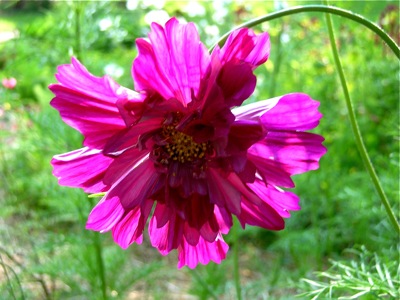
Cosmos bipinnatus 'Double Click'
Understandable. Closeup photos are the easiest to take, for one thing. Plus we know from the garden center in spring that nothing sells as well as eye candy. Add the fact that printing and postage are big expenses, and it’s no wonder the mail box wish books cut right to the chase.
But on the net, production costs are the same for one catalog or ten million; distribution is dirt cheap and space limitations have no meaning (let’s hear it for links!).
So why do we see mostly this:
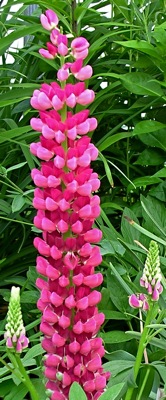
Lupine 'Morello Cherry,'
and nothing else?
Read More…
The big snow in Britain is making so much news I got a little worried about my long time penpal Roger Phillips and all the nifty plantings in Eccleston Square.
No problem, quoth he:
“Yes big snow last night the largest fall since 1963!
Here are a couple of shots, the Hamamelis ‘Jelena’ was great.

Hamamelis ( witch hazel) 'Jelena'
Plus a view

Eccleston Square covered with snow
All the kids are out there making snow men.
Love Roger
Given that I’ve always wanted one and never had a place to put it, I wish he hadn’t reminded me about ‘Jalena,” a cross between Chinese and Japanese witch hazels. It not only has those spiffy winter flowers but also sports some of the most brilliant fall foliage to be found. (When you find it on the tree; autumn storms often knock it all down.)
Pictures by Roger Phillips
Are you seduced by curvy Golden Crescent beans? By blue purple Purple Dragon carrots, pear shaped orange Jilo Tingua Verde Claro eggplants or yard long Red Noodle beans?

Red Noodle beans on the vine
Welcome to the club. I’ve never been able to resist oddball vegetables – show me a shape or color that’s different and bam, it goes on the order list.
This has been happening for 30 years and although most of these bizarro thrills have been consigned to the dustbin of “interesting experiment,” quite a few have become staples in our gardens.
STAPLES
* Ronde de Nice zucchini, not the best for slicing but ace for stuffing.

Ronde de Nice en route to stuffing
Read More…
Part 1 ( choosing varieties) here. Recipe hints that started all this here.
Please pretend that Mr. Earl is licking his lips because he just ate some delicious winter squash; I don’t happen to have any pictures of squash growing techniques.
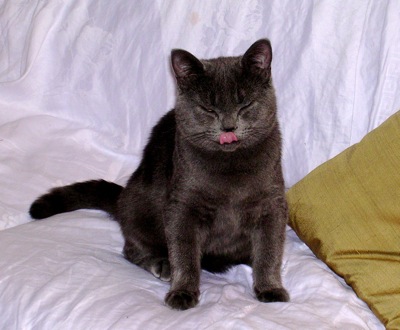
satisfied cat, no squash in sight
Technique # 1: Real Estate Rules! Location, location and location are fertile, well drained soil in full sun. “Giant garden” would seem to be equally essential, given the size of most winter squash plants, but that’s not true. The giant area in full sun is pretty much a requirement, but the only part of it that must be gardenly is the spot where the seeds are planted. The rest can be an open field full of weeds if you add a few refinements. Read More…
(* If you got here looking for pumpkin pie, rather than the other way ’round, there is now a detailed recipe.)
From the practical point of view, winter squash is a funny place to start this year’s food garden posts. The growing part is easy enough but the finding room part is hard. You can get a whole summer’s worth of beans and tomatoes and herbs and flowers and greens and garlic (and more), out of the amount of ground it takes to grow a modest crop of squash.

Squash patch @ 12 x 40 , self @ 4’10”
But it never hurts to Know Your Food; I promised back with the squash recipe hints that the garden part would come soon and seed ordering time is galloping toward us apace.
So is plant ordering time. And garden design time and all the rest of it. There are a few tips about coping in New Year Portfolio Analysis, Garden Division.
Meanwhile,back in the truck patch:
I’m not sure why, but we’re in the midst of a great squash boom.
Catalogs are crawling with scrumptious-sounding options: Pink Banana, Honey Bear, Sweet Dumpling… It’s easy to decide Long of Naples is probably too big (20 – 35 pounds) and Lady Godiva, a tasteless number grown for its “naked” seeds, probably doesn’t merit the space. But how do you decide whether to throw in your lot with, say,Galeux d’Eysines? Read More…