Garden
We’re visiting the New York garden to weed, tie up the tomatoes, harvest the garlic … and get majorly appalled by the Japanese beetles. What a year! They’re everywhere, and they’re especially everywhere on the contorted hazel and hollyhocks and raspberries and of course roses but NOT on Jens Munk,

once again proving itself to be as trouble free as roses get. Read More…
How dry we are! It’s just the worst – our sliver of the Maine coast has had less than a half inch of rain in the last 5 weeks and we have only a shallow well, barely enough for dishes and showers. I’m watering the joint with my tears, and when friends complain they’ve been stuck dragging hoses around for eversolong, it’s hard for me to dredge up much sympathy.
Some crops are going to be all right, and there’s still plenty going on – Lois had no trouble finding something to paint the other day
but if you look a little closer Read More…
Over the years, we’ve grown at least a dozen kinds of strawberries, mostly standard garden varieties (Fragaria x ananassa) like Sparkle and Tristar, and so-called “wild” strawberries, aka fraises de bois and alpine strawberries (F. vesca), like these Mignonettes being used as an edging in the lower garden.
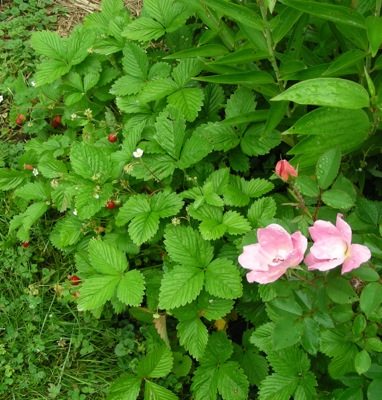
Cultivated strawberries are easy to grow, almost always tasty and sometimes very tasty. But none of them – yet; I keep trying – are as good as genuinely wild strawberries (F. virginiana), the intensely flavorful, amazingly aromatic gift that grows freely in woodland edges all over the northeast and beyond.
Read More…
Kristi the demon camerawoman was just complaining about it yesterday, so I know I’m not alone when I say
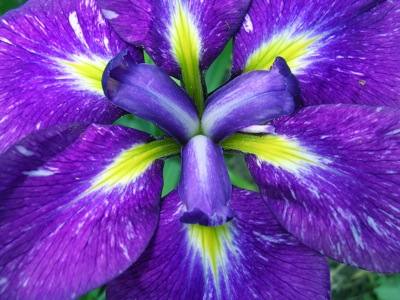
closeups are easy.

and mugshots present few problems

while landscapes are difficult

And anything in the middle is just about impossible
Yet the urge to photograph persists, along with the urge to get back to gardening and not be endlessly messing around with the equipment. Read More…
I post this picture of The Heap to warn you of what can happen if you do not prune your old fashioned spirea at least every other year
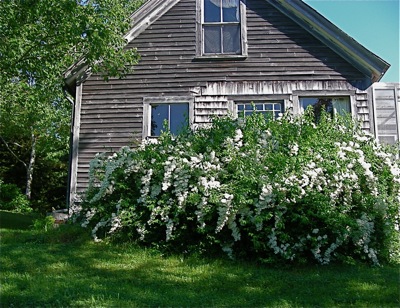
This Spiraea x vanhouttei was only a little slip of a thing when Lois fobbed it off on me – admittedly quite a while ago. The house is 20 feet wide. The spirea is still on the march. How did this happen? Read More…
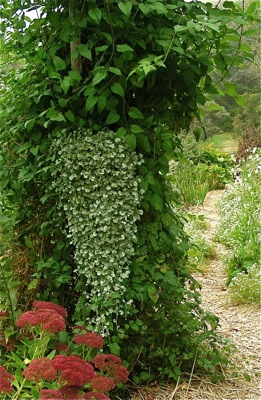
It’s fashionable to hate annuals, particularly common annuals like the licorice plant ( Helichrysum petiolare) that’s spilling along here in front of the clematis. But as stepdaughter Celia says ” Phooey on that.” Read More…
They’re vegetarian rats, basically. Eat bulbs, empty birdfeeders, gnaw through attic walls to make smelly nests, from which they sally forth to eat the insulation from electric wires. Absolute proof – if we needed any – that good looks can get you a pass on a lot of bad behavior. If they had rat tails instead of those bottle brushes and did not have the habit of sitting up and eating with paw-hands, and
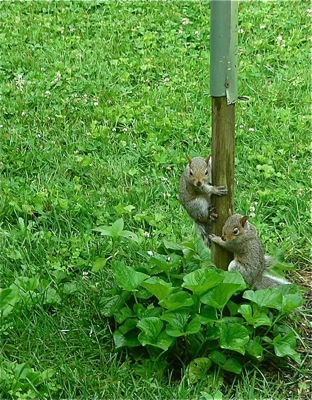
if the babies weren’t so damn cute, we’d be a lot farther ahead in squirrel eradication.
And don’t talk to me about dispersing seeds. If I find one more “volunteer ” black walnut with a taproot halfway to China…
Right. So what did we do with this little pair, scarcely larger than the violet leaves, happily playing for half an hour oblivious of dangerous humans only 10 feet away? We ooed and ah’d and elbowed each other and I ran out in my nightie to get photographs.
Bah, Humbug.
We all know the metal baffle does nothing. Taking down the feeder just sets them into the borders to nibble new buds. Any suggestions?
Former scenario:
It’s late August. The tomato rows are solid plant. I’m down on my knees in the jungle, pushing aside the mulch, digging around in the soft earth at the base of a mystery plant. It MUST be here somewhere and when I find it I will know whether the fat juicy sweetsharp tomato we had at lunch was a Brandywine or a Prudens Purple.

No more mysteries.
The place on the pole will be covered too, but the label will still be firmly in place.
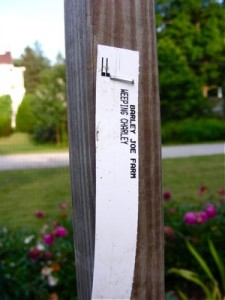 If you use wire supports you can use Kristi’s never-fail identification system. Get flat green plastic plant-tying tape, write the name on it with sunproof (!!) permanent marker and tie it to the top wire.
HA! No such thing. But if you want to make sure you don’t buy something like

this
and wind up with something like

this
Read More…
is almost ( not always) a good thing. But straw isn’t always the best mulch to use.
It’s ideal for tomatoes

These tomato babies have their bases covered in more ways than one.
Strawberries, on the other hand, do better when mulched with pine needles, aka pine straw. Pine needles are slightly acid, which strawberries like, and they’re more inclined to lie flat. This is important for very short fruit plants. Fluffy oat and rye straw tend to shade low leaves, and leaves need sun to make sweetness.