Garden
The twig and branch arch that divides the main upper garden from the white/herb garden near the house looks almost as though it grew there naturally, and every time there’s a garden tour it gets more comment from visitors than most of the plants. For years I have been promising to explain how Bill builds them, so here finally is the how-to.
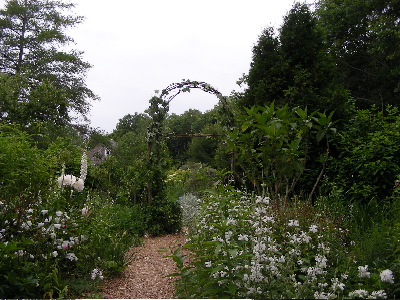
our new arch, right after completion
You will notice I called the arch “them” even though there is only one. That’s because structures like these biodegrade pretty quickly. The corner posts are durable – ours have been in place for 15 years and show no signs of declining – but the lacy branch work that makes the arch lasts only about 5 years, at least here in the Northeast where it’s exposed to pretty fierce weather.
This is a good thing. Whether you let it go as long as possible or decide to take it down earlier, everything will return to the earth without leaving paint residues, major quantities of rusting metal or other unpleasantness. There is no debris to dispose of except a little bit of wire and a few screws.
When I had Bill proofread these instructions to be sure I hadn’t missed anything, he said “This sounds complicated! If I had to read all this I’d never build anything.” It sounds more complicated than it is, but if you are as handy as Bill ( and as disinclined to read directions before plunging into projects), all you have to do is scroll through the pictures and you will know all you need to.
For those who would prefer a bit more guidance, I’ve written it up like a recipe. But please think of it as a recipe for stew, not a recipe for cake; it’s just a way to get you started. Bill can build an arch from posts to completion in an afternoon. You might want to spread it out, scouting for saplings and setting the posts on day one, building the arch on day two. Just don’t cut the saplings until you’re ready to use them; they stiffen up quickly and you want them to be as flexible as possible.
Materials (For an arch 6 feet wide, 20 inches deep and 9 or 10 feet tall) :
4 4-inch diameter 8-foot length cedar or locust posts, available at lumber yards
4 12-14 foot willow, oak or maple saplings, roughly 1.5 inches in diameter at the base. The ones that grow deep in the woods are more likely to be tall and straight because they’re reaching for the light. Make sure the main trunk is flexible from about 5 feet on up; sometimes skinny trees are older and stiffer than they look.
2 straight(ish) branches roughly 6.5 feet long and a generous inch in diameter .
12 to 15 straight(ish) branch pieces, each about ¾ inch in diameter and 19 inches long. This sounds like a lot, but most if not all of them can be gleaned from sapling branches you will be removing. It’s ok if 5 of them are only about ½ inch thick.
An assortment of different length screws: 1 to 2.5 inches long ( You won’t know exactly what sizes you need until you have the saplings and branches).
A roll of the thickest wire you can easily use as though it were string: 14 to 16 gauge probably.
Tools:
Shovel and trowel ( a post hole digger is better, should you happen to have one lying around. These instructions assume you don’t)
a pruning saw
Pair of pruners
Cordless drill
Wire cutter ( some pruners have one built in)
A ladder
Method:
1. Set the posts in pairs, 18 inches from center to center, the pairs 6 feet apart on centers. Bases should be buried 14 to 16 inches deep. If the soil is loose you can dig narrow holes using nothing but the trowel. If it isn’t, you’ll have to go at least partway down with the shovel, then backfill.
2. Cut the saplings. If you can’t get the 6 foot pieces from their side branches, cut lower branches from other trees. ( they don’t have to be the same kind of tree).
3. Bring the harvest to a spot where there is plenty of room to work, i.e. the lawn. Remove all branches from the bottom 6 feet of the saplings, so you have very skinny poles with very branchy tops. Bill just leaves the leaves in place; they fall off after a few weeks. You can remove them if you are a neat freak but then I take it back about one afternoon.
4. Prune side branches and twigs from the prunings to get the short pieces.
5. You are now going to tie the posts together with short pieces and build a ladder across the top of the arch to stabilize it. Use the hunkiest short pieces near the bottoms of the posts, the thinnest ones across the top. Let everything overlap a little. (Screws should be at least ¾ inch in from the ends or they’re likely to split the wood. And you need overlap to make tying things together easy.)

Bill trying out a cross piece
Okay. Attach the short pieces to the posts at regular intervals, screwing them to the inside faces. Attach the 6 foot pieces to the insides of the posts, around 2 inches down from the tops. Get up on the ladder and lash the cross-pieces to the tops of the 6-footers. ( You would think this would be easier to do on the ground, but everything is so irregular it doesn’t work out that way.)
6. Set the sapling bases against the outsides of the posts, starting about a foot off the ground, butting them up to the cross-pieces. Screw them into place.
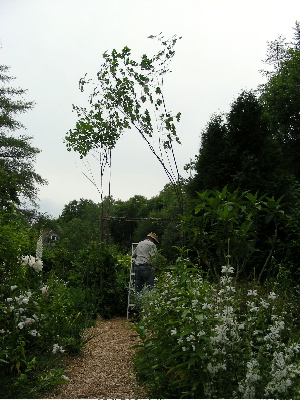
7. Now comes the interesting part. Get up on the ladder and bend the saplings down to form the arch. They can go in parallel or be crossed kitty-corner, whichever is easiest and most attractive. Tie them to the tops of the posts, weaving the wire in and out around the cross piece ends to keep everything secure.

8. The arch is still having a bad hair day. Weave the branches in and out around each other until the shape is under control.
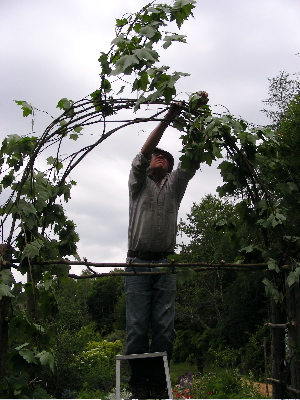
There; that’s it. Plant some vines. Clematis, perennial sweet peas and annuals like cup and saucer vine and Spanish flag work well, or you can plant climbing roses and pray they make their own woody frame before the arch gives out.
The previous arch, covered with Clematis virginiana and doing fine until this year’s Patriots Day Storm.
It’s nice to learn that a respectable, long-term study has confirmed that organic tomatoes contain far more beneficial flavonoids than the conventional kind, but this news won’t be much of a surprise to people who value true organic produce* for its (frequently) superior flavor. Other things like variety, climate and distance-from-farm being equal, good taste and high nutrient content are both results of a growing method that works in partnership with plants instead of treating them like machines for turning synthetic fertilizers into edible widgets.
Tomato plants grown the conventional way get frequent doses of those fertilizers and of powerful pesticides that provide blanket protection. Organic feeding is slower and steadier; and the permitted pesticides are usually less speedy and less lingering. That means organically grown plants must be able to stand up for themselves, and one of the ways they do it is with the antioxidants that look so promising for fighting human disease. Plants that have all their needs met in advance produce far less of these compounds.
And plants have evolved to use solar power. Sun on leaves is what makes flavor, especially when there is a high ratio of leaves to fruit. Heavy jolts of fertilizer can goose the plants into making more fruit, but fertilizer can’t make more sunshine. Result according to people with taste buds: pallid flavor. Result according to the scientists: “nutrient dilution.”
Meanwhile, back in the garden:
* be sure your tomato plants are getting enough water and getting it consistently. The stress of alternating drought and deluge prevents plants from taking up calcium; calcium deficiency leads to blossom end rot.
* if you have an eye on the county fair, consider sacrificing part of the crop. Remove all but one baby tomato from each truss of fruit and the survivor will grow far larger than it would have otherwise. ( Same goes for your dahlias, by the way. )
* if you are growing beefsteak type heirloom tomatoes like Brandywine and Georgia Streak, it’s best to harvest them before they’re completely ripe. I’m not talking about green ( at least not until frost) but just barely on the pale side of fully colored – 2 or 3 days in front of vine ripe. Picking before the fruit is ripe may seem counter to the whole point of growing your own, but unlike strawberries tomatoes do continue to improve after they leave the vine. Taking them indoors while they’re still slightly firm lessens the chances they’ll crack from a late rain or, as far as I can tell, just natural cussedness.
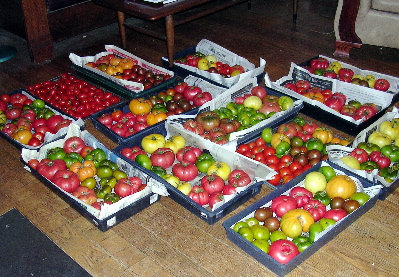
This is sort of cheating because it was taken in late fall and some of these were rather green when they left the vine. Note that they are in single layers, which helps prevent rot – among other things because we can’t help keeping an eye on them. Anything nasty gets removed promptly, before problems can spread. Flavonoid content of tomatoes like these has not been studied, as far as I know. But I do know that only the red ones contain significant amounts of lycopene (another, quite different, antioxidant that’s also much in the news) and that if you want to load up it’s best to cook and concentrate ‘em. Cup for cup, old fashioned Jersey-Italian tomato sauce will deliver a lot more lycopene than Southwestern salsa.
* I say “true organic” because sustainability matters. Spinach grown without conventional pesticides is a better choice than spinach grown with them (especially if you’re feeding children) . But if the organic spinach was grown on a monocropped 1000 acre field; tended and harvested by underpaid itinerant workers and then shipped clear across the country in something that burns petroleum, it still has a way to go before it’s organic by me, and it may also fall short in the flavor department.
In the market, at pick-your-owns and in plant catalogs.
Fair warning: I’m in strawberry delirium at the moment. We (well, Bill actually) got a big bowl of them for Father’s Day from Karen, Celia’s mother, and they were the Platonic ideal: firm but tender, very juicy, flavorful, sweet, and FRAGRANT? Omigosh. They perfumed the entire kitchen all afternoon, until I made them into shortcake – a subject about which I feel strongly – recipe coming next post. Biscuits, only biscuits, do not talk to me about cake.

Karen with home-grown gift
Or don’t bother to talk about making anything. When you get strawberries this good all you need to do is eat them. The part that takes effort is acquisition.
Getting industrial strawberries is easy; like industrial tomatoes they’re available everywhere always. And all of the tomato wisdom about far tastier when fresh and local certainly applies. But with strawberries ” vine-ripened” matters far more because strawberries – unlike tomatoes – cannot continue to ripen after they leave the plant.
They do get softer as they age ( except the gigantic iron strawberries sold for chocolate-dipping). But they don’t get any sweeter or more intensely flavorful. Whatever goodness they have when they’re picked, that’s all they’ll ever have.
Yet ripe strawberries are fragile and short-lived. Result: only berries that need not travel far or change hands often can be allowed to ripen fully. And only growers who sell locally can risk growing “home garden” varieties known more for flavor than durability.
So if you crave strawberry delerium – and don’t happen to know Karen – the places to get fruit are farmers markets, pick-your-own farms, and your own back yard.

Karen got her plants from a friend and doesn’t know their name, but these look a lot like Sparkle, a home garden variety introduced in 1942 and still popular in the Northeast, the region where it does best.
At the Market: go for sprightly green calyces ( the cap of leaves at the top) and stems that are fresh-looking. Don’t be put off by small berries or berries that aren’t all the same size; many of the tastiest varieties are neither large nor uniform. Some very sweet berries are not dark red, but if they’re light it doesn’t hurt to ask for a taste. And beware of super deep color too; the berries may be so close to overripe they’ll melt before you get them home.
At Pick-your-own farms: Try to get there either at the beginning or toward the end of the day. In many places people make side money picking at these farms and selling the fruit for a small profit. They show up early; they know what they’re doing; and they’re fast. By the time they leave, a lot of the fruit that was ripe at daybreak will be leaving with them. Fortunately, they seldom come back for a second round and strawberries can ripen in a matter of hours. On hot days late afternoon can offer great picking, especially when the weather is so brutal it discourages the competition.
In the Garden: Strawberries are already among the easiest fruits to grow, and if Colony Collapse Disorder continues they’re going to be an even better bet. In contrast to most other soft fruits, strawberries don’t rely primarily on honey bees; our native wild bees pollinate a lot of them and can continue to do so – assuming, of course, our native bees are still around themselves…
A disquisition for another day. To return to our berries,
Choosing plants:
Leaving aside specialty berries like fraises des bois, there are 3 types to consider: June bearers, everbearers and day neutrals. For descriptions of individual varieties consult plant sellers like Nourse Farms and Daisy Farms.
June Bearers – might better be called “once bearers.” They make a single large crop in spring and that’s it. They’re the original “garden strawberry,” the tastiest of the large-fruited types, and the one that offers far and away the widest choice of varieties.
Everbearers – their better name is “twice bearers,” one crop in spring and another, smaller crop in fall, with only a few berries here and there in between. Quality varies widely and is strongly climate dependant. Be sure you choose one that’s right for your region.
Day Neutrals – keep fruiting from spring to fall, with the largest and tastiest fruit often coming as the weather cools down. Berries tend to be on the small side but there are a lot when you add up a whole season’s worth.

Strawberry shortcake, made with biscuits. Recipe coming soon to a blog near you.
Because heirloom tomatoes are delicious; because they come in so many flavors, colors, shapes and sizes and because buying the seeds helps keep regional seed companies in business, heirlooms are what we mostly grow. There are about 150 possibilities, so we try a few new ones every year. Only a few; lion’s share of the space goes to essentials like Brandywine, the tomato that (deservedly) put heirlooms on the map.
The essentials list is rich with possessives: Pruden’s Purple – Brandywine-ish, but earlier and usually smaller; Kellogg’s Breakfast – fat, juicy and orange, named for a railroad man, not Mr. Cereal; and Aunt Ruby’s German Green, which after trying many ripe-when-green tomatoes we have concluded is best.
There is also a must-have hybrid: Sun Gold, a yellow cherry tomato unmatched for sweet fruit, disease resistance and mind-bending productivity. One plant could feed the multitudes if it were happy and given free rein to grow as large as it wanted ( and if rain didn’t crack all the fruit, a very common misfortune)
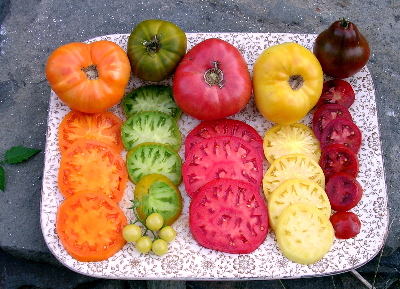
left to right: Kellogg’s Breakfast, Aunt Ruby’s German Green, Pruden’s Purple, White Wonder, Japanese Black Trifele. The little guys are White Currant
Where does the terroir come in? Because we grow the same varieties in both gardens but they don’t taste the same. The New York Brandywines, for instance, are sweeter than the Maine ones, while the Maine Green Grapes are swoonworthy compared to those from New York.
We’ve never tried a blindfold test and they do vary from year to year, but you can usually taste when you taste them the elusive “somewhereness” that wine writer Matt Kramer has used as a rough translation of “gout de terroir,” a staple term in winespeak. It can refer only to mineral flavors but just as often means “everything about a place that affects taste in ways that make that taste unique.”
The more literal translation is “taste of earth ( or soil),” though how and why – and if – it exists is a subject of some contention, especially in the wake of a debunking story in the New York Times ( Talk Dirt to Me) by Harold McGee
and Daniel Patterson.
To me it seems like a no-brainer, given all the ways – completely apart from the genetics of regional adaptation – that place matters to the taste of fruit: differences in soil lead to differences in nutrient uptake; differences in climate affect not only the plants themselves but also the likely assortment of pests and diseases and by extension the steps taken to combat them – or not.
The problem may be that in most cases you can’t compare growing places without comparing growers and the differences between them can easily trump everything else.
But not in our case. We are us in both places and our plants are as close to being the same plants as non-hybrid plants can be: all 70 of the seedlings we start with come from the same set of seeds and are grown by the same person at the same place (Jan MacDonald, at Barley Joe Farm in Warren Maine).

Maine babies about to hit the road for New York.
Oh, one more very important thing: we don’t make tomato wine and introduce all those variables, so my use of terroir for tomatoes can ( and no doubt will) be dismissed as apples and oranges. But if the taste of the fruit matters that little to the taste of wine, the dismissers are in a lot bigger trouble than anything I can cause.
Maps that divide the country into cold-hardiness zones are the tools you love to hate. The more experience you have, the less faith you put in those numbers and yet some belief is essential; no way to predict unknown-plant survival without some guidelines, be they ever so crude.
I’ve been reading reports ( both scientific and anecdotal ) on this ever-vexing subject for about 35 years now. And for the last 15 of those years I’ve been tending two gardens, one 400 miles Northeast of the other , both of them in the same zone: 5, according to the old fashioned USDA map – or 6 if you go by the more up to date Arbor Day Foundation version . Insights gained are below.
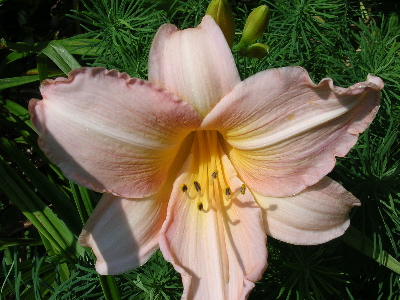
This is just to keep you amused; it has nothing to do with climate zones except that being a daylily (Hemerocallis spp) it’ll grow almost anywhere.
Rules that help:
a) Allow for 1 zone on each side of the one you’re allotted. If the map says you are in zone 5 you can probably grow a Zone 6 plant, but on the other hand your winter may kill something that has Zone 5 as its permitted lower limit.
b) Do the same thing with plant labels; they tend to be either overcautious or overhopeful, or (on those that offer a range of zones) both.
c). Learn your garden – if it’s big enough to call a garden, it’s probably big enough to have warm and cool spots, windy and sheltered ones, and quite possibly different soils within 10 feet of one another.
Hardiness Maps that attempt to Improve things:
By refining the description of the plants –
The American Horticultural Society has created a HEAT zone map, which makes a great deal of sense; most plants have death points at both ends of the thermometer. This map made its debut in 1960, but like the metric system it hasn’t made much headway.
It is used by the society’s magazine, where spicebush, for instance, is referred to as “Lindera benzoin, Zones 4-9, 8-1″. The first set of numbers are the cold zones, by the way, should you happen to run into a pair like this on a plant label somewhere and if you do please write and tell me about it.
By refining the description of the Zones:
Sunset Publishing offers – and works from – a national map that includes not only heat and cold but also length of growing season, humidity, rainfall and rainfall patterns. It is silent on the subject of soils, probably just as well given that there are 45 zones as it is.
The asparagus soup is below. But first, a word from our peony. Having extolled the early one while whining that it is very magenta and then showing nothing but a bud with an illustrative ant , it seems only fair to display a flower. Bill took this picture at my request, both because I was in Maine at the time and because he is a better photographer.
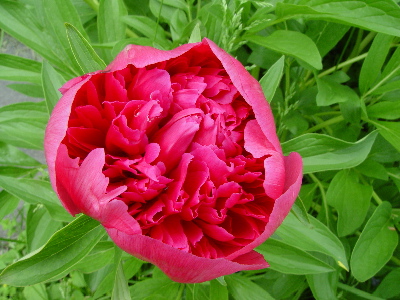
Bill Bakaitis
The ( neglected ) asparagus part.
It never fails. You read a recipe for asparagus and no matter what kind of recipe it is: steamed, grilled, stir-fried, whatever, you will be instructed to break off the tough ends and ” save them for soup.”
End of story. Nobody ever tells you how to make this kind of asparagus soup. And you know if you’ve ever tried it that soups that are not asparagus soup are not improved by having a few asparagus ends thrown in.
So. The following recipe is made – primarily – from tough asparagus ends. It’s easy, inexpensive and delicious hot or cold. Because asparagus ends are tough and stringy even after they’ve been cooked to death, you do have to use a food mill to get a velvety puree, but that’s the price of frugality. If you want to just throw it into a processor, you have to use tender asparagus (see note at end of the post).
Cream of Asparagus Soup
1 ½ pounds of asparagus ( roughly 2 bunches) is usually enough to make 4 servings of soup and 4 servings of asparagus-as-veg. , but the recipe works with whatever quantity you’ve got.
asparagus
sweet onion such as Vidalia
basmati or other flavorful white rice
heavy cream, preferably not ultra pasteurized although at this point that’s wishful thinking in a lot of places
1. Break the asparagus spears where they break naturally and set the tough ends aside. Divide the tender ends into 2 piles, one a little more than twice as big as the other. Refrigerate the larger pile until you want it for vegetable purposes. Chop the smaller pile into 1 inch chunks and set aside.
2. Trim off and discard any really hard white ends of the tough ends. Chop the remainder into ½ inch chunks and measure into a large saucepan.
3. Add 1/2 cup coarsely chopped onion, 1 ½ tablespoons rice, and 2 cups water per cup of ends.
4. Cover and cook over low heat until the vegetables are soft and the rice is fully cooked, about 40 minutes. Add the chopped tender asparagus, recover the pan and cook until vegetables are very soft and the rice is a fluffy mush, about 20 minutes more.
5. Put the whole works through a food mill into a clean saucepan ( for hot soup) or a heatproof bowl (for cold). Stir in 1/3 cup cream for each cup of asparagus ends. Reheat the hot. Chill the cold. Taste. Add salt as needed. That’s it.
Bill Bakaitis
Who wants to look at a picture of a bowl of cream soup? Suffice it to say it’s celadon with darker speckles and always reminds me of this lovely image from Elizabeth David:
” … soups delicately coloured like summer dresses, coral, ivory, or pale green…”
(French Provincial Cooking, British Penguin edition 1973)
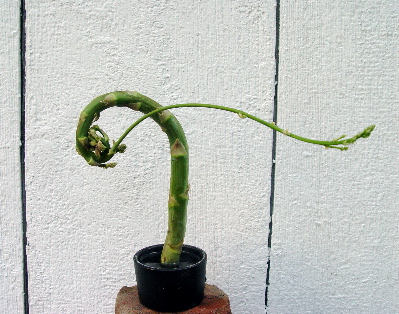
Curling of the sort in the picture is caused by damage to the spear as it was emerging from the ground. Usually , a cutworm tried and failed to sever it but sometimes you nicked it with your knife while harvesting an adjacent spear.
To make the soup using a processor or blender: Follow the proportions in the recipe, using tender asparagus uppers instead of ends. The only thing that changes is timing: Cook the onions and rice in the water for 20 minutes or so before adding the first batch of chopped asparagus. After that, it’s exactly the same except a processor is marginally easier to wash than a food mill and takes less manual effort to employ.
Tips on Choosing, Storing, Preparing and Growing Asparagus are here.
Our old house came with a yard full – and I do mean full – of old fashioned plants, things like yews and lilacs and peonies, a big magnolia and a truly hideous orange azalea that has long since gone to its just reward.
Among the plants we class as riches is a tree-sized autumn olive, Elaeagnous umbellata. It may have been planted when they were still on the OK list. Or, in the manner of autumn olives it may have arrived naturally, delivered by a passing bird.
In any event it’s here now, a late spring star whose clouds of starry white flowers perfume the entire lower yard. Beneath it, looking like fallen petals, is a carpet of tender white violets. Pick a bouquet of both and you see the olive blossoms are in fact pale cream.
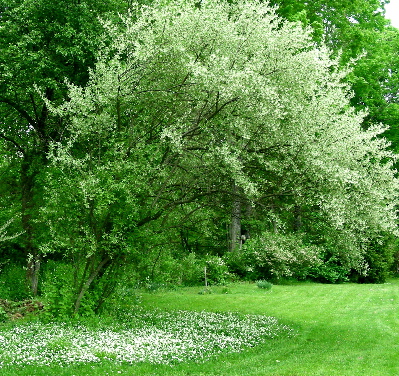
Both plants are invasive weeds, though only the olive seems to excite strong passions among preservationists. ( Plenty of people hate violets in the lawn. Another whole story.)
Because it is now tree-size, we thought for years it was a Russian olive, E. angustifolia. This made us feel slightly less guilty: the Russian kind seems marginally less inclined to cover the earth.
But only slightly, both olives are on the don’t plant this list and any day now we will cut ours down. Right after we fertilize the poison ivy, an unimpeachably native vine of which we have a great deal more than either Elaeagnous.
In the meantime, we’ll remember that these “olives” feed many wild creatures including but by no means limited to: Ruffed Grouse, Wild Turkey, Cedar Waxwing, Northern Mockingbird, Cardinal, Wood Thrush, Yellow-rumped Warbler, assorted sparrows, Black Bear, opossum and skunk).
Of course they also feed fellow-invasives like starlings. And deer are fond of them. These things are never simple.

These are the flowers that convinced me it was E. umbellata, after I read about the difference here.
As lilac lovers go, I’m a very small timer: there are 8 of them in the New York yard; 10 in Maine, a mere token compared to big public collections like Highland Park, in Rochester NY, where 500 different lilacs – 1200 plants – are blooming right this minute.
But even our tiny assortment gives us a full six weeks of fragrant delight because it includes a few season stretchers: bushy, pale purple ‘Miss Kim’ (Syringa patula), pink-flowered ‘James Macfarlane’ (S. x prestoniae) and a 20 foot tall pair of Japanese tree lilacs (S. reticulata), all of which bloom later than the old fashioned French kind (S. vulgaris).

I wish I could tell you. I bought it at a clearance sale at an Agway now long gone and it was supposed to be a plain old single flowered purple lilac, the sort used for hedging in an ampler age.
Hence this bit of lilac advice: keep the sales slip until you see flowers. Mislabeling is fairly common and it’s vexing – take it from my experience – to get a dark purple-red that looks like ‘Charles Joly’ when you thought you bought a white ‘Miss Willmott’.
One way to know what you’re getting is to join up with the National Phenology Network and request one of their lilac clones. Follow the” submit data” links and you’ll be sent to the application form.
The lilac will be a ‘Red Rothomagensis’ (S. x chinensis) a somewhat gangly, fragrant early bloomer with reddish buds that open to dark pink flowers. There is a picture of one here.
And why is the National Phenology Network sending you this present? Because they want your help. Phenology is the art/science of measuring climate with biological events like frog song, fish migration and plant bloom; and lilacs were chosen, way back in the 1950’s, to be standard measuring instruments. Gardeners all over the country have been watching lilacs, sending in data and, as citizen scientists, helping to document the process of climate change. (In the Midwest, where the Network was born, spring – as measured by lilac – is now almost a week earlier than it was 50 years ago).

For now, we’re watching this common lilac, which is already in place in Maine. As long as you monitor the same plant, year after year, you can contribute useful data by watching any lilac you choose. But we will ask for a ‘Red Rothomagensis’ and start watching that one too, because that’s even better. By eliminating the variations of species, cultivar and individual plant, clones make it easier to measure accurately.
For more on this communal effort, read the short history of the project that was broadcast on National Public Radio or go directly to Project Budburst, where there are full instructions and a long list of alternate watch plants. If lilacs aren’t your thing – and for some reason you’re still reading – the list includes ocotillo, redbud, wild strawberry and many other common plants.
One warning about the clone: Can’t say for sure about RR, but most Chinese lilacs are very mildew prone, and although the fungus does no long-term harm it isn’t very attractive. Try to plant your contribution to science in an inconspicuous place.
PS: Losing your local Agway isn’t phenological, but it’s just as reliable as a measure of change. Our county in Maine ( Knox) has fewer and fewer farms and truck gardens, more and more suburban sprawl.
And their sisters and their cousins whom they reckon up by dozens… no, no, just joking, but there are all kinds of nifty peonies.
And all of them have ants. Long ago, some observant gardener noticed that ants on peony buds always meant the flowers would open soon. Always. And so a bit of folk wisdom was born: Peonies cannot open until ants eat away the seal that keeps the buds closed.
I grew up believing this, my mother went to her grave believing it, and just the other day I heard it repeated again. But it isn’t true. The thing the ants are eating is nectar, not glue, and what this does for the peony is make sure there are plenty of ants around to eat any soft-bodied insects that might like to eat peonies.

This bud belongs to a super-early short peony that opens almost a month before the common (lactiflora) kind. It was here when we got the house and all we know about it is that it’s tough. The double flowers last a long time, too, a mixed blessing given that they are – to put it kindly – magenta.

When these fern leaf peony buds open the flowers will be single, in a clear true red. They’ll last about 35 seconds. And that nifty foliage will disappear by midsummer. Catalogs that describe fern leafs ( P. tenuifolia ) as rare and special seldom mention these attributes, but it’s something to bear in mind before plunking down large dollars. Oh, also they take several years to settle in and start blooming well. On the good side, they’re indestructible, even in acid soil that gets only a few hours of sun. And once you have them, you have them. Even small bits of root make new plants.

Ok, ok, here’s a picture of an actual peony, probably Queen Victoria, one of the antique varieties that came with the place.
Peony Tips Worth Repeating:
*They do need sun, but not that much; with most varieties you can get decent flowers from a half day’s worth and the farther south you are, the more the peonies can use a break from broiling afternoons.
* Be sure to plant shallowly – those fat growth buds should be no more than an inch and a half below ground. The number one cause of bloom failure is over-deep planting… or, over time, the gradual movement of compost and mulch that buries those buds as effectively as if you had done it yourself.
* They don’t like acid soil; if rhododendrons are doing great, better you add some lime to the peony bed before you start planting.
* Fall is the best time to plant. Potted peonies can go in the ground now, but the bare root kind – the kind with all the dazzling choices – must be planted in fall.
* No peony parts in the compost! The Botrytis blight that plagues them – their own personal fungus: Botrytis paeoniae – is ever present, even on apparently healthy growth, so everything that leaves the peony bed should stay gone: discarded bouquets , the fall cleanup pile, Everything. Burn it if you can, toss it deep into the woods where no peonies will ever grow, or be deeply retrogressive and send it to the landfill.
* Peonies last a long time as cut flowers and can be held in bud stage for a month or more – if you have the room in the refrigerator. For an exhaustive and very useful treatment of cut-flower choices and procedures, download Fresh Cut Peonies, from Kansas State University.
“The rose and herb garden outside our kitchen door” sounds poetic, but it’s really just a small sloping rectangle with a row of old roses at the bottom and a middle full of thyme and sage, cilantro, chives, tarragon, basil, parsley, oregano, lovage, fennel – and quite a few more roses. It was planted (in the Hudson Valley) in 1994, has always been managed organically, and has turned out to be quite a teacher.
Big lesson number 1: herbs do not repel pests as well as organic gardening advisors would have you believe. This includes garlic, unfortunately.
2: Some roses really are tougher than others and there are many to choose from besides the squatty, bland, scentless “foolproof” types (Knockout, I’m talking about you) that offer so little of roses’ splendor you might as well grow something else and be done with it. See below for sources that offer hundreds of handsome, hardy roses that can thrive without noxious chemicals.
3. There will always be at least one “must have” that’s a challenge to earth-friendly ideals. Mine is Reine des Violettes, an antique beauty (introduced in 1860) that cannot endure both crowded conditions and the Hudson Valley’s hot summers.
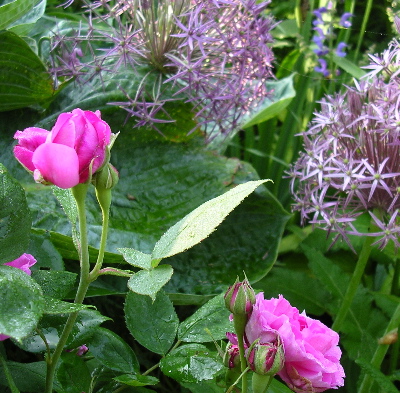
Here she is in Maine, where the cool summers we used to enjoy made it easy to grow even fussbudgets with relative ease. The fragrant flowers open dusky pink, then fade to the pale purple of the name, and the foliage has a distinct smell of pepper. The hosta in the background is Sum and Substance, unfazed by our current plague of imported snails, which brings us to
4. Japanese beetles, perhaps the greatest test of will in the organic rose department. Not counting milky spore, there are basically two ways to deal: with products derived from the tropical neem tree, or with calm acceptance and screening.
A) Neem: Attacks on mulitple fronts, discouraging beetles from feeding, interfering with their growth chemistry, and with !hooray! their mating behaviour. It only works when applied biweekly, but then it works very well indeed , as proved not only by us but also by a study done at Perdue and reported in the invaluable Hortideas newsletter. Insects must eat it to be affected; it seldom kills beneficials; and it’s relatively harmless to other creatures – except fish. But too much neem coated pollen can hurt bees, so we try not to spray open flowers.
B) That would be open flowers of potatoes. The roses we enjoy in spring before the beetles emerge, and in fall after they’re gone. In between, we let the garden go wild. Not so good for low-growing herbs, but excellent for drawing the eye away from devastated roses.

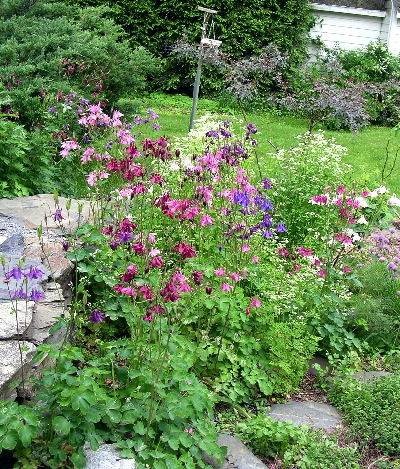
In person, columbines are not blurry. And because they cross so freely, new colors are always opening up, the gift of surprise every year.
Shopping for low-input roses:
Most of them are modern developments like hybrid rugosas, the Canadian Explorer and Parkland series, and recent introductions from Kordes. But there are also antiques, including beauties like Mutabilis, as changeable (from pale yellow through orange-pink to red) as its name suggests, and thornless, super-perfumed Zepherine Drouhin, a deep pink with no candy in it. Roses are highly climate sensitive – I’ve been tripped up more than once by the optimistic words “hardy to zone 5.” But that’s because I didn’t talk to the rose grower before placing my order; all the good ones are glad to help you fall in love with something you can actually live with.
North Creek Farm- run by Suzy Verrier, an expert in all things Rugosa
Antique Rose Emporium – exactly what its name promises
High Country Roses – for a large assortment of tough roses both elderly and brand new
Roses Unlimited – a good selection of modern Kordes roses, which until recently have been difficult to find in the US. Growers in the know have been ordering from Palatine, up in Ontario.