Garden
Like most of the Northeast, we had a false alarm last Wednesday: it was actually warm out, almost balmy. The crocus in the crocus lawn was beginning to look carpetlike although the effect was (and remains) patchy, because last fall’s newly planted fill-ins are in the usual way coming up later than the established clumps.
There are still plenty, all of them very attractive to the bees. We lost one hive over the winter, a loss rate of 50 % but better than a lot of the pros did. Bill picked up 2 new boxes yesterday. They’re in the basement keeping warm, and I’m baking some honey bars – just to inspire them.

Bill got this picture by putting his camera on one of those tiny tripods that looks like Mr. Gumby. There will be no crocus honey because honey is not being made yet. The first nectar all goes to feed the brood.
HONEY BARS
This is a close adaptation of the recipe for Candy Cake in the American Heritage Cookbook, published in 1964 and now out of print but widely available and worth having, for the wealth of historical photographs as well as the recipes.
½ cup butter
a scant ½ cup sugar
3 well-beaten eggs
½ cup mild honey
2 teaspoons vanilla
1 ½ cups all purpose flour
¼ teaspoon each salt and baking soda
1 cup coarsely chopped walnuts or black walnuts which are wonderful if you like them
1. Heat the oven to 350. Butter a 9 inch square 2 inch deep baking pan. (8 inch may be substituted, see note at end.)
2. In a large bowl, let the butter soften, then beat in the sugar. Beat in the eggs, honey and vanilla, then lightly stir in the flour, salt and soda. Add walnuts and stir/fold just enough to mix them through.
3. Turn the batter into the pan and bake until edges shrink and a toothpick comes out clean, about a half hour. Let cool in the pan, then cut into small bars.
Note: The original recipe calls for an 11 ¼ x 7 ½ x 1 ½ inch pan, which must once have been a common size, albeit I don’t think recently (ours was found in a junk store 25 years ago). 9x13x2 is too big. The only problem with an 8 inch square is that the edges usually overcook before the center is done. Solutions in order of hassle include: pretending you didn’t notice; slicing off edges and feeding to dog or edge-lover; and making the cake plus a cupcake: fill the pan about 2/3 full. Bake remaining batter in whatever small shallow ovenproof vessel you happen to have around.
Update: Shortly after writing this, I found an 11 ¼ x 7 ½ x 1 ½ pan in the not very well stocked equipment section of a local Hannaford. Don’t know what to make of this but will say that’s a very useful size for all sorts of 2-person cooking.
It’s not puddle-wonderful yet; but we’re gainin.’ About a third of the crocus are up; almost all of the snow is gone and Bill is starting to make fly-casting gestures as we walk over the hill to the broad meadow threaded by Sprout Creek.
And once we’re there the creekside trees are filled with red-winged blackbirds, the birds that mean spring to me. Never mind the robins; they’re around all winter now, and though geese on the move are still distantly evocative, the reality of geese on the ground is too painful for them to have much spring cred left.
The forecast is for April showers all week – until Thursday, when snow is predicted. Doesn’t matter, the red-winged blackbirds are here, trilling and burbling and rasping over the water. Better days are coming.

Red-wings do sometimes come to the feeder, but Mr. Earl is actually looking at a house finch. It’s clinging to a native wisteria (W. frutescens) that will eventually – we hope – provide summer shade.
Blackbird tidbit from the terrific Cornell bird site: The males fight mega for territory and each usually has multiple females resident in his real estate. But the females seem to be no boundaries types: from a quarter to half of their offspring are sired by the neighbors.
The plant breeder who creates a rhododendron that deer don’t like is going to be rich, but you don’t need to wait for this golden shrub if you have large old rhodies, which I wish I had but I don’t. What I do is nag all my friends and design clients: Think tall. Think sculpture. Think of Japan.
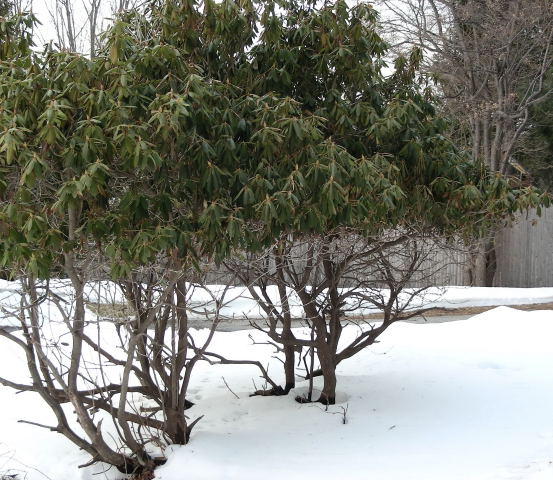
This clump grows about 1/3 mile from where the deer below were standing. Over and over in springtime those naked stems sprout healthy new growth, which sticks out randomly here and there in unhealthy-looking tufts. Over and over, the base fills out about halfway. Over and over, just when you’re starting to root for the thing and imagine it might manage to bush back out, Wham! Eaten again.
Mercifully, the owners do not encase the whole works in a gigantic net bag, but they also fail to see the obvious, which I would illustrate right here and now if I were adept with photoshop. Meanwhile, just look at those handsome trunks and the full green canopy of bud covered foliage. Imagine pruning out all but the strongest, most graceful wood. The easy, no-waiting deer-proof rhododendron is simply a multi-trunked tree. Hungry deer will stretch on tippy-hoofs, but they’re not goats. They don’t climb.
In the dampy doldrums of March, when all is dirty snow and mud, when snowdrops, skunk cabbage and tiny bulb shoots are more or less it for new green, it’s easy to forget that deer, like rust, never sleep.
But right now they’re hungrier than ever; they’ve already nibbled all the easy wild stuff; the leftover acorns are still buried… and your tender roses, hydrangeas, etc. are just starting to swell.
‘nough said. Get out there and spray before it’s too late, i.e. before they take the first nibble.

Deer are often boldest in spring; hunting season is long over and so is their easy access to wild food. This group was right next to the road until I was 50 feet away, and they only ran about 50 yards before figuring that was enough.
Most gardeners know how it is with lilies – you have enough; you definitely have enough. And then it’s March and it’s extremely dreary and here – surprise! – is a pile of summer bulb catalogs with extremely yummy pictures of lilies and you think, well, there’s always room for a few more in the cutting garden and they do make such effortless bouquets

And then, in an increasing number of cases, you think: well, nah; the wretched lily beetles will just get these too and make me feel terrible.

Gilles Gonthier
The scarlet lily beetle, Lilioceris lilii, is marching across New England, laying waste to all lilies in its path. Not everybody has them yet, but everybody who does has gone through the same dispiriting sequence: First there are only a couple and you hand pick them and it’s no big deal. Then there are a dozen or two and a combination of picking and neem sprays seems to do the trick. Then it’s many dozen and pyrethrin, and then it aint pretty.
It’s hard to think of anything good to say about these voracious creatures, but there is in fact one Giant Ray of Sunshine: they don’t travel far on their own. Unlike, for instance, Japanese beetles, which can fly considerable distances, lily beetles spread mostly by way of infected soil, and that means control is possible.
Our Lilioceris Strategy:
1. Prevention: No new ones! We don’t buy potted lilies (or fritillarias, their preferred host). When new bulbs arrive, we throw all the packing material in the trash and gently rinse the roots in tepid water if there is soil clinging to them. There shouldn’t be – and haven’t been – any of the oval, yellow eggs, which are deposited on the leaves, but we always check, just in case.
2. Constant Vigilance: overwintered adults are supposed to emerge from the soil in June. We assume ours might be precocious and start expecting them as soon as the lilies come up. I try to stay ever-alert for beetles or signs that they’ve been chewing, and a couple of times a week I scrunch down and look up. Eggs are deposited on leaf undersides and the black larvae tend to stay there until they’ve oozed out to the leaf tips and started chomping inwards. (Ragged leaf tips are a dead giveaway) .
3. Paranoiac Vigilance: They aren’t always on the lilies. Kristi found the very first one we saw on a tomato leaf. Alas, it was not the first one we had, and thus we come to
4. Kill, Kill, Kill:
a) Adults drop from the plants when disturbed, teach yourself to grab upward so they don’t get away. Crush thoroughly or drop in a jar of soapy water.
b) Larvae are disgusting – gooey and black because covered in their own shit, to keep predators at bay ( aint nature grand?), and they do much more damage than the adults. Removing them is unpleasant but easy; just wipe them from the plants with a rag or a glove covered hand. If you start at the base of the stem, wrap your hand around it under the first set of leaves and stroke gently but firmly upward, you can usually get most of them with one or two passes. People who make lewd remarks may be approached with the working hand, which will shut them up in a hurry. Be sure to revisit affected plants frequently, new larvae are likely to show up.
c). Don’t slack off. Many descriptions of L. lilii say there is only one generation per year. Hah! There are at least two, even in Maine.
5. Perseverance Furthers. It’s probably impossible to eradicate them, but our experience suggests you can keep them to small numbers without working too hard. Reducing them to small numbers from large ones does take a season of of all-out war, but after that it’s easy.
6. Oh, did I mention? The price of lilies is eternal vigilance.
Late July Addendum: When it became clear my torn knee would keep me from Maine all spring, I asked Kristi to put some diatomaceous earth on the leaves as well as on the ground ( see comments), and it looks like Peggy is on to something. It didn’t get rid of them completely and it did look horrible; but allied with the stuff on the ground it kept the population in check until I was back on patrol.
Some couples disagree about when to turn on the furnace in fall, others about the proper time to ask for directions or –– if partnered, you can no doubt fill the blank. With us, it’s a long-standing difference of opinion about when to prune the rescued old fruit trees in the New York yard. Bill wants to do it in late winter, when farmers have always pruned their trees. I want it done in summer, because I know there will be more flowers, less regrowth and fewer water sprouts.
He has the weight of tradition on his side; I have nothing except being right. And as “want it done” suggests, I have ( and should have) zero say, because he’s the one who does it.

If you’re serious about summer pruning, trying to produce good fruit or a well-behaved espalier, you follow some modified form of the Lorette system, developed in the early 20th century by Louis Lorette, a professor at the Lycee Agricole in Wagnonville, France. The process is briefly described by NAFEX member Mark Lee, gone into more deeply by a publication from New Mexico State University. M. Lorette’s book itself is out of print, but there are copies – both English and French – available through Bookfinder.
The climate of the Northern US having little in common with that of the Department du Nord, modified is the operative word; you can get into trouble treating your trees as though they were in France. But assuming you’re managing mature trees, not encouraging young ones, there’s much to be said for pruning that tends to stay put.
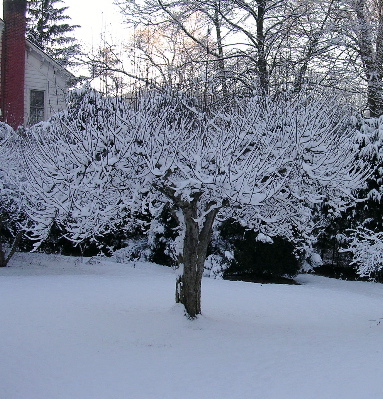
See all those useless, non-flowering water sprouts sticking straight up? That’s a present from last year’s dormant pruning. It’s not so bad on trees that have been kept in check from infancy, but it can still be a pain in the pruner.
The Argument, Short Version:
Advantages of dormant pruning:
Leafless branch structure is clear; you can see what you’re doing
Fungus diseases are dormant too, so there’s less danger of transmission
Tree is just about to start the active growth that promotes wound-healing
You are not doing the 30,000 other agricultural things that claim your time in midsummer
Advantages of summer pruning:
Vegetative growth is restricted. Tree stays smaller.
Tree does not send up a gazillion water sprouts that must in their turn be pruned.
Fruiting spurs develop closer to main branches, and there are often more of them.
It’s ( usually) more pleasant to be working outdoors
It was 4 degrees and quiet when we woke at 6:30. Now at noon it’s up to 10 and blowing like a bandit, with merry tinkling of ice pellets against the windows and the occasional loud whoosh of something that would be granita if it had flavoring.
Inside, two harbingers of spring:
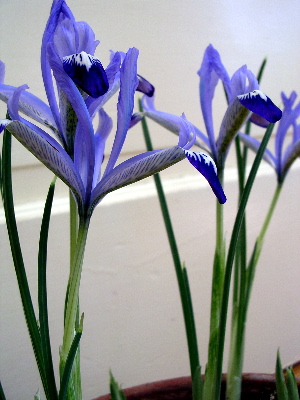
Iris reticulata is easy to force and unlike tulips, daffodils and I. versicolor (old-fashioned blue flag) it’s seldom sold by florists. This is Clairette, which is not like its picture both because it’s much more purple and because it’s much more fragrant. Catalogs seldom mention the perfume of these little charmers, but it’s definitely there and far easier to appreciate when the garden is on the tabletop.

The beans in the bag are Dr. Martin limas. !Delicious! Sweet and lima-beany and creamy, not mealy even at full huge size of over an inch wide. Didn’t used to be able to grow them in the Hudson Valley. Would cheerfully trade them for less global warming but let’s not forget the ill wind part … Seed is comparatively rare and well-worth saving; we got the original batch from Rohrer’s
For a delicious, versatile, inexpensive vegetable that has “winter” right in its name, hard-shelled squash gets surprisingly little seasonal respect. Dedicated foodies who can wax eloquent over the respective merits of yellow-eye beans and Jacob’s cattle seldom discuss the much larger differences between, say, the dry-fleshed, nutty-flavored Tetsukabuto and the creamy, well-named Sweet Dumpling.
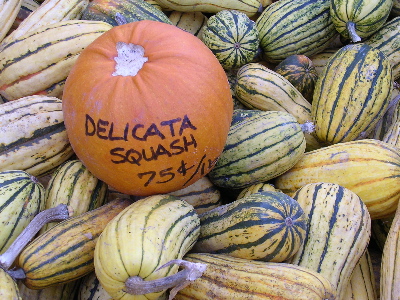
The sign-squash is a rejected pumpkin. No stem, no sale.
Think I’m exaggerating? Have a squash tasting, using at least 3 varieties and preferably 3 species. That might be delicata (Cucurbita pepo), buttercup (C. maxima ) and butternut (C. moschata), but if you range beyond the supermarket, you can probably put together a more exotic assortment. Either way, you will be amazed, and unless there are a lot of you you will also wind up with quite a bit of extra cooked squash. Terrific! Just freeze it in meal-sized packets and you’ve got a stockpile of nearly-instant great food.
When the basic ingredient is ready to roll, it’s only minutes to warming cream of squash and orange soup, with or without a sprinkle of Aleppo pepper; baked squash under a blanket of crisp crumbs flavored with olive oil and lemon zest; or utterly simple broiled squash, spread in a shallow buttered pan and broiled until the top is dotted with flavorful, caramelized brown spots. This is also tasty with store cheese grated over it at the last minute. Also salsa. Also parsley pesto… you get the drift; if you want it even sweeter, the thing to make is pie.
To Prepare Squash for a Tasting ( or almost anything else): Heat the oven to 375 degrees. Rinse any clinging dirt from the squash and whack off the stem with the back of your heavy knife. Cut squash in half as evenly as possible and scrape out the seeds. Oil the cut surfaces with olive oil and put the squash cut side down on a sheet pan or jellyroll pan. Bake until a thin-bladed knife sides in easily, anywhere from a half hour (Sweet Dumpling) to about an hour and a half ( Marina di Chioggia), depending on the thickness of the squash meat and the variety of squash. Turn it right side up and use a sharp-edged spoon to scrape the squash meat away from the rind.
On Sally Spillane’s freewheeling Garden Show our topic was (mostly) the joys of winter garden reading , and in the course of the proceedings I mentioned several favorite publications.
Then when we hit the usual frantic time crunch at the end I promised to list the access info. here , so:
The Flower and Herb Exchange yearbook
The Garden Conservancy open days directory
Pomona, quarterly journal of the North American Fruit Explorers
Baker Creek Heirloom Seeds
The Pepper Gal – seeds
Select Seeds-Antique Flowers – seeds and plants
Totally Tomatoes – seeds, not plants
At Seed Savers, it’s 5 Color Silverbeet. At Johnny’s, which got an AAS award for it in 1998, it’s Bright Lights. At our place, it’s just rainbow chard, a must-plant delight: easy to grow, easy to cook, beautiful all summer long and long into the fall.
Bill insists it’s sweeter after frost; I think he’s simply confusing it with cole crops like kale and collards, which are sweeter, because temperatures below 40 destroy sulfur compounds. Sweetened or not, rainbow is slightly less frost hardy than regular chard, so we dug it up when temperatures started going way down – way back in early November there actually were a couple of nights when it hit the mid-teens.
The plants were set upright in a big pot lined with a thick plastic bag, with no more dirt than what was left clinging to the substantial roots. The pot was stored in an unheated enclosed porch , aka our well-lit walk-in. Every once in a while, I pour some water over the bases, but not very much.

chard plant, out of pot for photographic purposes
We have been harvesting regularly, breaking off leaves as needed as though the plants were still in the ground. When all have been eaten, we’ll compost the stumps. They could be replanted in mid-spring, if we wanted to save seed, but we’re not that dedicated. (Colors cross, so the pros grow each one in isolation and mix the seeds at packaging. )
Some say the different colors taste different, a lot to assert given that the colors include pink, red, purple, magenta, orange, yellow, white, white with pink stripes and some extremely zingy mixtures of pink and tangerine. All I can say is that none of them are as good as plain old white-stemmed Lucullus. But gorgeousness counts, even if the colors don’t stand up all that well when cooked.
Cooking Swiss Chard
is sort of like cooking chickens and turkeys – it helps to remember that cooking the thing whole is likely to be unkind to one part. Instead of light and dark meat, chard has stems (petioles) and leaves.

Chard Stems appear almost celerylike, very sturdy and crisp when raw. But at least when the chard is freshly harvested, they get tender quickly and tend to end up unpleasantly flabby if cooked for more than a few minutes. Most recipes say the stems are tougher than the leaves and should be cooked longer, but when we cook the chard from the garden we add the chopped stems near the end, shortly before the leaves have cooked through.
In Europe , stems are as highly prized as the leaves and those from varieties like Blonde de Lyon and Monstruoso are frequently cooked solo. Standard advice is to cook them like asparagus , which I take to mean “like asparagus the old-fashioned way: briefly blanched, thoroughly drained, then finished with a rich sauce such as browned butter or hollandaise.” You’d think boiling would be ill-advised with something so watery, but in my experience it works as well or better than steaming and stir-frying.
The alternative, especially when you want to preserve the bright colors of Rainbow types, is not to cook the stems at all. Just slice thinly crosswise (longitudinal julienne can be stringy) and sprinkle over hot cooked greens, toss into salad or add to a slaw of fennel and celery.
Not much needs saying about the Chard Leaves, except that they’re delicious prepared any way you’d prepare spinach and most of the ways you’d prepare stronger greens like kale and broccoli raab. Also nice stuffed and stewed, just sub pairs of them for the single cabbage leaves in your favorite stuffed cabbage recipe.