Food and Flowers
In Part 1 of the fall planting series, I seem to have neglected to mention that many of the herbs and flowers that can be left to plant their own seeds should be grown directly from seed no matter who does the planting, so letting them do the job themselves is not only easy but wise.
Giant red amaranth, for instance, is very easy to transplant. It has such a great will to live that unwanted seedlings ripped out and thrown aside will pick up their heads and forge onward with no help at all. But transplants never achieve the great heights that make this thing such a head-turner. Even when coddled they seldom get more than about 4 feet tall, whereas plants that have never been disturbed…
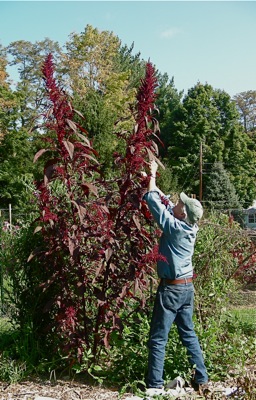
Bill showing you that the Giant Red Amaranth is about 9 feet tall right now. I can't show you the hedge of it in the other garden because he cut it down so it wouldn't shade the chrysanthemums and broccoli raab.
The impending sweep of storms is likely to fix it, but for right now the Maine garden is still way too dry to start moving shrubbery around. And let us not speak of the bulb order, which as usual (sigh) isn’t done yet. But none of this means next year is being neglected; the easiest fall planting of all is happening right now, all over the garden.
Flowering plants make seeds; it’s more or less their mission in life, so this is the season when negligence rules. No more deadheading! The birds are grateful right away, as anyone knows who’s watched their cosmos bending under the weight of goldfinches. And I’m (almost) always grateful in spring, when there’s a nursery’s worth of volunteers to play with
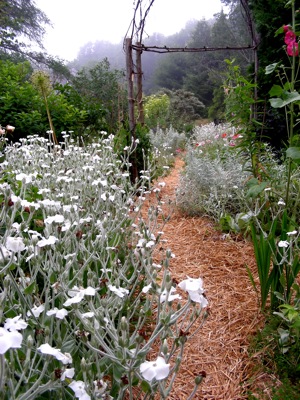
This border of Lychnis coronaria 'Alba' comes back every year, but it was unusually lush this summer because of the drought (hates wet feet).

The peony is Florence Nichols, the background of lychnis buds is the kind of happy accident you get when you let loose the self-sowers.
Read More…

people waiting for something besides food, please be patient. I’ll be with you in a minute, but right now
It’s Tomato Time!
although only because we have two gardens. The plants in Maine are pathetic – it was just too cold, too dry for too long when they were young. But the tomatoes in New York. Omigosh.

Bill ( 5’ 9 or so) in the tomato patch. Note the naked bases, disease-prevention at work.
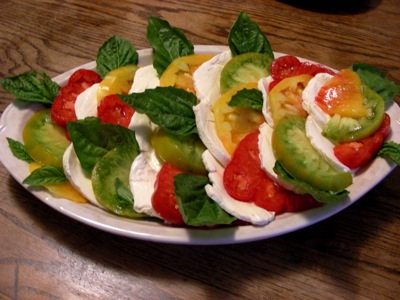
heirloom tomatoes and mozzarella, with lettuce leaf basil
The summer classic, with Pruden’s Purple (red), Malakhitovaya Shkatulla (green), and Hillbilly Potato Leaf (yellow with red streaks)
They’re all different sizes, as usual, but a larger number than usual are larger than usual
Read More…
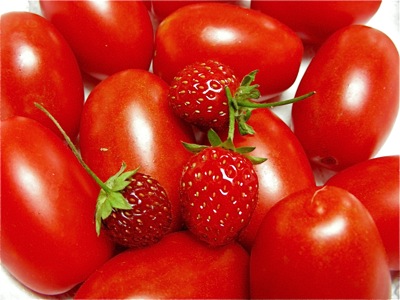
Department of fruit being red so animals will eat it and spread the seeds and Leslie will notice it and take a picture.
This arrangement is not a put up job, honor bright. I came in with only a few strawberries – more on the elusive Mara des Bois shortly – so I just threw them in the basket on the kitchen table on top of the Juliet plum tomatoes, our favorites for drying.
More on that, too, before long, but right now I have to go make supper: chantarelle and lobster-mushroom chowder with la ratte potatoes and what’s left of the grilled sea bass we had last night.
The first seriously beautiful allium that I remember seeing wasn’t an “ornamental” at all. It was a plain old leek that wintered over, didn’t get harvested and burst forth in early summer with a fist sized globe of little white stars, on a naked 3 foot stem. Quite a step up, in more ways than one, from the purple powderpuff flowers of chives. I was immediately hooked.
First and still a favorite: the Star of Persia, Allium christophii, a 2 to 3 footer topped with a loose ball of silvery purple from 4 to 6 inches across
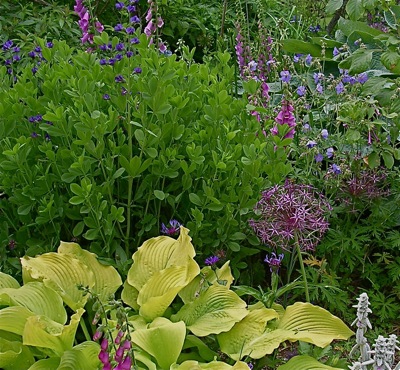
the Star is in the lower right Read More…
The peas are something I’ve taken for granted for a long time now, because classic Sugar Snaps never seem to fail. Good years and bad, those tall, late-bearing vines always come through with about 6 weeks of perfect snap peas: crisp, juicy and sweet. And twenty feet of double row pretty much guarantees enough. In good years, we give a lot away, and even in poor years like this one we still have plenty.  How much is plenty? I never measured before, but we just had an opportunity to check it out – Read More…
We’re visiting the New York garden to weed, tie up the tomatoes, harvest the garlic … and get majorly appalled by the Japanese beetles. What a year! They’re everywhere, and they’re especially everywhere on the contorted hazel and hollyhocks and raspberries and of course roses but NOT on Jens Munk,

once again proving itself to be as trouble free as roses get. Read More…
Over the years, we’ve grown at least a dozen kinds of strawberries, mostly standard garden varieties (Fragaria x ananassa) like Sparkle and Tristar, and so-called “wild” strawberries, aka fraises de bois and alpine strawberries (F. vesca), like these Mignonettes being used as an edging in the lower garden.
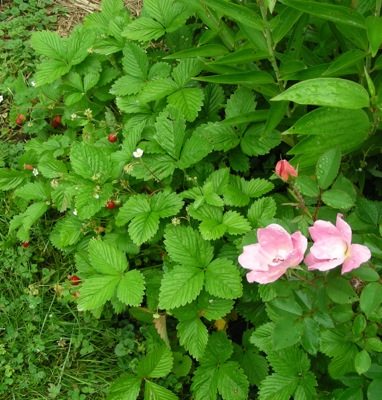
Cultivated strawberries are easy to grow, almost always tasty and sometimes very tasty. But none of them – yet; I keep trying – are as good as genuinely wild strawberries (F. virginiana), the intensely flavorful, amazingly aromatic gift that grows freely in woodland edges all over the northeast and beyond.
Read More…
Former scenario:
It’s late August. The tomato rows are solid plant. I’m down on my knees in the jungle, pushing aside the mulch, digging around in the soft earth at the base of a mystery plant. It MUST be here somewhere and when I find it I will know whether the fat juicy sweetsharp tomato we had at lunch was a Brandywine or a Prudens Purple.

No more mysteries.
The place on the pole will be covered too, but the label will still be firmly in place.
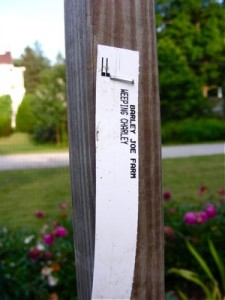 If you use wire supports you can use Kristi’s never-fail identification system. Get flat green plastic plant-tying tape, write the name on it with sunproof (!!) permanent marker and tie it to the top wire.
HA! No such thing. But if you want to make sure you don’t buy something like

this
and wind up with something like

this
Read More…