Friends and Foes
But before we get all excited and start spending zillions on gorgeous new ones, it’s peony cleaning up time. The fungus diseases that plague peonies overwinter on dead peony leaves and flowers, so getting rid of all traces of same is the best defense against future infection. There is no applied control, organic or otherwise, as effective as simply being tidy to the nth degree.
Cut stems down to an inch or so above ground, preferably while the leaves are still firmly attached. It’s always a wrench to remove a whole bush full of beautiful fall foliage, but snipping off all of this year’s growth before it falls apart makes the subsequent raking of leftovers far less of a chore.

Making bouquets helps; peony leaves and fall flowers are pretty much foolproof
Needless to say, none of the detritus should go on the compost. Sending it to the landfill is ungreen. Burning it is against the law in many places. Fortunately, there is almost always some dumping spot – in the woods for instance – where peonies will not be planted in the foreseeable future.
It doesn’t hurt to get rid of the mulch, too. Very small bits of former peony are undoubtedly embedded in it. And as a side benefit, mulch removal exposes the plant bases so you can get a good look at them. Everything is probably fine, but if you see humped up crowns you know it would be wise to divide and reset the plants.
Actually pretty gray right now, so that title may be premature, but assuming no more major rains fall (and that you don’t count the new leak in the roof), we got off lightly.
We had buckets out, not rain gauges, so the closest I can put rainfall is 6 to 8 inches; and although the winds were theatrical at 5AM, I doubt they were much over 30mph.

The good part is that it puts the top beans within reach.

You may be looking at this and thinking “What’s the big deal? jar o’ water under a tree.” The big deal is that there’s a huge hole near the bottom of the jar, on the side that’s jammed up against the trunk.
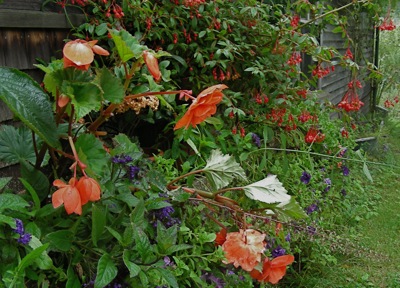
My punishment for not staking up the big begonia. ( The small flowered one hangs anyway)

aka Chenopodium album, tender, nutlike, easy to cook — and of course very easy to grow. All you need to do is stop pulling it up and start harvesting the tender stems and leaves to sauté in olive oil with garlic, steam in lemony chicken stock, cream just like creamed spinach or make killer lambsquarter quesadillas.

Read More…
We’re visiting the New York garden to weed, tie up the tomatoes, harvest the garlic … and get majorly appalled by the Japanese beetles. What a year! They’re everywhere, and they’re especially everywhere on the contorted hazel and hollyhocks and raspberries and of course roses but NOT on Jens Munk,

once again proving itself to be as trouble free as roses get. Read More…
How dry we are! It’s just the worst – our sliver of the Maine coast has had less than a half inch of rain in the last 5 weeks and we have only a shallow well, barely enough for dishes and showers. I’m watering the joint with my tears, and when friends complain they’ve been stuck dragging hoses around for eversolong, it’s hard for me to dredge up much sympathy.
Some crops are going to be all right, and there’s still plenty going on – Lois had no trouble finding something to paint the other day
but if you look a little closer Read More…
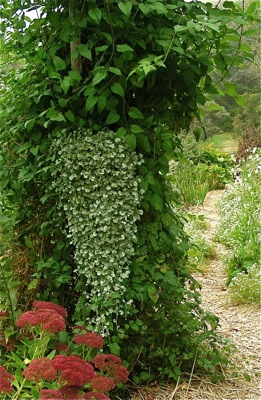
It’s fashionable to hate annuals, particularly common annuals like the licorice plant ( Helichrysum petiolare) that’s spilling along here in front of the clematis. But as stepdaughter Celia says ” Phooey on that.” Read More…
They’re vegetarian rats, basically. Eat bulbs, empty birdfeeders, gnaw through attic walls to make smelly nests, from which they sally forth to eat the insulation from electric wires. Absolute proof – if we needed any – that good looks can get you a pass on a lot of bad behavior. If they had rat tails instead of those bottle brushes and did not have the habit of sitting up and eating with paw-hands, and
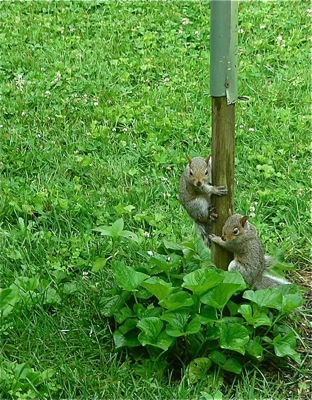
if the babies weren’t so damn cute, we’d be a lot farther ahead in squirrel eradication.
And don’t talk to me about dispersing seeds. If I find one more “volunteer ” black walnut with a taproot halfway to China…
Right. So what did we do with this little pair, scarcely larger than the violet leaves, happily playing for half an hour oblivious of dangerous humans only 10 feet away? We ooed and ah’d and elbowed each other and I ran out in my nightie to get photographs.
Bah, Humbug.
We all know the metal baffle does nothing. Taking down the feeder just sets them into the borders to nibble new buds. Any suggestions?
are the happiest tomatoes. Well, not really. Gentle, consistent warmth is what tomato plants want – not only on their leaves and flowers ( tomato pollen is sterilized by temperatures over 85), but also around their roots, which by the way – news flash! – prefer to stay moist.
Tomato Planting Tips
By now your seedlings are probably planted, so it’s too late (for this year) to say the first line of defense is deep planting – set the baby so 1/3 to 1/2 of the stem is underground. Useful new roots will form all along the buried portion.
I used to think it was important to remove leaves and suckers before burial. Bill made fun of me. We did a side by side experiment. He was right; didn’t matter a whit. One less thing.
Ok. They’re in there. Now what? Two things
1. Mulch, really a lot of mulch. We use a thin layer of newspaper – just one fold – under a largish pile of straw. This holds moisture in the soil and helps keep roots from frying. I put my hand down on the uncovered earth when I was weeding yesterday and it was HOT. Not warm. Hot. Not good.
 Tomato mulching in progress. The brown paper grocery bags are a thicker weed (and water) barrier. Helpful if your raised beds are really raised. These are about a foot above the paths.
2. Limb them up. If you have no problems with fungus diseases you can stop right here, but if blight has ever visited you, read on.

The scar is difficult to find, but if you look closely at the left side of the stem you’ll see the scar where a branch used to be.
Removing lower leaves and suckers so the stem is naked at the base accomplishes two things:
1. It provides good air circulation, an absolute necessity ( crowding is the mother of disease).
2. It deprives the fungus spores of handy landing spots from which to travel upward. In theory, a timely application of mulch will block spores so they cannot splash up. In practice, it helps but not enough to be relied on exclusively.
It has been several years since bears first came through our yard, knocking down the birdfeeders and leaving unmistakably bearlike deposits to corroborate the neighbors’ sightings: a mother and 2 cubs. The beehives remained untouched so we remained unconcerned, even though we should have known better.
As summers passed and nothing else happened, we stayed (relatively) unconcerned, even though Dan right down the road reported several ursine visits that played hell with his hives.
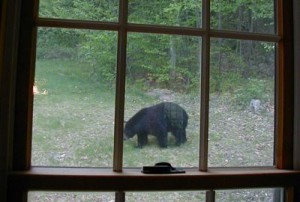
This year, the Dan reports were scary: a mom and cubs and a singleton, presumably male. In the yard. In the hives. On his porch.
Dan Connors
View through Dan’s sunroom window
When he chased the solo in his car, lights flashing and horn honking, it retreated to the edge of the woods. When he backed up it emerged, more or less thumbing its snout.

Dan Connors
And Then it came for us
As Bill wrote to a friend on the 6th of May:
“This morning we awoke to find our beehives and bird feeders all torn asunder. I had just spent $170 for 2 packages of new bees and they had just released the queens and were just getting settled in their new homes when this happened.
I spent the day rebuilding the hives and installing an electric fence around the hives. If you hang some bacon on the wires, so we hear, the bears wrap their tongue and lips around it and get a good jolt.. We are eagerly awaiting their shocking bellows.
A mother and two cubs and another solo have been raising havoc in the neighborhood. DEC said that, since the bees are livestock, I can shoot the bears. They will give me a permit for and provide me with, rubber buckshot if I wish. They would also like to come and grab these animals so for to give them a collar… Once they have good data to justify a hunting season they will allow hunting for them in this county.
In 1990 there were @ 400 bears in the Catskills (across the river). By 2005 the population had grown to 4,000 to 5,000. @ 500 were taken there last fall….”
So far Bill’s fence has not been challenged – or at least we have heard no bellows and the bacon appears undisturbed. (More points for crow smarts? They are expert compost-pickers, ever alert for a bit of protein, but they haven’t come near those wires, even though they should be immune.)
Here are the fence details Bill sent to Dan, should you wish to build a solar powered electric bear deterrent around anything:
“ I went ahead with the more expensive unit (Zareba SP10). It also happened to be just about whatCornell and Bee Culture (via Cornell apiarist) recommend. It puts out just about 5,000 volts and 0.17 joules.
It is good to see it snapping sparks for @ 3/16 inch over the raindrops!!!
I strung my wires alternating hot (+) and ground (-) with the lowest wire 6″ above the ground and the top wire ground (-) for lightning protection. Since I used steel posts the ground wires are wrapped directly onto the posts. I used 12 gauge copper jump wire to connect the hot wires as well as for the lead from the controller. I suspect I could make a slight improvement if I grounded the unit to the steel posts as well as the usual ground rods.
Gotta hand it to eggs. You can use EVERYTHING, including the shells, an extremely sharp-edged material that is almost pure calcium.
In the house:
* great for cleaning narrow-necked bottles and vases. Crush a shell, working it between your fingers so the bits aren’t stuck together. Stuff it into the bottle, add a small amount of very hot water and swish/shake vigorously until all looks clean. Pour out, catching the shell in a strainer in case you missed a spot and have to shove it back in.
In the garden:
* Dig one or two thoroughly crushed shells into the soil around tomato plants. The lack of calcium that causes blossom end rot is usually a result of inconsistent watering but a little extra insurance never hurts.
* Rinse and dry shells, then crush to roughly rice grain size bits and spread a carpet of them under hostas and similar plants to discourage slugs and snails. Many advisors say “sprinkle” the bits, but a sprinkling won’t have much effect in the deterrent department. This carpet is not beautiful. You can make it a little less sock-in-the eye by soaking the crushed shells in strong tea for several days to stain the white parts brown.
* Excellent in the compost. No need to crush if you don’t want to bother, but as with everything else, the smaller the piece the sooner it rots.
* substitute for peat pots. NOT. In An Island Garden (1894), Celia Thaxter charmingly describes starting poppies in halved eggshells. It sounds like a great idea: Biodegradable, easy to transport and free. In my experience, however, it’s difficult to get the shell halves reasonably even, even when you hard boil the eggs so you can slice them across. Then you’ve got to bore a drainage hole ( darning needle better than icepick). They don’t hold much soilless mix, so they won’t support plants for long. And then you’ve got to fracture them before planting so the tiny roots can get out. Applying just the right force to the squeeze is an art all by itself.