landscape and design
I hate to gush – ok, I don’t hate to gush – only giving fair warning that paragraphs are about to be spent swooning over the forsythia. It’s spectacular in the Hudson Valley, friends tell me the same is (was) true at least as far south as Pennsylvania and if the buds are any indication; it’s going to be amazing in Maine, any minute now.
Every spring is wonderful – how can a plant be so blindingly sunny – but I think this is the best I’ve ever seen it… seems like every single bud came through the winter unscathed.
Forsythia as a plant is tough, but the buds often get frozen; that’s why after a hard winter you often see bushes with only a skirt of flowers, all the color close to the ground where it was protected by snow.
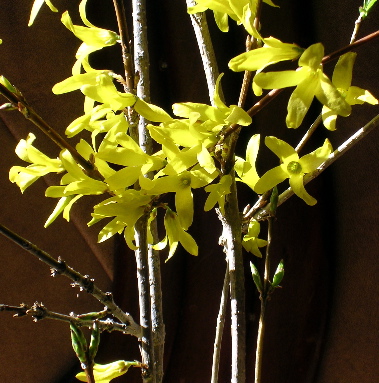
Common Forsythia (F. x intermedia), unknown cultivar from a friend
In theory, forsythia can be attacked by bugs and diseases, but the only problem I’ve ever seen is age. Best bloom comes on 2nd, 3rd and 4th year stems , so when the bush is choked with ancient trunks that can’t manage much in the way of new sprouts, total bloom begins to decline. The standard rule is to prune yearly, after the 4th year, by removing the oldest stems at the base, but I’ve never been that fanatical. It’s easier to just look at the bush and see what’s blooming well and what’s not. Unbranched young shoots won’t be flowering, but their youth is obvious, so there’s not much chance of making mistakes.
There is, however, a chance to make a great many more plants: common forsythia is as easy to propagate as willow. Just keep the stems in water – changing it every week or so – until root initials form along the submerged part.
Forsythia spreads like a weed, and a lot of ’em ARE weedy, but there are at least seven species and more than 40 cultivars, including many dwarf types, several that are variegated, and one : Forsythia viridissima var koreana ‘Kumson,’ that has white veins in its dark green leaves and looks like a real stunner. It’s rated hardy to zone 6, so it ought to be ok in the mid and lower Hudson Valley, and I intend to give it a try in Maine, too…
The widest choice is by mail-order , from sources like Rare Find Nursery and Forestfarm, but the more alert local nurseries also offer good selections, and many of them will special order if you ask, especially if you ask when they aren’t crazy-busy. Wholesalers sell far more
goodies than retailers have room to display
Department of Just in Case You Were Wondering: There is a European species (from the Balkans), but most forsythias are native to Asia. Plant hunter Robert Fortune is credited with bringing them to the West, in 1844, but the botanical name honors Scottish botanist William Forsyth (1737-1804), a major player in British horticulture who ran the Chelsea physic garden, started an international seed and plant exchange, and wound up as King George 3rd’s chief superintendent of the royal gardens at Kensington and St James’s.
I know this is the age of instant gratification, but – this being the season – let’s hear it for planting young trees. The rewards ( I speak from experience) are huge: a personal forest – or great big hedge, or both – isn’t simply a visual treat and haven for Our Friends The Birds, it’s also shelter from road noise, wind, and whatever lies next door. And as long as you don’t go overboard, trees are a terrific investment. Deposit a 4 to 6 footer now, enjoy a major increase in property value when it hits the 14 foot mark – or, of course, soars beyond.
Our hemlock hedge, for instance, is about a hundred trees long, so it had to start out as young ‘uns. We paid 5 or 10 bucks apiece – this being 12 years ago, more or less – for an assortment of rather spindly 4 to 5 footers. Two years later, when the tallest had barely hit 6 feet and were still more promise than performance I got antsy. Bought a bunch of 10 footers, at about 40 bucks a pop, to plant in front of the most grievous eyesore.
Sure enough it DID make an immediate difference, but the little guys only took 2 or 3 more years to catch up, and once they did that was it for the benefit – annual pruning evened it all out. Now that every tree in the hedge is 14 to 16 or more feet tall, you can’t tell which is which.
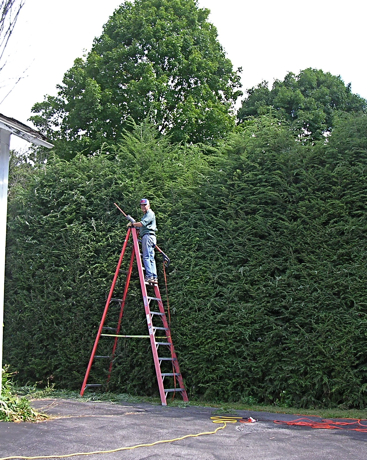
That’s Bill with the electric pruner, on a 12 foot ladder.
Other benefits of starting small:
* small trees suffer less damage when taken from the field, so they recover more quickly when planted ( big trees usually stay the same height for at least a couple of years ; they’re too busy repairing their roots to do much of anything else.).
* small trees are DIY, which matters huge when you’re talking about a lot of them. You can pick up a 4 footer without serious consequences for your back. You can dig a hole for it without taking all day, and you can keep it watered … even a skinny 8 foot tree needs about 20 gallons of water each week – more if the weather is hot and windy.
The alternative, if you’re planning to stay put for a long while or have truly extensive tree needs, is a whole bunch of the tiny trees sold super-cheaply by many soil and water conservation districts and slightly less cheaply but still bargainish by mail order tree-nurseries. These’re little sticks, about 18 inches tall… it’s gonna be a long time to glory; and you do have to spray ’em against deer for at least the first couple of years. But they’re certainly easy; one stroke of the shovel is all it takes. And the price is right: here in Dutchess County, NY, it’s $16.50 for a bundle of 10 Norway spruce, each of which will ( or more properly, can) grow 50 or more feet tall.
The pre-order period is over so there are no guarantees, but leftover bundles are usually available at the yearly plant sale at the Farm and Home center on Rte. 44 in Pleasant Valley. It’s April 21 and 22 ; be there early or be disappointed. For further details call 845 677 8011, extension 3, or see the website.
Can’t say I never met a plant I didn’t like – there are hundreds you couldn’t pay me to grow – but I do love far too many. Plus I’m a patsy for garden porn, easily swayed by catalogs that look like Frederick’s of Sissinghurst. As a result, spring around here is a constant struggle, a tug of war between loving plants and loving the garden itself.
Recall the gardens that struck a chord and it’s likely you’ll think first of a long view, framed but unobstructed, or a wide slice of sky between trees, a smooth lawn bordered with flowers, or maybe a waving hedge of tall grasses next to a flagged patio – nary a blossom in sight … in all these cases, place trumps plants: great gardens are always edited .
Even crammed-in cottage gardens, famously places where plants are “riotous,” that riot has harmony and rhythm. One or two orange lilies popping up in the middle of a small bed filled with a haze of bluish perovskia and pale purple verbena would look great. But if in addition there were also a couple of white phlox, a magenta coneflower, and 2 or 3 red and white roses …
Well, trust me. No.
In other words, the mantra for today is: take out the things that stuck out last year, and try to think of where that sexy new black elderberry, red monarda or gold-leafed heuchera is going to go before you plonk down your money.
This week’s garden tips:
* Weed. Weed , and then weed some more. Roots come easily out of cool, wet soil, and if you get evil actors like garlic mustard now, before they get a chance to flower, you’re well on the road to control… at least in selected spots.
* Have you cut down your big grasses yet? Removed all the artistic dead stuff you left last fall to add winter interest? If you do it NOW, you can just use hedge shears to slice everything off at the base, a couple of inches from the ground. Wait two weeks – or one – or maybe five minutes, and the new growth will be in the way.
In theory, you should have a wheelbarrow with you, so you can haul away the debris, but screw that. It’s more important to just leap out there and get stuff done whenever you can spare a few minutes. The world is largely one big debris pile at the moment anyway, it’s not going to make much difference if there’s a bit more of it lying around for a few days.
Of course, you don’t want to leave it around for long, any more than you want to let blown leaves sit on the new grass and kill it. First non-windy day, get out there and rake.
* This is also a good time to renew what I call fountain-growers, pliable-stemmed shrubs that are prettiest when allowed to grow tall and drape over gracefully. Standard wisdom advises pruning in late spring or early summer, after whatever-it-is has bloomed, so you don’t lose any flowers. But that’s just when you have about 40,000 other things to do; and you won’t “lose” any of the flowers if you bring the pruned branches indoors and let them bloom in the vase.
Forsythia is the best-known fountain-grower, but this group also includes kerria, mock orange, wiegela, deutzia, and spirea. They all bloom on year old stems and on year old stems that grow from trunks that are 2 to 4 years old. Trunks older than 4 or 5 no longer send out much new growth, so you have to keep new trunks coming if you want fountains of flowers. ( Simply pruning part way back makes a bristly thicket with polka dots. Not pretty.)
*To manage an old, established shrub, simply cut one trunk at the base each year. Allow 2 or 3 strong new shoots to rise from the ground, choosing those that are reasonably close to the one you’re cutting. Remove the other sprouts so things don’t get crowded.
To manage younger plants, do nothing for the first 3 years, then start the oldest trunk routine.
* To force pruned branches indoors: In addition to those listed above, magnolia , apple, crabapple, flowering cherry, and plum ( which in bloom smells just like cheap incense) are all likely bets. When you get the branches indoors, use a sharp pruner or heavy knife to split the stems several times, then immerse in a bucket of room-temperature water and store in a cool – not cold – place, out of direct sun, until the buds swell and start to open. Change the water every few days.
When the branches are ready to display, rinse the stems and recut them before arranging. It is almost impossible to go wrong with these, big blowsy bunches in pitchers look great, small twigs in tiny bud vases look nifty too. But it’s hard to beat the Japanese effect, if you have those heavy, shallow flower-holders with the spikes on the bottom. One blooming branch arching upward therefrom is almost too beautiful to bear ( also too tempting to the kitten; this year all our branches are in – and then pulled from – the biggest, heaviest vases we’ve got.)
Rereading Vita Sackville-West ( see below) reminds me to say a good word for spiraea, specifically the early bloomers that just had a sort of bloom-time preview because they were covered with snow. The ones in our yard are Spirea arguta, the old fashioned bridal wreath, and S. vanhouttei, which runs it a close second in the grandmother’s garden department. Soon enough they’ll be flowering in earnest, along with thousands of others just like them, in untidy great white arching hedges all over the Northeastern spring.
Like lilacs and forsythia, they lack a bit in year-round charm. But in their season, they’re glorious, they’re very easy to grow, and there are so many cultivars you’re bound to find one that will work at your place. ( One cultivar, that is. I can’t imagine one white spiraea looking like much except lonely.)
To get a better sense of what’s out there than any local nursery can provide, a sense more sensible than Google’s omnium-gatherum, go to Plantinfo online,
a service of the University of Minnesota. It provides access to:
” current sources in over 700 North American nurseries for over 88,000 plants, an estimated 250,000 – 300,000 citations to current plant science literature, listings for more than 2100 North American seed and nursery firms, and an evaluative review of 75 CD-ROMs and web sites of plant images.”
What you do not have is the human voice , which leads us back to Ms. Sackville-West, whose real name was Victoria Mary. She was a novelist and poet, a member of the British aristocracy, the lover and friend of Virginia Wolf and a whole lot else that we won’t go into now because I want to get right to her garden writing, and point you toward her white garden, at Sissinghurst, the most famous white garden in the West and inspiration for countless others.
Few of those others approach it in beauty, partly because they are not located on the grounds of Kentish castles and partly because – all too often – they’re just collections of white flowered items, rather than carefully designed gardens in which all flowers are white.
More on garden design to come, but for now, a few words from Vita Sackville-West. They come from A Joy of Gardening, a collection drawn from two of her books ( In Your Garden Again and More for Your Garden) published by Harper and Row in 1958 and now out of print. But that doesn’t mean much. Those books – and the others based on Sackville-West’s garden columns – have been and continue to be more or less continuously recycled, as a quick check at Amazon or your favorite used book store will reveal. Whatever form you find them in, these short pieces are inspiring and entertaining in equal measure and who can say fairer than that?
” One of the prettiest and easiest of spring flowering shrubs is surely spiraea arguta, more descriptively known as bridal wreath or foam of May. In a warm season it may well start foaming in April ; and foam it does, for every one of its black twiggy growths is smothered tight with innumerable tiny white flowers. In fact you cannot see the plant for the flowers…
Obviously the pure candor of its whiteness would look best against the dark background of a yew hedge, or any dark shrubs if yew is not available. There comes a moment at twilight when white plants gleam with a peculiar pallor or ghostliness. I dare to say of white, that neutral tint usually regarded as an absence of color, that it is every bit as receptive to changing light as the blues and reds and purples. It may perhaps demand a patiently observing eye, attuned to a subtlety less crude than the strong range of reds and purples that we get in, say, the herbaceous phloxes which miraculously alter their hue as the evening light sinks across them. I love color, and rejoice in it, but white is lovely to me forever…”
There isn’t much reason to bother with shoes when you’re just darting out to move the hose, especially now that the straw mulch on the paths is all soft and broken in. The problem is that late summer is also when many tall plants have fallen over, laying their flowering stems on said paths. Ms. Sausage-foot is thus able to report that ammonia DOES quickly dull the pain when you’ve gotten the mother of all bee stings, but don’t expect it to do anything about swelling.
A more tidy type would long ago have ripped up the bolted chicory – beautiful blue flowers be damned. And in the old days even I would have tried to do something about the thick cosmos stalks, broken at the base, that are now flowering at ankle height. Self-sown morning glories would have been ripped out – or given something besides the dahlias to climb … No more. The August garden is now a many-leveled thing and none the worse for it.
The crambe is in full bloom, so we are having the annual crambe debate: does it or does it not merit the space? It’s gorgeous, no doubt about that, numerous 5 foot stems topped with huge clouds of tiny white flowers, but those coarse, cabbagy leaves are not lovely – except to the slugs – and I’m not keen on the smell. Bill says the flowers ” have the fragrance of fine old pipe tobacco.” I say they smell like old socks….
Our other white clouds are the elderberries. Don’t know if it was the slow spring or something about last winter (which was milder than it felt at the time) but the elderberries are doing splendidly. We never net them, so birds will get all the fruit, but if I can squeeze out the time we’ll probably have blossom fritters at least once or twice. The flavor is pretty delicate; I’m not sure I believe the people who go into raptures over them, but they are easy enough to make and we both love doing something so traditional.
No point to complain about hot, so instead I’ll confess that once again I have failed to candy the green sweet cicely seedpods. They’re still tasty, like fennel seeds, but much bigger and sweeter. And they’re still tender enough to stir into the fish stew. But there’s only about 3 days a year when they’re brand new, juicy as well as crunchy – THIS year, there were probably only 2 days, or maybe 2 minutes, – and once again I missed it.
No use crying over spilled cicely when there is so much tying up to do. Even without as much rain as would be good, the heat has forced a lot of explosive growth, perfect for falling down in a thunderstorm. Connecticut Yankee delphiniums, for instance, which in spite of their reputation for sturdiness are just as flop-prone as Pacific Giants. Mine grow in a group of 5, so I can minimize the staked-up-tight look by using slender stakes inside the borders and a cats cradle of supportive string, but…well, just plain old but. Anyone who struggles with delphiniums knows what I’m talking about , and everyone else should grow larkspur instead and not get into this mess.
If you haven’t done it yet, be sure to get out there and thin overgrown clumps of perennials: phlox, coreopsis, monarda and the like, in order to increase air circulation and cut down on the mildew. Remove from a third to a bit over half of the stems, cutting them off at ground level. While you’re in manicure mode, this is also the time to cut back top growth on Shasta daisies, late asters and chrysanthemums, in order to encourage branching. Also don’t forget to keep pinching the basil.
If you’re like me, you’re walking through the garden immersed in a cloud of obligation: oughta weed, oughta prune, oughta mulch, oughta finish planting this ton of stuff that is not planted yet. All true. Nevertheless. This is also the time to garden tour. There is always something to be learned, almost always something to enjoy in other people’s gardens, and if you choose them through the Garden Conservancy’s Open Days Directory, it’s pretty hard to go wrong. The Northeast edition lists dozens of gardens in our area or close enough to be easy day trips. Available wherever good books are sold, or through the conservancy itself: www.gardenconservancy.org.
Now that the narcissi are done and the honeysuckle’s over, the back edge of the property is looking – almost – like someone designed it, someone who is fond of white ( no names, please) : Russian olive and white violets are still going strong; curved hedge of old fashioned bridal wreath is full out. Mock oranges are opening and behind it all there’s a frieze of pure white wild cherry blossoms, thanks to our neighbors’ unkempt swamp.
Memorial day has come and gone, but peony-wise, not much is happening : too dry and too cold for too long. Buds are looking promising, though, and in the meantime FINALLY! – seems like it took forever – we have rhubarb…There’s a reason this stuff is called pie plant, but it’s also a great sauce for lamb and duck and rich fish like shad and mackerel; just make the same stewed rhubarb you’d make to eat for breakfast, except don’t put as much sugar in it and put in a TINY pinch of clove and not-so-tiny pinch of salt.
Those Columbines: Select columbines for spreading by marking the prettiest ones, so you – or the friend you ask for the favor – will remember to let them go to seed. (Just wrap a twist tie around the stem; if you go for a discreet stake at the base, you’re likely to miss it when cleaning up.) They cross freely, so there will be some surprises, but if you start with a preferred color it improves your odds. I’ll put a reminder in when it’s time for seed-harvesting.
Don’t forget to prune the lilacs as soon as they finish: there isn’t much of a window before next year’s flowers start forming. Make sure your loppers are well-sharpened, then get rid of weak growth and bring tall, spindly trunks down to strong young branches. Removing spent blossoms saves energy the plant would otherwise spend making seeds, so it’s worth it when they are still small, but after that it doesn’t do much except help things look tidy.
The same is probably true of rhubarb. Everyone I know, including me, pulls out flowering rhubarb stalks while they are still in bud, in order to prolong the season… and it’s true, the stems DO get stringy when the plant blooms. I’ve been doing this long enough to know that’s mostly coincidence; time and temperature are the main triggers for stringy rhubarb stalks. But what the heck – it only takes a minute ; you feel like you’re doing something useful; and the big stems make gorgeous bouquets for the porch ( bring them into the house at your peril; every one of those tiny flowers drops off when it dies.)