in the wild
It has been several years since bears first came through our yard, knocking down the birdfeeders and leaving unmistakably bearlike deposits to corroborate the neighbors’ sightings: a mother and 2 cubs. The beehives remained untouched so we remained unconcerned, even though we should have known better.
As summers passed and nothing else happened, we stayed (relatively) unconcerned, even though Dan right down the road reported several ursine visits that played hell with his hives.
This year, the Dan reports were scary: a mom and cubs and a singleton, presumably male. In the yard. In the hives. On his porch.

Dan Connors
View through Dan’s sunroom window
When he chased the solo in his car, lights flashing and horn honking, it retreated to the edge of the woods. When he backed up it emerged, more or less thumbing its snout.

Dan Connors
And Then it came for us
As Bill wrote to a friend on the 6th of May:
“This morning we awoke to find our beehives and bird feeders all torn asunder. I had just spent $170 for 2 packages of new bees and they had just released the queens and were just getting settled in their new homes when this happened.
I spent the day rebuilding the hives and installing an electric fence around the hives. If you hang some bacon on the wires, so we hear, the bears wrap their tongue and lips around it and get a good jolt.. We are eagerly awaiting their shocking bellows.
A mother and two cubs and another solo have been raising havoc in the neighborhood. DEC said that, since the bees are livestock, I can shoot the bears. They will give me a permit for and provide me with, rubber buckshot if I wish. They would also like to come and grab these animals so for to give them a collar… Once they have good data to justify a hunting season they will allow hunting for them in this county.
In 1990 there were @ 400 bears in the Catskills (across the river). By 2005 the population had grown to 4,000 to 5,000. @ 500 were taken there last fall….”
So far Bill’s fence has not been challenged – or at least we have heard no bellows and the bacon appears undisturbed. (More points for crow smarts? They are expert compost-pickers, ever alert for a bit of protein, but they haven’t come near those wires, even though they should be immune.)
Here are the fence details Bill sent to Dan, should you wish to build a solar powered electric bear deterrent around anything:
“ I went ahead with the more expensive unit (Zareba SP10). It also happened to be just about whatCornell and Bee Culture (via Cornell apiarist) recommend. It puts out just about 5,000 volts and 0.17 joules.
It is good to see it snapping sparks for @ 3/16 inch over the raindrops!!!
I strung my wires alternating hot (+) and ground (-) with the lowest wire 6″ above the ground and the top wire ground (-) for lightning protection. Since I used steel posts the ground wires are wrapped directly onto the posts. I used 12 gauge copper jump wire to connect the hot wires as well as for the lead from the controller. I suspect I could make a slight improvement if I grounded the unit to the steel posts as well as the usual ground rods.
Hot then cold, dry then deluginal then dry again; it’s been a difficult spring. But this year the Northeast is having an excellent morel season, so there is definitely something good to be said, namely

Blonde morels, Morchella esculenta, get ’em while you can.
The place to get them is in open woodlands or hedgerows, where the soil is alkaline. They frequently keep company with dead elms and dying apples (and poison ivy, I’m sorry to say.)

Bill Bakaitis photo
Morels in a typical habitat. Look to the left and back of the one in the middle to see more. They hide.
Field cleaning ( shaking out bugs, trimming dirt from stems) is essential, and it can be enough if the morels are growing through matted leaves or thick new growth. But a lot of them are in sandy spots or open ground where dirt has splashed up. Always carry a separate bag or basket to put the dirty ones in, so they don’t contaminate the rest.

The little heap at left in front are the dirty ones from this expedition. The little heap at the right is trimmings. Morels last a long time in the fridge if you trim off anything nasty before you put them away, loosely wrapped in waxed paper so they can get air without drying up.
When you get this many, they will dry up before you can eat them all. We used to do this on purpose, threading them on string and hanging them in the greenhouse. Morels are thin fleshed and dry quickly, concentrating the flavor. But for the last decade or so we’ve been mostly stewing them in butter and storing them in the freezer. They keep better texture that way and are much more versatile.
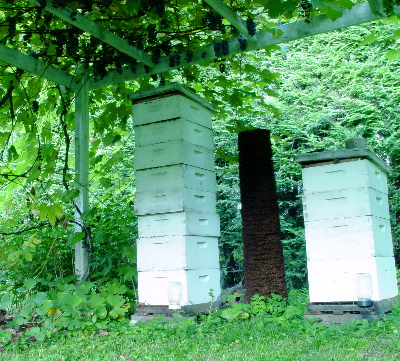
The well furnished home food garden has always and still should include at least one hive of honeybees. But this is easier said than done, so learning that bees were part of Bill’s dowry may have been the thing that clinched the deal, back when we were courting. Fast forward 16 honeyed years: I’m writing a N.Y. Times bee story and in the course of research discover – who knew? – that this little insect may well be the canary in the agricultural coal mine.
Honeybees don’t get much press compared to, say, petroleum, but their pollination services are just as crucial as fuel and fertilizer to about 15 billion dollars a year in crops, from almonds and alfalfa to sunflower seeds. More bees are needed in each place than any one place could provide, so tens of thousands of hives get loaded on trucks, taken to fields or orchards in bloom, then packed up again and hauled elsewhere.
These migratory honeybees are essential to agribusiness monocropping, which could not exist if it had to depend on local pollinators. That’s why the bees have been getting their 15 minutes of fame* – a mysterious affliction called CCD ( colony collapse disorder) has destroyed so many colonies it’s threatening a major industry. Farmers are paying much higher prices for hive rental while also worrying there may be shortages that can’t be overcome, even with expensive imports.
More than you really want to know is posted, with running updates at beeculture.com, but the very short version is:
*CCD probably isn’t new; reports of similar, albeit far smaller, epidemics go back at least as far as 1898.
* CCD is almost surely not one disease or pest or insecticide but rather some unknown combo thereof that exploits the weakness of bees stressed by profoundly unnatural ways of being kept and used. No study has yet revealed a single insult that is/was the tipping point. Each time a likely culprit is fingered, further investigation confirms that it is at best only part of the puzzle.
* Domestic honeybees are livestock: living creatures raised and used by humans. What do we know about them compared to what we know about chickens and cows? Zilch. What are we likely to learn soon? Also zilch, in part because there is no massive bee industry to lobby for public funds or undertake its own research.
The internet allows posts like this to go on at enormous length, but that doesn’t mean they should, so here are a few visuals from our own
Home Grown Honey Harvest, October 7, 2007
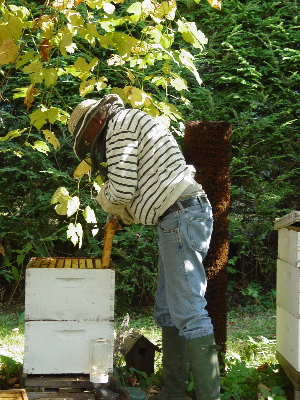
Bill checks to see if there’s any honey in the frame ( a pre-built foundation for the bees to start from).
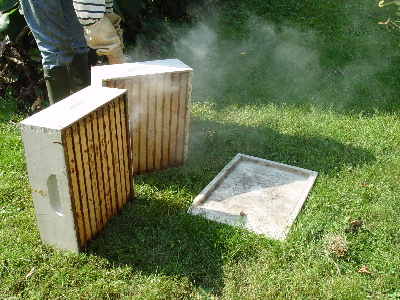
I always thought smoke made the bees think the hive was on fire, so they were too busy worrying about the house to sting anybody. Beekeepers just say it calms them, with the same result.
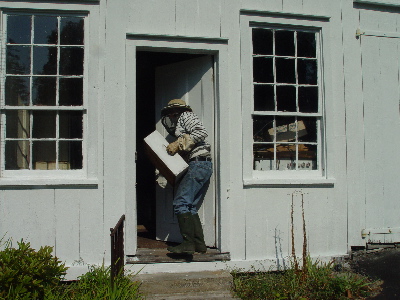
They don’t stay calm long; you have to extract the honey someplace they can’t get to, in this case the barn.
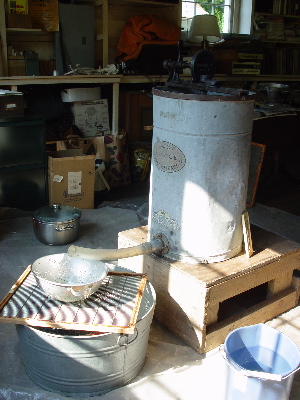
This is Bill’s honey extractor, a galvanized antique called the Root Novice. Modern extractors are steel or plastic and this is probably the place to say that honey is more or less self-sterilizing. It’s so sweet bacteria can’t grow in it and so low in water content yeasts won’t grow either. The reason you can’t give it to babies is that it can contain spores of anaerobic bacteria like botulism. The acid in all human digestive systems that process solid food prevents those spores from growing, but new people who still drink all their nourishment don’t have that protection.
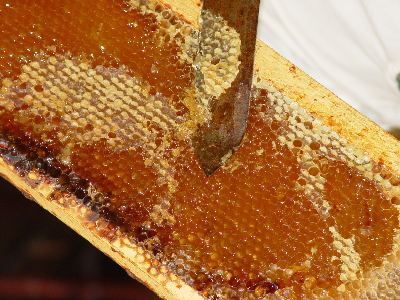
After each cell is filled with honey, the bees cap it with a wax lid. You have to slice off the lids (with a wicked sharp, thin-bladed knife) before you can extract the honey.

Bees gather honey from one source at a time. If you want to name the honey for its source – check out the list at honeylocator.com – you have to harvest it before the bees move on. The dark patch looks sort of like buckwheat but I’m sure it’s not. Doesn’t matter, whatever it is will just add complexity to this year’s vintage.

Frames are held upright by arms in the extractor. Turn the crank and the arms whirl around, flinging the honey out by centrifugal force, same as in a salad spinner.
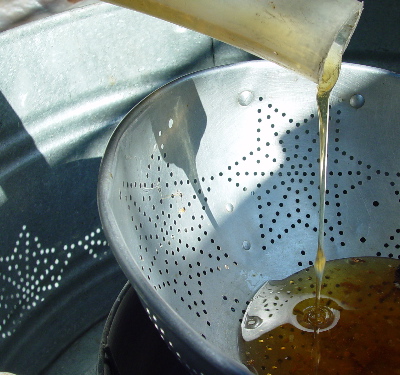
Honey isn’t the only thing that gets flung; the colander catches things like stray bits of wax and the occasional unfortunate bee that didn’t respond to the smoke.

After collection, the honey is poured into sterilized jars. Over the next couple of weeks, any tiny impurities rise and form a thin layer at the top. For gift-giving, we take the layer off. For us, we just leave it as an extra seal until we want to use the honey.
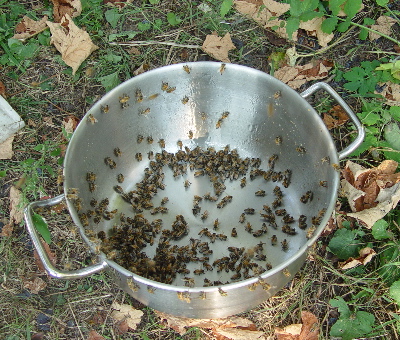
Before the equipment is washed and stored, it’s put outdoors for the bees to clean. They will retrieve almost all of the honey to add to their winter stores.
* Fifteen minutes seems to be about right. Bees are as gone from the headlines as they are from all those dead hives. Tune in next February for a brief flare-up, when almond orchards will need a surge from an army so grievously depleted it may not have enough troops.
Here we go again; it never fails. On the news just yesterday morning – “asparagus is the first vegetable of spring.”
NO! dammit. Dandelions are the first vegetable of spring, or rather they are the first green vegetable. Parsnips that have overwintered (” spring dugs”) are even earlier, but by spring one has had enough roots for a while no matter how sweet they may be.
What dandelions are: delicious. Tender and fresh-tasting, with a pleasantly bitter endive edge and an earthy greenness that has no analogy. They’re low in calories, high in vitamin A , lutein and beta-carotene – look out carrots, you’ve got competition – and absolutely free.
What dandelions are not: instant. On account of the picking and cleaning. But picking is pleasant, a good chance to get outside, and a great activity to share with kids; anybody over about 3 knows what a dandelion looks like. And cleaning goes fairly quickly if you use the greens washing trick that works for anything wrinkled and sandy.
Cooking takes about 5 minutes, so once you’ve got cleaned greens you’ve got fast food.

Greens must be gathered before the flower bud starts pushing up or they will be tough and unpleasantly bitter. Greens from shady places (left) are usually wider, flatter, and milder than greens grown in full sun (right)
Mediterranean Dandelions with olive oil, garlic and lemon.
Fine hot or cold as a vegetable dish, easily expanded into Dandelions with Pasta and Prosciutto, a one-dish supper for spring. Measurements are given mostly for the form of the thing. Please for the love of heaven don’t bother to follow them to the letter.
For 4 servings:
a basketball-sized heap of cleaned dandelion greens, well drained but not dried:
¼ cup olive oil
3 large cloves garlic, minced
2 tablespoons lemon juice; about half a lemon if it’s a decent lemon
salt to taste
Heat the oil in a wide sauté pan over medium-high heat. Add garlic and sizzle until pale gold. Add greens, standing back to avoid the spatter when water hits the hot oil. Stir, cover, turn heat to medium low. Cook about a minute, stir again, recover and cook 2 or 3 minutes more. As soon as they’re all wilted, they’re done.
Dandelions with Pasta and Prosciutto

For 4 servings:
6 ounces thick pasta ( about 2 ½ cups dry)
1/3 cup olive oil
4 or 5 large cloves garlic
about 2/3 cup prosciutto, cut into small dice. *
¼ cup currants
3 tablespoons lemon juice
1 batch cleaned dandelions ( see above)
lemon wedges
Hard grating cheese to accompany **
Get the pasta cooking. When it’s about half done, heat the oil in a wide skillet, sizzle the garlic and prosciutto dice until both start to brown on the edges. Stir in the currants, cover and turn off the heat.
When the pasta is barely cooked, stir the dandelions into the pasta pot. They will wilt instantly. Drain at once and return to the pot. Stir in the prosciutto mixture , taste, add salt if necessary and serve garnished with lemon wedges. Pass the cheese and a grater at the table.
* We use “prosciutto ends,” the bit at the tip that’s too small to slice neatly, chunks our local market obligingly sells at a bargain price. Failing that, start with a single thick slab roughly 1/3 inch thick or substitute some other strong-flavored ham. It won’t taste the same, but it won’t taste bad. Or switch gears completely and use toasted pine nuts instead of the meat.
** last time I made this we used Magic Mountain, a sheep cheese from Woodcock Farm, in Vermont. Parmesan is fine, but why not experiment with alternatives made closer to home? The American Cheese Society has accomplished members in almost every state.
Christmas day: Breakfast consumed, presents opened, the tree not twinkling ( we’ve given it a bye this year) and Baby, it’s warm outside – time for a cookie-redemptive walk.
Never mind the cliches about perpetual November, our bit of the mid-Hudson Valley is eerily like March. At the suet feeder, the usual crew of woodpeckers ( downy, hairy and  red-bellied, one of the worlds more misleadingly named birds, photographed here by Edward Russell)
has a visitor, a Carolina wren.
The wren is not mind-bendingly out of place – our 1980 Peterson field guide says “fluctuating in north; cut back by severe winters” – but personally myself I get a chill when I see Carolina in New York on Christmas day.
The forsythia at the top of the hill has been blooming for the last month, so the flowers are no longer a surprise, and neither is the clump of blewits that came up 2 weeks ago in the oak leaves by the roadway. They’re multiply frost-walloped but still hanging on, only slightly the worse for wear.
The weeds never were surprising; cold-resistance is one way biennials like wild phlox, garlic mustard and verbascum get such a jump on everything else. But we’ve seldom seen so much greater celandine , Chelidonium majus, even though, being a poppy , it’s perfectly happy to wax fat for next year in low light and cold-but-not-frozen soil.
The deeply scalloped greens were lovely, and a reminder of how close some weeds are to relatives on the approved list. This one looks a lot like our native woodland poppy, Stylophorum diphyllum, a rarer plant with larger flowers and less aggressive habits.
It’s easy to tell them apart when they’re blooming – C. majus has small, pale yellow flowers; S. diphyllum has good sized, deep gold ones – or when you see seed pods (C. majus = long skinny sticking up; S. diphyllum = sort of football-shaped, drooping ) but at this time of year the best way to know what you’re seeing is to simply assume the worst, especially if the plant is by the roadside or in some other highly disturbed ground.
Greater Celadine is a present from the New England colonists, who brought it as a medicinal herb, primarily for digestive complaints and to cure skin diseases. A brief google suggests the medical theory is hair-of-doggish; the bright orange sap of C. majus is very irritating to the skin and extracts of the plant have been implicated in liver disorders. It’s also supposed to help with sneezing, which I can testify it causes bouts of if you break the stem while pulling it up.

Greater celandine. The sap is as orange as the roots
Now that it’s over it’s safe to say that this was not the best of morel years in the mid Hudson Valley. Early fruitings were poor, late ones abundant but caught by the rain. Dedicated (i.e. constant) hunters did ok, but we were able to go out only 8 or 10 times and thus ended up with only a few meal’s worth and nothing to put by. Over and over we either found nothing or found the ultimate frustration: carpets of riches too old and rain-ruined to be worth gathering. Fortunately, Bill the determined never quits and on his final trip of the season came home with about 7 pounds of gigantic blondes.
Which we have of course been eating and eating in all of the usual ways, and some less usual ones too, including as a rich saucelike mélange of morels and corn. The combo is an affront to freshness – corn and morels are at opposite ends of abundance season – and I can’t vouch for how this would taste with supermarket corn, but frozen home-grown Silver Queen from last fall was great.
We used it to blanket pork chops and still had quite a bit left over, so the next night when it was Bill’s turn to cook he used it as stuffing for an enormous honker morel almost 8 inches long. ( He halved the thing, egg-and-crumbed the pieces, shallow-fried them crisp and then applied the reheated sauce mixture at the very last minute).
CORN AND MOREL SAUCE
For 4 generous portions:
Slowly cook a diced medium onion in 2 tablespoons of butter until it is semi-caramelized, starting to get deep brown around the edges. Add about 4 loosely-packed cups of coarsely chopped mature morels (3 cups would probably be enough if they were young and less copiously juicy). Let stew uncovered, stirring from time to time, until the morels are fully cooked and liquid is reduced to a few tablespoons. Add a slug of Madeira , simmer for a minute or two, then add 1 ½ cups of very tender cooked corn and about 1/3 cup of heavy, not-ultrapasteurized cream. As soon as these items are hot, it’s done. Taste, add salt if needed and serve.

One of Bill’s finds, with the proper cooking fat.
When it comes to Foods the Americas Gave the World (as the Smithsonian once described them), the Americas in question are mostly South and Central, original homes of tomatoes, potatoes, corn , chiles, chocolate and vanilla, just for starters. Once you head North, there aint much shakin’ except wild rice and maple syrup.
But there are the world’s best strawberries, tiny wild strawberries, Fragaria virginiana, the ones that Roger Williams was talking about when he said, in 1643 “…this berry is the wonder of all fruits growing naturally in these parts. It is of itself excellent so that one of the chiefest doctors of England was wont to say, that God could have made, but never did make a better berry. …”
Still true – and one of the wonderful things about them is their subtle variation: color, shape and sweetness all depending on the soil, the shade, the weather of the season. Always delicious but never predictable, the best are so intensely fragrant it takes just a handful to lift a whole quart of garden berries into the sublime.
A mercy, that, because picking wild strawberries is – let us not say a pain – but certainly not a task for the time pressed. The biggest one I’ve ever found was about the size of a nickel, though plumper, and you do have to know a good spot; thickly carpeted with plants – each one bears just a few fruits – and undercarpeted with grass, leaves or some other barrier to sand and dirt. (washing any strawberry is bad, washing the wild ones is criminal – and usually ineffective. )
It would be easier if you could move some into the garden, but for some reason you can’t. Or rather, you can move the plants; but they will remain just as shy bearing and the fruit won’t taste the same.
Enter fraises de bois, wood strawberries, F. vesca, often called wild strawberries by the wishful thinkers who write menus. Slightly larger than the wild ones and very easy to grow in gardens, they are dependably delicious — if you believe the catalogs.
Over the years, I’ve grown several varieties, including Alexandra and Baron Solemacher, each of which is often touted as tastiest. Every one of them, to a strawberry, tasted exactly like fake grape flavoring – the kind in cheap candy and gum. ( should say they taste the way this flavor smells on the breaths of others. I must have consumed some when a child but that was quite a while ago).
I am not alone in this opinion. A brief supporting quote – from Eleanor Pereny’s garden classic, Green Thoughts, is on the May 4th podcast from Virtual Hudson Valley.
Perenyi, who attributes the whole fraise de bois phenom to savvy marketing, starts out by quoting Alice B. Toklas, another authority to be reckoned with: ” The small strawberries, called by the French wood strawberries, are not wild but cultivated. It took me an hour to gather a small basket for Gertrude Stein’s breakfast, and later when there was a plantation of them in the upper garden our young guests were told that if they cared to eat them, they should do the picking themselves.”
I wouldn’t add these words (from The Alice B. Toklas Cookbook) if it weren’t for the next paragraph, forgotten until I went back to find the strawberries:
” The first gathering in the garden in May of Salads, radishes and herbs made me feel like a mother about her baby – how could anything so beautiful be mine. And this emotion of wonder filled me for each vegetable as it was gathered every year. There is nothing that is comparable to it, as satisfactory or as thrilling, as gathering the vegetables one has grown.”
(Green Thoughts and Ms. Toklas’ Cookbook have languished out of print from time to time but both are now readily available as inexpensive paperbacks..)
I’m seldom out ahead of the pack, but I did get fooled before April 1st. On the most recent podcast , to be exact, when Dean sidetracked my passionate defense of home cooking into a celebration of dandelions.
Well, okay. Not the best argument for home cooking. But a GREAT example of great food close to home. Dandelions are everywhere, first green of the season. They’re delicious (like endive, only more so) and almost obscenely good for you : tons of vitamin A, quantities of B complex, C, and D, plus iron, potassium, and zinc.
To say nothing of absolutely free,
BULLETIN: Just looked out at the feeder. The goldfinches are golden again, drab winter plumage all gone.
WILTED DANDELIONS
This is the way I learned to love them when I was a kid in Pennsylvania Dutch country. Italians have other ideas, which will be addressed another time.
For about 4 to 6 side dish servings or dinner for 2
A good sized heap – half a brown paper grocery bag full – of young dandelions ( see below) or other bitter greens, washed and coarsely chopped
½ pound bacon
1/3 cup cider vinegar
1/3 cup water
3 or 4 tablespoons brown sugar
Several turns of the pepper mill
A bit of minced garlic is not authentic but is tasty
2 hardboiled eggs
1. Let the greens come to room temperature in a large, heatproof bowl. Cook the bacon in a heavy skillet over low heat until very crisp.
2. Set the bacon aside to drain and pour off all but about 1/3 cup of the bacon fat. Put the pan aside, off the heat. Crumble the bacon and slice the eggs thinly.
3. Add the vinegar, water, sugar , pepper (and garlic) to the skillet and bring the mixture to a simmer, stirring to dissolve the sugar. When sugar is dissolved, bring dressing to a rolling boil and pour it over the greens. Toss thoroughly. Garnish with bacon and hard egg and serve.
(If the season is almost over and the greens are on the serious side, cook them briefly in the dressing … just until wilted.)
To Harvest and Clean Dandelions:
Size doesn’t matter – the older the root, the larger the rosette of leaves – but youth is crucial: go for plants with small, tight flowerbuds buried in the center. Once buds start swelling, greens turn bitter and tough.
Cut the rosette at ground level. Discard any discolored leaves and trim off the dirt-covered base before dropping the rest in your bag or basket.
Separate leaves and chop coarsely, then dump in a large bowl of cool water. Swish ’em around, then lift into a colander. Discard sandy water in bowl. Repeat until no more sand comes out. It almost always takes 3 passes and often takes more .
(Taste a leaf, bearing in mind that the dressing will gentle them quite a bit. If they still seem mindbendingly bitter, let them soak in cool water for an hour or two). Drain so they’re not sopping wet but don’t worry about drying them.
Today I come to you directly from a jolly therapy session; half an hour of poking around at our big orange jasmine, scraping off the scale. The therapy is for the plant, not me – those houseplant gurus are thinking wishfully when they say this kind of screwing around has a calming effect. But it does remind me to remind you to go peer closely at your indoor greenery for signs of unwanted life. Midwinter is explosion time for aphids, whiteflies and scale. Like all of us, the plants have had it with short dark days and dry stale air.
The jasmine, a murraya, actually, is also getting a course of drenchings with insecticidal soap. You know the drill: Put the plant in the tub. Spray the hell out of it, being sure to get the undersides of the leaves. Leave it in place overnight. Next day, put a sheet of plastic over the pot surface to protect the soil, weight it with a few shampoo bottles or whatever, so it doesn’t slip, then draw the curtains and give the plant a long, gentle, tepid shower.
Is that it? No it’s not. Once there are enough bugs to see, there are enough bugs to breed, and it usually takes 2 or 3 treatments to get rid of them. Why bother? In the case of the murraya, fragrant flowers all year round, in batches every couple of months. The full name is Murraya paniculata, and they are not all that uncommon – I got mine at a local nursery that offers them every winter.
BTW, the shower part is a good idea even for plants that don’t have bugs… not only will they look better without dust, they’ll be able to absorb more sunlight. Needless to say, this advice does not apply to cactus or to damp-hating succulents like aloes and jades.
* Nothing like fooling around with the houseplants to make you want to head outdoors, to refill the birdfeeder if nothing more. And while we’re out here, allow me to recommend the hanging wire mesh conical collapsing basket model, currently playing at a hardware store near you. They’re terrif: unobtrusive, welcoming to multiple birds and difficult for squirrels to get at – — also hard for larger perching birds, as we discovered by watching one poor female cardinal ( the winter’s loveliest bird, in my opinion) swooping hopefully by the sides without being able to land. To solve this problem , stick a few lengths of thin bamboo stake through the mesh, letting them protrude just a few inches on each side. As long as you choose a very thin stakes, the perches are too flimsy to support anything bigger than a bird.
* And finally, a nice tidbit for lovers of Jamaican food: there is suddenly quite a bit of goat meat around, probably a happy outgrowth of the goat cheese boom. This is not tender young kid, it’s grown goat. Wonderful for curries and stews, but tough and I do mean tough. You’d think a 2 inch piece of anything would get tender after 2 and a half hours of stewing, but if you were thinking about goat you’d be wrong. Don’t forget to start dinner early.
* It’s best to harvest big heirloom tomatoes like Brandywine and German Streak a little bit early: completely colored but not yet really dead ripe. This may sound nuts – why else are you growing your own – but most of these “unimproved” beauties are very vulnerable to cracking, even when there’s no last minute rain. Letting them finish up indoors for the last day or three won’t make them taste any less vine ripened; just be sure to keep them in a single layer, out of the sun and somewhere between 60 and 75 degrees.
* If you haven’t tested your soil for a long time – or ever – this is a good time to check things out and see if adjustments are called for. Organic amendments like greensand and lime need time to break down, so if you want their good effects next spring you have to spread them this fall.
* Goldfinches are very food-needy right now; they wait to raise families until wild seeds are ripe. Even if there are feeders around, your little black and yellow neighbors will be grateful – and gratifyingly in evidence – if you stop deadheading the cosmos.