in the wild
I take it back. Can’t talk too much about mushrooms when there are so many delicious all-stars popping up all over, so here’s our resident wild mushroom guru, Bill Bakaitis, on what may be the holy grail. I used the haul from Lois’ lawn to make a wild mushrom and caramelized onion focaccia, and the recipe for that will be coming soon. But first you’ve got to catch your porcini!
PORCINI: THE WHAT, THE WHERE, THE HOW TO FIND THEM
by Bill Bakaitis

Boletus edulis, the Porcino, cèpe de Bordeaux or Steinpilz
PORCINI, THE WHAT: These mushrooms are best thought of as a “species complex”, a group of rather similar Boletes that have a bun-shaped cap, a stem which tends to be stout and swollen in shape and which bears a white chicken wire like reticulation at its apex. The colors of the cap run from off white through the tans and browns to reddish. The taste is usually described as ‘nutty”. Read More…
I know, I know. Enough already with the mushrooms. And just as Bill is confident I’ll want to weigh in with recipes for hen of the woods (see below), I’m reasonably sure he’ll have guidance on finding porcini.
This is just a reminder that if you already know a good place, now would be a good time to check. We found a bunch the other day in a favorite Hudson Valley spot and this morning, my first back in Maine in a week, look what was growing in Lois’ lawn! I’d normally pick everything, to forestall insect infestation. But even the big ones were – amazingly – almost bug free, so I’m leaving the little guy to get bigger.

Boletus edulis, from porcino grosso to porcinettino. Button in the middle is dime sized, honker on the lower left weighed 3/4 pound, after I cut off the base.
OK, mushroom fans, another guest post from Bill Bakaitis, on another of the all time great delicious wild mushrooms, the hen of the woods ( Grifola frondosus), now appearing on an oak tree – or on a shelf at a high end market- somewhere near you.

time to look for hen of the woods
by Bill Bakaitis
September. The days grow shorter. For mycologists, gone are the languid days of summer when we would slowly, patiently, and gently try to identify those interesting mushrooms that grow singly here and there. The photographs, spore prints, the keys, the chemical and microscopic analysis, the process that might take hours or days for us to determine even the genus are luxuries we can no longer afford. The sap that now flows through our veins and that of the world around us cries out for haste. There is so much to do in so little time: the garden, the house and yard, the movement of game in the forests, fall migrations of fishes in the ocean. Each claims its hegemony over our lives and the dwindling hours available. As for mushrooms, we have not time for the tiny, the new, the tantalizing odd; we long instead for the truly substantial. Enter frondosus!

Polyporus (Grifola) frondosus
Frondosus – call it Polyporus frondosus, or Grifola frondosus, Maitake, Sheep’s Head, or Hen of the Woods. Here is the mushroom that answers the question, “Where’s the meat?” It is large in size and fruits reliably in the same locations year after year, allowing us to take a twenty minute detour from our hectic lives to collect a year’s supply. And it is one of the best tasting of all wild mushrooms, appearing on every mycologist’s top ten list. Read More…
As the recipes – more to come! – suggest, my job is to have a great time collecting, followed by having a great time cooking and preserving. HIS job is to know where and how to look, so here’s another guest post from mushroom expert Bill Bakaitis.
Finding Chanterelles
by Bill Bakaitis
Mention ‘summer mushrooms’ around here and someone is sure to say “Oh yes, Chanterelles! They are the only mushroom I collect.”
And for good reason. They are delicious, they resist insect damage, clean up easily, are distinctive and easy to identify, and are found in beautiful locations. Oh, did I mention that they are delicious?
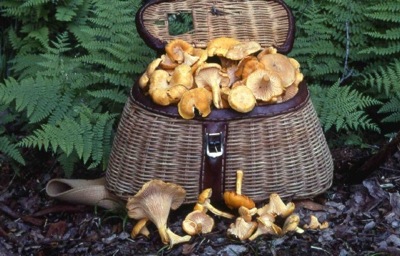 Read More…
After 2 months of solid drought followed by 2 weeks of solid rain, we finally have actual August in the produce department: potatoes, beets and basil, tomatoes, summer squash and beans…Plus way more lettuce than we can eat which must be harvested before it bolts but where to put it is a problem because the refrigerator is full of mushrooms.
I try to be disciplined and process everything we’ve picked before going out for more, but I don’t do any better with that than with taking out a plant for every new plant I acquire.
There are still some boletes left from last week, for instance, because I got sidetracked dealing with the chanterelles.
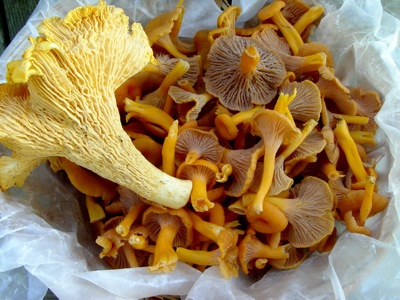
Bakaitis photo
The big one is the classic chanterelle of commerce, Cantharellus cibarius. The little guys (no common names) are a mixture of C. ignicolor – the all-yellow ones – and fragrant, tasty C. tubaeformis, which is unusually abundant this year. *
Read More…
Actually, I just said that to get your attention. What we really had was a Bolete taste-off, comparing a few of the Northeast’s many edible boletes ( all from recent hauls) to the gold standard, Boletus edulis, aka porcino, cep, steinpilz and King bolete.
We know edulis is good. We crow with delight whenever we find them. But we have eaten others that came close, and now that the rains are bringing us so many others… well, how could I resist?
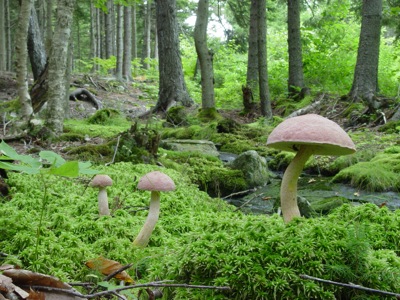
Bill took this photo of one of the contenders, Tylopilus chromapes, the day we did the test.
It wasn’t a completely fair fight, because the mushrooms weren’t all at the same stage of development. Read More…
This guest post is by Bill Bakaitis, founder of the Mid-Hudson Mycological Association, consultant to the New York and New England Poison Control networks, wild mushroom guru for the Culinary Institute of America (and, full disclosure, my husband). Although collecting is over for this year, morel hunting is not. A big part of success next spring is learning to find their haunts now, as Bill describes in:
A Successful Strategy for Finding Morels
by Bill Bakaitis
As seasons go, 2008 was a pretty good one for Morels. I investigated only a small fraction of the potential collecting sites near my home and was able to pick a peck or so at each visit.

A Peck of Morchella esculenta
Others had the same success. The best collector I know, Dennis Aita, wowed Coma members in May with his large flat of pristine fist to corncob sized esculenta collected only hours before the evening’s lecture.
As it happened, several digital images of collections circulated in emails and I soon received calls and questions from curious mushroomers. “Just how do you manage to find all of those Morels?” they wanted to know. “I have looked and looked and still come back empty handed.” Read More…
Over the years, we’ve grown at least a dozen kinds of strawberries, mostly standard garden varieties (Fragaria x ananassa) like Sparkle and Tristar, and so-called “wild” strawberries, aka fraises de bois and alpine strawberries (F. vesca), like these Mignonettes being used as an edging in the lower garden.
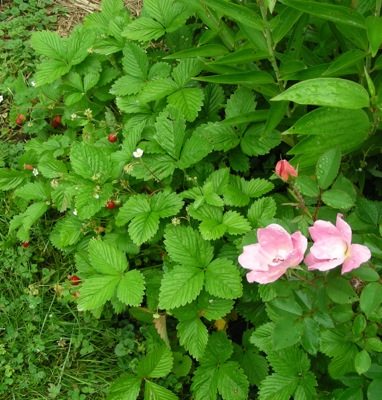
Cultivated strawberries are easy to grow, almost always tasty and sometimes very tasty. But none of them – yet; I keep trying – are as good as genuinely wild strawberries (F. virginiana), the intensely flavorful, amazingly aromatic gift that grows freely in woodland edges all over the northeast and beyond.
Read More…
They’re vegetarian rats, basically. Eat bulbs, empty birdfeeders, gnaw through attic walls to make smelly nests, from which they sally forth to eat the insulation from electric wires. Absolute proof – if we needed any – that good looks can get you a pass on a lot of bad behavior. If they had rat tails instead of those bottle brushes and did not have the habit of sitting up and eating with paw-hands, and

if the babies weren’t so damn cute, we’d be a lot farther ahead in squirrel eradication.
And don’t talk to me about dispersing seeds. If I find one more “volunteer ” black walnut with a taproot halfway to China…
Right. So what did we do with this little pair, scarcely larger than the violet leaves, happily playing for half an hour oblivious of dangerous humans only 10 feet away? We ooed and ah’d and elbowed each other and I ran out in my nightie to get photographs.
Bah, Humbug.
We all know the metal baffle does nothing. Taking down the feeder just sets them into the borders to nibble new buds. Any suggestions?
Bill happened into it when he was out fishing near Esopus creek, famous among fishermen for trout and among foodies for one of America’s most delicious apples, the Esopus Spitzenburg (frequently lauded by Thomas Jefferson), about which more some other time.
He was walking through the woods back to his car and there it was, barely dry and still wobbling. It went to ground immediately. The doe was in the underbrush, snorting. He could have picked it up and carried it away, thereby saving somebody else’s garden a lot of trouble, but of course he didn’t.

Bill Bakaitis
Newborn fawn in the woods on public land. The blue paint on the tree is a forest service mark: “this one is to be cut down.”