Food and Flowers
As far as I’m concerned, garlic gets the blue ribbon for growing your own. It’s absurdly easy to plant and care for; it tastes great; it looks beautiful and it takes up so little ground that even those with very small gardens can raise enough to be self-sufficient in garlic for a good part of the year.
All you have to do is choose the right varieties; plant at the right time, in the right soil; then harvest when just right and store correctly.

Home grown garlic, fresh out of the ground
CHOOSING VARIETIES
If you look in a specialist catalog like the one at Gourmet Garlic Gardens, you’ll find dozens of choices. The folks at Filaree Farm, who offer a hundred, divide them into 7 groups: Rocambole, Purple Stripe, Porcelain, Artichoke, Silverskin, Asiatic Turban and Creole. Gourmet GG says it’s 10 groups because they divide Asiatic from Turban and add Marbled Purple Stripe and Glazed Purple Ptripe to the list.
You see where this is going – and you can see a lot more on either of those websites, but for general purposes the most important difference is the one between softneck and hardneck.
Read More…
Did you keep cutting off the rhubarb flower buds, doing your best to extend the season by preventing

Rhubarb flowering instead of making pie material
If so, welcome to the club of “if only.”
Just about every rhubarb grower I know is convinced that removing the flower stalks will
a) keep the edible leaf stalks from growing tough and
b) encourage the plant to produce more of them,
and they are abetted in this belief by most of the published information on rhubarb growing, including that from reliable sources like universities and extension services.
Nevertheless, (a) is untrue and (b) applies mostly to the following season.
Read More…
Today we have a question from Leigh Ann:
“My husband gave me a pot of tulips for Mother’s Day, “ she wrote,” how can I save the bulbs to plant next fall? “
Over my years at the Times, most questioners just wanted to know how to get the damn things to come back in the garden, but as the answers are similar and Leigh Ann was first this spring, potted tulips will be addressed in

Parrot tulip Estella Rijnveld, in Maine, in its 6th or 7th year
How to Make Your Tulips Rebloom
Read More…
Figfip? That would be Food Gardeners’ Fine Points, a new occasional series inspired by my friends Matt and Shannon.
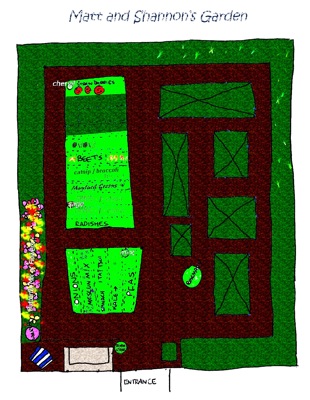
Shannon’s drawing of the garden from when Matt first wrote to say
“ We have some very exciting news. After nearly three years on the waiting list, Shannon and I now have a plot in the community garden next to our apartment building!!!…. Naturally, I have mile-long list of vegetables I’d like to grow….”
He meant it; it is a mile long, ending with: “ Are there any realistic choices for two newbies from that list? We’re prepared for failures and setbacks. But we’re also giddy with enthusiasm. ”
Who could resist an appeal like that?
M&S may be newbies but they’re certainly not dummies ( a title from Hell, imho). They already the have usual gardening manuals and an unusually large ability to conduct web searches. They even have a resident sage at the community garden.
But a lot of “how to” leaves out choice tidbits. Some information does get dated. And I don’t always agree with the sage, even though he’s right with them in Washington, DC and I am in New England.
So from now on, when I’m doing something in the garden and it makes me think “I ought to tell Matt and Shannon about this,” I will. And as I have just been planting vegetable seeds, that’s where we’re going to start.
Read More…
In a lot of ways it’s no different from growing some of the easier vegetables: plant in a good place. Wait, being patient and hoping for rain. Harvest crop.
But of course there are a few fine points, elucidated here in a guest post by our resident mushroom expert.
Growing Mushrooms in Your Garden
By Bill Bakaitis
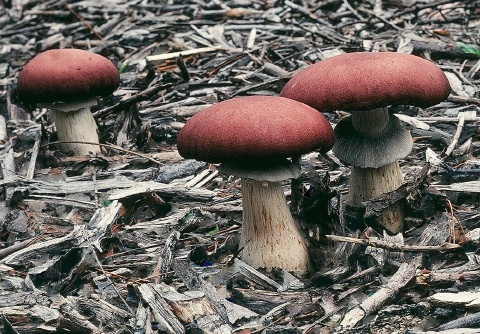
Consider planting Stropharia rugusoannulata in your garden this spring.
If you like to eat mushrooms, and would like to gather them fresh, along with your vegetables, now is the time to consider inoculating a piece of your garden. You can easily fit a patch on one of your paths or tuck it into a mulched weed barrier. Here is how.
Read More…
Background: The day is warm and so is the soil. I decide to push it and plant some peas, even though the forsythia is only swollen instead of blooming and

Crocus are still the main attraction.
I look in the seedbox
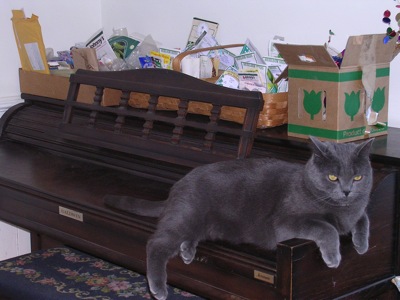
It's in back. I couldn’t bear to edit him out
Gee, I thought I bought some.
Read More…

Start on the endless spring to-do list. Lawn and garden cleanup, shrub pruning, seed-starting, seed planting…
and (among yet other things)
* Consider the freezer
* Start on the bulb maps
* Figure out where the garlic is going to go
* Cut back and repot tired houseplants
* Scout for morel spots Read More…
That’s “trellis” as in “utilitarian structure that holds up annual vines and comes down at the end of the season,” and the way we build them is with simple uprights and really a lot of untreated twine.

pole beans on sapling trellis, woods left and straight ahead
In Maine, we use saplings from the surrounding woods – they’re handy, they’re free, and because they’re nothing more than little trees they tie the riotous, colorful garden to its wild environment.
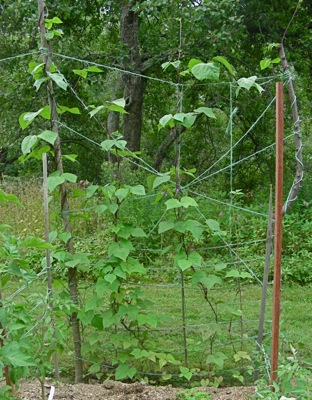
string and sapling trellis (please ignore oak posts in foreground)
This bean trellis was created by Kristi, who had evidently gotten bored with just running vertical lines. Beans would rather go up but will travel horizontally if encouraged. The spiderweb was completely covered about 2 weeks from this picture.
In New York, where there’s no convenient sapling source and the garden is if not formal at least orderly, we use 8 foot oak 2×2’s. Read More…
Just in case that might be on your mind, today’s heartfelt plea is

Not yet!!
At least not in the Mid-Hudson Valley or most places north of here.
Having just been in the cutting garden getting an eyeful of dead material, I know the temptation is huge.
Resist. It isn’t yet time to encourage new growth. And I know ( having more than once said ” oh, it won’t hurt”) that if you prune properly, cutting past anything that looks weak, all the way down to a strong node, that node now has a wounded tip exposed directly to any hard frost that happens to come along.
This doesn’t keep me from removing ( and burning) the bulk of the dead stuff. I just make sure to stay well away from anything living, no matter how weak and wimpy, until safe pruning time comes. It’ll only be a couple of weeks — let us hope!
In our part of the Hudson Valley there’s still snow on hard ground in all the low places. But Sunday morning is clock-switching time and the forecast is for everything that’s usually loathsome about March. Furthermore, the stores are festooned with shamrocks and leprechaun hats and green crepe paper ribbons. Two good things to be said for the decor:
1. It reminds you to make soda bread.
2. You are warned that it’s almost pea-planting time, since tradition says you’re supposed to plant peas on St. Patrick’s Day. Where this tradition began nobody seems to know, but where this tradition makes sense are places – like Ireland – where March 17th really IS (more or less) what seed catalogs and garden guides call “ as early in spring as the ground can be worked.”
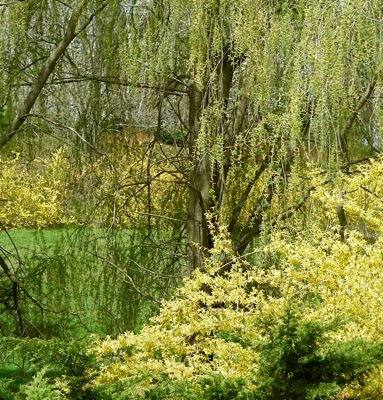
Not folkloric enough? How about “when the forsythia starts blooming?”
Read More…