Garden
It’s a ‘Chicago Hardy’, reputedly among the toughest, this year’s shot at zone denial. The goal is to have it live outdoors all winter, without dying down to the roots.
But our part of the Hudson Valley is still zone 5b, though teetering on the edge of 6, and figs are not hardy north of zone 7. So what makes me think we can pull this off? Pure hubris? My usual oversupply of sunny optimism ? Too much research into fig protection during the Times Q&A days?
Some of each, I have no doubt. But the main reason to give it a try is this house’s uniquely suitable spot, a double protected corner facing southwest.

The fig in late September, slightly taller than 5 feet, planted as close as possible to a very cosy corner.
If you count the fact that the house ( circa 1870) is not exactly a model of tightness, the protection is triple. But double is the important part; the corner has extra backup because the house sides don’t meet.
Read More…
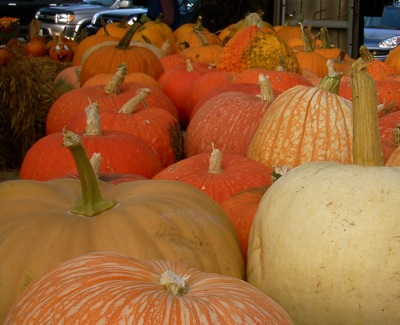
To avoid the same old same old, stock up on winter squash while you can still buy it from a farmer.
(* Thanksgiving note: If you got here looking for pumpkin pie, rather than the other way ’round, there is now a detailed recipe.)
As a general rule, there’s no need to issue the annual squash warning until shortly before Thanksgiving. But tomatoes aren’t the only fruits that suffer when it’s cold and wet for weeks on end in June and July. This year has been very hard on a lot of squash growers in the Northeast and mid-Atlantic.
So I figure I ought to mention it now: If you want to eat good winter squash all winter and don’t want to die of boredom, this is the time to start cruising the farmstands looking for interesting squash and stocking up on an assortment, bearing in mind that “winter squash” is really 3 different vegetables – Cucurbita pepo, C. maxima and C. moschata – each with a different season of glory.
Read More…
(Part 1 – bouquets – is here.)

Miscanthus floridulus, wishing it were in Floridula.
Okay, it doesn’t look like lilac time, and the snow that fell on the Hudson Valley last Thursday doesn’t help. But looks can be deceiving; mid fall is when you go out and buy lilacs on sale –
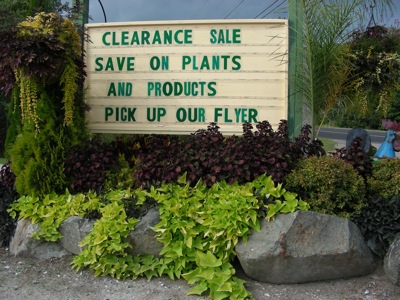
Leftover lilacs can be a good deal
If there are lilacs, that is, and they’re in good shape.
Why buy more? Silly question. Those with huge collections may have enough. The rest of us almost always need to add, because having a long lilac season requires multiple species as well as multiple varieties.

This ‘James Macfarlane' was sold to me as a Preston lilac, Syringa x prestoniae.
Other reputable sources say James is S. x josiflexa and still others, equally reputable, say it’s a hybrid between that and S. x prestoniae. Doesn’t matter, really, prestoniae and josiflexa both bloom about 3 weeks later than the well known common lilac (S. vulgaris).

A favorite common lilac, name alas unknown, that blooms early in the traditional lilac season.
Read More…
Is well named. Hauling yourself out to Unity on the 24th for MOFGA’S annual apple jamboree is a great way to spend a fall day and that’s because Maine has a lot of great apples.
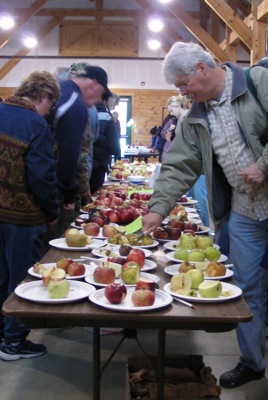
Somewhere well north of 50 apple varieties laid out for tasting.
The tasting part is a unique opportunity to check out all sorts of flavors and textures, and of course to sample apples not routinely sold in stores.

A lot of the tastiest varieties are not likely to win beauty contests
Although some
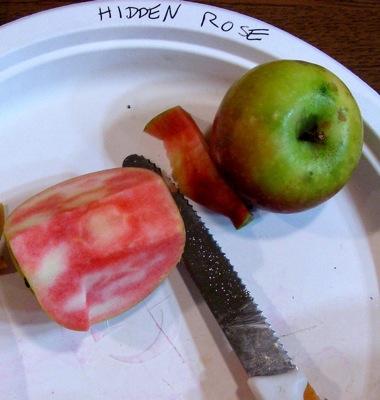
do have their spectacular aspects.
Read More…
Or not, depending on what you plan to do with the ground after the daffodils are gone.
Turns out they not only have all the virtues recently extolled, they also ” contain alkaloids that can inhibit the growth of other plants,” according to a paper titled “Applied Allelopathy: Effects of Daffodils on Other Species in Sustainable Agriculture and the Home Landscape,” presented at the 2009 conference of the American Society for Horticultural Science.
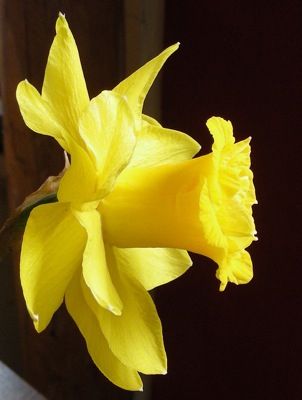
daffodils, like black walnuts and garlic mustard, can inhibit the growth of other plants
The authors were looking at success with followup crops like snapdragons, geraniums, basil and zinnias ( all of them adversely affected) but on the good side, “no airborne weed seeds germinated in pots placed outdoors containing daffodils but did germinate in pots with no daffodils.”
That second quote comes from HortIdeas, which alerted me to the daffodil paper. HortIdeas is a newsletter-form aggregator of recently published horticultural and agricultural information from hundreds of universities, plant societies, popular magazines and commercial interests, all presented in digest form. It’s one of my favorite publications, heartily recommended to all hortnews geeks.
Read More…
by Bill Bakaitis
It just goes to show how the collecting season varies here in the Northeast.
In Maine, where we had a poor mushroom season all year, the beginning of October brought with it a flush of Honey Mushrooms (Armillaria mellea complex) and the attendant Aborted Entoloma (Entoloma abortivum). The Hen of the Woods (Grifola frondosus) has not yet appeared on trees that I know and those that are found in Farmers Markets are pitiful fist sized, dried out specimens. I anticipate the big flush in the next week to ten days, conditions permitting.
Meanwhile, in the Hudson Valley and Catskills of New York, which had a fabulous mushroom year, the Honeys began in Mid-September, right on cue, but most of the Hens remained in their underground coops for another fortnight.
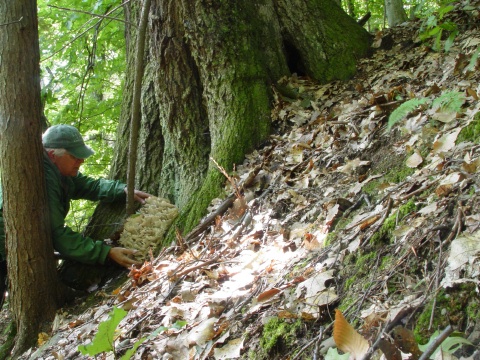
Bill finding a fat hen, on a fat oak
They are out now: succulent, fragrant, and large – with what appears to be an attendant flush of young chicks following big momma. Bring your basket and go get ’em.
It had to happen sooner or later, and sure enough here they are, catchily called Ecotulips.
As usual with newly-introduced organic versions of things, there still isn’t much selection and prices are a bit higher than for the conventional kind, but if you’d like to buy certified organic tulip bulbs, lovingly grown in Holland by an experienced bulb farmer, at least you’ve got the option.
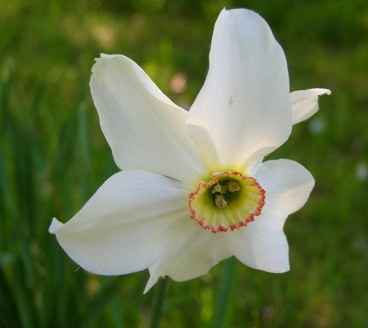
a poeticus narcissus, probably 'Pheasant's Eye'
So if the title is Organic Tulips, why is the picture of a narcissus? Partly because I’ve already gone into how to grow tulips, and partly because there’s more to environmental responsibility than simply buying organic and calling it a day.
Read More…
As you’ve no doubt noticed if you follow these things, the current fashion in bouquets has oneness at its heart. Either it’s one kind of flower – roses, say or gerbera daisies – or it’s one color: white or pink or (in the higher rent districts) green.
Not usually purple, it must be admitted, but …

Otherwise this is typical
Or typical of one colorness, anyway. Gladioli and sweet peas are not typically buddies but this has been a weird summer.
This year, the kind of bouquets my old friend Sharon calls “ It must be August,” only became possible in early September. Most of the good annual cutting flowers take time to start producing in earnest, and that goes double for the ones you get by letting things like Verbena bonariensis and nigella self-sow.
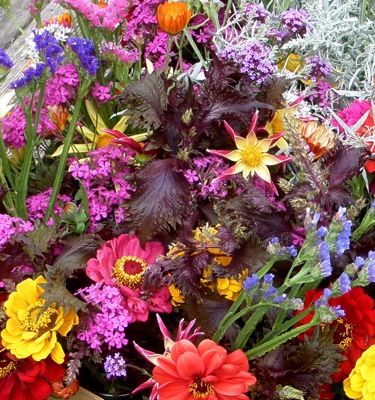
Not subtle, but satisfying in it’s own way.
Read More…
ideal for making applesauce and (when very fresh) Always Right Apple Pie and Big Chunky Apple Cake with Pecans, among other baked items, also terrific fried in butter – to say nothing of simply eating out of hand.
I was actually shopping for tomatoes to sample (our bout with the blight means we’ll be buying whatever I put up for the winter), when there right in front of me among the more usual offerings were bags of Gravensteins.
YAY!

They’re called Red Gravensteins, I guess because that’s easier than ” the strain of Gravenstein that’s green with stipplings and smudges of red and red-orange”
This happy discovery was made at Schoolhouse Farm, in Warren, Maine. The owner, Bill Beckwith, has a high opinion of Gravensteins for fresh eating. He put in the trees 25 years ago and has continued to sell the fruit, even though it’s not a fast mover. “Not very many people know about them,” he said.
Gravensteins are the first early apples with real sweet-tart apple flavor, able to hold their own for deliciousness with the best of the later harvest, although they’re far less firm. But their season is short; they don’t keep well – in fact they hardly keep at all – and almost all of the commercial crop is grown in California.
On the Slow Food Ark of Taste they’re called ” Sonoma Gravensteins,” and I learned to love them in my Berkeley days, so they’re sort of California in my mind, too. Yet there’s no reason the left coast should claim them.
Read More…
I was all set to go on about how this is primo planting time and then discuss a few must-haves. But then I woke up: discussing Fall Planting is like discussing Volunteers, a book, not a post. Last time I tried, “volunteers” became ” shirley poppies” with everything else on the in-a-minute list.
A minute having gone by, this will be about Italian parsley, a must-have volunteer.
But first the annual reminder: time to get those bulb orders in! And that includes the garlic, if you want to try something new from the dozens of types available.
As usual, garlic is the least of it. We’ll mostly be planting tulips and alliums, including more of

tulip 'Mount Tacoma,' not generally sold in stores
for the white garden in Maine.
For New York, there’s yet more crocus, both species and giant Dutch, and of course a few more lilies – primarily trumpets.

this one is 'Golden Splendor,' rock-solid reliable
and Japanese lilies (L. speciosum) the last lilies to bloom.
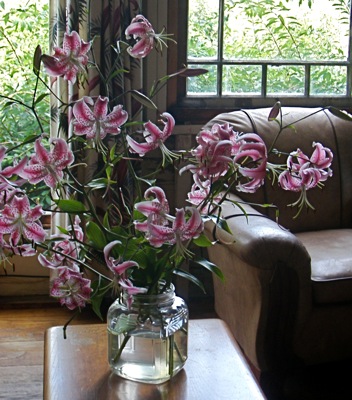
Lily Speciosum rubrum. Bill just brought these up from New York; the ones in the Maine garden are fewer and later.
Mercifully, it’s not time yet to plant or move peonies (although it is time to clean them up), and …what was I just saying about too much?
Onward to the parsley! Can’t have too much of that.

Self-sown Italian parsley; the full carpet is roughly 12 square feet
Read More…